The Story Of Wm.
pp. 81-93 · Read in the full issue
Reiher—I
By' William Schutz
(Most people of the Central Pacific have heard of the Reiher Brothers—the three clever sons of a German father and a Marshallese mother. The family was among many people of similarly mixed blood who were driven out of the Micronesian archipelagoes by the Japanese into the adjoining British islands after World War I.
The Reihers, although at first handicapped by lack of English, be came British citizens and outstand ing technicians.
In this and a second article (next issue) Mr. William Schutz —himself a Gilbert Islands resident of similar origin, and now head of the group’s biggest co-operative society—tells the story of William Reiher. All three Reiher Brothers are now dead.) ON August 1, 1953, William Henry Reiher died in his home on Abemama, leaving his wife, 3 sons, 6 daughters, 4 grand-children, 1 son and 1 daughter-in-law to mourn his passing.
Continuous bad health robbed the Gilbert and Ellice Colony of the full service of an accomplished trades man and skipper—in fact, a man of all trades. This is the life story of a man who was educated in a Ger man Mission School; trained by a conscientious Mission Brother (who was a master of all trades himself) ; who later, through self-study, mastered the English language suf ficiently to acquire in English and
in German, the arts of navi gation, engineering, archi tecture and ship-building.
William held no ticket or certificates, but anyone know ing his achievements will ad mit that he was a talented and skilful man.
This story of a remarkable man, of mixed European and Islands blood, should give food for thought to those re sponsible for planning the education and upbringing of Islands youth. There are thousands of these young people, as clever and talented as William was; but, through lack of facilities, they cannot make use of their talents be cause educators and planners fail to give them opportunities for education and training.
William Reiher Was
born in Jaluit, Marshall Islands, the second son of Captain Adolph Christopher Reiher, and Mary nee Foliet, on November 28, 1889.
In 1900 the Sacred Heart Mission started a school on Jaluit. William, with his elder brother Fritz, his younger sister Elizabeth, and the youngest brother, Heinrich, were the first pupils of that school.
Fritz, the eldest, robust and strong, was apprenticed to the Jaluit Geaselschaft as carpenter after a year in school. He continued his studies in the evenings under one of the Mission Brothers.
William, Elizabeth and Heinrich finished their eight years’ schooling.
William was put under Brother Servatius, the Mission house builder, and this training made William a most accomplished car-
penter and the man-of-all-trades.
Shipbuilding knowledge was added when the Mission decided to build a vessel of its own—the 60 ft schooner Regina.
The Marshall Islands were then a German Territory.
The Jaluit Gaselschaft employed William as a skilled tradesman. He joined his brother Fritz in doing all odd jobs in wharf, punt and boat building, with ships’ repairs added, under the direction of a man named Muller. The latter directed the outside work of a firm owning a mail-steamer of 1,000 tons, and three auxiliary vessels of 150 tons.
About 1913 he was sent to Truk to erect new buildings for the com pany’s branch there and, on com pletion, he was offered a vacant trading station. He was to run it on his own account, the company granting him credit for a start.
After the outbreak of World War I. and the Japanese occupation of the Marshall Islands, William de cided to return to Jaluit (1916).
Fritz Reiher was now trading on the island of Majuro. No jobs offer ing from the Japanese, William went to Majuro. About the middle of 1918, a fearful typhoon devastated Majuro, killing many people and destroying all coconuts and fruit trees. Some 300 natives were evacuated to Jaluit and later to Ebon Island.
MV Mauno, Burns Philp’s trading ship under command of Captain I. R. Handley, was the first vessel to visit the island after the catas trophe. Seeing the plight the islanders were in, Captain Handley landed all his cargo of rice and flour and returned to Jaluit to re port the matter to the Japanese administrator. (Captain Handley was among those murdered by the Japanese at Tarawa in 1942).
(Continued on page 89)
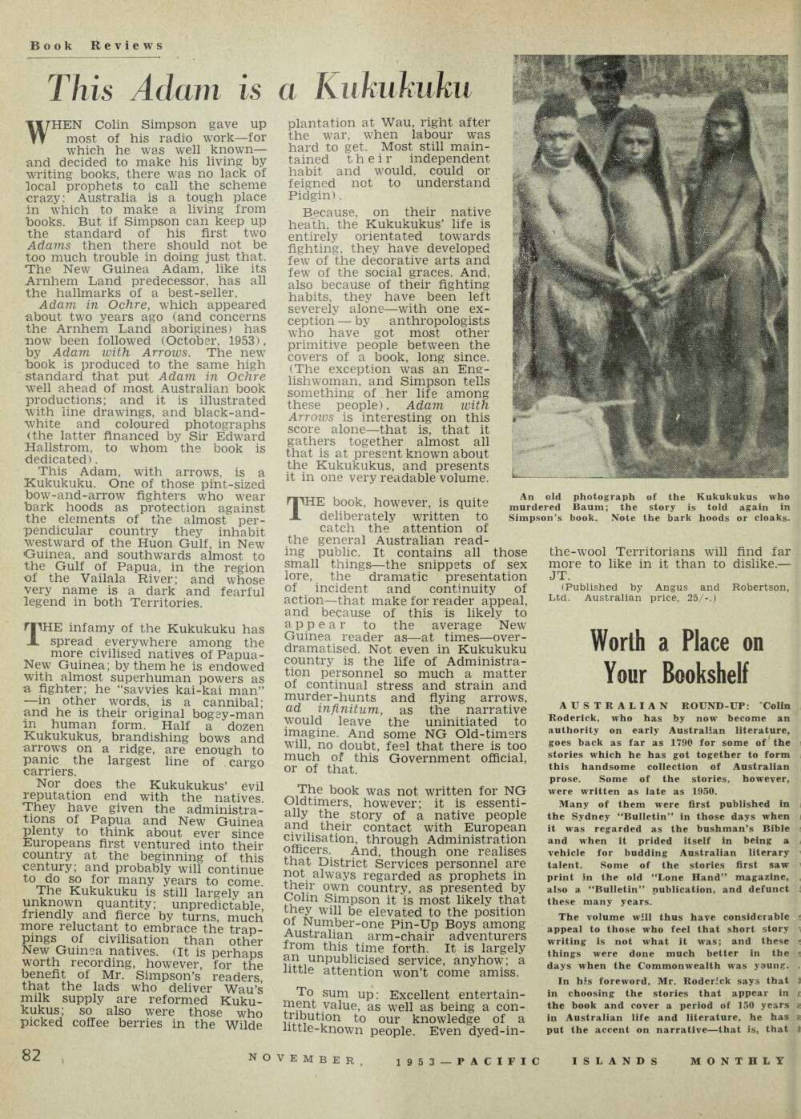
A scene on the deck of the LMS [?]chooner ‘John Williams.’ where William Reiher was a temporary deck officer.
(Photograph taken by editor of PIM in the Ellice Islands which he visited in September, 1941.)
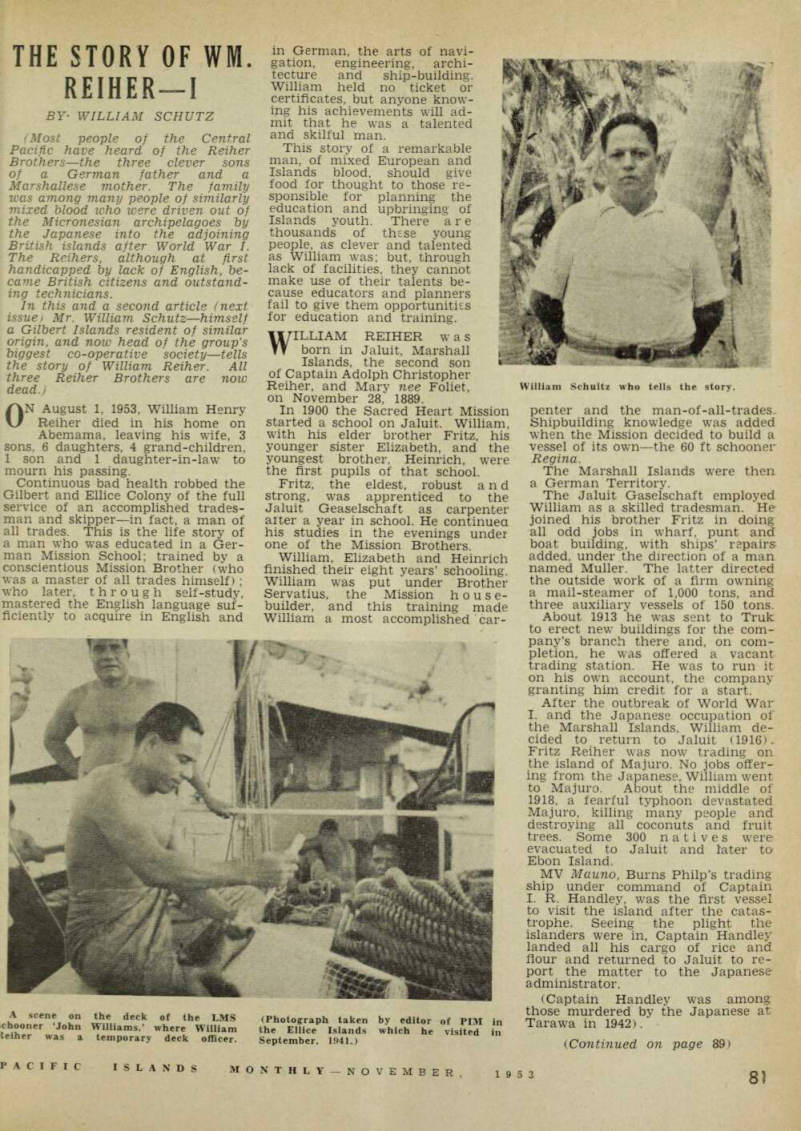
William Schultz who tells the story.
As there was now nothing doing on Majuro, Fritz, with his family and William, returned to Jaluit.
Fritz went as plantation manager to Kili, a small island, owned by a German named Bock, which the Japanese Government confiscated.
William got a repair job on the Boston Mission ketch Ijuran (Morn ing Star) which lasted a few months. Then a small Japanese firm engaged him to finish a small schooner which it was building, after the Japanese builder, follow ing a dispute, abandoned the job.
When the ship was ready, William took command of it and, with a full cargo of general stores, a crew of four and two Japanese repre sentatives as passengers, he left Jaluit for Ebon, about 60 miles to the SW. When 20 miles off Ebon, calm set in; and their water supply, although strictly rationed, ran out on the fourth day of the calm.
William, expert in Marshall Islanders’ weather lore, knew the calm would last. Luckily, he had his tools aboard, and his ingenuity saved them all. Among the general cargo were several cases of Japanese biscuits, in tins. From two biscuit tins, William manufactured a distilling plant, from which about 24 oz of fresh water was obtained in 12 hours.
They kept the fire going day and night, using all the case wood in the cargo and dumping the contents of cases into the hold. The ration ing of the water, agreed on by the Japanese passengers and the crew, was half a bottle for the master, and half a bottle for the crew and passengers, every 12 hours. With the juice from tinned fruits, of which they had a good supply, they nearly doubled their water supply. (Japanese fruit-juice is not so sweet as American or Australian fruit syrup). The half bottle for the crew and passengers was doled out by the senior Japanese, to himself, his companion and the four Marshallese, in spoonfuls; whereas William could do with his half bottle as he pleased.
For fully 14 days the calm lasted, and part of the cabin linings were
already used up for fuel, when a breeze sprang up from the east, bringing a shower of rain with it.
Food was plentiful, but no one cared to eat, except a bit of biscuit and canned fruits, as the thirst after eating was unbearable. All day long, all hands—with the exception of the two Japanese, who kept to the cabin most of the time —were in the water, hanging to the side of the ship, to escape the burning rays of the sun; or they huddled on deck, heads between their knees, under cover of mats from the sun. just staring at the deck. The four Marshallese youths stood the ordeal well, and they tended to the break ing up of cases to keep the fire going, and refilling the boiler with salt water.
William said he felt himself get ting weaker and weaker. Sleep was a sort of dozing off, with hallucina tions, but each time he started to talk or groan one of the crew would force on him the bottle with water, with fruit juice added, and a sip of this drink marvellously refreshed him and cleared his brain for an hour or so. Then the process would start again. He concluded that a healthy human being can live long on a little biscuit, with fruit juice once a day, and a sip of water every 11 hours or so during the heat of the day.
Then the rain came, and this is how William Reiher described it: If it were not so pathetic, the scene that followed would have
been funny. A few seconds after the rainfall all hands—himself, the Japanese and the Marshallese— went down on their knees to lap up, like dogs, the water running over the deck and in the scuppers.
None of them thought to let the rain clean the deck and scuppers first, before drinking. Though all were weak, they were so refreshed
by the water that they were able to set sails. The wind was steady and the rain kept falling for over two hours. They filled their small tank, all the buckets and pans available, and set course for Ebon.
William had only a sextant, a compass and a chart to navigate the ship with. His knowledge of navigation by instruments was all
self-taught as he had never served on a ship before that trip, although he had sailed a lot with native skippers on their little boats and was able to learn the Marshall Islanders’ art of navigation by “watching the waves.” This know ledge helped him a lot in later years, as master of the Government ships Kia Kia, Margaret and Maureen, and the Mission ship Santa Teretia in bad weather, around the Gilberts, Phoenix and Ellice groups. It is well known that he never once lost his way.
According to his dead reckoning, he was about 30 miles NW of Little Makin when the calm ended; and from that point he set his course for Mille, and thence to Ebon.
Back in Jaluit, he repaired the damage to the cabin of the ship and left to take command of the ex- Catholic Mission ship Regina which, as an apprentice, he had helped to build years before. The Japanese Government took the vessel over after the German missionaries were sent home, and the object of the trip was to take two Japanese Gov ernment officials around the eastern islands of the group (Radak) for inspection. The treatment he got from those arrogant Japs was so bad that, on his return to Jaluit, he left the ship.
As there was nothing doing on Jaluit—the Japanese having their own handymen working for low wages—William left the main settle ment and lived with relations on an islet about 14 miles distant.
Here he did some native house building and fishing.
About September or October, 1920, MV Mauno (I. R. Handley, still master) developed engine trouble.
The engineer, a young Australian, named Goulding, could not repair This young man, playing the rich man’s son on Jaluit, used to light his cigarettes with 5 or 10 Yen notes. Once, in the presence of the Chief Customs Officer in the main coffee shop on Jaluit, (it was called To-sang Coffee Shop, but you could, in a backroom, get sake, beer and imitation whisky labelled “Pure Whisky, made in Scotrando”) Goulding attempted to light his cig arette with a 10-Yen note. Value in those days of a yen was 2/-.
Quickly the Japanese took the note from his fingers, before it got alight and, jumping up, he shouted: ‘Don’t do that. You insult my country.”
Goulding stood up, took the note, tore it in half and, throwing the :wo halves on the table, walked out saying, “Oh, it’s nothing. In Aus :ralia I light my cigarettes with £5 notes,”
The Jap pocketed the two halves md, lifting his cup of sake, said to ns companions (who were not Jap mese) ; “Let us drink and be happy.
He is a silly boy playing the rich nan’s son. To-morrow I will paste ;he note together and return it to :he captain.”
Sure enough, next day he appeared aboard the Mauno. After an hour with the Captain he went ashore again. In £he evening he shouted drinks to the same fellows with the 10-Yen note, which Captain Handley told him to keep. Three days later, young Goulding was put aboard the mailboat as passenger for Aus tralia, via Yokohama.
The arranging of Goulding’s passage is of interest, as it throws some light on how the Japanese mind works in regard to prestige, and the age-old Asiatic fear of “losing face.” It shows how Burns Philp treat employees who failed.
Captain Handley insisted on a second-class passage. The Purser countered that he could not allow a man known as chief engineer of a
Burns Philp ship to travel other wise than first class. Burns Philp, he said, are our agents in Sydney, and they are well known in Yoko hama, and this man arriving there in second class would damage the prestige of Burns Philp. In fact, he continued, Burns Philp would “lose face” in Japan. So Goulding travelled first class NYK, benevolent BP forking out nearly 1,000 Yen for expenses.
Mauno, lying at anchor without an engine off Sydney Town (Burns Philp station) \-mile distance from Jabwor (the main settlement) was like a lame duck. None could be found to repair the engine, until someone remembered William, liv ing on his islet 14 miles away. Old Handley knew Fritz, who had done
odd repair and improvement jobs on his vessel about a year before, but had never met William. But he knew the Reihers as clever craftsmen — as did all in the Marshalls —and he sent his launch for William. Then he told William to repair.the engine.
“Captain, I am not an engineer, t have never been in an engine room before, he protested.
But Handley was adamant. “Damn pou,” he said. “They told me you are a man of all trades. Get on to it.”
“Very well, Captain. But you must >ive me time to strip the whole mgine, so I can see what each part s there for, and study the instruc tion book. I may be able to find the fault.”
The two engine room boys were nstructed to work under William’s »rder, and the stripping began. Half vay through, when he asked one of the boys to crank the fly-wheel, he lojticed that the fly-wheel was cobbling. The thought came to him hat the whole trouble might be in he fly-wheel—all pipes and parts itripped appeared in perfect order Mauno’s engine was an old-style in those days new) Union Engine •f 110 H.P., 3 cylinders, that stood (early 7 feet high, with a fly-wheel if about 5 feet diameter —starting m benzine, then running on power :erosene and water. When he took ut the fly-wheel key, he found that t was worn out, hence the wobbling, ,nd the whole trouble.
A new key was found in the spare larts locker, and refitting was quick pork. In seven days from the day
he took over the engine he had it running.
He was made engineer and mate, with a bosun’s pay. He stayed on the Mauno in that capacity until the Mauno had to go to Sydney for overhaul in 1924, when it was neces sary to have a ticketed man as mate. Old George Carter got the job, and William was engineer. Re turning from Sydney, in May, 1924, he took his vacation in the Marshalls. He joined the Mauno again as mate, and mar ri e d Terautete, nee Johnson, in 1926. (To be concluded in December)