To Fish
p. 119 · Read in the full issue
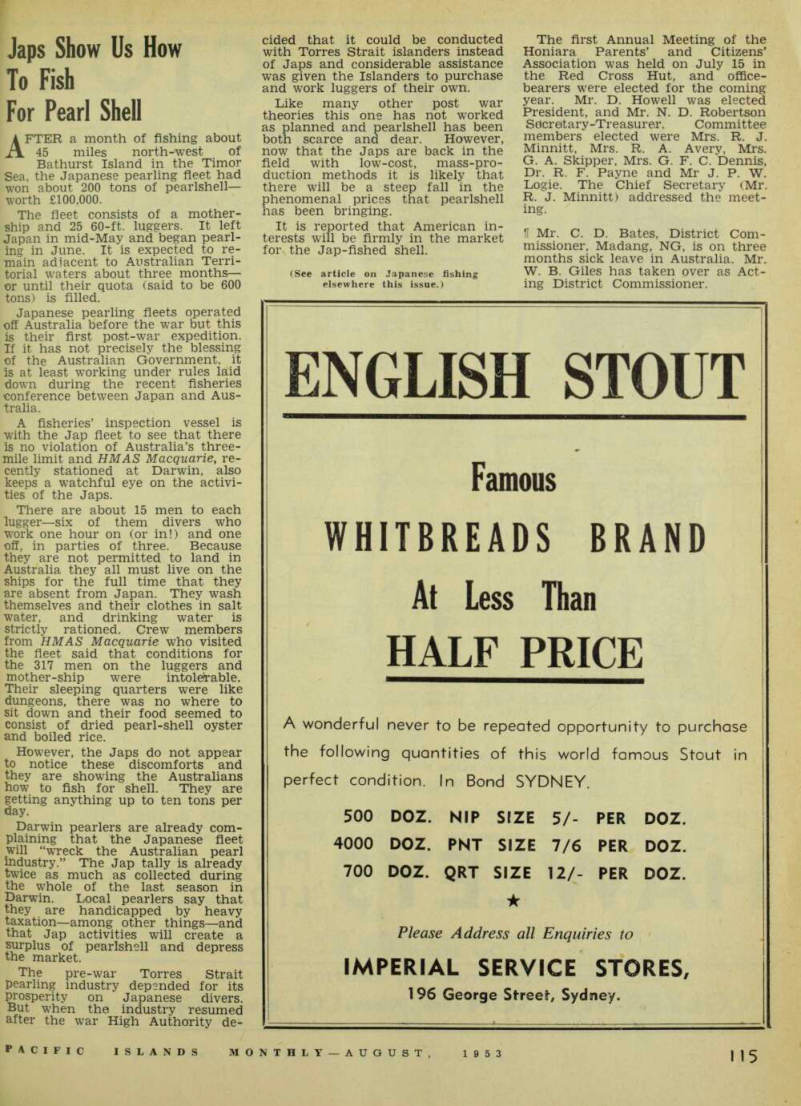
Japs Show Us How To Fish For Pearl Shell
AFTER a month of fishing about 45 miles north-west of Bathurst Island in the Timor Sea, the Japanese pearling fleet had won about 200 tons of pearlshell— worth £lOO,OOO.
The fleet consists of a mother ship and 25 60-ft. luggers. It left Japan in mid-May and began pearl ing in June. It is expected to re main adiacent to Australian Terri torial waters about three months — or until their quota (said to be 600 tons) is filled.
Japanese pearling fleets operated off Australia before the war but this is their first post-war expedition.
If it has not precisely the blessing of the Australian Government, it is at least working under rules laid down during the recent fisheries conference between Japan and Aus tralia.
A fisheries’ inspection vessel is with the Jap fleet to see that there is no violation of Australia’s three mile limit and HMAS Macquarie, re cently stationed at Darwin, also keeps a watchful eye on the activi ties of the Japs.
There are about 15 men to each lugger—six of them divers who work one hour on (or in!) and one off, in parties of three. Because they are not permitted to land in Australia they all must live on the ships for the full time that they are absent from Japan. They wash themselves and their clothes in salt water, and drinking water is strictly rationed. Crew members from HMAS Macquarie who visited the fleet said that conditions for the 317 men on the luggers and mother-ship were intolerable.
Their sleeping quarters were like dungeons, there was no where to sit down and their food seemed to consist of dried pearl-shell oyster and boiled rice.
However, the Japs do not appear to notice these discomforts and they are showing the Australians how to fish for shell. They are getting anything up to ten tons per day.
Darwin pearlers are already com plaining that the Japanese fleet will “wreck the Australian pearl industry.” The Jap tally is already twice as much as collected during the whole of the last season in Darwin. Local pearlers say that they are handicapped by heavy taxation—among other things—and that Jap activities will create a surplus of pearlshell and depress the market.
The pre-war Torres Strait pearling industry depended for its prosperity on Japanese divers.
But when the industry resumed after the war High Authority de
cided that it could be conducted with Torres Strait islanders instead of Japs and considerable assistance was given the Islanders to purchase and work luggers of their own.
Like many other post war theories this one has not worked as planned and pearlshell has been both scarce and dear. However, now that the Japs are back in the field with low-cost, mass-pro duction methods it is likely that there will be a steep fall in the phenomenal prices that pearlshell has been bringing.
It is reported that American in terests will be firmly in the market for the Jap-fished shell. (See article on Japanese fishing elsewhere this issue.)
The first Annual Meeting of the Honiara Parents’ and Citizens’
Association was held on July 15 in the Red Cross Hut, and office bearers were elected for the coming year. Mr. D. Howell was elected President, and Mr. N. D. Robertson Sdcrotary-Treasurer. Committee members elected were Mrs. R. J.
Minnitt, Mrs. R. A. Avery, Mrs.
G. A. Skipper, Mrs. G. F. C. Dennis, Dr. R. F. Payne and Mr J. P, W.
Logie. The Chief Secretary (Mr.
R. J. Minnitt) addressed the meet ing.
U Mr. C. D. Bates, District Com missioner, Madang, NG, is on three months sick leave in Australia. Mr.
W. B. Giles has taken over as Act ing District Commissioner.