More Expert
p. 102 · Read in the full issue
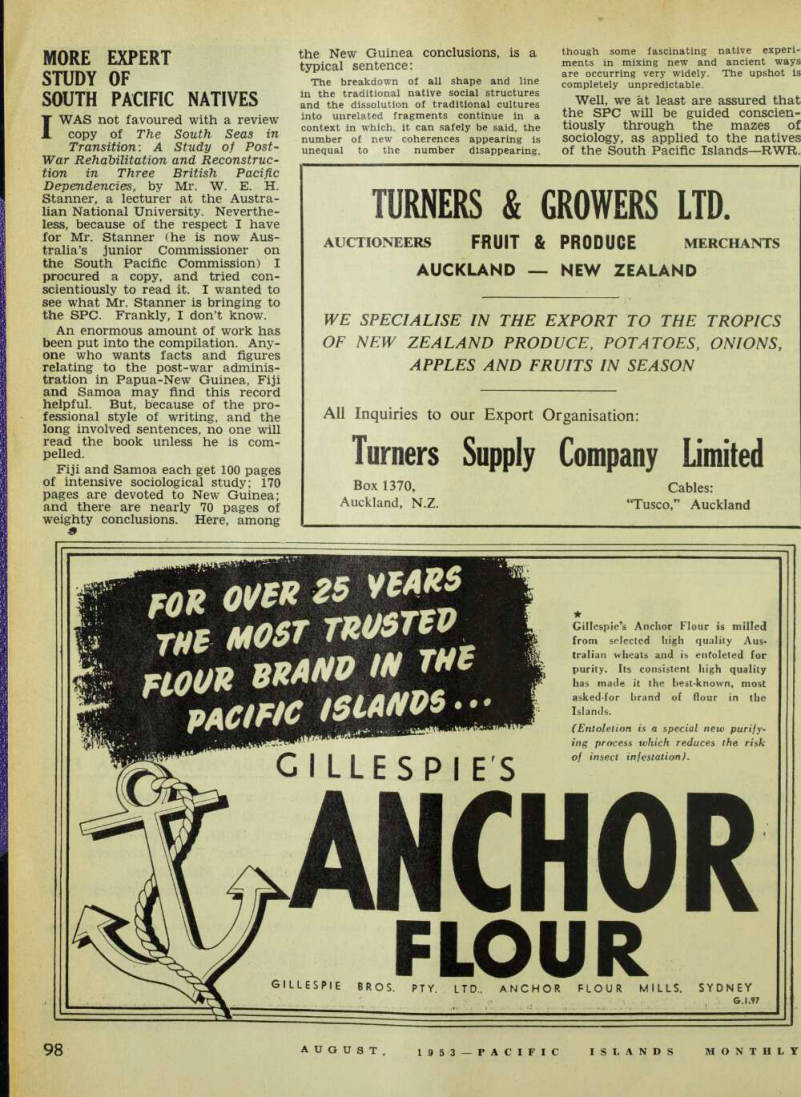
Study Of
South Pacific Natives
I WAS not favoured with a review copy of The South Seas in Transition : A Study of Post- War Rehabilitation and Reconstruc tion in Three British Pacific Dependencies, by Mr. W. E. H.
Stanner, a lecturer at the Austra lian National University, Neverthe less, because of the respect I have for Mr, Stanner (he is now Aus tralia’s junior Commissioner on the South Pacific Commission) I procured a copy, and tried con scientiously to read it. I wanted to see what Mr. Stanner is bringing to the SPC. Frankly, I don’t know.
An enormous amount of work has been put into the compilation. Any one who wants facts and figures relating to the post-war adminis tration in Papua-New Guinea, Fiji and Samoa may find this record helpful. But, because of the pro fessional style of writing, and the long involved sentences, no one will read the book unless he is com pelled.
Fiji and Samoa each get 100 pages of intensive sociological study: 170 pages are devoted to New Guinea; and there are nearly 70 pages of weighty conclusions. Here, among 9
the New Guinea conclusions, is a
typical sentence:
The breakdown of all shape and line in the traditional native social structures and the dissolution of traditional cultures into unrelated fragments continue in a context in which, it can safely be said, the number of new coherences appearing is unequal to the number disappearing,
though some fascinating native experi ments in mixing new and ancient ways are occurring very widely. The upshot is completely unpredictable.
Well, we at least are assured that the SPC will be guided conscien tiously through the mazes of sociology, as applied to the natives
of the South Pacific Islands-