Danger
pp. 80-81 · Read in the full issue
Unlimited !
By Judy Tudor
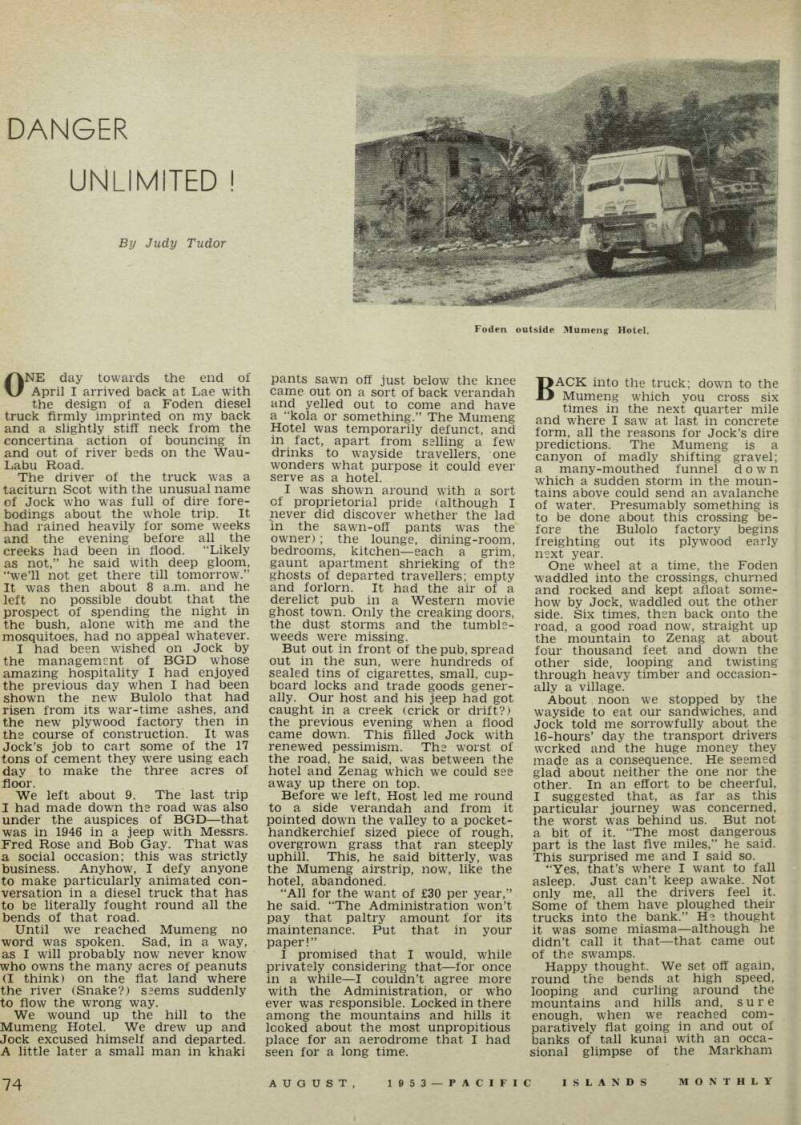
ONE day towards the end of April I arrived back at Lae with the design of a Foden diesel truck firmly imprinted on my back and a slightly stiff neck from the concertina action of bouncing in and out of river beds on the Wau- Labu Road.
The driver of the truck was a taciturn Scot with the unusual name of Jock who was full of dire fore bodings about the whole trip. It had rained heavily for some weeks and the evening before all the creeks had been in flood. “Likely as not,” he said with deep gloom, “we’ll not get there till tomorrow.”
It was then about 8 a.m. and he left no possible doubt that the prospect of spending the night in the bush, alone with me and the mosquitoes, had no appeal whatever.
I had been wished on Jock by the management of BGD whose amazing hospitality I had enjoyed the previous day when I had been shown the new Bulolo that had risen from its war-time ashes, and the new plywood factory then in the course of construction. It was Jock’s job to cart some of the 17 tons of cement they were using each day to make the three acres of floor.
We left about 9. The last trip I had made down the road was also under the auspices of BGD—that was in 1946 in a jeep with Messrs.
Fred Rose and Bob Gay. That was a social occasion; this was strictly business. Anyhow, I defy anyone to make particularly animated con versation in a diesel truck that has to be literally fought round all the bends of that road.
Until we reached Mumeng no word was spoken. Sad, in a way, as I will probably now never know who owns the many acres of peanuts (I think) on the flat land where the river (Snake?) S3ems suddenly to flow the wrong way.
We wound up the hill to the Mumeng Hotel. We drew up and Jock excused himself and departed.
A little later a small man in khaki
pants sawn off just below the knee came out on a sort of back verandah and yelled out to come and have a “kola or something.” The Mumeng Hotel was temporarily defunct, and in fact, apart from selling a few drinks to wayside travellers, one wonders what purpose it could ever serve as a hotel.
I was shown around with a sort of proprietorial pride (although I never did discover whether the lad in the sawn-off pants was the owner); the lounge, dining-room, bedrooms, kitchen—each a grim, gaunt apartment shrieking of the ghosts of departed travellers; empty and forlorn. It had the air of a derelict pub in a Western movie ghost town. Only the creaking doors, the dust storms and the tumble weeds were missing.
But out in front of the pub, spread out in the sun, were hundreds of sealed tins of cigarettes, small, cup board locks and trade goods gener ally. Our host and his jeep had got caught in a creek (crick or drift?) the previous evening when a flood came down. This filled Jock with renewed pessimism. The worst of the road, he said, was between the hotel and Zenag which we could see away up there on top.
Before we left, Host led me round to a side verandah and from it pointed down the valley to a pocket handkerchief sized piece of rough, overgrown grass that ran steeply uphill. This, he said bitterly, was the Mumeng airstrip, now, like the hotel, abandoned.
“All for the want of £3O per year,” he said. “The Administration won’t pay that paltry amount for its maintenance. Put that in your paper!”
I promised that I would, while privately considering that—for once in a while —I couldn’t agree more with the Administration, or who ever was responsible. Locked in there among the mountains and hills it looked about the most unpropitious place for an aerodrome that I had seen for a long time.
BACK into the truck; down to the Mumeng which you cross six times in the next quarter mile and where I saw at last in concrete form, all the reasons for Jock’s dire predictions. The Mumeng is a canyon of madly shifting gravel; a many-mouthed funnel down which a sudden storm in the moun tains above could send an avalanche of water. Presumably something is to be done about this crossing be fore the Bulolo factory begins freighting out its plywood early next year.
One wheel at a time, the Foden waddled into the crossings, churned and rocked and kept afloat some how by Jock, waddled out the other side. Six times, then back onto the road, a good road now, straight up the mountain to Zenag at about four thousand feet and down the other side, looping and twisting through heavy timber and occasion ally a village.
About noon we stopped by the wayside to eat our sandwiches, and Jock told me sorrowfully about the 16-hours’ day the transport drivers worked and the huge money they made as a consequence. He seemed glad about neither the one nor the other. In an effort to be cheerful, I suggested that, as far as this particular journey was concerned, the worst was behind us. But not a bit of it. “The most dangerous part is the last five miles,” he said.
This surprised me and I said so.
“Yes, that’s where I want to fall asleep. Just can’t keep awake. Not only me, all the drivers feel it.
Some of them have ploughed their trucks into the bank.” He thought it was some miasma—although he didn’t call it that—that came out of the swamps.
Happy thought. We set off again, round the bends at high speed, looping and curling around the mountains and hills and, sure enough, when we reached com paratively flat going in and out of banks of tall kunai with an occa sional glimpse of the Markham
Foden outside Mumeng Hotel.
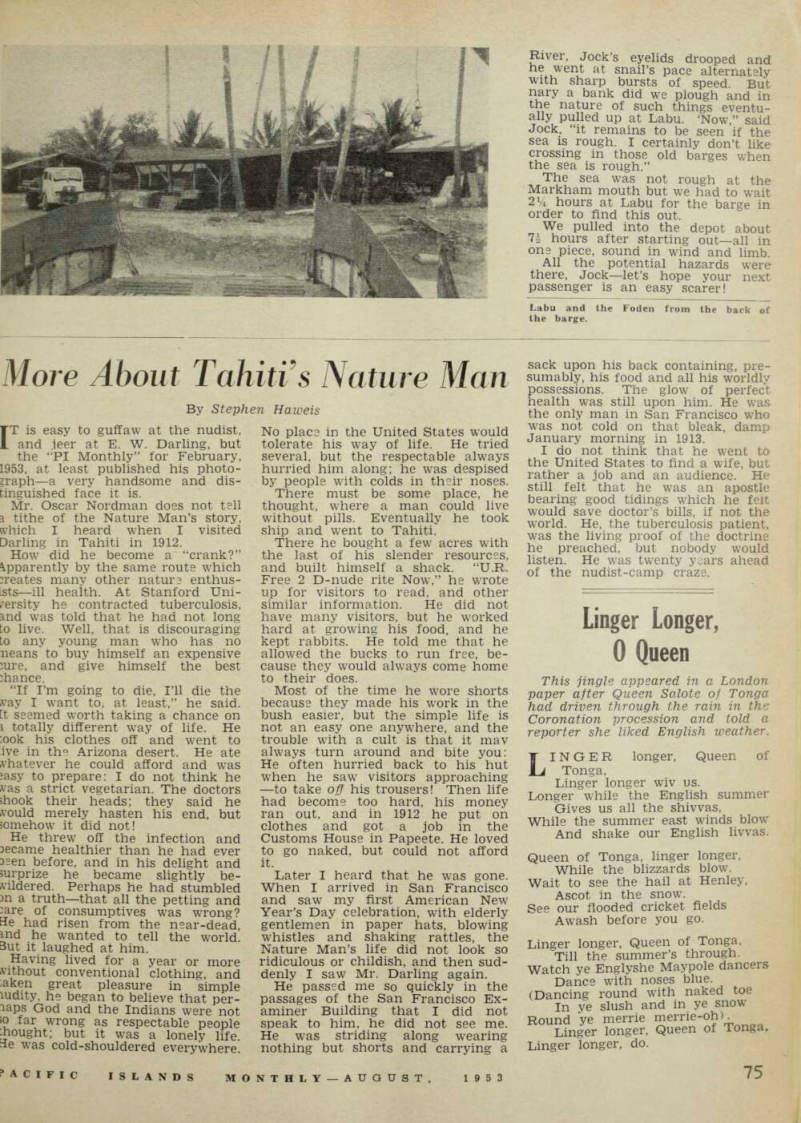
River, Jock’s eyelids drooped and he went at snail’s pace alternately with sharp bursts of speed. But nary a bank did we plough and in the nature of such things eventu ally pulled up at Labu. ‘Now,” said Jock, “it remains to be seen if the sea is rough. I certainly don’t like crossing in those old barges when the sea is rough.”
The sea was not rough at the Markham mouth but we had to wait 2% hours at Labu for the barge in order to find this out.
We pulled into the depot about hours after starting out—all in one piece, sound in wind and limb.
All the potential hazards were there, Jock—let’s hope your next passenger is an easy scarer!
Labu and the Foden from the back of the barge.