In Some Pacific Islands
pp. 67-69 · Read in the full issue

Prospects For Cocoa And Coffee Growing
A Summary Issued by the South Pacific Commission
A SERIES of reports on surveys made for the South Pacific Commission envisages the pro duction of cocoa and coffee on a large scale in the South Pacific area.
Mr. D. H. Urquhart, former Director of Agriculture, Gold Coast, was engaged to assist in these in vestigations. In past years he had made a special study of cocoa and since his retirement three years ago has visited various tropical countries on behalf of Cadbury Brothers Ltd., to assess potential cocoa production and give advice and help to planters, interested companies and Govern ments.
The territories visited in the course of his SPC engagement last year included New Caledonia, New Hebrides, Western Samoa, Fiji and Netherlands New Guinea.
Mr. Urquhart says that it is im possible to forecast world prices of copra, but if they fall it will mean serious reduction in the incomes of many of the territories he visited.
He believes that cocoa prices are likely to remain high, and that a possible loss of copra income could be offset if a policy of cocoa plant ing were embarked on now.
There is, of course, the chance that if Mr. Urquhart’s suggestions for increased cocoa acreage are adopted by all the Territories, there is a possibility of a world glut of cocoa developing with a consequent
drop in price.
His surveys cover territories where cocoa flourishes—as in Western Samoa —and range through others where little has been at tempted, to the New Hebrides which presents a picture of neglect of a once flourishing industry. The reports are summarised below.
Fiji Islands
trees were first planted in Fiji towards the end of last century, and despite long periods of neglect some of them survived. Mr. Urquhart noted that vegetative growth was good, some trees were in bearing or flowering, leading to the conclusion that they would have done well with normal attention.
The texture and depth of the soils in the wet zone of Fiji (Viti Levu) appeared suited for cocoa, and areas would also be found on the islands of Vanua Levu, Taveuni, Kandavu, Koro, Ngau and other smaller islands. The total area would be considerable.
As European (and Indian) interests are mainly concerned with coconuts, sugar cane and pineapples, the main hope of buiiding a cocoa industry lies with Fijian peasant farmers.
The native system of farming annual crops where the bush or forest is cut, burned out and farmed for four or five years and then left to grow to bush or forest again, lends itself to the easy establishment of ?. permanent crop such
as cocoa. Instead of leaving the garden to return to forest, cocoa can be planted between food crops in the second or third year and some food crops, such as yams and cassava, would provide primary shade. Permanent shade could be established in the meantime.
Netherlands New Guinea
npHERE is a small amount of cocoa already growing in Netherlands NG.
The trees were derived from Java and bear beans of good shape and size. The rainfall is adequate for any tropical crop, but the difficult nature of the terrain and the widely scattered population are factors which make for difficulties in develop ment.
As the climate everywhere in the low lands, excluding Merauke, is suitable, cocoa can be grown where the soils are suitable, although considerable experi mental work is required.
The most satisfactory way to plant cocoa here would he to clear the forest completely and grow the cocoa under temporary shade and later under per manent shade. As the local people are generally lacking in energy and industry, it may be impossible to induce them to undertake the necessary labour of clear ing the forest completely. A compromise is a partial clearing of the forest, leav ing some of the forest trees as shade, Local people might be encouraged to plant suitable trees gradually as permanent shade, and w’hen these grow up the forest trees could be removed.
Western Samoa
of cocoa from Western Samoa began early this century and by the year 1910 had reached just short of 500 tons. The average export figure between 1911 and 1930 was under 1,000 tons per annum and between 1941 and 1950 it had risen to an average of 1,857 tons.
In 1951 3,212 tons were exported, valued at £BOl,BOl. (For the same year 14,619 tons of copra were exported. value £781,172).
Climate and soil conditions are suited to growing cocoa, and nests and diseases are less prevalent than in most parts of the world where cocoa is grown on a large scale. NZ Rep?, rations Estates control 1,600 acres of cocoa, and on both
main islands (Upolu and Savai’i) there is much spare land capable of cultivation.
Western Samoa has far the largest and most important cocoa industry in the Pacific and it has maintained a steady increase over the last 50 years but there is considerable risk attached to the com placent attitude which appears to assume that the increase is likely to continue.
More detailed soil assessment is neces sary, more research directed towards in creasing the yield per acre, more study of disease-resistant trees, and considera tion to the types of cocoa required by the world markets.
Cocoa might well become the country’s main source of income if these steps were taken. Samoa has a more promising prospect for increasing output under these conditions than any other cocoa-growing country to-day.
New Hebrides
TN dismal contrast with the flourishing -*• picture presented by W’estern Samoa, is that of the New Hebrides, where neglect of the plantations owing to labour difficulties has resulted in a startling decline in production.
In 1935 the production of cocoa was given as 2,770 tons, whereas in 1951 the export figure was only 400 tons. The decline is partially due to labour shortages—the cocoa and other industries flourished when indentured labour was available from Indo-China. Now that it is not, some plantations have been neglected and others abandoned.
If the New Hebrides is to avoid serious decline in income it must rebuild its plantation industries. The natives will not come to work on European plantations in sufficient numbers to enable the Euro pean plantation industry to expand.
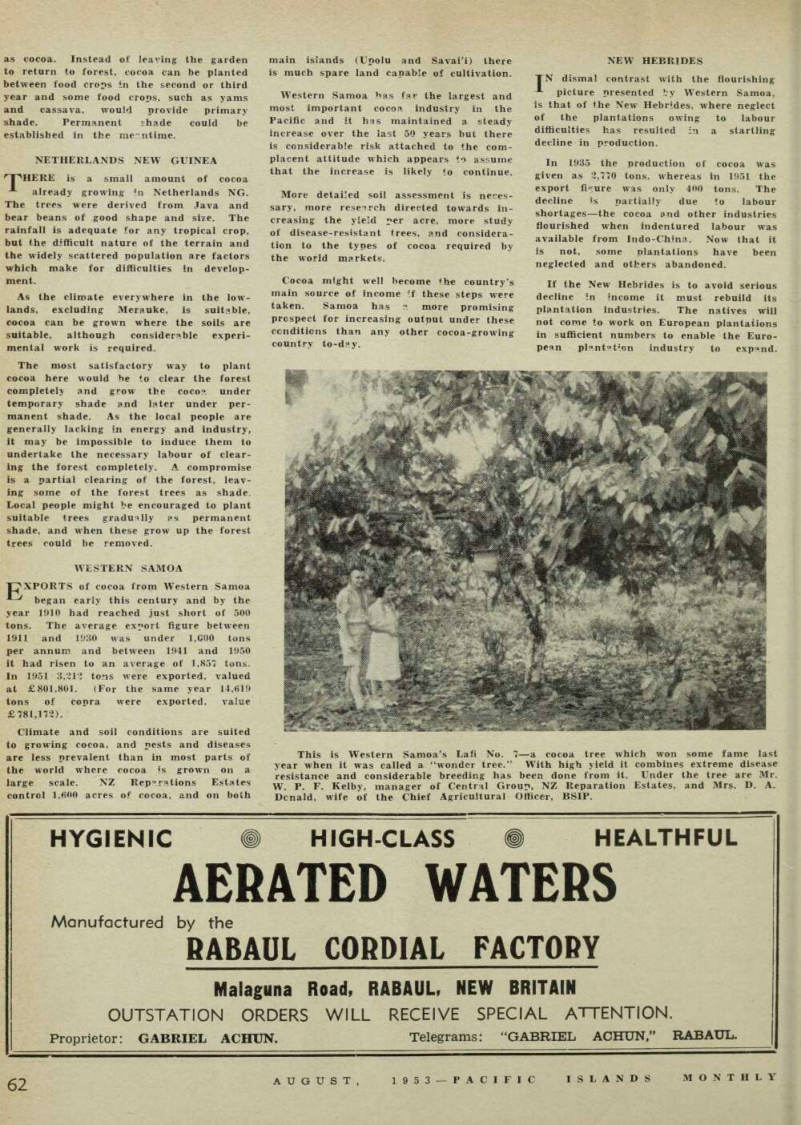
This is Western Samoa’s Lafi No. 7—a cocoa tree which won some fame last year when it was called a “wonder tree.” With high yield it combines extreme disease resistance and considerable breeding has been done from it. Under the tree are Mr.
W. P. F. Kelby, manager of Central Group, NZ Reparation Estates, and Mrs. D. A.
Dcnald, wife of the Chief Agricultural Officer, BSIP.
The report suggests that the only alternative is to take the plan tation industry to the natives. Although the natives are primitive, says Mr.
Urquhart, much of the palm oil and cocoa of Africa have been produced by natives just as primitive.
The estimates for 1952 made financial provision for a Department of Agriculture and much will depend on its adequacy and efficiency. The climate is suitable for cocoa and there are extensive areas of good soil on both Santo and Efate.
Coffee In New Caledonia
nPHE SPC has issued also a report by Mr. Urquhart on coffee growing in New Caledonia. In 1951 there were 14,570 acres under coffee cultivation in the area, where it grows well and is capable of giving high yields of high quality.
Cyclones and floods are the outstanding features in the climate which are un favourable to coffee.
The limitations to the extension of coffee planting are decided at the present time mainly by the availability and cost of labour and lack of access to more land suitable to the crop in favourable climatic conditions. The difficulty of finding regular labour has led some planters to adopt a system of employing tenants with their families to tend the plantations and harvest the coffee on the basis of one-third of the crop going to the farmer and two-thirds to the tenant.
The natives of New Caledonia number about 30,000 and, as they are natural agriculturalists, it is suggested that the future of coffee in New Caledonia rests with them. The report suggests that surveys of the soil should be made and an experimental station established to investigate coffee problems. Low-yielding trees should be replaced with trees giving a high yield and efforts made to improve juality. It is generally admitted that the skill applied to the preparation of the JUlk of New Caledonian coffee to-day falls far below the standard which was applied n the early days when coffee from this sland enjoyed such a high reputation in France.
Cook Islands
A SMALL section of the report on cocoa growing in Western Samoa is levoted to the Cook Islands, where the dimate is marginal for cocoa.
There are a few cocoa trees growing in Rarotonga and it is considered possible 0 grow cocoa in the valleys, provided hat the trees are well sheltered. It should be possible to obtain rooted •uttings of high-yielding trees from >amoa, when there is a supply available.
In past years, there was an export of offee from the Cook Islands. A certain mount of this cron is found growing in 1 semi-wild state in all the Lower Group slands. The Department of Agriculture us recently planted some Arabica coffee •n its experimental station. Rarotonga is n approximately the same latitude as
New Caledonia where coffee grows well.
Given adequate shelter by trees or hills it should be possible to grow coffee profitably on the foothills and in the valleys of Rarotonga.
The foregoing are only brief summaries of what Mr. Urquhart has to say about cocoa (and some coffee) growing in the Territories mentioned. In his reports he covers each Territory thoroughly as to soils, climate, history of the crop, agri cultural research, su’tabfe varieties, etc.
Each Territory is treated in a separate report and the reports are available from the South Pacific Commission, Noumea, New Caledonia, or from the South Pacific Commission, GPO Box 5254, Sydney, Australia, for 2/- Stg. per copy.
(I T.orlv IVTovoic 4- r-,- Lala Suklina, Was 300 guests presented to the Queen Mother at a garden party given bv the Women’s Corona Club in the grounds of Lambeth Palace. Ratu L f la , Su kuna and Lady Maraia
September. On thes Way "back to
Fiji they win visit th e Ist Battalion Fiji Infantry Regiment, in Malaya LeSS than 3 per Cent, of the 148,000 Indians in Fiji were Christians, Mr. Sultan Ali, an Indian missionary from Fiji, said recently When Speaking at Maughan Church, Franklin St., Adelaide. The WOlk of Community was the biggest task remaining for Christians in the South Pacific.