£1,663,055 in P-NG Copra
p. 39 · Read in the full issue
Stabilisation Fund
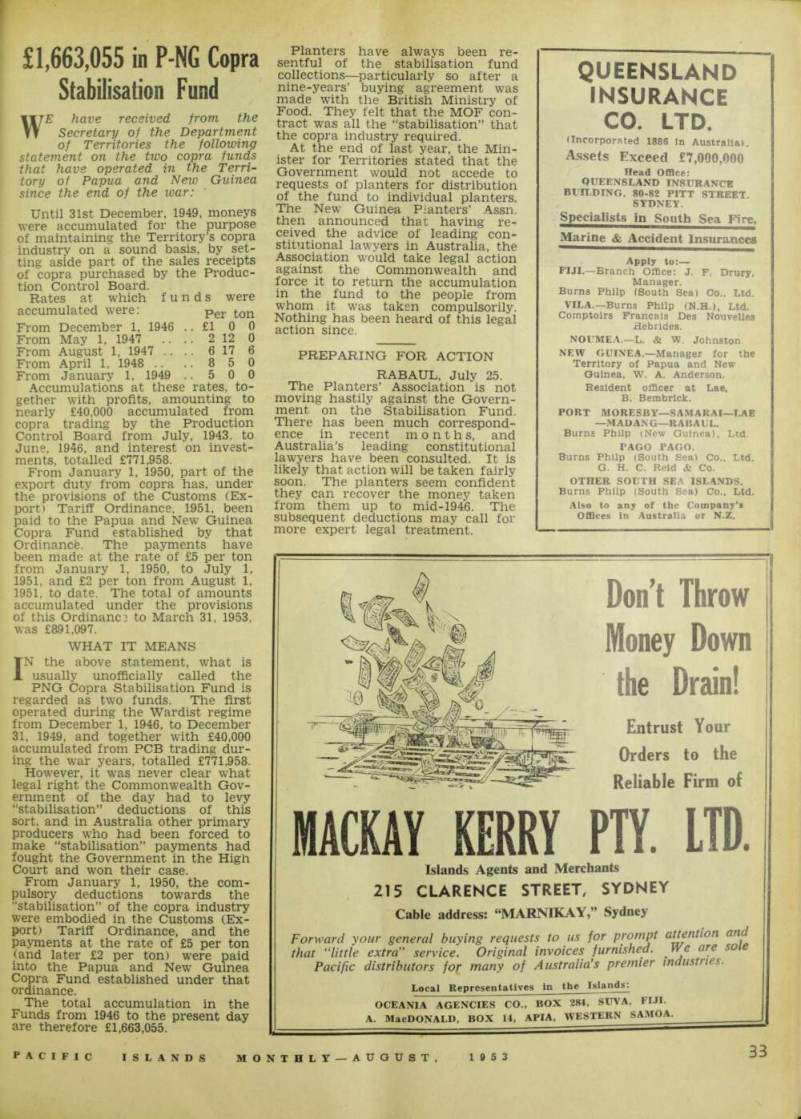
WE have received from the Secretary of the Department of Territories the following statement on the two copra funds that have operated in the Terri tory of Papua and New Guinea since the end of the war: ' Until 31st December, 1949, moneys were accumulated for the purpose of maintaining the Territory’s copra industry on a sound basis, by set ting aside part of the sales receipts of copra purchased by the Produc tion Control Board.
Rates at which funds were
Accumulations at these rates, to gether with profits, amounting to nearly £40,000 accumulated from copra trading by the Production Control Board from July, 1943, to June, 1946, and interest on invest ments, totalled £771,958.
From January 1, 1950, part of the export duty from copra has, under the provisions of the Customs (Ex port) Tariff Ordinance, 1951, been paid to the Papua and New Guinea Copra Fund established by that Ordinance. The payments have been made at the rate of £5 per ton from January 1, 1950, to July 1, 1951, and £2 per ton from August 1, 1951, to date. The total of amounts accumulated under the provisions of this Ordinance to March 31, 1953, was £891,097.
What It Means
IN the above statement, what is usually unofficially called the PNG Copra Stabilisation Fund is regarded as two funds. The first operated during the Wardist regime from December 1, 1946, to December 31, 1949, and together with £40,000 accumulated from PCB trading dur ing the war years, totalled £771,958.
However, it was never clear what legal right the Commonwealth Gov ernment of the day had to levy “stabilisation” deductions of this sort, and in Australia other primary producers who had been forced to make “stabilisation” payments had fought the Government in the High Court and won their case.
From January 1, 1950, the com pulsory deductions towards the “stabilisation” of the copra industry were embodied in the Customs (Ex port) Tariff Ordinance, and the payments at the rate of £5 per ton (and later £2 per ton) were paid into the Papua and New Guinea Copra Fund established under that ordinance.
The total accumulation in the Funds from 1946 to the present day are therefore £1,663,055.
Planters have always been re sentful of the stabilisation fund collections—particularly so after a nine-years’ buying agreement was made with the British Ministry of Food. They felt that the MOF con tract was all the “stabilisation” that the copra industry required.
At the end of last year, the Min ister for Territories stated that the Government would not accede to requests of planters for distribution of the fund to individual planters.
The New Guinea Planters’ Assn, then announced that having re ceived the advice of leading con stitutional lawyers in Australia, the Association would take legal action against the Commonwealth and force it to return the accumulation in the fund to the people from whom it was taken compulsorily.
Nothing has been heard of this legal action since.
accumulated were: p er on From December 1, 1946 .. £1 0 0 From May 1, 1947 .. .. 2 12 0 From August 1, 1947 .. .. 6 17 6 From April 1, 1948 .. ..8 5 0 From January 1, 1949 ..5 0 0