Japs Get Huge Hauls Of Fish
p. 25 · Read in the full issue
Profitable Operations in the Solomons Area
SUVA, July 30.
FURTHER reports of “mysterious vessels” being sighted in the Solomons area may soon be ex pected. Japan’s largest and most modern tuna fishing fleet —consisting of 30 fishing craft and an 11,000-ton mother ship—sailed from Japan on May 28 to operate in the vicinity of the Solomons, according to a report in an American fisheries journal.
As an indication of the enormous wealth that Australia is failing to exploit in the Solomons-New Guinea area, it is stated in this report that the Japanese expedition expects to take home about 12 million pounds’ weight of tuna from this voyage.
Also from Japan comes word that the Government has just approved a subsidy of £A500,000 to private owners to build ten motor-ships of from 240 to 270 gross tons, for tuna fishing in Trust Territory and equatorial waters of the Pacific.
The building of this fleet is to be expedited, following favourable fishing reports by an American Fish & Wild Life Department’s survey of the area by an expedition from Honolulu in recent months.
Jap Haul in 1952
WE learn from a report received through the Fisheries Division of the Australian CSIRO that in three months, in 1952, the Taiyo Fishery Company of Tokio, operat ing in the waters of the Solomon Islands, caught 4,580 tons of fish.
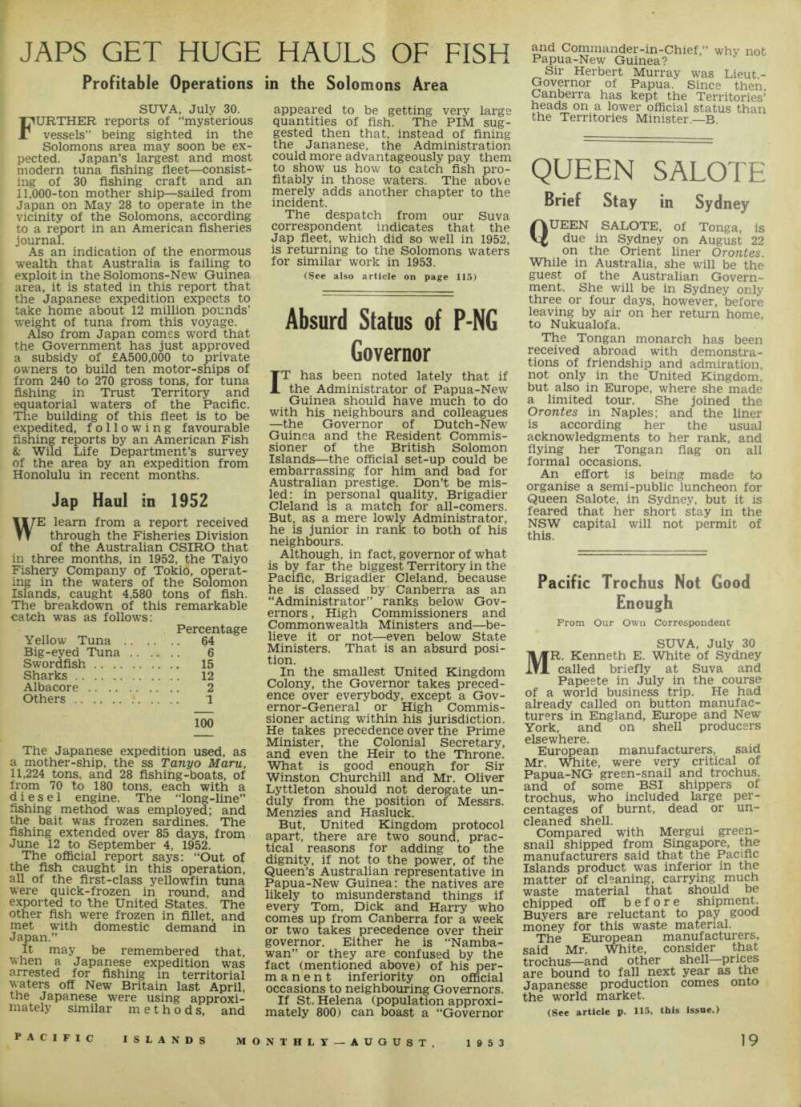
The breakdown of this remarkable catch was as follows:
The Japanese expedition used, as a mother-ship, the ss Tanyo Maru, 11,224 tons, and 28 fishing-boats, of from 70 to 180 tons, each with a diesel engine. The “long-line” fishing method was employed; and the bait was frozen sardines. The fishing extended over 85 days, from June 12 to September 4, 1952.
The official report says: “Out of the fish caught in this operation, all of the first-class yellowfin tuna were quick-frozen in round, and exported to the United States. The other fish were frozen in fillet, and met with domestic demand in Japan.”
It may be remembered that, when a Japanese expedition was arrested for fishing in territorial waters off New Britain last April, the Japanese were using approxi mately similar methods, and
appeared to be getting very large quantities of fish. The PIM sug gested then that, instead of fining the Jananese, the Administration could more advantageously pay them to show us how to catch fish pro fitably in those waters. The above merely adds another chapter to the incident.
The despatch from our Suva correspondent indicates that the Jap fleet, which did so well in 1952, is returning to the Solomons waters for similar work in 1953.
(See also article on page 115)
Percentage Yellow Tuna .. . .. .. 64 Big-eyed Tuna .. .. .. 6 Swordfish ... 15 Sharks ... 12 Albacore .. .. 2 Others .. .. 1 100