Caledonia!
pp. 21-147 · Read in the full issue
Many ‘Happy Septembers’ To New
And Less Tragedy in the Next Hundred Years
Specially Written For "Pacific Islands Monthly.”
SEPTEMBER is an important month in the New Caledonian calendar. British people will always remember that on Sep tember 19, 1940, the Colony rallied to Free France, and turned out its Vichy-minded governor.
Going back to the very beginning; it was on September 4, 1774, that Colnett, look-out man on the Resolution, caught sight of the dim outline of the island’s northern mountain range, whose liking to the Scottish Highlands led Captain James Cook to give the country the name which the French have con verted into La Nouvelle Caledonie.
The French took possession 79 years after Cook’s arrival, on Sep tember 24, 1853 and it is this event that the people of New Caledonia will celebrate next month with a fervour which should exceed that with which their grandfathers cele brated the 50th anniversary, in 1903.
John Rider Haggard, brother of the English novelist, who was British Consul in Noumea at the time, has left a cheerful account of that occasion.
In New Caledonia, there is no monument to the great navigator who discovered the island, to Cook; but he left names on the map. Be sides a reef named after him, there is Cape Colnett, the Isle of Pines, and Botany Bay. To the south, he mistook He Ouen for a part of the main island and called it Prince of Wales Foreland. It was not until the 1850’s that an English sandal wooder rounded He Ouen and gave his name to the delightful little Woodin Passage. And nearby is swift Havannah Pass, named after Admiral Erskine’s English warships, there in 1847.
Before the French came, these seas were the haunt of sandalwood and beche-de-mer traders, Paddon, Towns, Rodd, Underwood and others, who brought much wealth to Old Sydney. They also carried to Aus tralia the first kanaka labour, Loyalty boys who worked for the NSW pastoralists, for the Port Eden whaling establishment, and even on Sydney wharves, where their em ployment caused a strike of ticket of-leave men who were the lumpers of those days.
At La Conception mission, near Noumea, there is an interesting museum of early history, contain ing one of the handsome medallions left behind by Cook; and another of these turned up in a native’s hut only last year.
IT was at Balade, not far from Cook’s landing place, that Rear-Admiral Auguste Febvrier- Despointes, commander of the
Division Navale du Pacifique, raised the French flag 100 years ago, in the name of Nanoleon 111. (Cook anchored the Adventure and Re solution in the Bay of Bouayaoup, a little to the north). The French then were seeking a big penitentiary establishment, as far away from France as possible. This plan dark ened the island’s story for much of the following century.
For the first few years, the island was under the French Governor in Tahiti. At first, the tiny settle ment of Noumea was known as Port-de-France. That name was abandoned owing to postal con fusion with Fort-de-France, in
Martinique.
Unlike Cook, the French formed an unfavourable opinion of the natives, who suffered under French rule. There is a long history of massacre; and punitive expedition: down to the final revolt of Chief Noel, of Kone, in 1917-18. Noel, in the end, was decapitated by a formerly friendly Arab, who claimed the big reward offered for his head.
This head was put on a pol?, on the main highway, by the gendarmes, as a warning to rebels.
The only witness of the original flag-hoisting in 1853 were the crew of the steam corvette Phoque, a few Marist brothers, and a tiny military garrison left behind at Balade to protect them. The French chastised the natives who had earlier driven
the first missionaries away, to take refnge with Paddon, at Anatom, in the New Hebrides and at the Isle ot Pines; one or two also found their way to Sydney. The French naval ship Seine, which had gone to their assistance, had run aground nearby and been pillaged by the natives, so that the crew of 250 had been taken to Sydney by an English ship. A dozen sailors of the warship Alcmene had also been massacred in 1850.
MANY French writers since 1853 have repeated a statement by Pere Montrouzier, one of the early priests, that the British were about to proclaim sovereignty over New' Caledonia, and were only beaten by a short head. There cer tainly was a British ship of the Sydney station in the vicinity of the Isle of Pines, but she was doing a routine hydrographic survey. Also the Anglican Bishop Selwyn, of New Zealand had paid the Loyalties a visit and touched at Hienghene. on the East coast. But British policy then and for many years later was to discourage commitments in the South Seas, as the Australian Colonies were to find out.
For instance, the first British Consuls in Noumea received explicit instructions from the Foreign Office not to give encouragement to British missions in the area (in cluding the New Hebrides), even though in the Loyalties the natives were coerced by the French who backed their own co-religionists by force of arms in an attempt to make the natives desert their English pastors. This led to an unfortunate religious war on Mare, Lifou, and Ouvea, in which scores of natives lost their lives.
(Continued on Page 141)
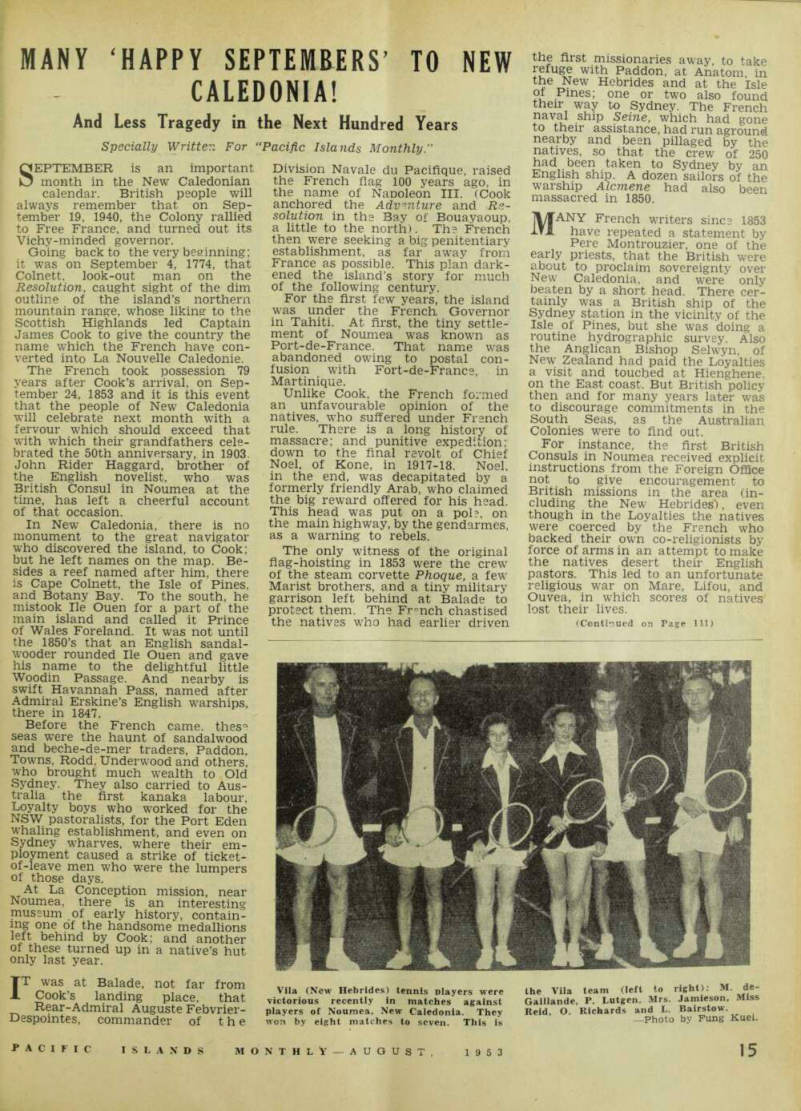
Vila (New Hebrides) tennis players were victorious recently in matches against players of Noumea, New Caledonia. They won by eight matches to seven. This is
the Vila team (left to right): M. de- Gaillande, P. Lutgen, Mrs. Jamieson, Miss Reid, O. Richards and L. Bairstow. —Photo by Fung Kuei.
On the main island, the worst re volt—or rather the worst of a state of revolt which was to cover 65 years—came in 1878-80, when 200 whites were massacred in a matter of weeks. This was followed by a war of extermination in which no quarter was given on either side.
The outcome was a decline in the Melanesian population, which lost all faith in the future. The remnants of the decimated tribes have since become reconciled to living on reservations, but the de cline has been finally arrested (at something like 16,000 on the main island in recent years). It is hardly to be wondered at that up to now the native inhabitants have played little active part in the making of the present New Caledonia. /TIHE early days are of interest be- JL cause of the story of Paddon, the famous trader whom the French found in possession of He Nou. Paddon was a man beloved by all he met, French and English, black and white. He is the recog nised Father of the Colony, this seaman from Portsmouth who was so well known in Sydney’s colonial days.
The French were suspicious of most Britons they found on the Island on their arrival. They claimed that the Sydney captains touched the chord of self-interest by telling the natives that once France took over the supply of trade goods would dry up. The French shot out-of-hand two Britishers and an American—their names, Fred Williams, William Smith and Samuel Baily —on Hienghene beach, though nothing definite was proved against them.
The matter was hushed up for fear of international complications, but It may have been because of this affair that Paddon temporarily left the colony.
Directly he had gone, the French prayed him to return. Shipowner in a big way, he was their only link with Australia, and that meant with the outside world. On him the infant settlement relied for supplies as well as for immigrants; and the immigrants he brought were among the best free citizens and pioneers the island was ever to get.
It was after 1880, with the discovery of great mineral wealth, that the free settler, whether from Australia or France, was discouraged, and the country handed over to interests which used unpaid or little-paid convict and coolie labour. Paddon’s influence with the chiefs saved the first whites from extermination.
The long story of opposition and bitterness between the local-born free white population and the gov ernment and penitentiary officials who backed the nickel interests began in 1880. Their points of view were irreconcilable.
From this period, too, one can trace causes of friction with Aus tralia which were to last through the remainder of the century— until the end of transportation in 1898, followed by the New Hebridean Condominium settle ment and the Entente Cordiale, brought a welcome change of temper in South Pacific relationships. Two world wars have cemented the French Colonial friendship with Australia and New Zealand, follow ing a long period of estrangement.
In or about 1880, France passed many laws navigation, mining, trade, and so on whose apparent purpose was to discourage the Colonists and assist the new metal industries.
UP to 1897, 25,000 convicts were brought into the island. The result was to repeat in a small country all the features and horrors of a system that Australia had been only too thankful to rid herself of.
We find on He Nou, at Bouloupari, and elsewhere, the convict station system which formerly disgraced Tasmania, New South Wales and Norfolk Island. We get the same tales of inhumane warders; of convicts drawing lots as to who should “do in” the other; the same chain-gang miseries; the same tales of bushrangers and escapees, and of white derelicts (known as ticket-of-leave men) roaming un wanted through the island, and consorting with the blacks, who sometimes put them in the pot, and sometimes brought in the escapees trussed like pigs for the customary 25-francs reward. Now
and again we also find the occa sional convict making good and be ing allowed to join the body of free and generally worthy citizens.
One Australian worry was the number of escapees who turned up in Queensland and had to be re patriated. Another was the French threat to stock the New Hebrides with convicts on an employment basis. There were hazardous escapes in open boats as far afield as New Guinea.
There was a bad development when the Paris Government signed over to the mining companies, and to big commercial concerns, large numbers of unpaid convicts, who thus became lifetime slaves in very fact—many of these contracts cov ered periods of up to twenty years.
This so-called “market in human flesh” caused strong protests in the French Parliament which, however, voted that the system should con tinue. The free settlers of the colony became very irate indeed, but the nickel bosses paid no heed.
The colony was not directly repre sented in Paris, and self-govern ment was practically unknown.
As a result of this policy, hun dreds of Australian, New Zealand, Cornish and Dalmatian miners, as well as French settlers, packed up and left the island never to return.
Hundreds of kanaka labourers from the New Hebrides, brought along by Higginson’s blackbirders, were sent to virtual slavery in the mines alongside the convicts.
Few of the convicts founded families or stable homes, so the island was unable to build up a permanent labour force. With the de cline of the convict element, instead of turning to free and fairly paid labour, the mining interests brought jn . some 15,000 Japanese, Indo- Chinese, Javanese and other Asiatic
coolies to replace the convicts. The Asiatics, poorly paid and accustomed to low living standards, have not done the colony much good. Un like the convicts, they were allowed to raise families on the spot, usually big ones, so that the population has steadily increased—but has be come less white and less Melanesian.
Now, with the end of World War 11, cheap Asiatic labour is at an end, and the mining concerns are in something of a dilemma. The heterogeneous mass which, based on the original pioneer and freed con vict stock, make up the majority of New Caledonia’s citizenry are now demanding that the opening of the Colony’s second century be marked by a new policy. There always has been a desire in the Colony that the mining industry should employ adequately paid labour, so that whether recruited locally or brought in from outside, workers should have a real stake in the country. Such a development could be more satisfactory to Aus tralian and New Zealand sentiment than coolie labour importations.
The New Caledonians who are now claiming a degree of self-gov ernment, are a patriotic and a friendly people. They fought readily and well for and in France in World War I, and were the very first to rally to Free France in 1940, sending contingents to help the Eighth Army in the desert. They have the will to be good neighbours and always give a friendly welcome bo Australians. There is much com mercial and social intercourse be tween New Caledonia and Aus tralia.
A suggestion was made in the Sunday edition of a Sydney news paper that Sydney and Noumea should adopt or “marry" each other, as certain English and French towns have recently arranged to do. In any case Australians will do well, m September 24 next, to wish New Caledonia not only many happy re turns, but a century of greater pro gress and less tragedy than the one that has passed. i Queen Salote, of Tonga, was re ceived in official audience by the Pope at the Vatican during her nsit to Rome. The Queen, who was accompanied by her daughter-in aw, was presented with a com nemorative gold medal by the Pope. r Mr. A C. (Bill) O’Reilly returned « Suva recently as secretary to W.
Carpenter & Co. (Fiji), Ltd., md associated companies. He was ransferred to New Guinea as lecretary to Coconut Products, Ltd., wo years ago, but before that he vas formerly secretary to Islands -ndustries, Ltd., Suva. While in xabaul he took a prominent part n the commercial and social life >f the town.