in the transportation field-trans
pp. 76-80 · Read in the full issue
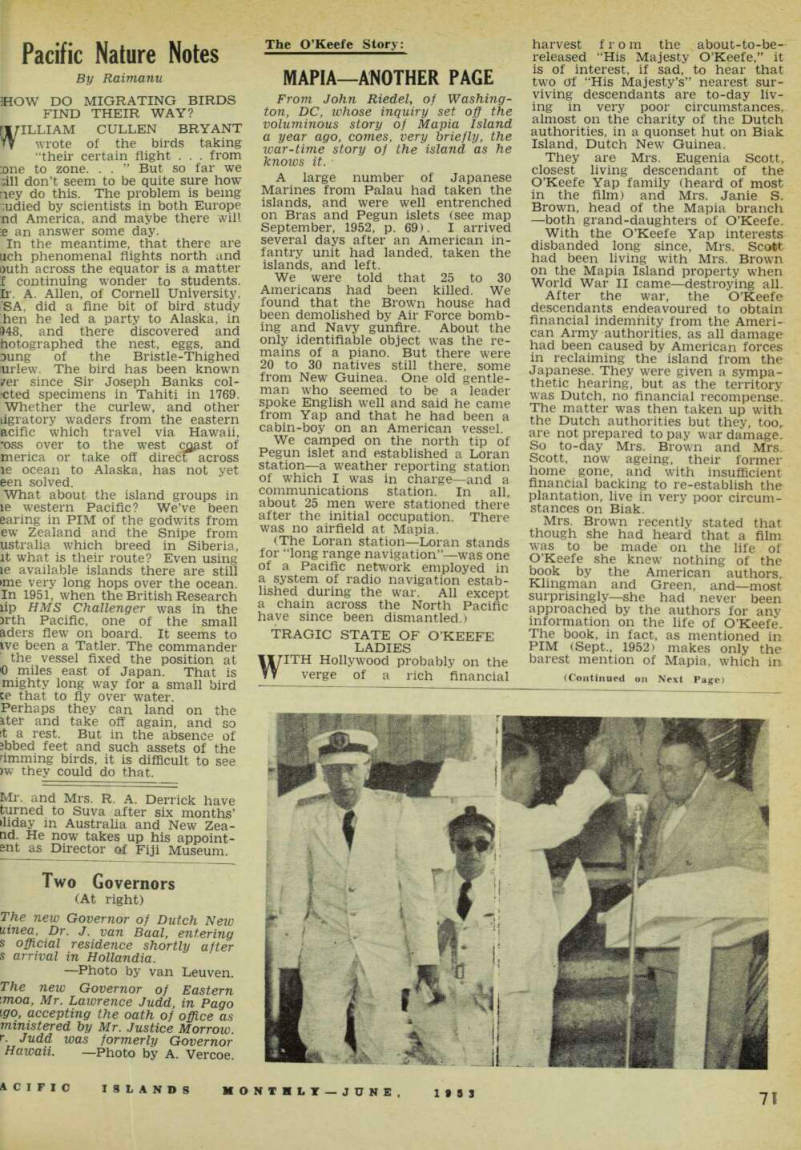
port in this part of the world must essentially be a matter of large and small ships.
The war scrap and the war junk must come to the credit side of the ledger; it provided building materials when building materials were almost impossible to obtain from regular sources. It has pro vided fortunes for some shrewd operators and profit to the Govern ment in a percentage rake off.
BUT all that is past history.
Whether it is good or whether it is bad, BSI residents are stuck with their capital city—so much money has been poured into it now, it certainly will not be abandoned, even if that were desirable.
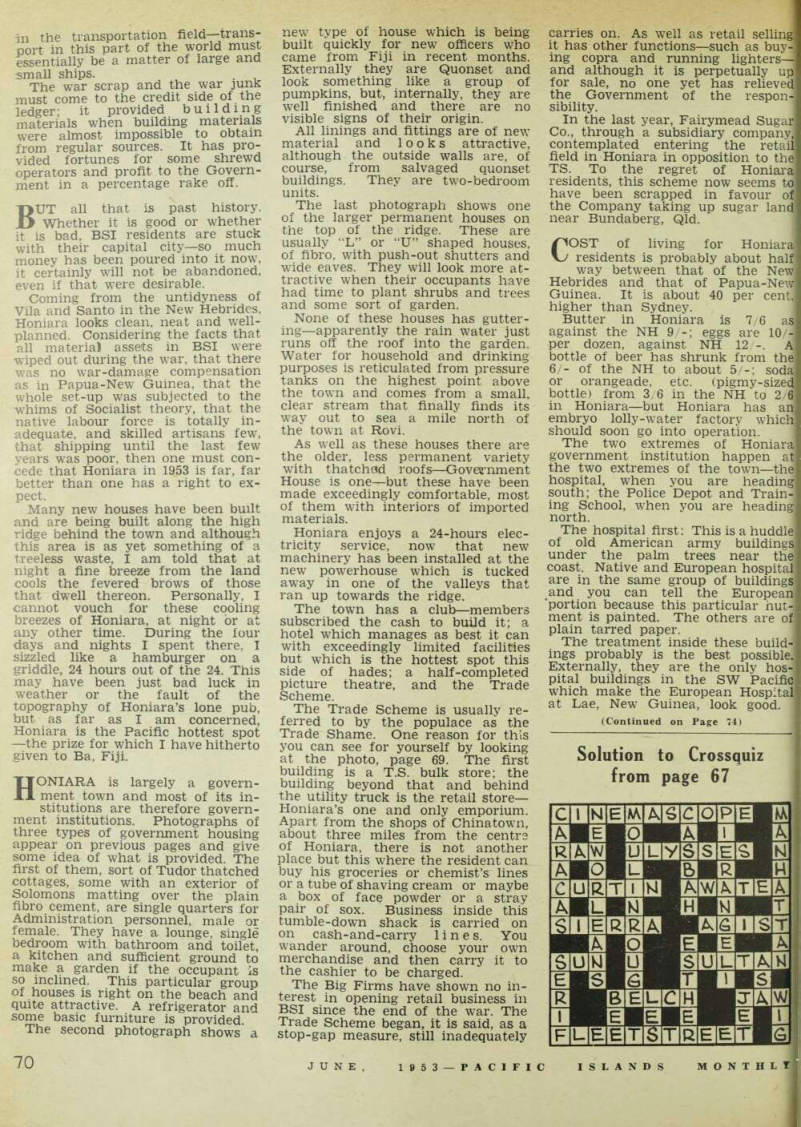
Coming from the untidyness of Vila and Santo in the New Hebrides, Honiara looks clean, neat and well planned. Considering the facts that all material assets in BSI were wiped out during the war, that there was no war-damage compensation as in Papua-New Guinea, that the whole set-up was subjected to the whims of Socialist theory, that the native labour force is totally in adequate, and skilled artisans few, that shipping until the last few years was poor, then one must con cede that Honiara in 1953 is far, far better than one has a right to ex pect.
Many new houses have been built and are being built along the high ridge behind the town and although this area is as yet something of a treeless waste, I am told that at night a fine breeze from the land cools the fevered brows of those that dwell thereon. Personally, I cannot vouch for these cooling breezes of Honiara, at night or at any other time. During the four days and nights I spent there, I sizzled like a hamburger on a griddle, 24 hours out of the 24. This may have been just bad luck in weather or the fault of the topography of Honiara’s lone pub, but as far as I am concerned, Honiara is the Pacific hottest spot —the prize for which I have hitherto given to Ba, Fiji.
HONIARA is largely a govern ment town and most of its in stitutions are therefore govern ment institutions. Photographs of three types of government housing appear on previous pages and give some idea of what is provided. The first of them, sort of Tudor thatched cottages, some with an exterior of Solomons matting over the plain fibro cement, are single quarters for Administration personnel, male or female. They have a lounge, single bedroom with bathroom and toilet, a kitchen and sufficient ground to make a garden if the occupant is so inclined. This particular group of houses is right on the beach and quite attractive. A refrigerator and some basic furniture is provided.
The second photograph shows a
new type of house which is being built quickly for new officers who came from Fiji in recent months.
Externally they are Quonset and look something like a group of pumpkins, but, internally, they are well finished and there are no visible signs of their origin.
All linings and fittings are of new material and looks attractive, although the outside walls are, of course, from salvaged quonset buildings. They are two-bedroom units.
The last photograph shows one of the larger permanent houses on the top of the ridge. These are usually “L” or “U” shaped houses, of fibro, with push-out shutters and wide eaves. They will look more at tractive when their occupants have had time to plant shrubs and trees and some sort of garden.
None of these houses has gutter ing—apparently the rain water just runs off the roof into the garden.
Water for household and drinking purposes is reticulated from pressure tanks on the highest point above the town and comes from a small, clear stream that finally finds its way out to sea a mile north of the town at Rovi.
As well as these houses there are the older, less permanent variety with thatchad roofs—Government House is one—but these have been made exceedingly comfortable, most of them with interiors of imported materials.
Honiara enjoys a 24-hours elec tricity service, now that new machinery has been installed at the new powerhouse which is tucked away in one of the valleys that ran up towards the ridge.
The town has a club —members subscribed the cash to build it; a hotel which manages as best it can with exceedingly limited facilities but which is the hottest spot this side of hades; a half-completed picture theatre, and the Trade Scheme.
The Trade Scheme is usually re ferred to by the populace as the Trade Shame. One reason for this you can see for yourself by looking at the photo, page 69. The first building is a T.S. bulk store; the building beyond that and behind the utility truck is the retail store— Honiara’s one and only emporium.
Apart from the shops of Chinatown, about three miles from the centre of Honiara, there is not another place but this where the resident can buy his groceries or chemist’s lines or a tube of shaving cream or maybe a box of face powder or a stray pair of sox. Business inside this tumble-down shack is carried on on cash-and-carry lines. You wander around, choose your own merchandise and then carry it to the cashier to be charged.
The Big Firms have shown no in terest in opening retail business in BSI since the end of the war. The Trade Scheme began, it is said, as a stop-gap measure, still inadequately
carries on. As well as retail selling it has other functions—such as buy ing copra and running lighters— and although it is perpetually up for sale, no one yet has relieved the Government of the respon sibility.
In the last year, Fairymead Sugar Co., through a subsidiary company, contemplated entering the retail field in Honiara in opposition to the TS. To the regret of Honiara residents, this scheme now seems to have been scrapped in favour of the Company taking up sugar land near Bundaberg, Qld.
COST of living for Honiara residents is probably about half way between that of the New Hebrides and that of Papua-New Guinea. It is about 40 per cent, higher than Sydney.
Butter in Honiara is 7/6 as against the NH 9/-; eggs are 10/ J per dozen, against NH 12/-. A bottle of beer has shrunk from the 6/- of the NH to about 5/-: soda or orangeade, etc. (pigmy-sized bottle) from 3/6 in the NH to 2/6 in Honiara —but Honiara has an embryo lolly-water factory which should soon go into operation.
The two extremes of Honiara government institution happen at the two extremes of the town—the hospital, when you are heading south; the Police Depot and Train ing School, when you are heading north.
The hospital first: This is a huddle of old American army buildings under the palm trees near the coast. Native and European hospital are in the same group of buildings and you can tell the European ‘portion because this particular hut ment is painted. The others are of plain tarred paper.
The treatment inside these build ings probably is the best possible.
Externally, they are the only hos pital buildings in the SW Pacific which make the European Hospital at Lae, New Guinea, look good.
(Continued on Page 74)
But out at Rovi, on the other sidd of Honiara, beside the small! bubbling stream that in its highefl reaches provides Honiara with its water supply, is the Police Depot where the native constabulary are trained; and beyond the Depot is the native gaol.
Running beside these two establ lishments, and round and about tha bends of the creek, is about eight acres of garden—bananas and pine-4 apples, citrus fruit and beans! tomatoes and lettuce and still more beans —that provide the whole establishment with its greengrocer! needs.
Native prisoners are taught to| make cane furniture, axe handles! police batons, and do other wood! work and to make the bread thal supplies the police establishments and the hospital.
THE Depot and the Honiara Polica Station, right in Honiara town, are something right out of the South Pacific World. I daresay tha European police officers in Honiara number half a dozen or so. In tha interval since seeing the fruit of their toil, I have pondered occasion! ally on their methods —discipline, the tactics of a nagging wife] psychology? Knowing something o£ the Pacific islander, none of thesa methods seems to be likely to havd produced the effect that it has.
At the depot, the lawns and tha paths look as if they are groomed twice daily by half a million brushes and combs. The interior of the barracks are so neat and tidy thal you look instinctively to see if yoifi have dust on your shoes. The messl halls have tables covered with plastic tablecloths, with a bowl of flowers in the centre of each. Tha kitchens are shining clean —I’d lika to bet that they are shining-estj cleanest kitchens in the whole South Pacific, bar none.
The trainees and native police! men have a club house and canteen on the other side of the parade! ground that is far superior to tha European Club in Honiara.
But these words can give only an outline. To get the degrees of efficil ency, shinyness, neatness and clean! liness you have to see for yourseln A British Guards Regiment mighj have managed something of the sort* —but Islanders! The wonder is that! they can go on living like this and not break out in a rash througll suppression of all their native in! stinct for dirt, disorder and lazii ness.
ALTHOUGH many of the roads the Yanks left on Guadalcanal are overgrown or useless because* of bridges that have fallen into dis 4 repair, the roads in Honiara itself are good, hard-packed white coral;,