Report on Honiara—Dwelling Place of Bods
pp. 74-75 · Read in the full issue
By Judy Tudor
Catchwords, when they get loose in an isolated community are about as deadly as a new germ. In April, the epidemic word in the British Solomons was “bod”—short for body, and meaning person. It is used, on occasion, further around in the SW Pacific but in Honiara everyone from the High Commis sioner to a house-boy is a bod of some sort or another; with its suit able qualifying adjectives, it is used to describe every kind of human there is in the Solomons—and that is quite an assortment. Maybe this particular word is endemic to the Solomons; on the other hand it may have already passed its popu larity peak.
WHEN High Authority, right after the war, decided that it was the site for the future capital of the British Solomon Islands Protectorate, Honiara was not even a name upon a map. No mention is made of it in the 1944 edition of the Pacific Islands Year Book, although the Americans had put the locality—we usually thought about it as Henderson Field—into
the history books a good two years before that. Early editions of the Year Book tell of the good planta tion country round Lunga Point and that Aola (much further to the South East) was the govern ment station for the district; but of Honiara, nothing.
Even now, why it was called Honiara, and not Attleeville (or after some other ruling deity of the immediate post-war years) is a minor mystery. Perhaps Honiara, in local dialect, means “junk-heap”; maybe it is the name of a native village.
At the end of three years of war in the Pacific, virtually nothing re mained of the pre-war civil instal lations at the former BSI capital on the small island of Tulagi, while a long strip of Guadalcanal facing Tulagi across about 24 miles of water, contained Henderson Airfield, plus numerous other landing strips, mile upon mile of hutments, work shops, clearing stations, hospitals, roads, bridges, wharves and piles of miscellaneous junk. Some of these things were defunct; some were still functioning. All had been or
were about to be, left behind by the homeward-bound Americans. It probably seemed sensible to abandon small, cramped Tulagi nestling beneath larger Florida, for the com parative breadth and scope of that spot on the coastal plain of Guadal canal, soon to be called Honiara.
And those were the days when, not conceiving of the stringency of post-war supplies, we thought in terms of rapid expansion—and in this regard, the comparatively flat, well-watered coast, south of Hon iara, from which the Americans had cut the coconut trees and where, 12 or so miles out at Ilu, they had had a very large vegetable farm to supply their forces, seemed the an swer to a theorists’ prayer.
There was no lack of people who saw nothing but dire disaster in the choice of Honiara —a hitherto nameless spot on an unprotected coast which could never have a harbour without the expenditure of millions. And to a degree, their direst predictions have been cor rect. Honiara still has no harbour.
The wharves the Americans left soon fell into the sea and until re-
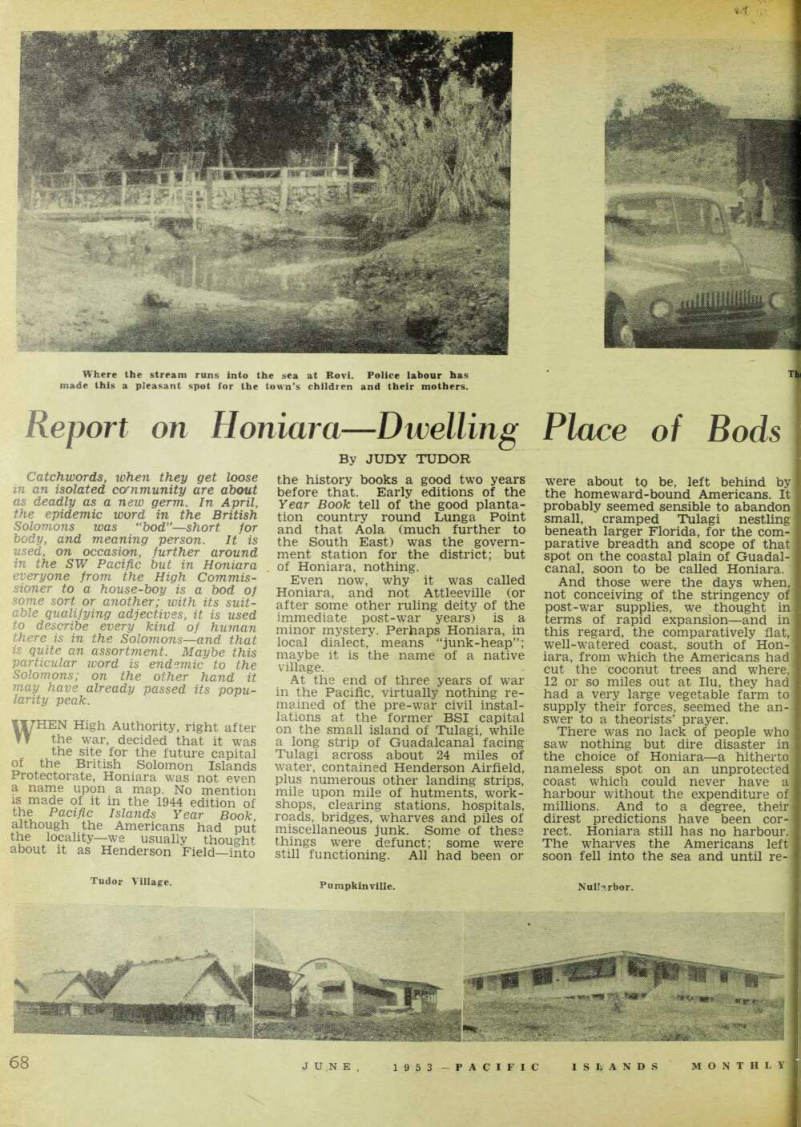
Where the stream runs into the sea at Rovi. Police labour has made this a pleasant spot for the town’s children and their mothers.
Tudor Village.
Pumpkinville.
Nullarbor.
a ntly overseas ships continued to se the war-time wharf at old “ulagi the goods then being ghtered across to Honiara at £2 er ton Within recent weeks, a Bank line lip administered the coup de grace ) the Tulagi wharf; ships will now
have to discharge their cargoes into lighters at Honiara when the weather is calm. When it is rough, during the north-west season, this cannot be done.
Nor (while we are still on the debit side) has the expected expansion of agriculture occurred
along the Guadalcanal Coast; Ilu Farm which produced mightily for the Yanks has produced mighty little for Honiara officialdom. And Henderson and other associated air fields, apart from being at the end of a very expensive air journey from Sydney, have produced few dividends
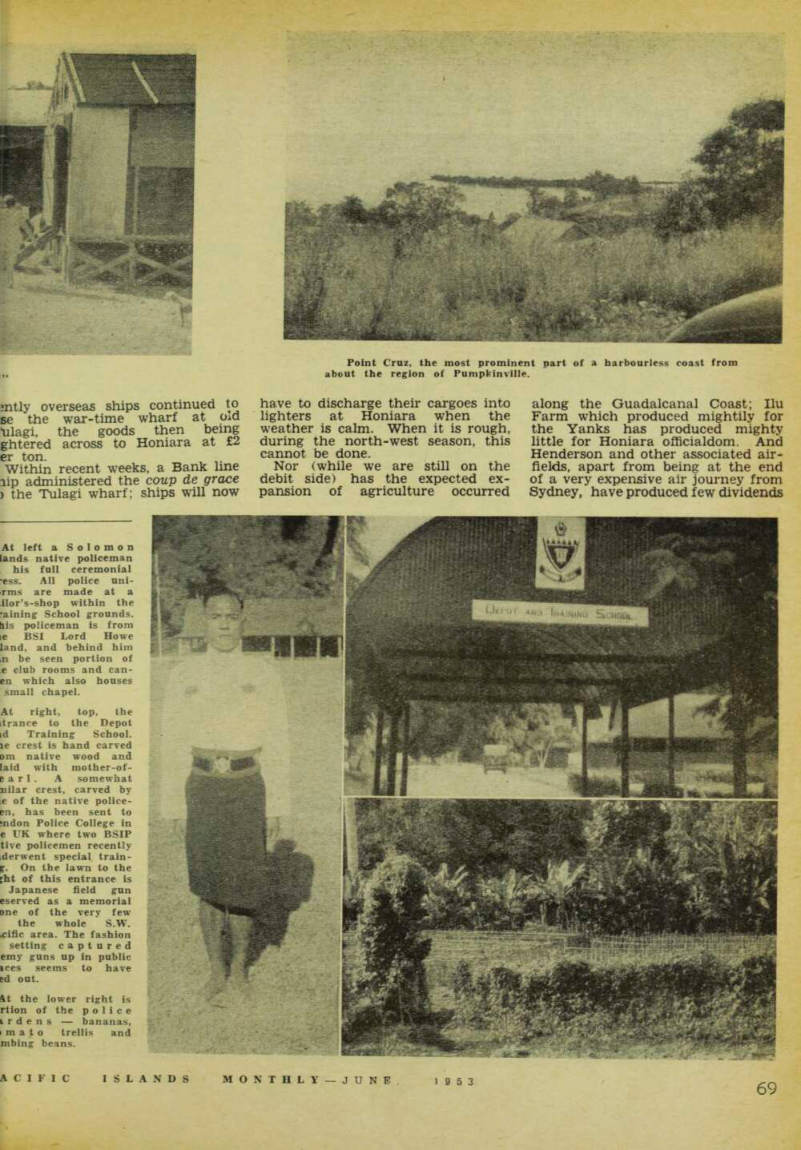
At left a Solomon lands native policeman his full ceremonial [?]ess. All police uni forms are made at a sailor's-shop within the gaining School grounds, his policeman is from [?]e BSI Lord Howe land, and behind him [?]n be seen portion of [?]e club rooms and can en which also houses small chapel.
At right, top, the trance to the Depot [?]d Training School, [?]e crest is hand carved [?]m native wood and laid with mother-of earl. A somewhat milar crest, carved by [?]e of the native police en, has been sent to []ndon Police College in e UK where two BSIP live policemen recently derwent special train er. On the lawn to the [?]ht of this entrance is Japanese field gun []eserved as a memorial one of the very few the whole S.W. [?]rific area. The fashion setting captured emy guns up in public [?]ces seems to have [?]ed out.
At the lower right is portion of the police gardens bananas, tomato trellis and mbing beans.
Point Cruz, the most prominent part of a harbourless coast from about the region of Pumpkinville.