Tropicalities.
pp. 72-73 · Read in the full issue
The Contra
CAPTAIN A. S. FITCH, retired chief of Steamships Trading Co. Ltd. was warmly enter tained when he visited Moresby re cently, and at one function he was asked how he came to find E. C.
Crisp, his successor, and now the Co’s present well-known managing director.
“A little trading concern had gone out of business,” said “Gappy.” “We bought from it a vessel called the Vaemari. We agreed to pay £4,000, plus stores. There were practically no stores on it. But the bill pre sented to me read: ‘To vessel Vaemari, as agreed, £4,000; to stores (4 bars of soap) 4/-; total, £4,000/4/-.’ I was so struck by that that I made it my business to find out who had prepared the account.
I wanted that man in my business.
It was young Crisp. The rest you know! ”
But the victim would not let him get away with it.
“I found STC a tough firm,” said Mr. Crisp, acknowledging a toast.
“The accountant was a conscienti ous man named—call him Smith— and Gappy was the bane of his life.
A neglected debtor would drive Gappy to distraction. One day, look ing through a ledger, Gappy noticed that an account owing by the Browns was overdue. Brown was a dentist, and Mrs. Brown helped him out by keeping boarders. They owed £7. Smith acknowledged that he had made no attempt to collect.
Gappy snarled, and poor Smith left for the Browns’ forthwith.
“He came back, and reported no
success. Times were hard, just then, and Gappy was in a bad mood. ‘Go back there and don’t return to this store without that cheque, or some se curity for it,’ he shouted at Smith.
The desperate Smith departed. a comae of hours later he returned, with a wrap around his face, and spitting blood.
“‘Well, where’s the cheque?’ de manded the merciless Gappy.
“‘I didn’t get it,’ said Smith. ‘But I got a contra. I got all me teeth pulled out!”’
Another Malaria Drug
rE search for the perfect answer to malaria still goes on. At least half-a-dozen drugs have been used widely in the last 15 years, but most have dropped out of favour. The latest prepara tion now being publicised in Southeast Asia, is called Daraprim described as “synthetised by Dr.
George Hitchings and widely tested during the year.” It is claimed that, if it is taken before the mosquito bites, it will give general immunity against the disease-carrying ana pholes, whereas such well-known drugs as Atabrin and Chloroquin, while controlling malaria, do not give protection against later re lapses.
Meanwhile, some experienced medical officers, after lengthy ex periments, have gone back to Quinine, and are using it, usually in combination with other drugs, as the basis of their war against malaria. Much of the terror has gone out of malaria in the past decade, and medical science is con fident that it will have the disease completely under control before long.
Dr. R. H. Black, lecturer on Tropical Medicine at the University of Sydney, left for New Guinea at the end of February to continue ex periments with an anti-malarial drug named Totaquine. This drug, like Quinine, is made from the bark of the Cinchona tree. Working with the South Pacific Commission, Dr.
Black has been administering the drug since last year to the natives of a village in the Trobriands, and results are being observed with in terest. The plantations of Cinchona, first introduced to New Guinea Highlands before the war, are now being steadily increased.
Not A Happy Job
SOMEONE has said that a police man’s life is not a happy one; but what about the happiness of an Assistant District Officer in New Guinea, who also holds the job
of Coroner? Of such a one is Mr.
Max Orken, of Rabaul.
Early in February there was a re port that a native woman who had apparently died from natural causes and been buried a fortnight, actually bad been killed by a blow on the iaw. Exhumation was decided upon.
Ihe Coroner had to supervise the job, and make arrangements for a post-mortem (which did not sup port the assault story).
ADO Orken was still reeling when a male native was found hanging from a tree in the bush at Nam inula. He had been dead for about ;en days. The Coroner had to view he body and hold an inquest. After ;wo days’ inquiry, he found that ;ause of death was “strangulation ind a cervical fracture of the spine consequent upon his having hung rom a tree by a rope passing iround his neck.” There was not ;ufißcient evidence to say whether t was suicide or murder.
“If I had to be a Coroner,” said me resident, after buying Max an Jcoholic stimulant and hearing his ale, “I think I’d choose Greenland n mid-winter!”
Like Old Times
EARLY in February the Union Steam Ship Company was advertising round-trip tourist ccommodation in the Islands vessel latua —twenty-one days of com ortable, leisurely sea travel for 71/10/-.
We understand that the new 'ofua is fully booked far in advance ut during the summer months here appear to be some vacancies fferihg in the Matua. The vessel i fact sailed on her February oyage with some empty accom lodation.
Sandals Versus Shoes At
Suva Grammar School
i T intervals for more than a year \ parents of boys attending the Suva Grammar School (for uropeans and part-Europeans) ave protested against an apparently cupid new convention.
For years the boys wore neat indals on bare feet—wear which is ninently suitable in the rainy heat E Suva. Then came the bureau :atic instruction that shoes and >cks must be worn. The cost of eeping growing boys in shoes in iji, where footwear prices went irough the ceiling years ago, is a eavy item to add to the constantly sing cost of living. There is also le unfortunate fact that more 'ten than not, in the Suva climate, le wearers of socks spend much of le day with damp or wet feet, A suspicion persists that the )surdity may be due to some in uence which hopes to make a cial distinction between people bo wear shoes and socks, and jople who wear sandals or even ) footwear at all.
Ngg And Bulolo Pine
BECAUSE most of the Klinki and Hoop pine of the Morobe plateaus, in New Guinea, has been made available to the lumber ing enterprise formed by the Aus tralian Government and Bulolo Gold
Dredging Co., jointly, most people overlook the fact that the other big NG company, New Guinea Gold field Ltd., branched out into lumber at about the same time as BGD (1948-49). It was able to get timber supplies from some of its leases, and in the year ended September 30, 1952, it cut 1,820,000 super feet. The important fact, from operations view point, is that the Co’s big transport lorries, carrying machinery and supplies in on the new Lae-Wau road, can now get a profitable back loading of timber.
But the outlook is not bright.
The Co’s plant is capable of milling at least 2,000,000 super feet per annum, but the reserve of stand ing pine timber does not exceed 10,000,000 feet. Unless more timber
leases are made available to NGG —which does not seem to be Can berra’s policy—there is only a limited future for the Co’s new enterprise.
WEEKLY broadcasts to housewives on nutrition questions have been instituted at Suva by the South Pacific Health Service. This little -publicised organisation—sup ported by Fiji Colony, the Western Pacific and New Zealand (on behalf of Western Samoa, the Cook Islands and the Tokelaus) —does valuable work in health practice and theory.
Its headquarters are at Suva, and the Inspector-General of the SPHS is the Director of Medical Services, Fiji. The running of the Central Medical School at Suva is one of its responsibilities.
The first broadcast was directed largely to European housewives who are new to the tropics and who are often sadly disillusioned in Islands where they had imagined they would find no food worries.
Newcomers often spoil local fruits and vegetables through not knowing how to prepare or cook them. In Fiji it is noticeable that dalo (taro), when cooked by Fijians, is a totally different thing from the soggy or brick-hard object often produced by Europeans and Asiatics.
The first broadcast described how to cultivate pineapples and to pre pare the fruit, ending up with a series of recipes for pineapple dishes. (See next page).
Savage Is Still Not Far
Away
NOT many Government Gazettes in the world contain references to such weapons as spears, bows and arrows, clubs, wooden swords and bone daggers, unless they have to do with museums.
In the Papua-New Guinea Gazette, however, early this year, these primitive weapons were soberly banned from being carried as the personal possessions of native em ployees. Axes, knives and toma hawks were authorised, but only when required as “tools of trade” in the employee’s line of duty.
This ban is needed, for experi ence has proved that a native, though superficially very adaptable to the environment of a planta tion or workshop, quickly reverts to skilled handling of his ancient tribal weapons when tempers flare.
And it has been known that in close-quarter clashes natives armed with rifles have flung aside then trusty firearms and got down to ding-dong fighting in the \time honoured way with well-aimed stones and stout sticks.
Mr. G. R. Powles, High Commis sioner for Western Samoa, left Auckland by air on March 3 en route to Samoa, after furlough and consultation with Government De partments in New Zealand.
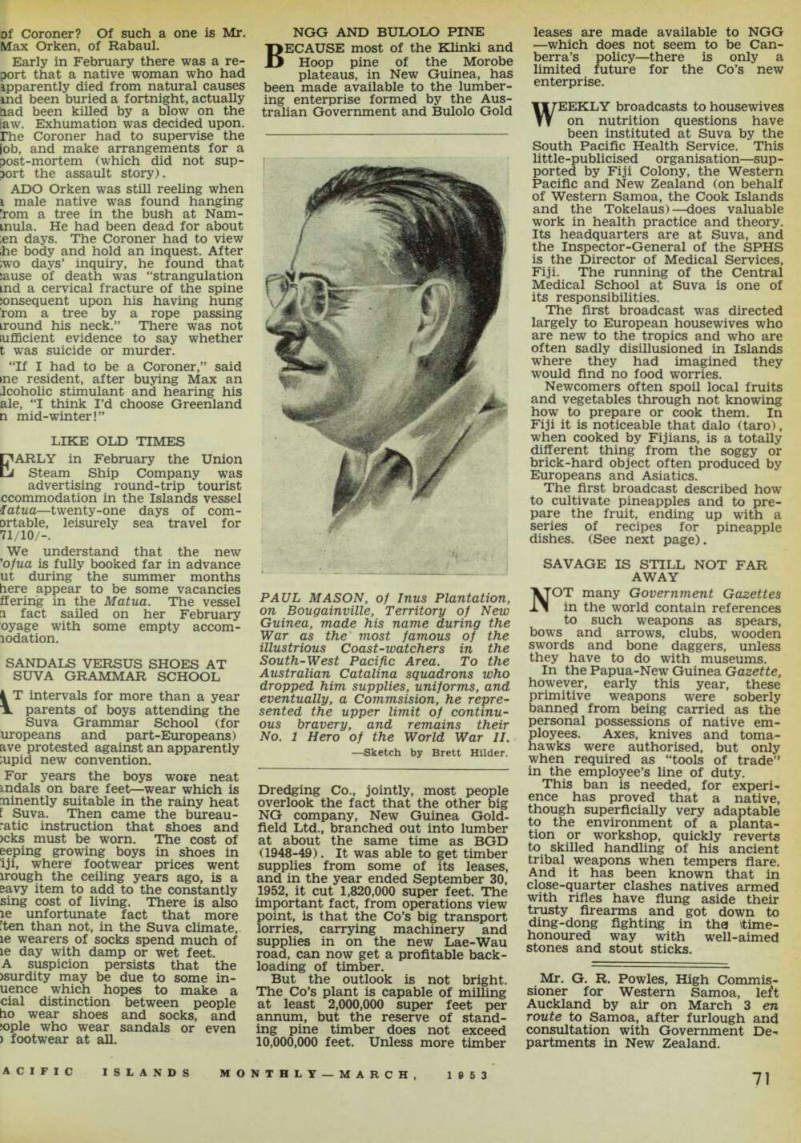
PAUL MASON, of Inus Plantation, on Bougainville, Territory of New Guinea, made his name during the War as the most famous of the illustrious Coast-watchers in the South-West Pacific Area. To the Australian Catalina squadrons who dropped him supplies, uniforms, and eventually, a Commsision, he repre sented the upper limit of continu ous bravery, and remains their No. 1 Hero of the World War II.
Sketch by Brett Hilder.