Magazine Section
p. 67 · Read in the full issue
Film Music
ON
Fiji Location
By Jack Thornton
COME with me to a copra plan tation near Thalanuku, a small Fijian village on the shore of a deep-water lagoon, about 50 miles from Suva.
In the midst of a circle of Eng lish, Australian and New Zealand members of the film-production unit, thirty frizzy-haired, husky Fijians sit in the shade of lofty palm trees. Embarrassed expressions are caused by the presence of their ivomen-folk, who stand in front of the spectators, giggling expectantly; they have come to see the fun and bhide the performers.
From around the point chugs a launch, nosing toward the shore.
From its glistening deck leaps the central character* loaded with the paraphernalia of his profession. He Is a New York songwriter flown specially from the States to or ganise, arrange and orchestrate background music for this film about STap Island of the 1870’s, now being made in Fiji. (At time of writing. -Ed.).
Dressed in a check suit, loud tie, Panama hat, red socks, brown moccasins, and wearing thick horn rimmed glasses, he advances breathlessly up the beach to the boconut plantation, carrying a portable table and a bulging brief base.
Arrived in the centre of the semi-circle of native musicians, he erects the table, mops his brow vith a huge red handkerchief and
pells: “How do, boys!” to the as sembled orchestra.
“Bula!” they bhant in reply, laughing among themselves.
The central
character removes his hat and places it on the table, together with the brief-case, from which he extracts a conductor’s baton and reams of manuscript—music scores for his musicians. The orchestra is divided into three instrumental sections; reed-blowers, bamboo drum bouncers, conchshell blowers. Each man respectfully receives his sheets of musical markings.
After emptying his pockets of aspirins, packets of chewing-gum and two stop-watches—all of which he places neatly on the table —the conductor raises his baton, calls for silence, and the performance commences.
“Okay, boys—let’s take it from the beginning,” he says. “Every body on the ball? Okay! Here we go”—in best Broadway rehearsal style “one-two-three-four-da-da de-da-da-da—DA!”
The music starts, the girls giggle, the musicians sweat as they bang and blow their single-note instru ments.
One by one the European on lookers discreetly detach themselves from the circle of spectators, hold ing their sides as they make for the beach, where everybody erupts into uncontrollable laughter.
I think I was the last to leave the vicinity of the orchestra. I had not wanted to miss a note of this astonishing performance. But when the conductor waved his baton furiously for silence, swal lowed four aspirins and told the orchestra to go back to the seven teenth bar, I could not control my self any longer.
You see, I knew that not one of the Fijian musicians could read a note of music.
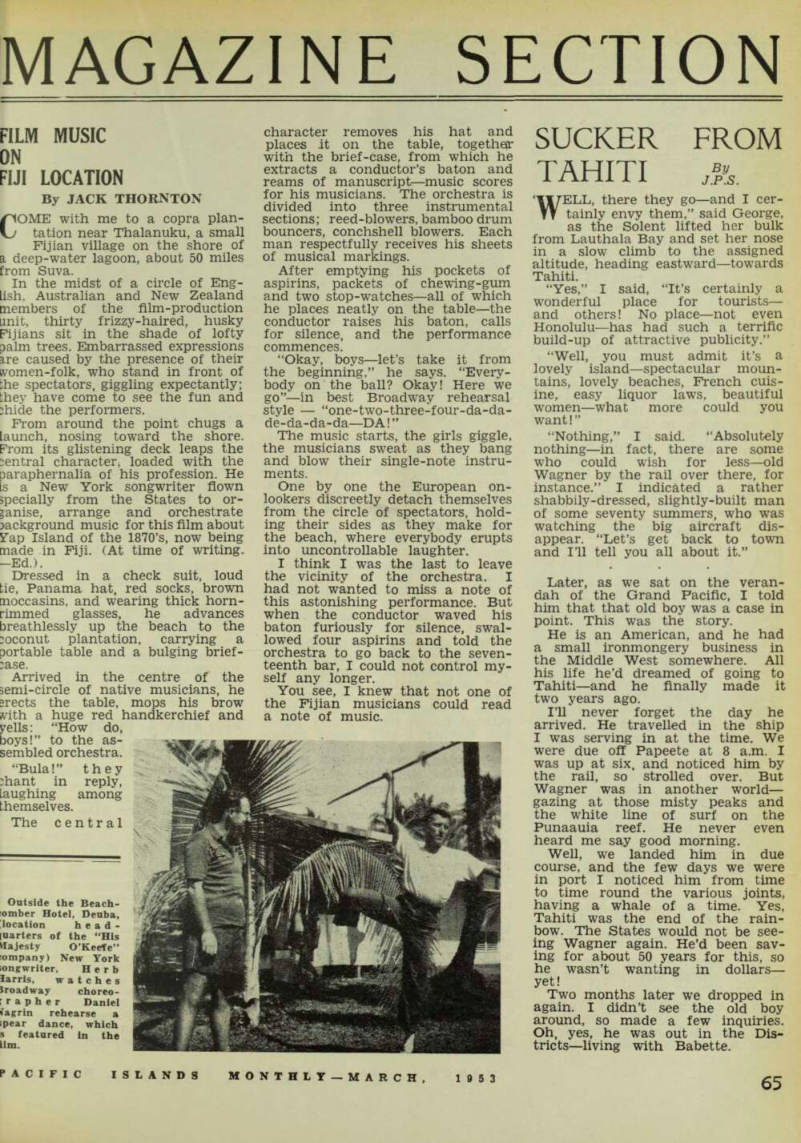
Outside the Beach comber Hotel, Deuba, location head quarters of the “His Majesty O’Keefe”
Company) New York songwriter Herb Harris, watches Broadway choreo
grapher Daniel
chagrin rehearse a
spear dance, which s featured in the ilm.