Tahiti's Nature Man
pp. 74-75 · Read in the full issue
AS TOLD BY OSCAR NORDMAN TO R. W. ROBSON
“■fTJRNEST W. DARLING, Tahiti’s Jlj famous Nature Man, lived up there about 40 years ago,” said Oscar Nordman. He pointed to a lush valley up in the steep hills beyond Papeete. Then he chuckled reminiscently, and told me the story of how the Nature Man went to San Francisco to look for a Nature Woman.
Darling originally was a student at Stanford University, and he de veloped ideas of his own. He was a pleasant, harmless young fellow —a kind of ratbag, in modern parlance—and his ratbagginess was expressed in a determination to wear no clothes and eat uncooked food. To return close to Nature, in other words.
About 1906 he sailed on a steamer, out of San Francisco, bound for the South Seas. He ex pressed his determination to found a colony for Nature Men. He disembarked in Papeete. The French authorities were easy-going in those days. If Darling wanted to be a Nature Man, that was no concern of theirs. (I should like to see Papeete officialdom’s reaction to-day to a similar enterprise!) Somehow —I don’t know how — Darling got himself an area of land in one of those lovely little valleys up in the foothills of the Tahitian mountains; announced he was ready to extend hospitality to people of similar views; and settled himself down as a Nature Man. He wore no clothes, and he ate only raw fruits and vegetables.
There was nothing wrong with that. Anyone who has experienced the pleasant climate of Tahiti, and eaten the Island’s bananas,
mangoes, oranges and other delicious fruits, could easily enough take root there, with only a G- String between himself and pure Nature.
Two or three men of similar ideas appear to have joined Darling in his pleasant valley, and their place of residence was called Darling’s Nature Colony. They lived for practically nothing, and as they did not interfere with their neighbours, they were not interfered with. The Europeans regarded them as freaks; the natives decided they were a little mad, and respected them accordingly.
But officialdom showed a very lively interest in them when they tried to visit Papeete clad exactly as in their own valley—namely, completely naked, without either hat or shoes. The outraged gen darmes hunted them back into the hills.
Back home, after such episodes, the Nature Men held indignation meetings and decided that the call was upon them to strike hard for a vital principle—namely, the right for freeborn men to go naked, if so they wished. So they tried on a few occasions to enter the capital, as Nature Men; and the patient constabulary was not always com pletely patient.
However, the Colony did not flourish. Its members drifted away.
About 1914 Darling decided he would return to the United States; and he bequeathed his ranch to his one remaining associate, Eugene Dufour, to be maintained as a Nature Colony.
DARLING’S method of going abroad was simple and primitive. He sneaked aboard a steamer bound for San Francisco, and hid himself. They were far at sea when he was discovered.
He said he would sleep on the fore castle head, and exercise himself by shovelling coal, and eat the plain, raw food he had brought with him; and the captain, who was not amused, arranged it that way.
The San Francisco reporters greeted the Nature Man with whoops of delight. Ancient cuttings from Oscar Nordman’s scrap-book show that Darling’s quest for a wife caused keen interest in that sophisticated community. These were the specifications, as then published:— He has no preference in the matter of race or colour. She must be in good health . . . She must be willing to dispense with raiment except in such places as are
burdened with a chief of police of conventional ideas; and she must be willing to subsist on uncooked food. In return for these sacrifices she gets Darling.
The reporters said that, in deference to the San Francisco climate and police, Darling was wearing a sweater and “knicker bockers” (that is what they called shorts before World War 1), but that his head and feet were bare.
They said he subsisted on a vege tarian and uncooked diet. That morning, they said, his breakfast consisted of shredded coconut, bananas and raisins.
Darling did not find his Nature Woman. A few months later, he was haunting the San Francisco waterfront, trying to stow himself away on some ship bound for Tahiti.
One day, just as the Union SS Go’s, steamer Tahiti was on the point of sailing for Tahiti, Nordman (who was then in San Francisco) whispered to Port Captain Lewis that Darling, who had been vainly seeking a chance to get aboard, was not anywhere in sight. The worthy Captain Lewis passed on the good news to Captain Evans, master of the Tahiti.
Captain Evans almost had a stroke. “What! A damned naked man stowed away on my ship.
Lower the gangway!”
Down came the gangway. Dock officials joined the ship’s company in a frantic search of the steamer!
Where had the wretched Nature Man concealed himself?
The ship was half-an-hour pasti
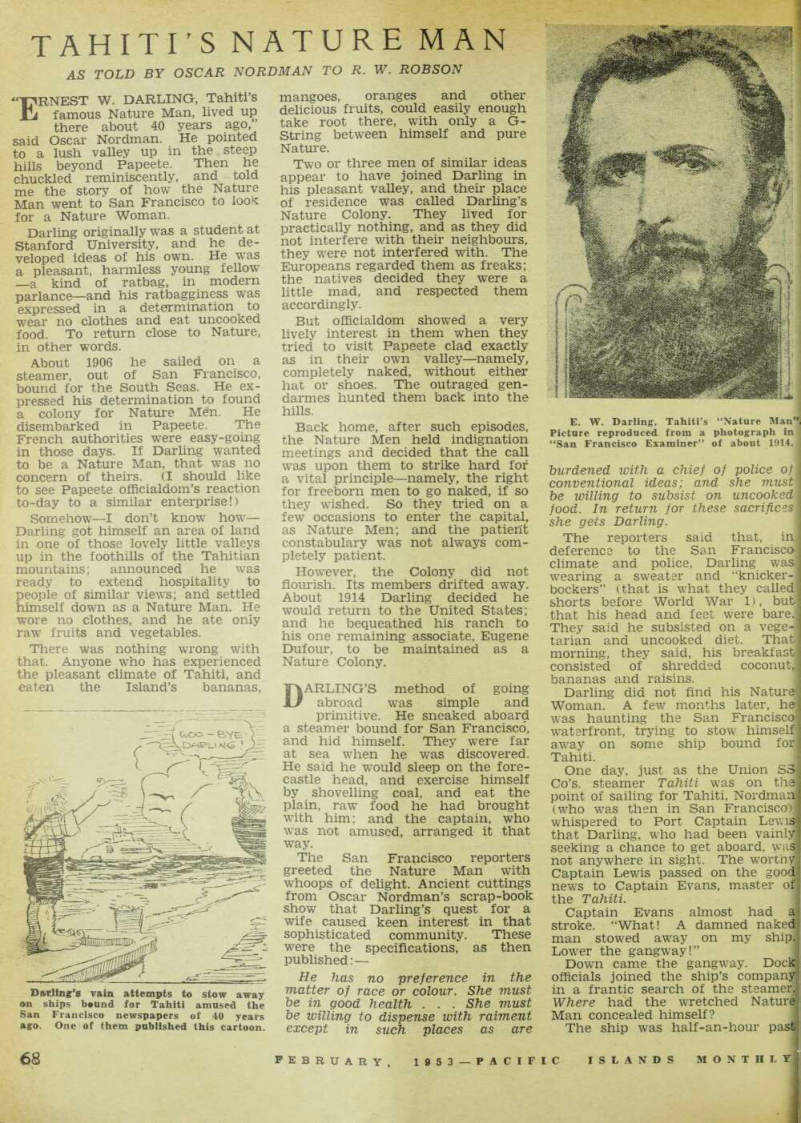
Darling’s vain attempts to stow away on ships bound for Tahiti amused the San Francisco newspapers of 40 years ago. One jof them published this cartoon.
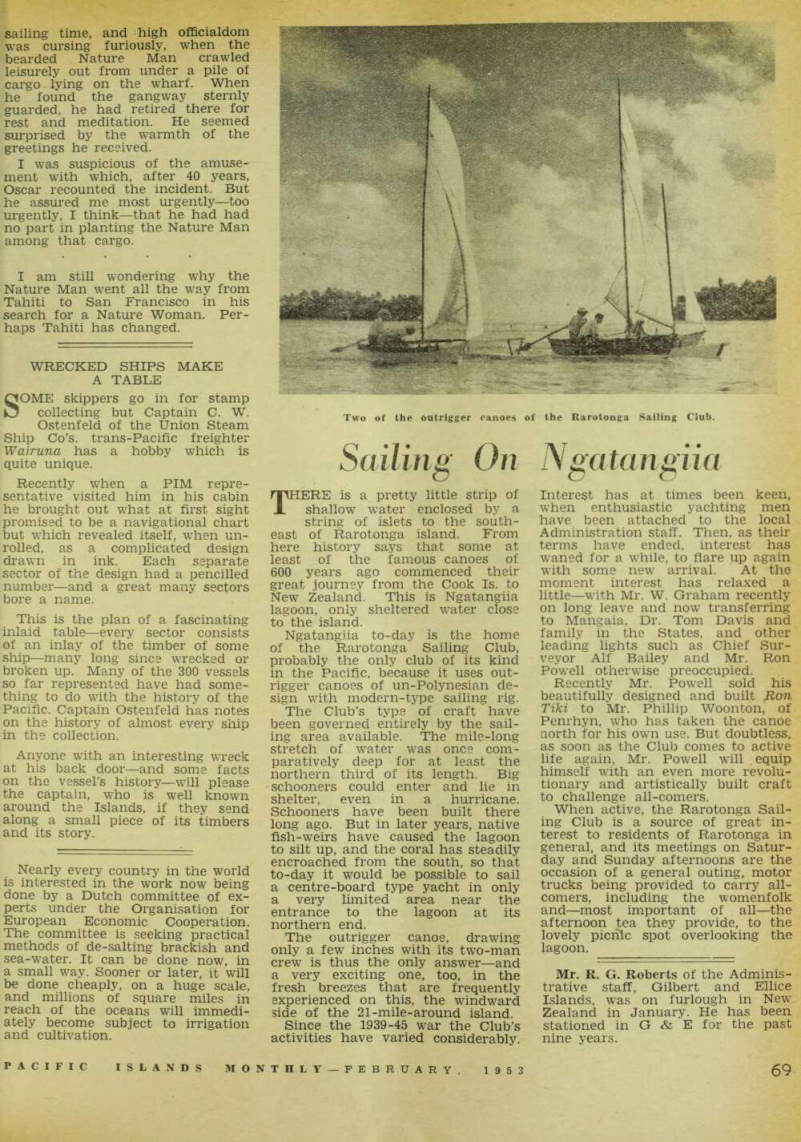
E. W. Darling, Tahiti’s “Nature Man’
Picture reproduced from a photograph in “San Francisco Examiner” of about 1914.
sailing time, and high officialdom was cursing furiously, when the bearded Nature Man crawled leisurely out from under a pile of cargo lying on the wharf. When he found the gangway sternly guarded, he had retired there for rest and meditation. He seemed surprised by the warmth of the greetings he received.
I was suspicious of the amuse ment with which, after 40 years, Oscar recounted the incident. But he assured me most urgently—too urgently, I think —that he had had no part in planting the Nature Man among that cargo.
I am still wondering why the Nature Man went all the way from Tahiti to San Francisco in his search for a Nature Woman. Per haps Tahiti has changed.