Tropicalities
pp. 73-76 · Read in the full issue
Back In Your Box,
Cap’N Cook
[F you think that Captain Tames Cook discovered a sizable lumber of the Pacific Islands, etc., /ou couldn’t be more wrong. The fact is that they were all discovered Dy Russian gents long before Cook »ot around to it. The authority? ked Fleet, official organ of the Soviet Vavy. The Americans particularly ire given to robbing the Russians of heir hard-won nautical honours, ays the paper . . . (Quote) “For nstance, all discoveries in the Pacific )cean are ascribed to foreigners, larticularly the notorious Captain ames Cook, although they know /ell that Cook gave his own name o lands and islands discovered by Russians long before him”. (Un uote).
Put Not Your Trust In
Ghosts
VT the Court of Petty Sessions at Moresby in January, a young native recounted how a host led him into temptation.
He told the magistrate that one ight while he was asleep at a ogeri District plantation, a ghost oke him up, and told him to come utside. Then, at the ghost’s sug estion, they walked together into le bush and to a neighbouring lantation. This landed them at le door of Ihe plantation trade ;ore where the ghost again gave Dice and said: “Open the door.”
Now this was a bit of a poser »r the lad since the doors of lantation stores are not usually ft on the latch, but the ghost as equal to the occasion, “Take us stone and hit it,” he told the >y, who obediently followed in ructions.
Things happened smartly after At. One of the native employees the plantation appeared, where in the ghost’s pupil dropped the one and fled, but was caught and lally taken to the police depot, lere seemed to be a bit of a ystery as to the whereabouts of e ghost when all this occurred, r when questioned on the sub zt the lad informed the police at he was not aware of what ,ppened to the ghost after he opped the stone.
The magistrate committed the y for trial at the Supreme Court
on a charge of having attempted to break into a plantation trade store.
No Sirens (Ships’ Type) For
Papeete
rR some time Oscar Nordman of Papeete has had a siren in stalled in front of his water front home, former American con sulate, with which to answer the parting bellows of vessels as they leave Papeete’s friendly waterfront and head for the open sea. These friendly parting hoots are an established custom with vessels leaving. They are a way in which the shipmasters, on behalf of then ships’ companies, thank Tahiti for its hospitality.
Oscar felt that someone ought to acknowledge the blasts, so he appointed himself official acknow ledger.
Now it seems that Oscar’s siren is not appreciated—the President of the Syndical dTnitiative lately
lodged a complaint with the Mayor.
Perhaps the tone of Oscar’s hooter Is not as sweet as might be —or perhaps, with a ship heading out through the pass, the members of the Syndicat feel a little jaded.
Oscar points out, in his own de fence, that there is a hooter mounted on Honolulu’s Aloha Tower for this same purpose—so why shouldn’t Tahiti have the same? What’s more, when the new Assembly commences its sittings, Oscar plans to have the matter raised.
Bananas For Prestige—
Not Pleasure
rE poor condition of Island bananas on sale in New Zea land in January drove a number of Aucklanders to write letters to their local newspapers.
The condition of the bananas was evident for all to see in Auckland fruit stores. However, Mr. C. Ross Walker, of Fruit Distributors, Ltd., sprang to their defence. He said that green fruit was sold as a result of customer pressure and because of shortages over a number of years. He could have added that in many parts of New Zealand these green bananas are dealt out—at 1/2 per pound—only to favourite customers who make a substantial purchase of other goods. The bananas are kept, and bagged, in a back room, to be inspected by the customer only on arrival home.
Anyone exposing his wares in front of other unqualified customers in the store is guilty of a cardinal sin and likely to have his name struck forever from the green grocer’s banana list.
In provincial towns New Zea land country-women, gathered to gether on their day-a-week in town, boast with one another as to how many of these poor-quality bananas they manage to persuade from their individual greengrocers. A twelve-banana woman may really strut!
In cold, north European and American countries, far removed from the source of supply, they somehow manage to have golden unblemished and flavourful bananas. Why cannot New Zealand, which is little more than 1,000 miles from the banana lands of Fiji?
Cruise-Ship Passengers Are
Fully Dressed
SUVA laughed in December when it was reported that the Orcades’ cruise passengers had been solemnly warned to dress with strict sabbatical propriety for fear of shocking the Fijian people. As it happened, it was the Orcades passengers who took the jolt when they discovered the extent to which some local European and pert
(Continued on Page 70)
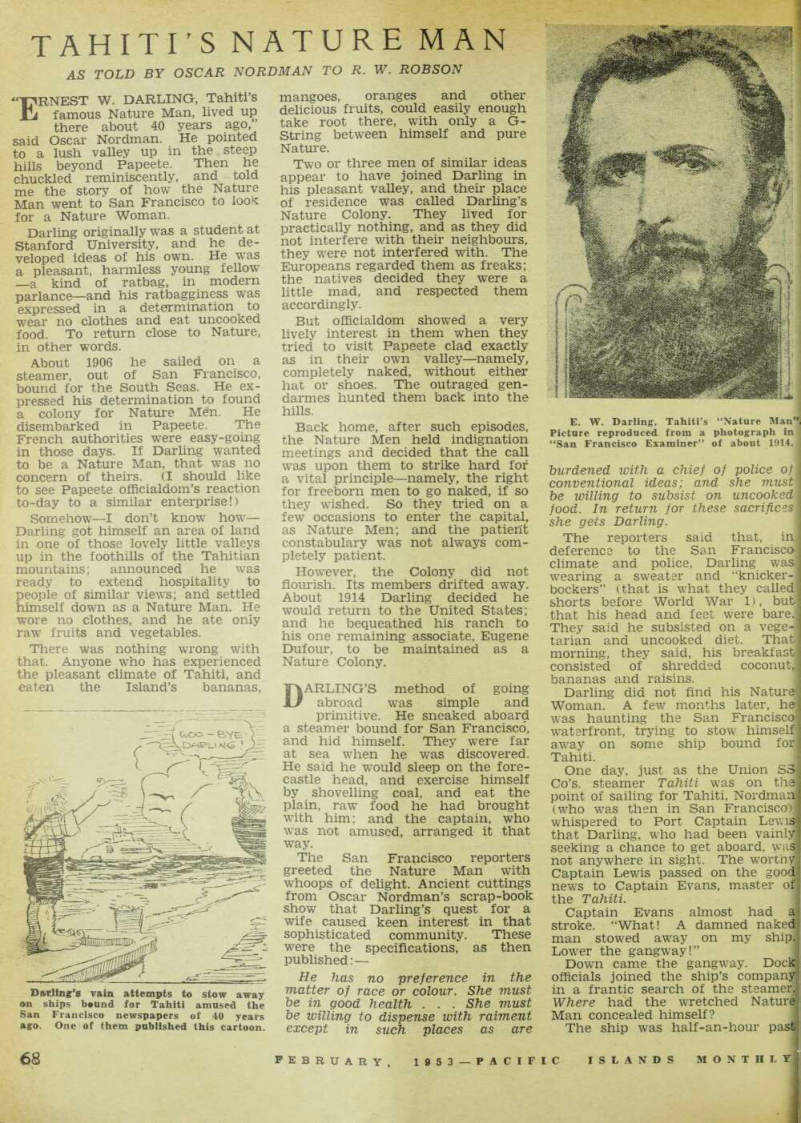
Mr. Norman J. H. Woods, of Rabaul, the New Guinea representative of Brett’s, the Brisbane timber firm. He thoroughly merits his nickname of "Diwai”, Pidgin word for a tree, or for timber or woods of any sort; not only is his name sufficient, but he is a timberman as well.
He is one of the staunchest pillars of the New Guinea Club. He not only drinks there, but eats there as well, and would sleep there too, if he had the chance "Diwai” went to New Guinea from Melbourne in 1937, when he started get ting logs out from Wide Bay on the Northern coast of New Britain. Since then (except in the occupation years) a steady stream of timber has gone to be peeled into plywood at Brisbane, shipped from Powell Harbour in overseas shins
—Brett Hilder. P
European misses partly emerged from their garments in the hot weather. The warning was dropped in the case of the 1,300 tourists in the Oronsay, which visited Suva on January 18-19.
Judging by the attire of most of the tourists, any sort of caution was unnecessary. It seems that Youth ‘"cl Fijian choral singing at Albert Park.
On each occasion the Methodist Church organised 150-voice choirs which, packed in the Albert Park pavilion, kept hundreds of tourists and several thousand Suva people spellbound for two hours or more.
On both evenings the main worry
has not been to keep the visitors entertained but to get them to go away after the programme is finished.. Hundreds of them surged up to the pavilion steps to beg for encore after encore and to submerge the young Fijian conductor (Josua Rabukawaqa, of Bua, Vanua Levu) with requests for autographs.
T 'B'esasta
JJS 1 in Austra ia last vS? s 1 e ’ coras m Auslralla last year.—S.
RAROTONGA hatrcitt
Raruiunga Haircut
TN these days when haircuts cost J. anything from half a crown to a dollar and a half—de pending on the longitude—an item
from the Rarotonga (Cook Is.) official news of January 14 makes pleasant reading: “An interesting ceremony was held in the Avatiu Packing Shed last Saturday when a boy, Tearii Fuller Henry, aged 7, adopted son of Tearii Toru, had his hair cut for the first time.
“The boy’s hair, which reached his shoulders, was neatly tied with ribbon in 36 locks. The ceremony commenced when each of the boy’s 36 relations cut off one lock of hair, at the same time presenting the boy with a monetary gift. The remainder of the 150 invited guests presented their gifts and, after a barber had trimmed the boy’s hair, all sat down to a big umukai.”
Away From It All—
To Tonga
YET another Paradise Hunter appears to be making prepara tions to invade the Pacific, if press despatches from Port Eliza beth, South Africa, in January are any indication.
The gentleman who does not wish to disclose his name at present, is “weary of national and international hypocrisies and the eternal dog-fight of party politics”.
He has selected Tonga for his re treat (no reasons given).
Members of the expedition must be “persons of integrity, especially those interested in the arts and sciences”, have “a valid reason for getting away from it all, and ability to pull one’s weight and a willing ness to pool £2,000 or more for the common good”.
The organiser first contacted the Tongan Government on the subject back in 1938-39, but war intervened.
Now “it is proposed, given per mission, to secure the lease of one of the smaller islands in the Tonga Group”.
The self-supporting colony would “cultivate copra and engage in other local trades. It would be non political and non sectarian . . .
Thousands of books and hundreds of gramophone records would be available. Some settlers would write, others would paint and draw, and others would do scientific work”. (And a few make copra, perhaps).
One might well conjecture as to just how long a group of artists and scientists, used to city frustrations and other amenities, would remain “r>r>n ’-'ffit.ical non sectarian” and 100 per cent, tame, if cooped up on one of the smaller Tongan Islands. Still, it would be interest ing to watch, so let us hope that Queen Salote, having taken all due precautions to quell any riots, sees her way clear to lease them an islet.