Who Owns The
pp. 74-75 · Read in the full issue
Shabby Cheng Ho?
By R. W. Robson
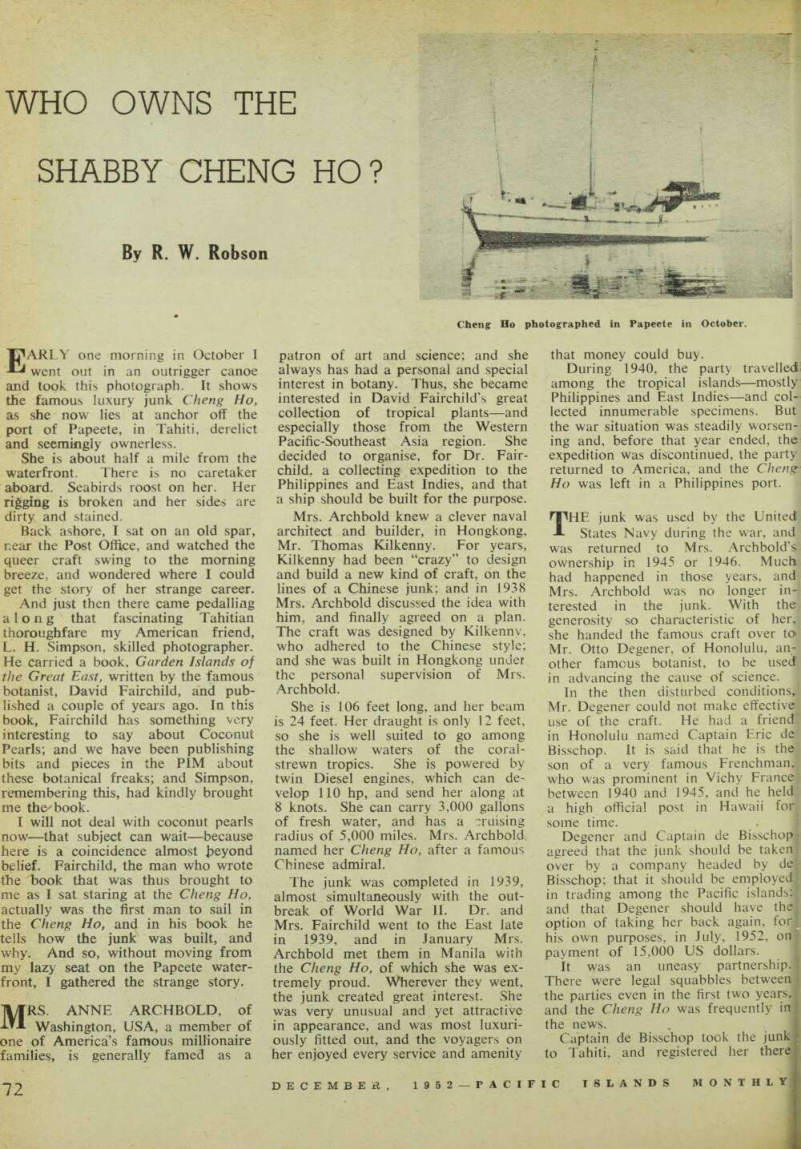
EARLY one morning in October I went out in an outrigger canoe and took this photograph. It shows the famous luxury junk Cheng Ho, as she now lies at anchor off the port of Papeete, in Tahiti, derelict and seemingly ownerless.
She is about half a mile from the waterfront. There is no caretaker aboard. Seabirds roost on her. Her rigging is broken and her sides are dirty and stained.
Back ashore, I sat on an old spar, near the Post Office, and watched the queer craft swing to the morning breeze, and wondered where I could get the story of her strange career.
And just then there came pedalling along that fascinating Tahitian thoroughfare my American friend, L, H. Simpson, skilled photographer.
He carried a book. Garden Islands of the Great East, written by the famous botanist, David Fairchild, and pub lished a couple of years ago. In this book, Fairchild has something very interesting to say about Coconut Pearls; and we have been publishing bits and pieces in the PIM about these botanical freaks; and Simpson, remembering this, had kindly brought me the-book.
I will not deal with coconut pearls now—that subject can wait—because here is a coincidence almost beyond belief. Fairchild, the man who wrote the book that was thus brought to me as I sat staring at the Cheng Ho, actually was the first man to sail in the Cheng Ho, and in his book he tells how the junk was built, and why. And so, without moving from my lazy seat on the Papeete water front, I gathered the strange story.
Mrs. Anne Archbold, Of
Washington, USA, a member of one of America’s famous millionaire families, is generally famed as a
patron of art and science; and she always has had a personal and special interest in botany. Thus, she became interested in David Fairchild’s great collection of tropical plants—and especially those from the Western Pacific-Southeast Asia region. She decided to organise, for Dr. Fair child, a collecting expedition to the Philippines and East Indies, and that a ship should be built for the purpose, Mrs. Archbold knew a clever naval architect and builder, in Hongkong, Mr. Thomas Kilkenny. For years, Kilkenny had been “crazy” to design and build a new kind of craft, on the lines of a Chinese junk; and in 1938 Mrs. Archbold discussed the idea with him, and finally agreed on a plan.
The craft was designed by Kilkenny, who adhered to the Chinese style; and she was built in Hongkong under the personal supervision of Mrs.
Archbold.
She is 106 feet long, and her beam is 24 feet. Her draught is only 12 feet, so she is well suited to go among the shallow waters of the coral strewn tropics. She is powered by twin Diesel engines, which can de velop 110 hp, and send her along at 8 knots. She can carry 3,000 gallons of fresh water, and has a cruising radius of 5,000 miles. Mrs. Archbold named her Cheng Ho, after a famous Chinese admiral.
The junk was completed in 1939, almost simultaneously with the out break of World War 11. Dr. and Mrs. Fairchild went to the East late in 1939, and in January Mrs.
Archbold met them in Manila with the Cheng Ho, of which she was ex tremely proud. Wherever they went, the junk created great interest. She was very unusual and yet attractive in appearance, and was most luxuri ously fitted out, and the voyagers on her enjoyed every service and amenity
that money could buy.
During 1940, the party travelled! among the tropical islands—mostly Philippines and East Indies—and col lected innumerable specimens. But the war situation was steadily worsen ing and, before that year ended, the expedition was discontinued, the party returned to America, and the Cheng' Ho was left in a Philippines port.
THE junk was used by the United States Navy during the war, and was returned to Mrs. Archbold’s ownership in 1945 or 1946. Much had happened in those years, and Mrs. Archbold was no longer in terested in the junk. With the generosity so characteristic of her, she handed the famous craft over to Mr. Otto Degener, of Honolulu, an other famous botanist, to be used in advancing the cause of science.
In the then disturbed conditions,' Mr. Degener could not make effective use of the craft. He had a friend in Honolulu named Captain Eric de Bisschop. It is said that he is the' son of a very famous Frenchman, who was prominent in Vichy France between 1940 and 1945, and he held a high official post in Hawaii for some time.
Degener and Captain de Bisschop agreed that the junk should be taken over by a company headed by de Bisschop; that it should be employed in trading among the Pacific islands; and that Degener should have the option of taking her back again, for his own purposes, in July, 1952, on payment of 15,000 US dollars.
It was an uneasy partnership, f There were legal squabbles between the parties even in the first two years,! and the Cheng Ho was frequently ini the news.
Captain de Bisschop took the junk to Tahiti, and registered her there
Cheng Ho photographed in Papeete in October.
in his own name.
During 1950 and 1951 he and his issociates used her : or trading and ransport in French Oceania. She lost nuch of her pris ine glory. A large lumber of her fil ings were taken lut, to make room or cargo and iative passengers, nd it is reported bat they are lost. n h e rooms in diich the Ameri an VlP’s travel ;d in luxurious omfort were now iv e n over to imple islanders id the übiquitous ipra bug.
Mr. Degener. in 951, decided that 5 would exercise is option and re ime possession of ie Cheng Ho. But ie situation was iund to be com
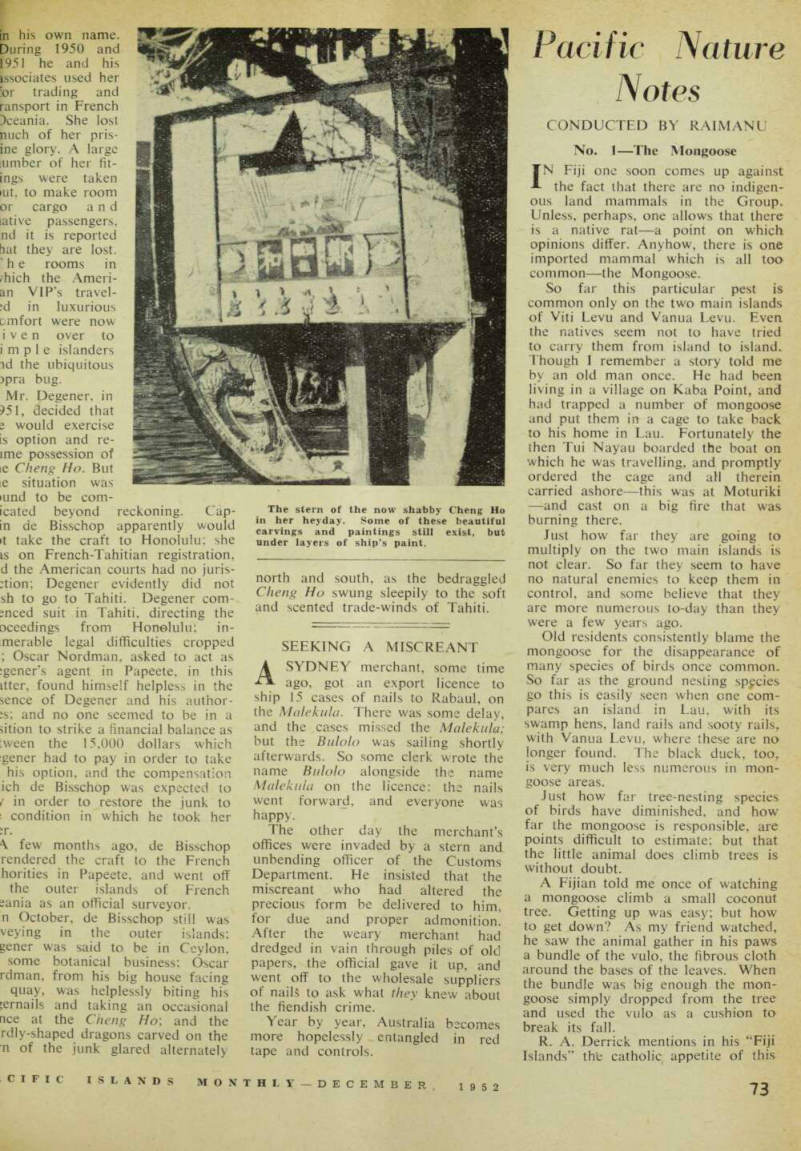
icated beyond reckoning. Cap in de Bisschop apparently would >t take the craft to Honolulu; she is on French-Tahitian registration, d the American courts had no juris :tion; Degener evidently did not sh to go to Tahiti. Degener com mced suit in Tahiti, directing the oceedings from Honolulu; in merable legal difficulties cropped ; Oscar Nordman, asked to act as :gener’s agent in Papeete, in this itter, found himself helpless in the sence of Degener and his author ;s; and no one seemed to be in a dtion to strike a financial balance as ;ween the 15,000 dollars which gener had to pay in order to take his option, and the compensation ich de Bisschop was expected to / in order to restore the junk to ' condition in which he took her ;r. \ few months ago, de Bisschop rendered the craft to the French horities in Papeete, and went off the outer islands of French -ania as an official surveyor, n October, de Bisschop still was veying in the outer islands; gener was said to be in Ceylon, some botanical business; Oscar rdman, from his big house facing quay, was helplessly biting his and taking an occasional ace at the Cheng Ho\ and the rdly-shaped dragons carved on the n of the junk glared alternately
north and south, as the bedraggled Cheng Ho swung sleepily to the soft and scented trade-winds of Tahiti.
The stern of the now shabby Cheng Ho in her heyday. Some of these beautiful carvings and paintings still exist, but under layers of ship’s paint.