Fiji's Second City Has Crowing Pains
p. 73 · Read in the full issue
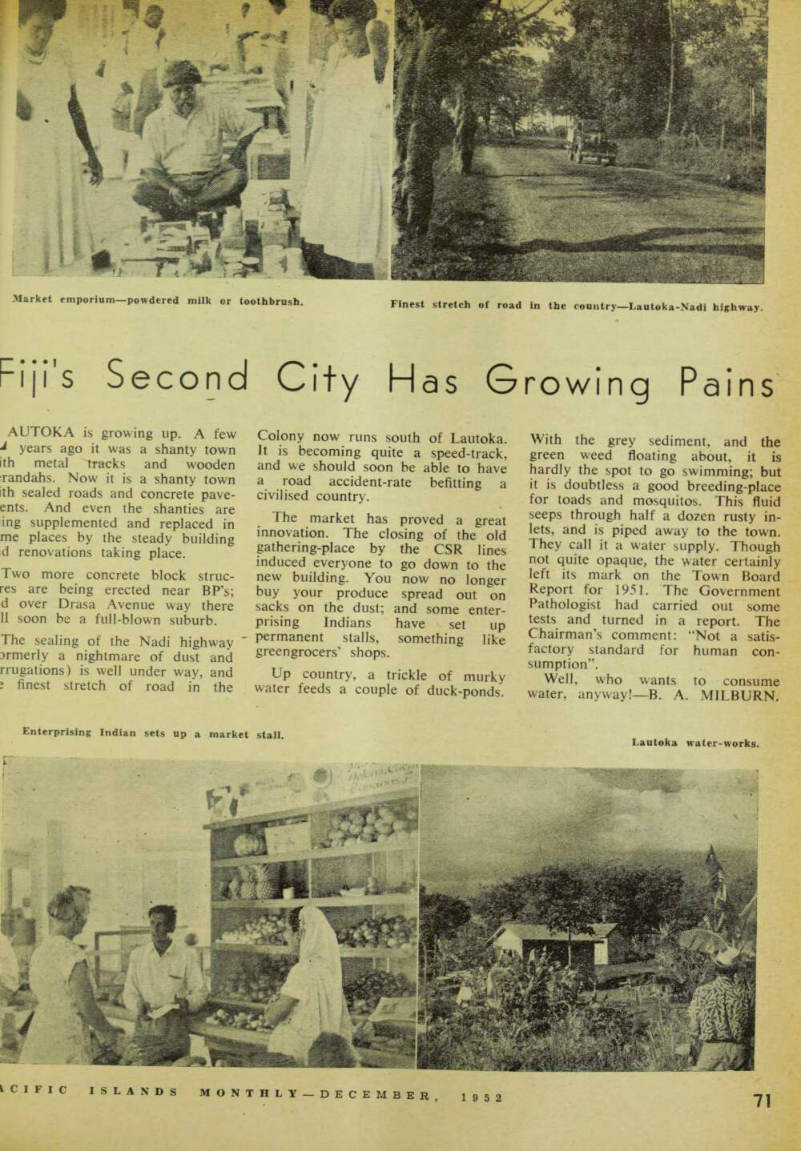
AUTOKA is growing up. A few I years ago it was a shanty town ith metal tracks and wooden randahs. Now it is a shanty town ith sealed roads and concrete pave ents. And even the shanties are ing supplemented and replaced in me places by the steady building d renovations taking place.
Two more concrete block struc res are being erected near BP’s; d over Drasa Avenue way there II soon be a full-blown suburb.
The sealing of the Nadi highway Drmerly a nightmare of dust and negations) is well under way, and finest stretch of road in the
Colony now runs south of Lautoka.
It is becoming quite a speed-track, and we should soon be able to have a road accident-rate befitting a civilised country.
The market has proved a great innovation. The closing of the old gathering-place by the CSR lines induced everyone to go down to the new building. You now no longer buy your produce spread out on sacks on the dust; and some enter prising Indians have set up permanent stalls, something like greengrocers’ shops.
Up country, a trickle of murky water feeds a couple of duck-ponds.
With the grey sediment, and the green weed floating about, it is hardly the spot to go swimming; but it is doubtless a good breeding-place for toads and mosquitos. This fluid seeps through half a dozen rusty in lets, and is piped away to the town.
They call it a water supply. Though not quite opaque, the water certainly left its mark on the Town Board Report for 1951. The Government Pathologist had carried out some tests and turned in a report. The Chairman’s comment: “Not a satis factory standard for human con sumption”.
Well, who wants to consume water, anyway!—B. A. MILBURN.
Market emporium—powdered milk or toothbrush.
Finest stretch of road in the country—Lautoka-Nadi highway.
Enterprising Indian sets up a market stall.
Lautoka water-works.