Do You Like Fe’I?
pp. 36-109 · Read in the full issue
At a friend’s table in Papeete I at( a succulent food, and liked it.
My host was delighted. “That h Fe’i,” he said. “You know what thai means!”
Fe’i is the plantain, or wild banana, of Tahiti. It grows plenti fully, but it cannot be eaten ra\* —it must be boiled or baked. The French-Tahitians prepare it in severa] ways—some delicious, some not sc exciting.
Friends from overseas, for whom they have regard, are served with Fe’i, and watched anxiously. If they like Fe’i, they will surely return to the beautiful island. The omen never fails.
“Many years ago, when Robert Keable decided to leave Tahiti, 1 gave him a farewell dinner,” said my host. ‘I asked him if he ever would return, and he replied with an emphatic ‘No!’ ‘lt is too late,’ I said to him.
You have eaten the Fe’i.’ He only laughed at me—but he did return to Tahiti, and he died here.”
The Frisbie Kids
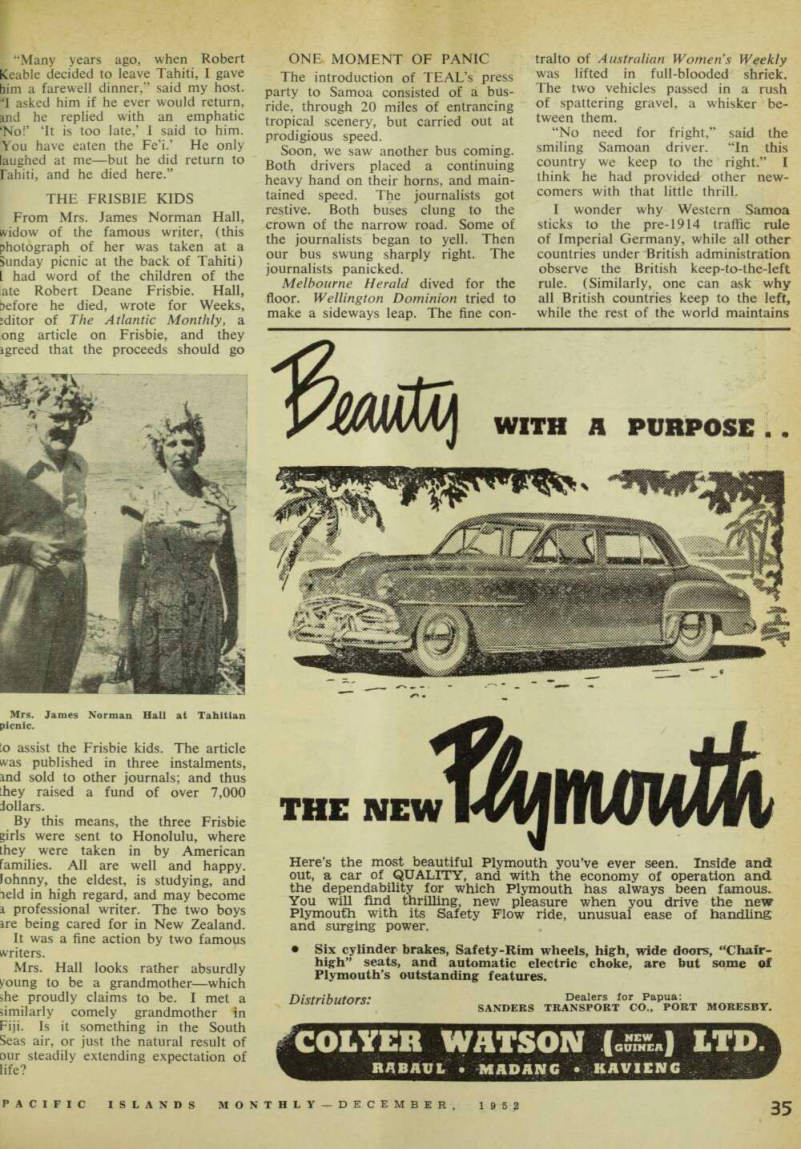
From Mrs. James Norman Hall, widow of the famous writer, (this photograph of her was taken at a Sunday picnic at the back of Tahiti) I had word of the children of the ate Robert Deane Frisbie. Hall, before he died, wrote for Weeks, iditor of The Atlantic Monthly, a ong article on Frisbie, and they igreed that the proceeds should go
to assist the Frisbie kids. The article was published in three instalments, and sold to other journals; and thus they raised a fund of over 7,000 dollars.
By this means, the three Frisbie girls were sent to Honolulu, where they were taken in by American families. All are well and happy, lohnny, the eldest, is studying, and leld in high regard, and may become a professional writer. The two boys are being cared for in New Zealand.
It was a fine action by two famous writers.
Mrs. Hall looks rather absurdly young to be a grandmother—which »he proudly claims to be. I met a similarly comely grandmother in Fiji. Is it something in the South Seas air, or just the natural result of our steadily extending expectation of life?
One Moment Of Panic
The introduction of TEAL’s press party to Samoa consisted of a busride, through 20 miles of entrancing tropical scenery, but carried out at prodigious speed.
Soon, we saw another bus coming.
Both drivers placed a continuing heavy hand on their horns, and maintained speed. The journalists got restive. Both buses clung to the crown of the narrow road. Some of the journalists began to yell. Then our bus swung sharply right. The journalists panicked.
Melbourne Herald dived for the floor. Wellington Dominion tried to make a sideways leap. The fine con-
tralto of Australian Women's Weekly wa * lifted in full-blooded shriek, The two vehicles passed in a rush °f spattering gravel, a whisker be tween them.
"No need for fright,” said the smiling Samoan driver. “In this country we keep to the right.” I think he had provided other new comers with that little thrill, I wonder why Western Samoa sticks to the pre-1914 traffic rule of Imperial Germany, while all other countries under British administration observe the British keep-to-the-left rule. (Similarly, one can ask why all British countries keep to the left, while the rest of the world maintains
Mrs. James Norman Hall at Tahitian picnic.
the right-hand drive). I suppose, when NZ finally took over in 1920, there were too many trained Samoan irivers in charge of vehicles on the samoan roads to make a change-over Jesirable. A trained driver reacts lutomatically to traffic conditions md his habit, in an emergency, vould be to pull to the right.
The Australians, similarly taking iver the former German colony of few Guinea, did not have the same iroblem. In 1920, there were few oads and fewer motor vehicles in lew Guinea.
I told the journalists my choice tory of the early days of motoring i the Condominium of the New lebrides, when the French kept to le right, and the English, as was British and proper, stuck to their rinciples and kept to the left. But le shock of the non-colliding buses r as still too recent, and they did not 5e the humour of it.
A Cool Country House
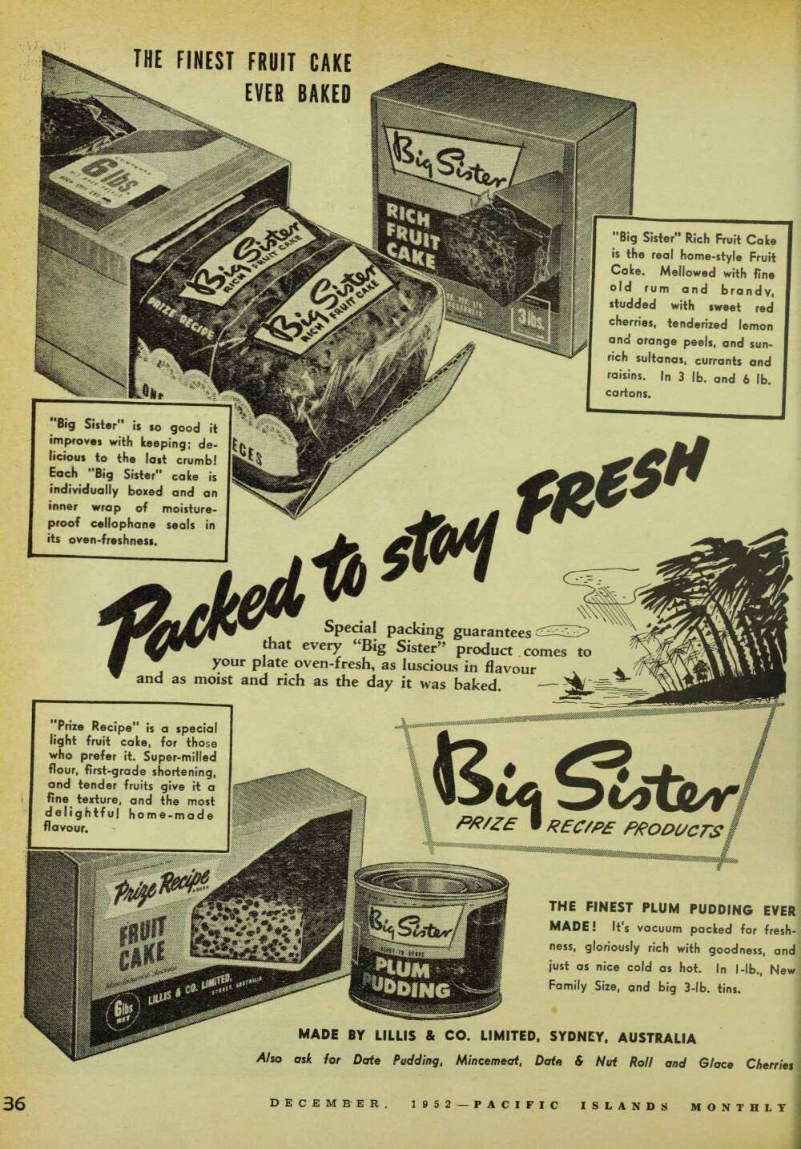
This is the country home of apeete’s Oscar Nordman—cool, airy id beautifully furnished. It looks at over the lagoon at Papara, and surrounded by green lawns and ■illiant flowers—a suitable abode >r the seven lovely children who >mp around here, and call Oscar id Margot their grandparents in ree languages. (The fluency of ost kids in French, English and
Julian, is one of the remarkable ings in Tahiti). In a green valley hind the residence, Mr. Nordman ns a fine herd of cattle, for beef d dairy. Like several other land mers in these parts, he breeds refully, and gets best results from small mixture of Cebu or Brahmin th European strains.
Many of the wiser folk in these >pical islands claim to get the best use for the climate by making the af of native construction and
materials, as shown in this picture.
The magnificent bure built by E.
G. Theodore at his Emperor gold mine at Vatakoula, Fiji, became famous in three continents—it got coolness from the native construction, and comfort from European fittings.
And, in these inflation days, there is a great saving over European building materials—which are un suited to the climate, anyway.
To Cut Trochus In Fiji
A long overdue effort to establish in Fiji an industry for the manufac ture of articles from trochus shell
is being made by Mr. McGowan, of Levuka. It is reported that he has orders from USA for millions of button blanks, and that he is now importing the necessary machinery from Europe. Experts believe that there is enough trochus shell in Fiji waters to provide all he will need.
The export of trochus shell has been an important part of the economy of several Islands Terri tories for the better part of a century. It is cut and shaped for many purposes—mainly buttons.
Until World War 11, most of the manufacturing was done in Central
Europe, Japan and, to a lesser extent, in America. The war altered all that and, since 1945, there has been only a precarious sort of market in United States. Japan may soon be an important buyer again.
Fiji gains substantially because a large and increasing proportion of her copra is milled in Fiji instead
of in Europe. Why should not the same procedure be followed in the much smaller, but nonetheless im portant, trochus industry?
Isolated Pago Pago
En route to Tahiti, the TEAL plane flies over American Samoa and, from the air, one gets a re
markable picture of Tutuila and th famous port of Pago Pago.
This should be a place of call fc TEAL, but the harbour lies s narrowly between steep 2,000 mountains that it is unsafe for flying boats. One remembers the disaster thi befell Pan American Airways whe it tried to work Pago Pago wit flying-boats. There is no lagoon t use, as in Western Samoa. Tutuih for some reason, has no fringin coral reef—the waves actually brea against the base of the island' cliffs, like they do at Norfolk o Ocean islands.
Tutuila has a land strip for fairl big planes, and one day there wi] be a regular air service there. Br not at present. Since the US Nav pulled out, Eastern Samoa has bee in a state of painful economic re adjustment, trying to find somethin to take the place of the half millio or so dollars which Uncle Sam use to spend there each year; and jus now it cannot afford luxuries lik an air service.
The Henning’S Home
Soon after our TEAL Solent lei Lauthala Baly for Samoa, word wa passed around that we should fl; low over an island in the Lau group and. parachute urgently - neede<
nedicine to a very sick planter.
Wien I learned that the island was 'Jaitamba my concern mounted. )nly five days before, in Suva, I lad said goodbye to Mr. Gus lennings, who was returning home ►y schooner after a visit to Auck and, and a very severe bout of virus lu in Fiji.
The plane circled low over Jaitamba, and dropped the parcel; nd I got this photograph of the imous plantation home of the lennings family.
I learned afterwards that Gus had ot relapsed. The drugs arrived after
Canned Beef Mystery
\ staple article of diet throughout the South Pacific Islands is canned T. In some places, tins of beef accepted as currency.
Naturally, the canners of Australia I New Zealand hold most of the ie —although, every now and then, iners in America and Europe ke an assault on this “Anzac serve”. fhere is one thing about this rket that intrigues me. Why does med corned beef from New iland come in round tins, while t from Australia is always in are tins, slightly tapered. Because the nature of the demand, NZ’s nd tins have a definite advantage r Australia’s square product; but stralia cannot send round tins ause “the Government won’t >w it.”
This seemed strange, so I asked an Australian exporter. He said that that was so—for Islands trade he could buy beef only in square tins.
When I asked him why, his language became unseemly; but I gathered that he did not know why—it was just one of those rules laid down by “the blasted bureaucrats”.
Has anyone got the explanation of this queer thing? n „ rvTAlir4l .
Phenomenal Cocoa Tree
The prize exhibit of Reparation Estates—a phenomenal cocoa tree — interested the journalists who visited Samoa in October, just as it has
excited cocoa-planters throughout the world.
Western Samoa claims that it pro duces the world’s best cocoa; and the price paid for the Territory’s product —which has enriched Samoa gener ally—bears this out.
Reparation Estates have a quarter million cocoa trees, and the experts there, by endless experiments, have finally evolved a tree which has a very much larger yield than any other tree, and is completely resistant to the diseases which beset cocoa planta tions. But it was found that it cannot reproduce its quality through its seeds, So plantation-manager W. H. Kelly
left Suva and his kindly medical [?]ends in Suva got the kindly [?]ptain McHardy to drop them to [?] on the island, just as a pre [?]ution. I am told that Gus—who [?]w has counted more than 80 [?]mmers, most of them in Fiji—is 11 again.
is trying—and apparently with su cess—to reproduce it through ci tings, aided by hormones and coi trol of light, and it looks as if th phenomenal producer of cocoa beaj will become available for much wid planting.
Western Samoa, in 1951, export* 3,200 tons of cocoa beans, won £BOl,OOO sterling (average, £250 pi ton).
They Earn Many Dollar
Practically all of the cocoa < Western Samoa (worth near £1,000,000 sterling per annum), ar most of the sugar and gold of Fi (another £6,000,000 to £7,000,000) j to United States and Canada, ar are turned into dollars. If it wei permitted, Fiji’s copra and coconi oil also could be sold in Nort America.
But neither Fiji nor Samoa gets ar special benefit from this direct ean ing of substantial dollar funds—it a goes into the sterling pool, to he] the Western European nation Economists, like doctors, are mad to differ; but there are some politic* economic students who argue thj the two big South Pacific Territori* are being somewhat sacrificed on th altar of their British connections.
If the Australian Prime Minister plan to make pound and dollar mor rapidly interchangeable succeeds, will spell immediate and substanth benefits for Fiji and Samoa.
Papeete’S Honoured Boss
Early one morning, in Papeete, i: Mayor Alfred Poroi’s hospitable cai I went back behind the town, to quiet and lovely valley, where I in spected the town’s excellent water supply. A stream comes down ou of the perpetually rain-soaked moun tains, and is led by special channel into a series of gravel beds, when it is thoroughly filtered before beinj sent on its healthful, cleansing wa? down the valley. There is an ingeni ous and economical system of con trols, to regulate the flow in flood time.
Alfred Poroi is quite a young man with a business of his own to loot after; but, over the years, he ha; done such a remarkable job in th« management of the careless little city of Papeete that the wise burghers— European, part Tahitian, Chinese.
Tahitian—are determined that nc other man shall rule their municipal organisation. With the goodwill and practical help of the Governor, he superintends bridge-building, school management, street control, and a score of other communal activities;
(Continued on page 106)
and still finds time to entertain a stray visitor in the unsurpassed French way. Among his other qualtiies, he speaks colloquial English.
Memory Of Pierre Loti
As I strolled under the trees in that peaceful waterworks valley—not a soul in sight—l came unexpectedly upon a monument, erected to the memory of Pierre Loti, famous French sailor-author of exotic love stories. He had an international reputation, and he died in 1923, aged 73—only 11 years after he had offered to throw out of his window the seconds of a Balkan major, who wanted to fight him because he sneered at Bulgaria.
I had forgotten that Loti lived for a time in Tahiti. He went there as a young naval officer, after the Franco-Prussian war, and his passion ate love affair with a Tahitian girl inspired one of his most notable books, Rarehu. I learned then that, over 70 years ago, within a few yards of where I stood in that secluded valley, Pierre Loti and his devoted Tahitian mistress came frequently to bathe in the river pools. This, pre
sumably, was the real setting Rarehu.
Tahiti is haunted by hundreds such memories. I suppose that, i its size, no country in the world h seen so many writers, artists, po< and dreamers who wanted only to \ away from it all.
Stuck In All The Lifts Ii
The Islands!
She was a comely lass of mis parentage and, I imagine, had be much pursued by “wolves.” 1 suppc that was why she let herself go ini mighty ululation when she found h» self trapped alone with me in tl only lift in the Western Pacific Islan —a modern automatic contraption Ed Pentecost’s new building Noumea.
The lift came to a shuddering stc between floors. I, having had mui Sydney experience, smiled resignec at my co-captive, and leaned again the wall. But she gasped, cried “Oc la, la!” or something, and hurled he self upon the control buttons. Not ing happened; and then she rea' reached for top notes. That startlJ me—only murder or rape cou justify noises like that.
Staff gathered on the floors aboi and below, and shouted instruction
y French was not adequate to fol w them, and my companion was i) horrified by her impending doom me or the lift, I still do not know to comprehend. So I blindly lacked into the buttons, and some e up above jiggled something, and 5 lift suddenly dived to the ground or. I opened the door, and idemoiselle left that place like a t just released from the evils of I. fhere is one other lift in the inch South Pacific Islands—in the v Grand Hotel, in Papeete—and I stuck in that, too. But this time as accompanied by a tough porter die, and I think it was the ?uage he used, rather than his vy hand, that put the instrument k so quickly to its proper courses.
In Papeete Town
he swarming cyclists of Papeete e two things peculiar to Tahiti early all the bicycles are made i no central crossbar, so that they r be used conveniently by both i and women; and an ex rdinary proportion of them are 1 with light, little, two-popping pr-engines, which push the ists along at a good speed. ne needs to go to a virtually spaper-less country like Tahiti to se the usefulness of discarded spapers in bigger cities. The Ireds of household shoppers who 'd into Papeete’s early morning ket carry away their fish, vege is, fruit, etc., either wrapped in uia leaves, or enclosed in a short th of fat bamboo, sealed over tied leaves, or tied up in plaited nut leaves, with coconut fibre, early morning markets of Suva, ml, Papeete are very similar character, but in Papeete they i to have the widest variety of e foodstuffs. In Tahiti, every ; that swims in the sea or crawls :he lagoon rocks is considered e. Fish is a very important le of diet—everywhere one sees ■o (which were shaped by idence for the purpose) dangling heir tails from lorries, cycles, te cars—and the quiet seas ad these Windward Islands pro an endless supply. iree Baptist missionaries were /died in Auckland in late No •er before departing for work in Guinea. They were Miss •ey Turner, of Auckland, Mr.
' Cochrane, of Gisborne, and Alan Sinclair, of Invercargill.