From Notes Made in Pacific
pp. 35-36 · Read in the full issue
By R. W. Robson.
Dog Incident In Keable’S
Old Home
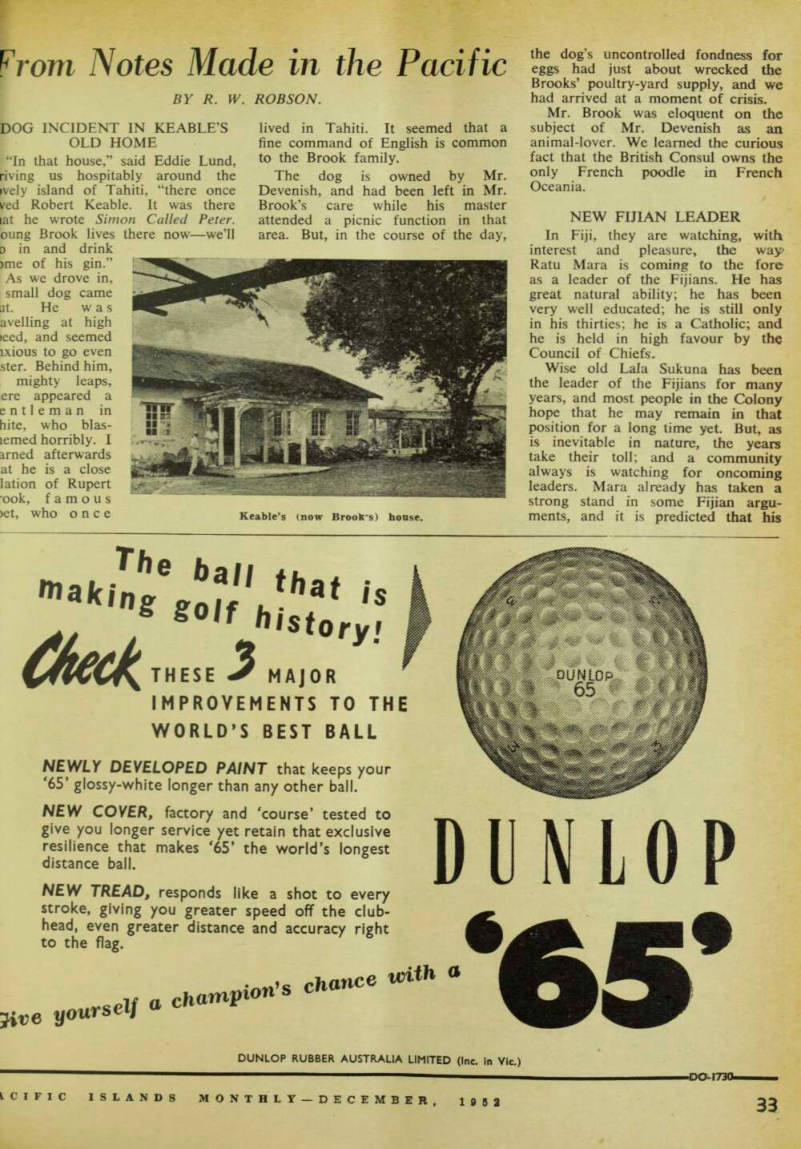
“In that house,” said Eddie Lund, riving us hospitably around the >vely island of Tahiti, “there once ved Robert Keable. It was there lat he wrote Simon Called Peter. oung Brook lives there now—we’ll
d in and drink >me of his gin.”
As we drove in, small dog came lit. He was avelling at high •eed, and seemed ixious to go even ster. Behind him, mighty leaps, ere appeared a entleman in hite, who blas lemed horribly. I arned afterwards at he is a close lation of Rupert ook, famous >et, who once
lived in Tahiti. It seemed that a fine command of English is common to the Brook family.
The dog is owned by Mr.
Devenish, and had been left in Mr.
Brook’s care while his master attended a picnic function in that area. But, in the course of the day,
the dog’s uncontrolled fondness for eggs had just about wrecked the Brooks’ poultry-yard supply, and we had arrived at a moment of crisis.
Mr. Brook was eloquent on the subject of Mr. Devenish as an animal-lover. We learned the curious fact that the British Consul owns the only French poodle in French Oceania.
New Fijian Leader
In Fiji, they are watching, with interest and pleasure, the way Ratu Mara is coming to the fore as a leader of the Fijians. He has great natural ability; he has been very well educated; he is still only in his thirties; he is a Catholic; and he is held in high favour by the Council of Chiefs.
Wise old Lala Sukuna has been the leader of the Fijians for many years, and most people in the Colony hope that he may remain in that position for a long time yet. But, as is inevitable in nature, the years take their toll; and a community always is watching for oncoming leaders. Mara already has taken a strong stand in some Fijian argu ments, and it is predicted that his
Keable’s (now Brook's) house.
name will be prominent in the future, in relation to native affairs.
Tahiti’S New Hotel
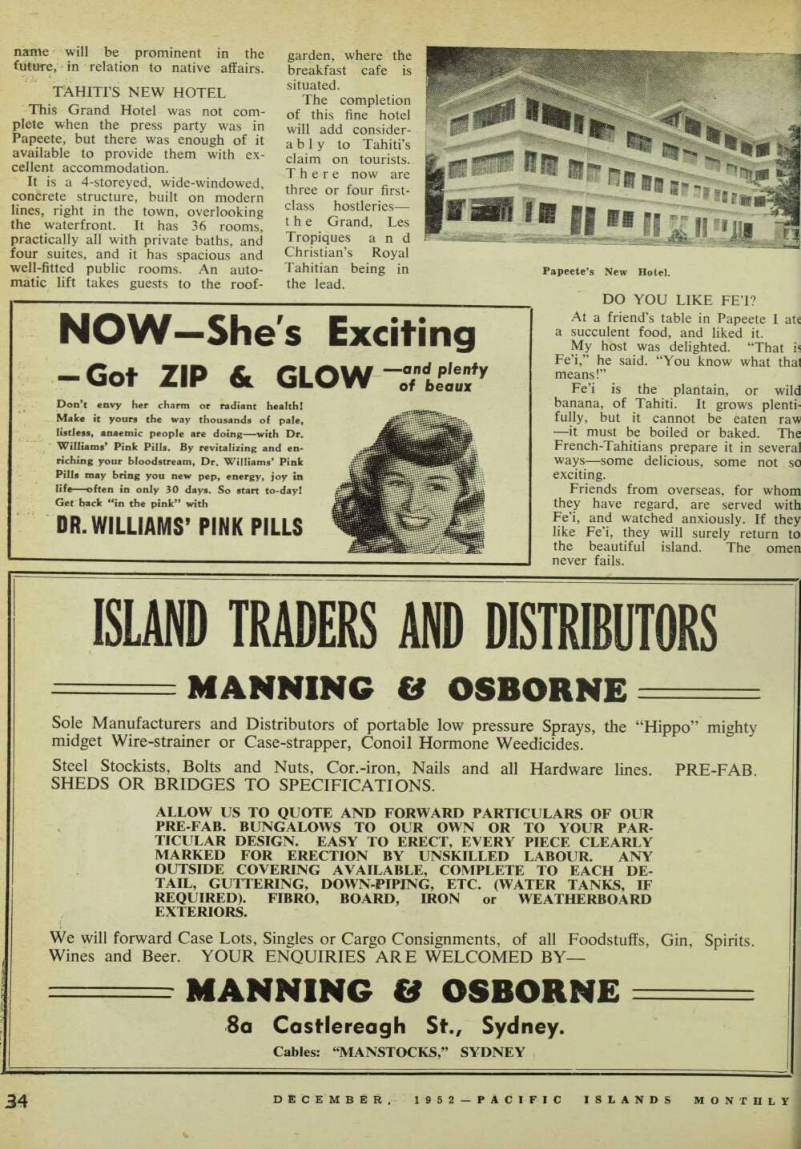
This Grand Hotel was not com plete when the press party was in Papeete, but there was enough of it available to provide them with ex cellent accommodation.
It is a 4-storeyed, wide-windowed, concrete structure, built on modern lines, right in the town, overlooking the waterfront. It has 36 rooms, practically all with private baths, and four suites, and it has spacious and well-fitted public rooms. An auto matic lift takes guests to the roof
garden, where the breakfast cafe is
"completion
G f this fine hotel w iu a dd consider ab 1 y to Tahiti’s claim on Jurists, The r e now are r , , °J" .^ rst " c lf ss hostlenes the Grand, Les Tropiques and Christian’s Royal Tahitian being in the lead.
Papeete’s New Hotel.