Experts Look Over Papua’s Rubber Industry
pp. 111-113 · Read in the full issue
And Suggest Some Improvements
THE wild fluctuations in the rubber market over the last two years are indicated by the report on the Papuan rubber industry, issued re cently as a Commonwealth Depart ment of Agriculture bulletin. This bulletin also shows how long it takes these official reports to reach the zeneral public.
The report was prepared after •übber producers in Papua had asked he Commonwealth, in 1949, to as ist them in marketing their produce. \t that time, Australian manufac urers were refusing to take Papuan irst grade as such and the Port Moresby price was then about 1/3 ter pound.
A general fact-finding investigation Qto the Papuan industry was begun y the Bureau of Agricultural Eco lomics in October 1949 and com leted in December that year. This eport is the result of that investi iation. However, the Director of tie Bureau, in a foreword to the leport in January 1952, points out bat the circumstances had changed Mnewhat since the investigations fere made and that due to stock fling for defence, the price at Port loresby was then 4/7 per pound nd at one stage in 1951 had been r-. \ Since then, of course, there has een another change in the position; rices are now down to around 2/6 er pound, Australian manufacturers re again having periods of haughti ess about accepting all that is vailable from this source, and many f the planters’ troubles which are fe subject of the report of 1949, are gain raising their heads. In ad ition, plantation costs have risen Misiderably in the last three years.
The two aspects of the report of iterest to Papuan producers are (1) ie Bureau’s finding with regard to le efficiency of the industry in the erritory; and (2) the basis of the )mplaints levelled against the fcpuan product by Australian manu- Icturers.
After considerable investigation, ® Bureau arrived at 14.5 d per )und as the average cost of pro icing 1 lb of rubber in 1949. They >und that the industry was con icted with reasonable efficiency and tergy although costs of production ere higher than in Malaya, prob fly because of lack of labour or sufficient labour plus the official quirements for native living slam trds. Yields per acre are about
1/3 lower in Papua than in Malaya, one reason for this being that the trees are not of modern high-yield ing types.
Manufacturers (in 1949) claimed that a better system of grading of Papuan rubber should be established.
They said that Papuan No. 1 grade was inferior to the equivalent Mal ayan grade because of the presence of dirt and bark, lack of uniformity in colour, excessive moisture and unsatisfactory washing at the plant ation.
They claimed also that deliveries
of Papuan rubber to Australian manufacturers were slow and that manufacturers had been inconven ienced by irregularity of arrival.
The Bureau indicates that the manufacturers have some basis for their complaints and recommends better attention to grading, and to plantation treatment of the rubber before export. However, the Bureau makes the comment that during the scarce years of war, rubber manufac turers had to perform considerable improvisation, out of which sprang new techniques which in some cases now allow them to use second or third grade rubber, where before the war it was considered essential to use only top grade.
As far as the complaint re irregu
lar delivery is concerned Paj New Guinea did suffer from irr< lar shipping services up till 1949 since then shipping should be i quate for manufacturers’ needs be no more infrequent than fi Malaya.
Future Of The Industi
Officialdom (and others) are f of saying that Papua should be j to supply Australia’s total rut requirements. At present rub from Papua is barely l/10th Australia’s total rubber import there is, therefore, great scope improvement in this field, and jud on these figures, it seems that would be no great hardship if Commonwealth guaranteed Pap planters a market for their pre; production. However, as Pap rubber is the first to suffer dui recessions* in the industry, it se< obvious that there is room for provement also in plantat methods in Papua—it cannot wholly a matter of prejudice 1 Australian manufacturers pn Malayan rubber. All things b( equal, there should be room fo: 10-fold expansion of the Papuan dustry. Whether the provision o guaranteed market for all Papi rubber would help or hinder production of better rubber, is matter of opinion. Planters pr ably believe that a guarantee wo encourage the establishment of r plantations, planted to better stc Manufacturers could reply t the market is already there, v open, if Papua could deliver goods, and that if they are for to take all the rubber the Territ can produce, slip-shod plantat methods and inferior rubber co be the result.
Rubber Export For P-N
It was announced from Canbei end of July, that an outstanding pert on rubber growing will, August, visit Papua and New Guii at the invitation of the Comm wealth Government.
The Minister for Territories, I Paul Hasluck, said that the Gove ment had secured the services Mr. C. E. T. Mann, Director of Rubber Research Institute of Mala to advise on technical aspects rubber planting in the Territory z on measures which might be taken expand the industry.
Norfolk Island has had a m and showery winter, reports a lo correspondent, but visitors a local farmers would like to see m( of the island’s famous sunshine
More Island Travellers
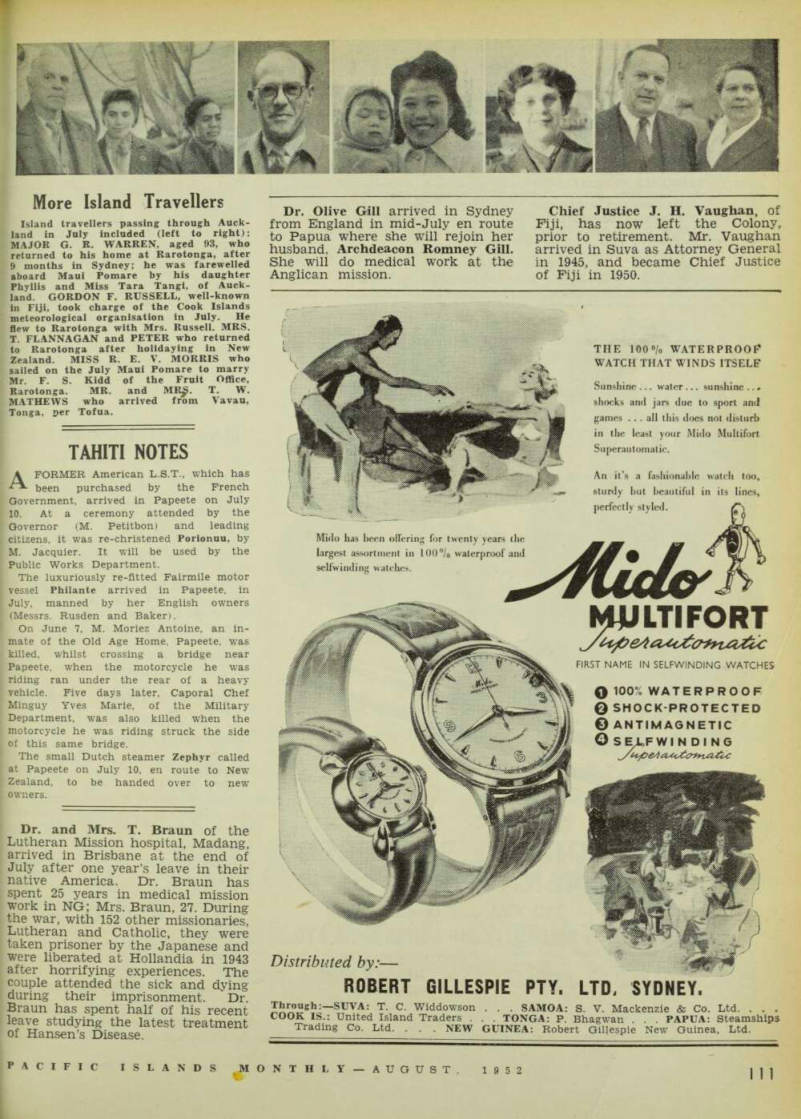
Island travellers passing through Auck land in July included (left to right): MAJOR G. R. WARREN, aged 93, who returned to his home at Rarotonga, after 9 months in Sydney: he was farewelled aboard Maui Pomare by his daughter Phyllis and Miss Tara Tangi, of Auck land. GORDON F. RUSSELL, well-known in Fiji, took charge of the Cook Islands meteorological organisation in July. He flew to Rarotonga with Mrs. Russell. MRS.
T. FLANNAGAN and PETER who returned to Rarotonga after holidaying in New Zealand. MISS R. E. V. MORRIS who sailed on the July Maui Pomare to marry Mr. F. S. Kidd of the Fruit Office, Rarotonga. MR. and MRS. T. W.
MATHEWS who arrived from Vavau, Tonga, per Tofua.