Training
pp. 109-110 · Read in the full issue
Islanders’ Medical Training New Buildings for Suva School
From Our Own Correspondent SUVA, July 29 AN important step in the history of the Central Medical School was taken on July 25, when the Acting Governor of Fiji (Mr. A, F.
R. Stoddart) laid the foundation stone of the School's new buildings at Tamavua, Suva.
With the possible exception of the South Pacific Commission, at Nou mea, the Central Medical School now is the most important single in stitution in the South Pacific Islands.
Year by year, for many years, it has produced trained native men for medical work in all the tropical Territories east of New Guinea.
These young men, carefully selected, are given a medical training over four years in Fiji, and when they qualify, they go back to their own Territories with the diploma of As sistant Medical Practitioner, (form erly called Native Medical Practit ioner, or NMP).
The system has been of incalcul able value in lifting native morale and in raising the standard of native welfare throughout the Islands.
The impressive ceremony of laying the foundation stone was attended by members of the Executive and Legislative Councils, the Council of Chiefs, students of the Central Medical School and a representative gathering which included the new High Commissioner for the Western Pacific (Mr. R. C. S. Stanley), Tamavua is to become an impor tant section of the new Suva Medical Centre, which, it is estimated, will :ost £250,000 (of which £240,000 will come from Britain’s Colonial Development and Welfare Fund).
The Acting Director of Medical Services (Dr. R. W. D. Maxwell) aid that Tamavua would be a centre or medical and nursing training for J iji, and possibly for the whole trop cal South Pacific. Students would earn medicine, dentistry, sanitation, Cray technique and the branches of nodern medicine.
Dr. Maxwell added that the new Curses’ Training School at Tamavua lad already been started. It was •ossible that there would be a new ieneral hospital in the area. , Mr. Stoddart outlined the im pressive record of the Central Medi al School since 1883, when the idea
was conceived of training young Fijians to work among their own people. The new building, he said, would be the centre of the School’s main activities. The students would continue to receive practical training at the Colonial War Memorial Hospital. Further, the influx of students from the American Pacific Islands Territories (now being sent to Fiji for training) meant that some of the students would have to live in the present quarters near the CWM Hospital.
In his book “Britain and the South Seas,” Sir Harry Luke, a former Governor of Fiji, describes the Central Medical School as “one of the
biggest items in the repayment of the debt which the white man owes to the brown man of the Pacific.”
Its students, totalling more than 80, are now drawn from Fiji (Fijians and Indians), Western and Eastern Samoa, Tonga, Cook Islands, Niue, Gilbert and Ellice Islands, Solomon Islands, Papua, Nauru, New Heb rides and the American Trust Terri tories.
The Central Medical School’s first women students were enrolled in 1951. These pioneers are five Fijian girls of the type who, as competent nurses, have long been the main stay of the hospital system through out Fiji.
Three well-known missiona] recently departed from Vunapc Rabaul, on long leave —Fathers Hagen, A. Herzog and J. Krum] Father Hagen, an Austrian, ] worked in the Bainings and Tala since 1935. Father Herzog, also Austrian, has been principal of i portant mission schools —especk the Teachers Training College, Vuvu. Father Krumpel, a Germ has done most of his work in 1 New Ireland and Rabaul areas.
Now in Auckland
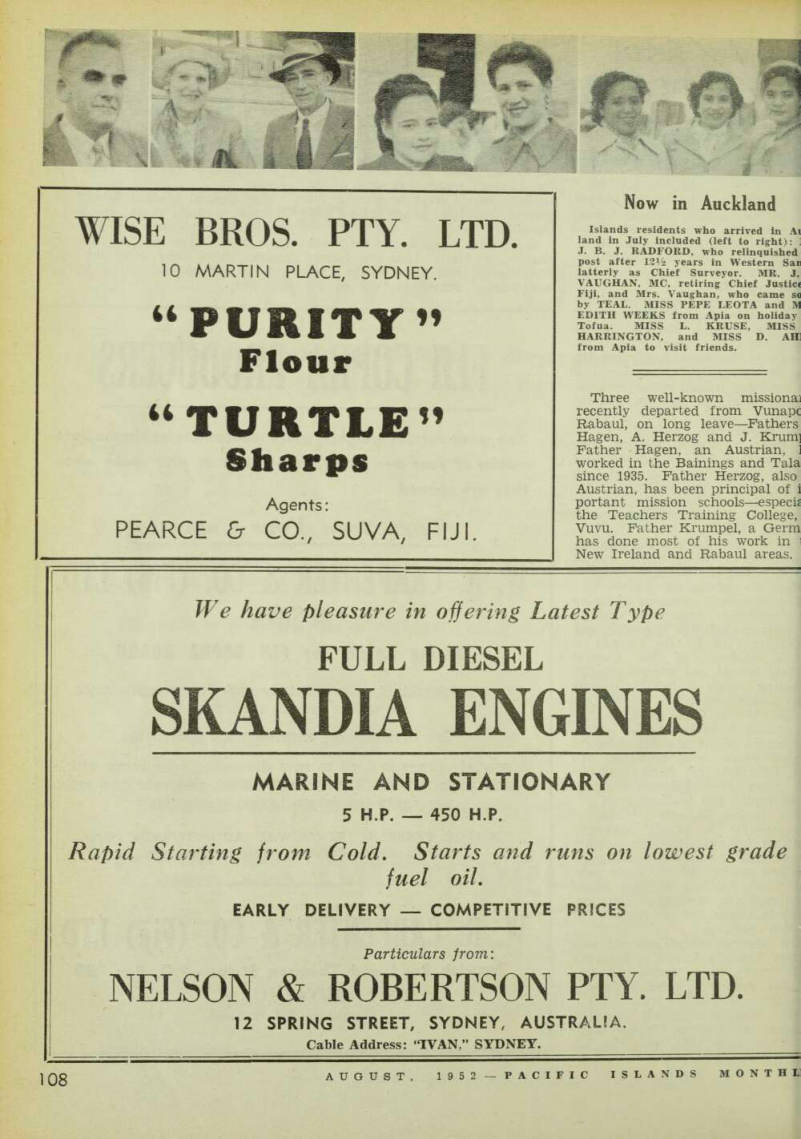
Islands residents who arrived in A? land in July included (left to right): ?
J. B. J. RADFORD, who relinquished post after 12½ years in Western San latterly as Chief Surveyor. MR. J.
VAUGHAN, MC, retiring Chief Justice Fiji, and Mrs. Vaughan, who came so by TEAL. MISS PEPE LEOTA and M?
EDITH WEEKS from Apia on holiday
Tofua. Miss L. Kruse, Miss
Harrington, And Miss D. Ah?
from Apia to visit friends.