Big Copra Mill
p. 20 · Read in the full issue
For Rabaul
Carpenter Establishment Starts Next Month
THE biggest single economic de velopment in the history of Papua-New Guinea will occur next month, when the new copra-crush ing mill established by the Carpenter interests at Toboi, Rabaul, will com mence operations.
This is a 3-expeller mill and, judged on Fiji standards, it is cap able of putting through 25,000 tons of copra per annum. It is not pro posed, at present, that treatment shall be at a larger rate than 15,000 tons per annum; but the capacity for expansion is there.
In the manner characteristic of the big Carpenter organisation, very little publicity has been given to the development of this big project. It was known that building operations on a large scale were afoot at Rabaul; but, in view of the fact that shipping and other conditions brought about the closure of the Company’s desiccated coconut mill at Madang, the impression got abroad that the Rabaul plan also had been shelved.
Actually, the considerable ma
chinery required has been brought in and installed on a long-range plan; the factory buildings, and no less than eight bungalows for European staff, have been completed; diesel engined generators to provide light and power have'been put in; wharf age required to accommodate the small ships that bring in the copra, and the big ships that take away the finished product, has been provided; and both European and native staff have been assembled. Operations will formally commence in September, without ceremony, and without the booming of one official drum.
This is a very important develop ment, for the copra industry and for the re-established town of Rabaul.
It does not mean the production— for the moment—of more copra; but it does mean that a larger share of the wealth that copra produces will remain in the Territory. As before, the whole product will go to the British Ministry of Food under the 9-years MOF contract; but up to 15,000 tons of it will go in the shape of coconut oil and meal, and the money represented in the conversion of raw copra to oil and meal remains in New Guinea. Papua-N Guinea is now producing about 80,000 tons of copra per annum.
THE economic effect of the new industry may be measured by the experience of Fiji. There, also, the Carpenter interests have erected a 3-expeller mill, which now has been in full operation for two or three years; and now no less than 25,000 tons per annum, of Fiji’s total copra production (estimated this year to reach 36,000 tons) is going through
the mill. This does not greatly in crease the value of the copra crop so far as the growers are concerned but it does substantially increase th amount of money from copra tha remains in Fiji, and it does giv greater stability to the industr generally.
The Fiji mills produce margarine in addition to oil and meal. That i not planned yet at the Rabaul mill; One does not know why. Butter i very dear and not abundant, an the consumers of Australia and Ei rope probably would be very gla to get larger supplies of margarim Probably, politics enters into th picture, somewhere. Butter-producei in Australia represent a lot of vote! and butter interests just natural! hate margarine.
The Carpenter interests have nc indicated the cost of the new Rabat establishment. One well-informe man thinks it is not less tha £250,000.
It is interesting to note the wa in which Carpenter interests, over th years, have moved slowly and steac ily from the purely copra busines which contains many elements c uncertainty, to the safer harbour c copra-milling. Sir Walter Carpente in the Thirties, was personally re: ponsible for the establishment c copra-crushing mills in Canadi which provided a safe market thei for a proportion of South Pacif copra. Then came the Fiji develo] ment, when mills were estal lished by W. R. Carpenter & O (Fiji) Ltd.; and now we have th new installation by Coconut Produc Ltd., which is a New Guinea sectic of the Carpenter Group.
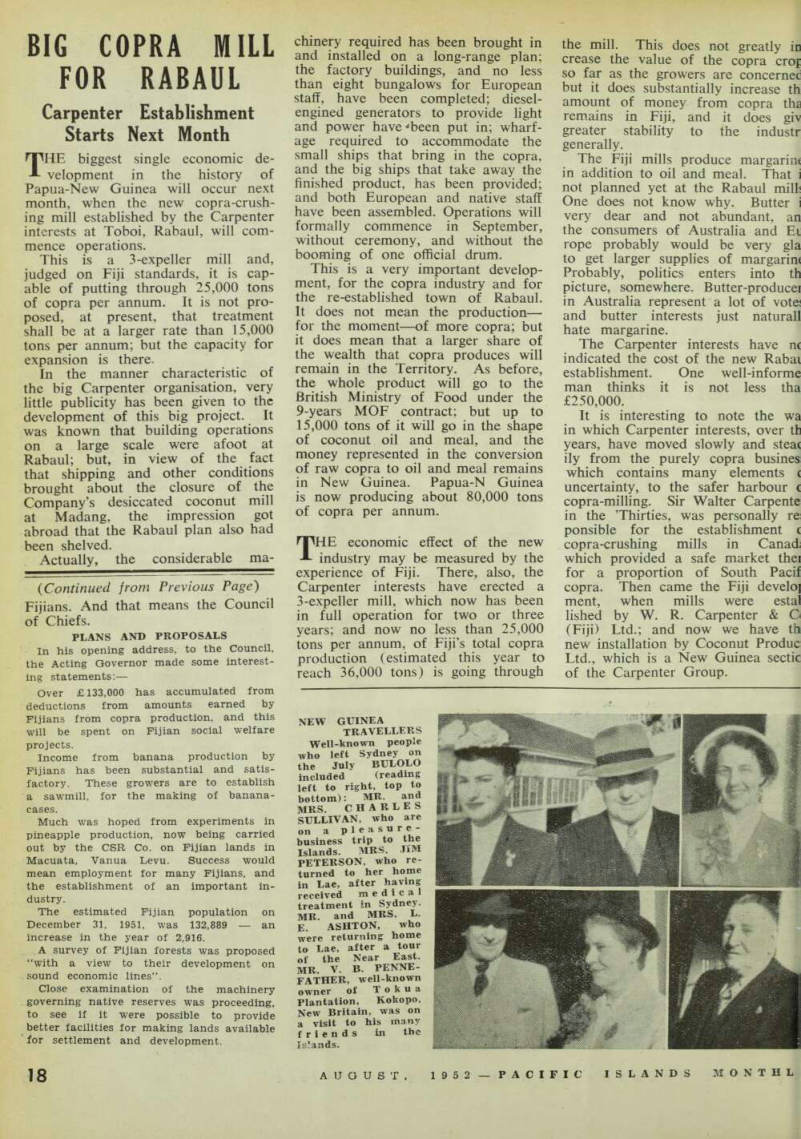
New Guinea
Travellers
Well-known people who left Sydney on the July BULOLO included (reading left to right, top to bottom): MR. and
Mrs. Charles
SULLIVAN, who are on a pleasure business trip to the Islands. MRS. JIM PETERSON, who re turned to her home in Lae, after having received medical treatment in Sydney.
MR. and MRS. L.
E. Ashton, Who
were returning home to Lae, after a tour of the Near East.
Mr. V. B. Penne
FATHER, well-known owner of Tokua Plantation, Kokopo, New Britain, was on a visit to his many friends in the Islands.