Far Outpost of the O'Keefe Empire
p. 71 · Read in the full issue
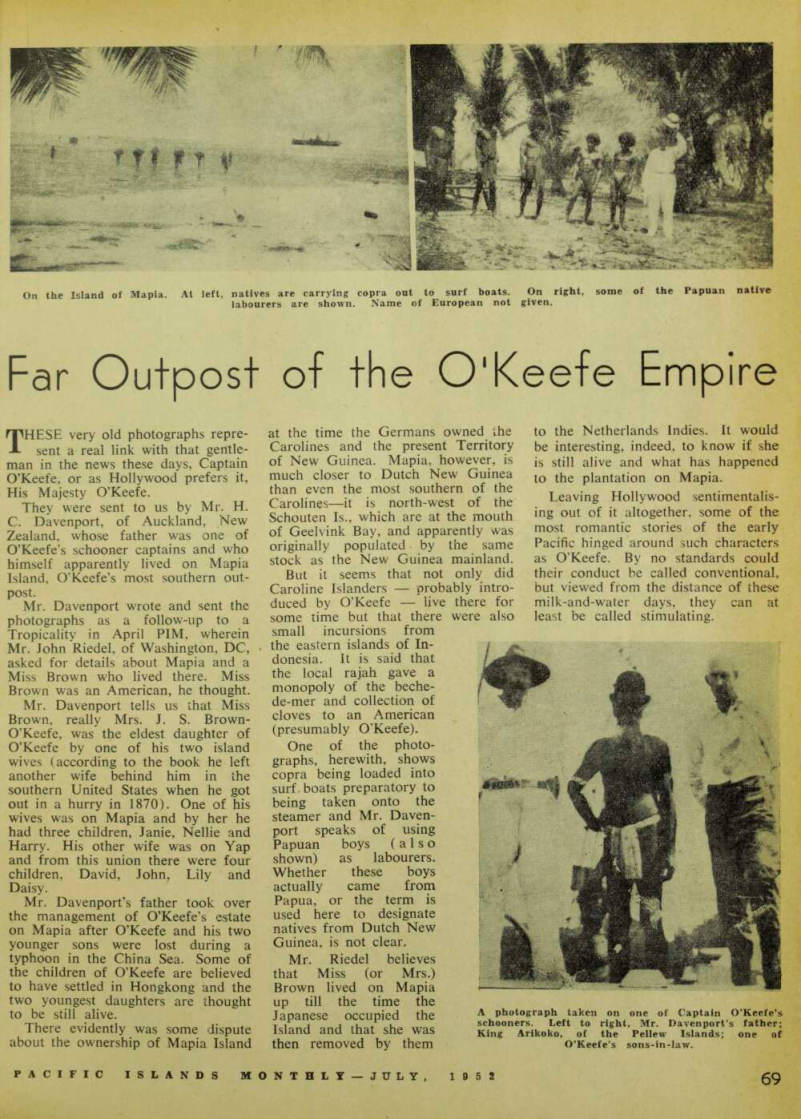
THESE very old photographs repre sent a real link with that gentle man in the news these days, Captain O’Keefe, or as Hollywood prefers it, His Majesty O’Keefe.
They were sent to us by Mr. H.
C. Davenport, of Auckland, New Zealand, whose father was one of O’Keefe’s schooner captains and who himself apparently lived on Mapia Island, O’Keefe’s most southern out post.
Mr. Davenport wrote and sent the photographs as a follow-up to a Tropicality in April PIM, wherein Mr. John Riedel, of Washington, DC, asked for details about Mapia and a Miss Brown who lived there. Miss Brown was an American, he thought.
Mr. Davenport tells us that Miss Brown, really Mrs. J. S. Brown- O’Keefe, was the eldest daughter of O’Keefe by one of his two island wives (according to the book he left another wife behind him in the southern United States when he got out in a hurry in 1870). One of his wives was on Mapia and by her he had three children, Janie, Nellie and Harry. His other wife was on Yap and from this union there were four children, David, John, Lily and Daisy.
Mr. Davenport’s father took over the management of O’Keefe’s estate on Mapia after O’Keefe and his two younger sons were lost during a typhoon in the China Sea. Some of the children of O’Keefe are believed to have settled in Hongkong and the two youngest daughters are thought to be still alive.
There evidently was some dispute about the ownership of Mapia Island
at the time the Germans owned the Carolines and the present Territory of New Guinea. Mapia, however, is much closer to Dutch New Guinea than even the most southern of the Carolines —it is north-west of the Schouten Is., which are at the mouth of Geelvink Bay, and apparently was originally populated by the same stock as the New Guinea mainland.
But it seems that not only did Caroline Islanders probably intro duced by O’Keefe live there for some time but that there were also
small incursions from the eastern islands of In donesia. It is said that the local rajah gave a monopoly of the beche de-mer and collection of cloves to an American (presumably O’Keefe).
One of the photo graphs, herewith, shows copra being loaded into surf, boats preparatory to being taken onto the steamer and Mr. Daven port speaks of using Papuan boys (also shown) as labourers.
Whether these boys actually came from Papua, or the term is used here to designate natives from Dutch New Guinea, is not clear.
Mr. Riedel believes that Miss (or Mrs.) Brown lived on Mapia up till the time the Japanese occupied the Island and that she was then removed by them
to the Netherlands Indies. It would be interesting, indeed, to know if she j s still alive and what has happened to plantation on Mapia. TT .. , .. . . Leaving Hollywood sentimentahs mg out of it altogether, some of the most romantic stones of the early Pacific hinged around such characters as O Keefe. By no standards could their conduct be called conventional, but viewed from the distance of these milk-and-water days, they can at least be called stimulating.
On the Island of Mapia. At left, natives are carrying copra out to surf boats. On right, some of the Papuan native labourers are shown. Name of European not given.
A photograph taken on one of Captain O’Keefe’s schooners. Left to right, Mr. Davenport’s father; King Arikoko, of the Pellew Islands; one of O’Keefe’s sons-in-law.