Tropicalities
pp. 69-105 · Read in the full issue
Those Godwits Again
THOSE godwits which migrate down through the Islands each year from Siberia and Alaska, were in the news again in June. (See May, Tropicalities).
When Walter Tepinia appeared be fore a magistrate at Kaitaia, New Zealand, charged with being in possession of totally protected birds —to wit, godwits—his defending lawyer pleaded as follows: — “When the godwits go back to Siberia they are slaughtered in thousands for food, and the general opinion in the North (of NZ) is that if it is good enough for the Russians, it is good enough here.”
But the magistrate thought differ ently. £l5, and costs of £6/12/-.
“Cultural Dynamics”
Mr. D. Marshall, An An
thropologist from Harvard University, USA, left New Zealand in late April to visit the Cook Islands, via Fiji.
Mr. Marshall is a specialist in Cultural Dynamics—“the study of factors that go to make people do what they do”.
Mr. Marshall said in Auckland that, while a great deal of work had been done in Polynesia on material culture, by specialists of the Bishop Museum, Honolulu, and others, his own particular field of study re mained largely untouched. He would examine the factors that tend to alter social conditions, and the social aspects of economic development in the Cook Islands. “Does the people’s way of life fit in with certain economic developments?” such matters will be studied, said Mr.
Marshall.
An Appreciation
IN the time “belong before” in P-NG tourists came and went, and I fear there were occasions when we despised them as does the round the-year-dweller the trippers to Eng lish posh seaside resorts! They parked themselves on you, drank your Scotch and Bundaberg, took photos (“We will send you some”: They never did) and left; and that was Finis.
Not so with the Percivals (Mr. and Miss). 1 met them first at Wasida, on the Buna-Kokoda Road. R. M.
Jack Atkinson had already advised me that two English people could be expected at Kokoda. Returning to the rest-house at Wasida, after ploughing around creeks all day try ing to ascertain exactly where a fall ing tree had killed a youth, I found Mr, and Miss Percival in residence.
They were tough: their kit and tucker an absolute minimum, but enough. Blankets on boughs and a net —no Hollywood stuff.
I told them I was in no hurry to get home. For hours, every day, they listened in to court cases, taking many notes. As world travellers (includ ing a trans-Andean trip) they must have enjoyed themselves! At Kokoda they hiked to Yodda, and to several hill-tops.
The day they left per Ford high winger for Moresby Miss Percival said, “Is there anything I can do for you in England?”
“Yes,” I said. “I want a copy of a very special book,”
It, and some others, are now on my bookshelves. They sent snaps, too. I gather from Miss Percival’s last letter from Blighty (16.3.52) that both she and her brother (University graduates both) did their jobs in World War II and, to those who met this couple, 1 regret to report that Miss Percival has lost a leg, and is philosophically awaiting an artificial one. She fears it’s the end of her travels. Tourists like the Percivals are few and far between.—
Sanasi, (Q).
More About The Taralala
AFTER patient research, a Fijian reader of PIM has settled the origin ot taralala, which caused mis givings in the mind of Judy Tudor when, last year, she found that she had called it “tralala.”
It is stated by this authority that it all began as organised recreation in the kindergarten at (of all places) the Methodist stroughold of Davuilevu.
Small Fijian children sang an Eng lish jingle to the rhythmical walk, and the jingle duly contained the English “tra-la-la” fill-up line. But Fijians, like Polynesians, don’t like the consonants “t” and “r” together, and so it became “taralala,” with
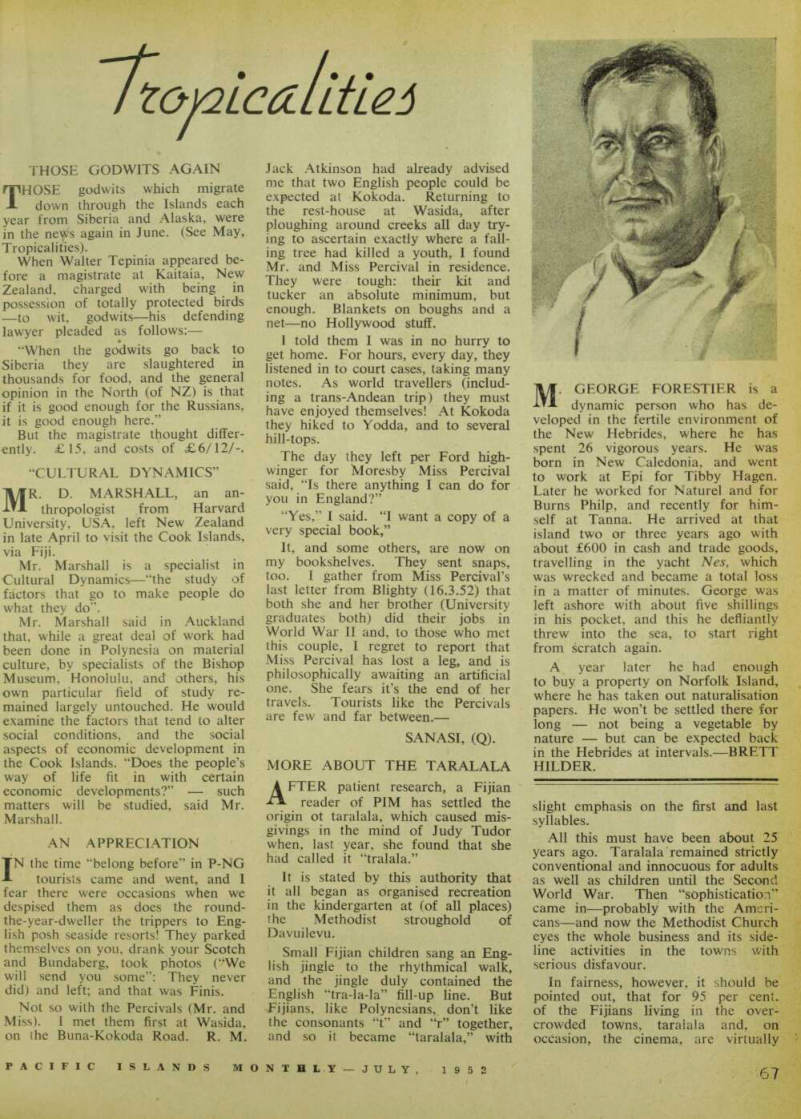
M. George Forestier Is A
dynamic person who has de veloped in the fertile environment of the New Hebrides, where he has spent 26 vigorous years. He was born in New Caledonia, and went to work at Epi for Tibby Hagen, Later he worked for Naturel and for Burns Philp, and recently for him self at Tanna. He arrived at that island two or three years ago with about £6OO in cash and trade goods, travelling in the yacht Nes, which was wrecked and became a total loss in a matter of minutes. George was left ashore with about five shillings in his pocket, and this he defliantly threw into the sea, to start right from scratch again.
A year later he had enough to buy a property on Norfolk Island, where he has taken out naturalisation papers. He won’t be settled there for long not being a vegetable by nature but can be expected back in the Hebrides at intervals.—BßETT
Hilder.
slight emphasis on the first and last syllables.
All this must have been about 25 years ago. Taralala remained strictly conventional and innocuous for adults as well as children until the Second World War. Then “sophistication” came in—probably with the Ameri cans—and now the Methodist Church eyes the whole business and its side line activities in the towns with serious disfavour.
In fairness, however, it should be pointed out, that for 95 per cent, of the Fijians living in the over crowded towns, taralala and, on occasion, the cinema, are virtually
the only forms of entertainment available.—J. K.
Rabaul Quotations
WHY is everyone getting hot and bothered about Clyde Cameron’s declaration that New Guinea natives should be paid the same amount as Europeans for doing the same work. Of course, they should, “for the same work.”
Visitors to Rabaul Regional Library are disappointed to find that the latest numbers of, say, “Sydney Morning Herald,” are dated late April. Reason: Head Office, Mores by, thought it more efficient if all orders were submitted through them.
Alas, instructions were faithfully carried out. Result: no papers.
Lauans Break Records To
Build Canoes
SUVA reported early June that ihe natives of Fulaga and Ogea islands in the Southern Lau Group recently completed in three weeks a film company order for 55 canoes of 16, 24 and 36 feet in length, to be used in the filming of Warner Bros.’ “His Majesty O’Keefe.”
Five hundred men, women and children were on the job. Final assembly is to take place at the film company’s Deuba headquarters near Suva. This was to simplify shipment from Lau.
Only Americans could inspire South Sea islanders to get this sort of hustle on.
Fiji Pwd Provides A Junk
FIJI generally is putting its best foot forward to help the movie makers. Properties required for the film include such exotics as rick shaws and a Chinese junk. Mr. Alex Bentley is going to work on the junk which will be manufactured out of an old PWD barge. The junk is not expected to do any deep sea sailing, but it is expected to look “romantic.”
Members of Fiji’s Chinese com munity will be the crew in the film.
A sound stage is being built near the Deuba Hotel and the hotel itself is being added-to to accommodate the 85 members of the company.
New bures are being made and old ones rethatched at the village of Galoa but here again improvisation is necessary because, although the film ing is being done in Fiji, Mr.
O’Keefe was inconsiderate enough to have lived on Yap in the Carolines.
There is a difference between native houses in Yap and native houses in Fiji and the script called for one edi fice 50 ft long by 40 ft wide and 50 ft high. Fijians do not go in for
mansions of this sort, but with the help of local carpenters, something adequate has been contrived.
Miss Elizabeth Hennings, who is designing the costumes is using a variety of local material such as vau bark which is being gathered in Lau, Vanua Levu and Taveuni.
Good For Fiji Publicity
WHATEVER the merits of the finished picture—and only movie-makers would dare to over look the marked differences between Fijians and Yap Islanders, and Fiji and the Caroline Islands—Fiji is cer tainly getting plenty of publicity from Mr. O’Keefe.
The Gos ford Times, a NSW prov incial twice-weekly paper, in recently recording the fact that a local girl was off to Fiji to assist H. M.
O’Keefe in her profession of hair dressing, described the story as being one about a half-cast Australian aborigine girl.
But that is another film, being made in Australia. The Times can be pardoned for the error—there has been a veritable plague of movie makers in Sydney recently and, to the average Australian, aborigines, the Torres Straits Islands, Samoa, Fiji, Yap and Micronesia all come under the general heading of Fumners and Furrin Parts.
A Recent Story Of Dogs
J'HIS has nothing to do with the Pacific Islands. It is told here because it is the funniest oversea story of the month.
A debate was proceeding in the House of Commons on July 2.
Mrs. Barbara Castle (Labour, and very Leftist): We used to think of Mr. Churchill as a bulldog, sitting on the Union Jack. He has become a lap-dog, sitting on the Stars and Stripes.
Mr. lan Harvey (Conservative): We all know on what flag the honourable lady is sitting—and she is no dog.
Rubbed Out
TF anybody knows how the appli cations for 27 Suva Europeans for enrolment in the new, Southern District electoral roll came to be “disallowed”, he or she is not saying anything about it.
Most of the rejects have been vot ing for years. They include two heads of Government departments, a deputy head, some present and former members of the Legislative Council, civil servants and prominent business executives.
Nobody could do anything about it because the Gazette containing the “disallowed” list came out hours after the deadline for lodging pro tests. One of the aggrieved depart mental chiefs has said that apparently the more respectable members of the community are not to vote and stuck to it, even though it was pointed out that a well-known businessman was apparently to have two votes because his application had been allowed twice and he had two registration numbers.—J.K.
Case Of The Big Cake
Mixer
YOU never know with volcanoes, said Aucklanders (NZ), in June, although assured by geologists that the 60 local ones had been extinct for from 5,000 to 20,000 years.
The citizens, unable to explain a shaking city waterfront building, a mysterious blowhole in a suburban garden, and heating underground petrol tanks of the Mt. St. John Garage, called in vulcanologists, geologists, thermo-physicists and other scientists. As these experts were about to converge on the city, local officials of the Department of Scientific and Industrial Research un covered the mysteries. The quaking five-storey building in Quay Street really did shake. The cause: An (Continued on Page 71)
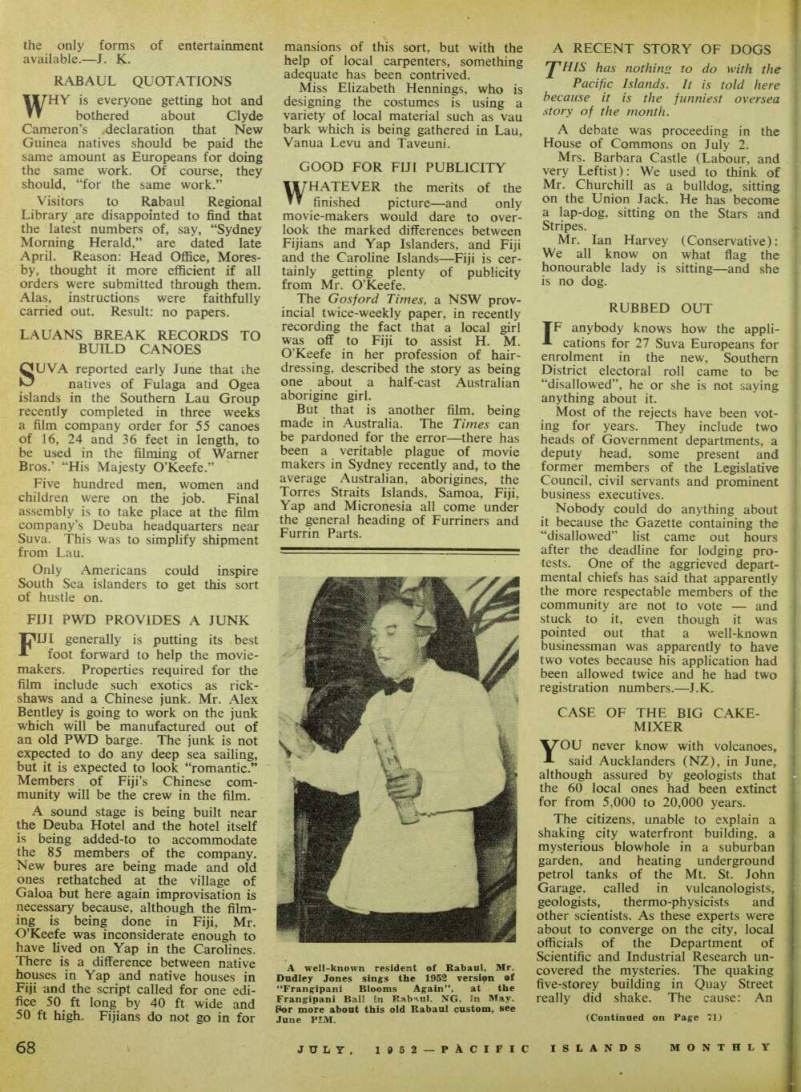
A well-known resident of Rabaul, Mr.
Dudley Jones sings the 1952 version of “Frangipani Blooms Again”, at the Frangipani Ball in Rabaul. NG, in May.
For more about this old Rabaul custom, see June PIM.
oversize cake-mixer in the building next door.
The blowhole in the Onehunga front garden was caused by weed killer washing into a hole where it reacted with organic matter or leakage from a sewer.
The self-heating petrol tanks re main a partial mystery, but the scientist who investigated thinks that it is hot water leaking from broken drains.
An urgent telegram was sent to the Director of Geological Surveys in Wellington, who was about to set out for Auckland, telling him to stay home. A few days previously he had pulled a long face and said volcanic signs and portents in Auckland were “most serious”.
Morinda's Astonished
Buyer
I AM told that the most astonished man at the auction sale of the old Burns Philp steamer Morinda was Mr. Stanley P. Bell, who bought her for the Henderson-Trippe Ship ping Co., a Philippines concern, for £3,100.
He went to the sale prepared to start the bidding at £5,000, and go up to £15,000 —he was not to know that the reserve had been set at £2,000.
The Morinda had been a faithful servant of the Big Firm for 39 years,
and they probably had written her off to nothing long ago.
Before our Philippines friend could get going, someone whipped in a bid for £5OO, and the auctioneer accepted £5O rises. So Mr. Bell just tagged along, and he got the ship without much competition, but with much surprise, for £3,100.
A few of the merchants and agents around Bridge Street have been kick ing themselves hard ever since. The Morinda's lifeboats alone are worth perhaps £2,500. If she had been broken up and sold for scrap, any syndicate buying her for £3,000 would have made a little fortune.
As the Morinda's engines were done up recently, she could go to Manila under her own power. But, as the new owners have bought her so cheaply, and want to avoid labour complications, they probably will hire a tug and have her towed to her new field of operations.—R.W.R.
The Gin In The Coconut
Mr. William Pieris, Newly
appointed to the South Pacific Commission, Noumea, as copra ex pert, had a few things to say about the coconut when passing through Sydney recently.
Mr. Pieris has devoted most of his 47 years to the study of the coconut and says he has hardly scratched the surface. Coconuts are used for soap,
clothing, biscuit-making, meal, build ing material, margarine, rope, char coal and a “pretty potent gin”. “It is illegal to distil the gin,” he said, “but it shows that you shouldn’t underestimate the coconut.”
He has been director of the Coco nut Research Institute in Ceylon and is compiling a bibliography on the coconut tree; has already 10,000 references to authors.
Please, Don’T Flog Your
Poor Natives
A VARIETY of the Have-you
stopped-beating-your-wife ques
tion arose in Australia in June when the Attorney-General announced por tentously that “corporal punishment in New Guinea would be abolished . . . except in certain cases”.
Thereupon—although, hitherto, no Australian had spared a thought pro or con corporal punishment in New Guinea—every little editor of every tin-pot weekly in provincial Australia started madly to write leaders about it.
How many New Guinea natives have been corporally punished in the last 10 years apart from the attentions of our allies the Japs?
The only case even dimly related to corporal punishment since the war occurred a few months ago when a Madang native was ordered a caning a caning, mark you for an offence against a young European girl, (Continued on Page 75)
Tolala remarked in Talk-Talk at the time that it would not be long before someone was muttering darkly about flogging poor innocent natives.
He had not long to wait. Although he foresaw some emissary of Russia wailing at the United Nations, first wails actually came from the country editors of Australia who howl about “human rights”.
It does not seem to occur to them that it is a question that can quite safely remain in the hands of those in charge of law and order in the Territory.
Whale Tagging In Nz
SOME time ago we reported that, to check on the migratory routes of swordfish, the New Zealand Bay of Islands Swordfish and Mako Shark Club at Russell this year tagged six fish and released them in the hope that the tags will eventually be recovered elsewhere in the Pacific.
These swordfish are now heading north to their unknown winter re sort in the tropics or northern hemis phere.
Now from New Zealand’s only re maining station in Cook Strait comes word that a special gun is being im
ported from England to fire tag darts into passing whales which it is not intended to harpoon.
Norfolk Island and Tongan whalers should keep a sharp look out for these southern visitors, which are now on the move north, cheek by jowl with swordfish.
The Cook Strait station reports a particularly early and prolific run of whales this season, indicating similar conditions for the Islands. But from London comes word that whale oil prices have hit a new low—£Bo Stg. per ton —due to increased (Continued on Page 102)
supplies of competitive vegetable oils glutting the market.
Untrue To Label
A FORMER resident of Tahiti re cently calling in, thumbed back
through the pages of an old volume of PIM. Spotting a photo of Papeete Museum on page 35 of the October, 1941 issue, he unloosed a burst of hearty laughter.
“You know,” he said “there used
to be a signboard somewhere ir front by the road there, with th< words ‘Hotel de Ville’ in peelinj paint. Maybe its still there some where; for the building of course used to be the Mayor’s residence That was years ago.”
“Well some years back a Dane resident in the outer districts anc footing it into town, saw the sigr and, feeling very ready for sonu liquid refreshment, decided to stej into the bar for a while. Rathei surprised to find the front dooi closed and unable to raise any re sponse he presented himself at the back, where the lady of the house answered his knock and enquired of his wants. Naturally the Mayoress was somewhat taken aback when he called for a rum punch—but after all, how was a Dane expected to know that Hotel de Ville is not as all other hotels?”
No Nudists Here
FIJIAN proprieties are offended— but not as much as they used to be—by the insistence of the pro ducers of tourist-bait literature on the inclusion of pictures of entirely undraped figures to give the im pression of carefree pagan abandon in the South Seas.
Last month a New Zealand journal
nblished a more than idyllic version E the Yasawa Group (the southern lands that the hurricane missed), rith it went a picture of an authen eally muscular and beautifully pro artioned gentleman with no clothes, i a fish-spearing pose. The caption as “Poised for Action: A Fijian >earing fish from the rocks at aradise Island.”
Very effective, but the truth is that there is one thing that a tourist ill not see in Fiji it is a naked ijian spearing fish (or a naked Fijian, jriod).
Generally speaking, Fijians are issy to the point of prudery in the latter of covering. If the man legedly spearing fish had really been >earing fish for the family meal he ould have worn an ample sulu with, tore likely than not, a pair of shorts iderneath. So much for primitive mplicity in the Yasawas.—J.K.
Tofua Nightmare
HHE Union Steam Ship Go’s l Island vessel Tofua was surging mthward from Suva towards Auck nd one night in May. Most of the issengers ha*d turned in as it was )ld on deck.
Suddenly, someone right aft heard faint cry “Help! Help!”—and, isely, lost no time in giving the arm to the bridge.
Immediately the whole emergency rganisation came into operation. boat’s crew stood by ready to >wer away. The ship circled back, yes peered into the darkness. Ears rained to maximum pitch. A ghted buoy marked the approximate )Ot.
It took some time for the excite tent on deck to filter through the lip. Naturally it reached the off atch crew before reaching the issengers below.
Then an urgent messenger rushed ) the bridge with the horrible nth. It was just old Bill, one of the igine-room boys, having one of his lutine nightmares by an open port ot far below the deck level. The up resumed her voyage.
Nightmare over and snoring bliss illy, Bill was disturbed from his reams to be told of the trouble he’d msed. He snarled and went right ack to sleep.
Some national teams will be atched with great interest at the lympic Games in Finland this lonth. For the first time, the Rus* ans will be there, and they have oasted in broadcasts that their eds are going to “clean up” the ipitalist athletes. The new “Re ublic of Indonesia” has sent a ;am of eight men.