Where Lies the Trouble in Fiji?
p. 16 · Read in the full issue
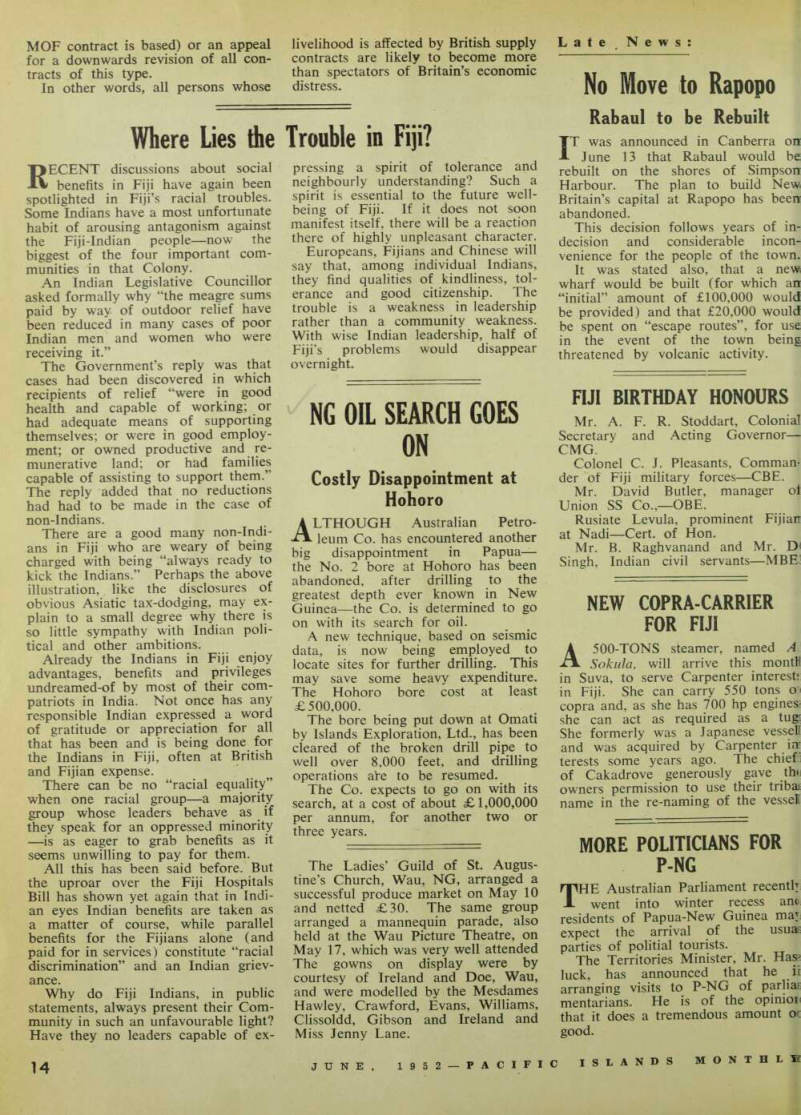
RECENT discussions about social benefits in Fiji have again been spotlighted in Fiji’s racial troubles.
Some Indians have a most unfortunate habit of arousing antagonism against the Fiji-Indian people—now the biggest of the four important com munities in that Colony.
An Indian Legislative Councillor asked formally why “the meagre sums paid by way of outdoor relief have been reduced in many cases of poor Indian men and women who were receiving it.”
The Government’s reply was that cases had been discovered in which recipients of relief “were in good health and capable of working; or had adequate means of supporting themselves; or were in good employ ment; or owned productive and re munerative land; or had families capable of assisting to support them.”
The reply added that no reductions had had to be made in the case of non-Indians.
There are a good many non-Indi ans in Fiji who are weary of being charged with being “always ready to kick the Indians.” Perhaps the above illustration, like the disclosures of obvious Asiatic tax-dodging, may ex plain to a small degree why there is so little sympathy with Indian poli tical and other ambitions.
Already the Indians in Fiji enjoy advantages, benefits and privileges undreamed-of by most of their com patriots in India. Not once has any responsible Indian expressed a word of gratitude or appreciation for all that has been and is being done for the Indians in Fiji, often at British and Fijian expense.
There can be no “racial equality” when one racial group—a majority group whose leaders behave as if they speak for an oppressed minority —is as eager to grab benefits as it seems unwilling to pay for them.
All this has been said before. But the uproar over the Fiji Hospitals Bill has shown yet again that in Indi an eyes Indian benefits are taken as a matter of course, while parallel benefits for the Fijians alone (and paid for in services) constitute “racial discrimination” and an Indian griev ance.
Why do Fiji Indians, in public statements, always present their Com munity in such an unfavourable light?
Have they no leaders capable of ex
pressing a spirit of tolerance and neighbourly understanding? Such a spirit is essential to the future well being of Fiji. If it does not soon manifest itself, there will be a reaction there of highly unpleasant character.
Europeans, Fijians and Chinese will say that, among individual Indians, they find qualities of kindliness, tol erance and good citizenship. The trouble is a weakness in leadership rather than a community weakness.
With wise Indian leadership, half of Fiji’s problems would disappear overnight.