Mr. Churchill, ‘Bankruptcy'—and Copra
pp. 15-16 · Read in the full issue
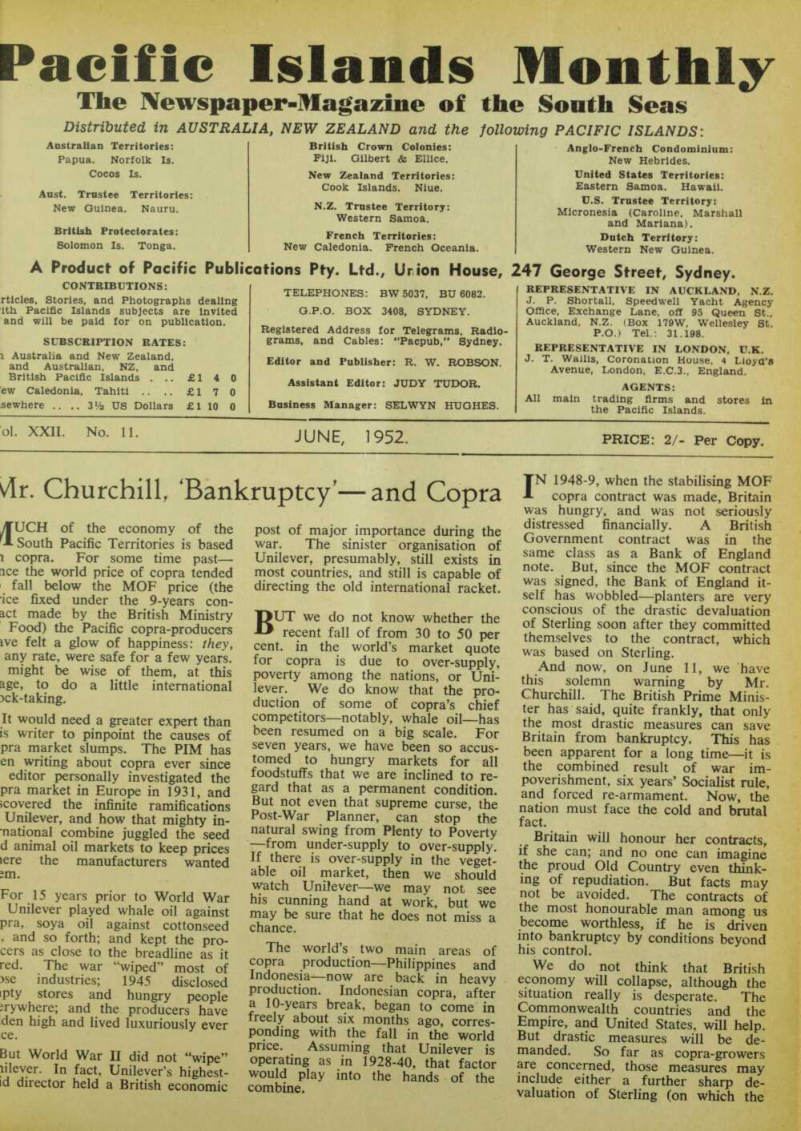
I’UCH of the economy of the A South Pacific Territories is based i copra. For some time past— ace the world price of copra tended fall below the MOF price (the ace fixed under the 9-years con act made by the British Ministry Food) the Pacific copra-producers ive felt a glow of happiness: they, any rate, were safe for a few years, might be wise of them, at this age, to do a little international ick-taking.
It would need a greater expert than is writer to pinpoint the causes of pra market slumps. The PIM has en writing about copra ever since editor personally investigated the pra market in Europe in 1931, and >covered the infinite ramifications Unilever, and how that mighty in national combine juggled the seed d animal oil markets to keep prices iere the manufacturers wanted mi.
For 15 years prior to World War Unilever played whale oil against pra, soya oil against cottonseed , and so forth; and kept the pro cers as close to the breadline as it red. The war “wiped” most of >se industries; 1945 disclosed ipty stores and hungry people mywhere; and the producers have den high and lived luxuriously ever ce.
But World War II did not “wipe” li lever. In fact, Unilever’s highest id director held a British economic
post of major importance during the war. The sinister organisation of Unilever, presumably, still exists in most countries, and still is capable of directing the old international racket.
BUT we do not know whether the recent fall of from 30 to 50 per cent, in the world’s market quote for copra is due to over-supply, poverty among the nations, or Uni lever. We do know that the pro duction of some of copra’s chief competitors—notably, whale oil—has been resumed on a big scale. For seven years, we have been so accus tomed to hungry markets for all foodstuffs that we are inclined to re gard that as a permanent condition.
But not even that supreme curse, the Post-War Planner, can stop the natural swing from Plenty to Poverty —from under-supply to over-supply.
If there is over-supply in the veget able oil market, then we should watch Unilever—we may not see his cunning hand at work, but we may be sure that he does not miss a chance.
The world’s two main areas of copra production—Philippines and Indonesia—now are back in heavy production. Indonesian copra, after a 10-years break, began to come in freely about six months ago, corres ponding with the fall in the world price. Assuming that Unilever is operating as in 1928-40, that factor would play into the hands of the combine.
I copra contract was made, Britain was hungry, and was not seriously dlstressed financially. A British Government contract was m the sai J ie a , s a Ean £ En gl and note ‘ • , "J” 7 contract w fl ® En Sl and lt_ self P as wobbled—planters are very TcTT ° f the raslt i c devaluati <>n
IS T thf con?raT"
wasTased on Sterhng ’
T’ ° n Iu "? “•,.** have
£ sat
Britain from bankruptcy. This has been apparent for a long time—it is the combined result of Z7im poverishment, six years’ Socialist rule a nd forced re-armament. Now the nation must face the cold and brutal fact s:vr.”- 1 -
the hF* C °^
? 1 hon °urable man among us become worthless, if he is driven lnto bankruptcy by conditions beyond his control.
We do not think that British economy will collapse, although the situation really is desperate. The Commonwealth countries and the Empire, and United States, will help, But drastic measures will be de manded’ S ° far as copra-growers 3r6 “ nceri ? ed ' those measures may ‘ n f ud ? cither a further sharp de valuation of Sterling (on which the
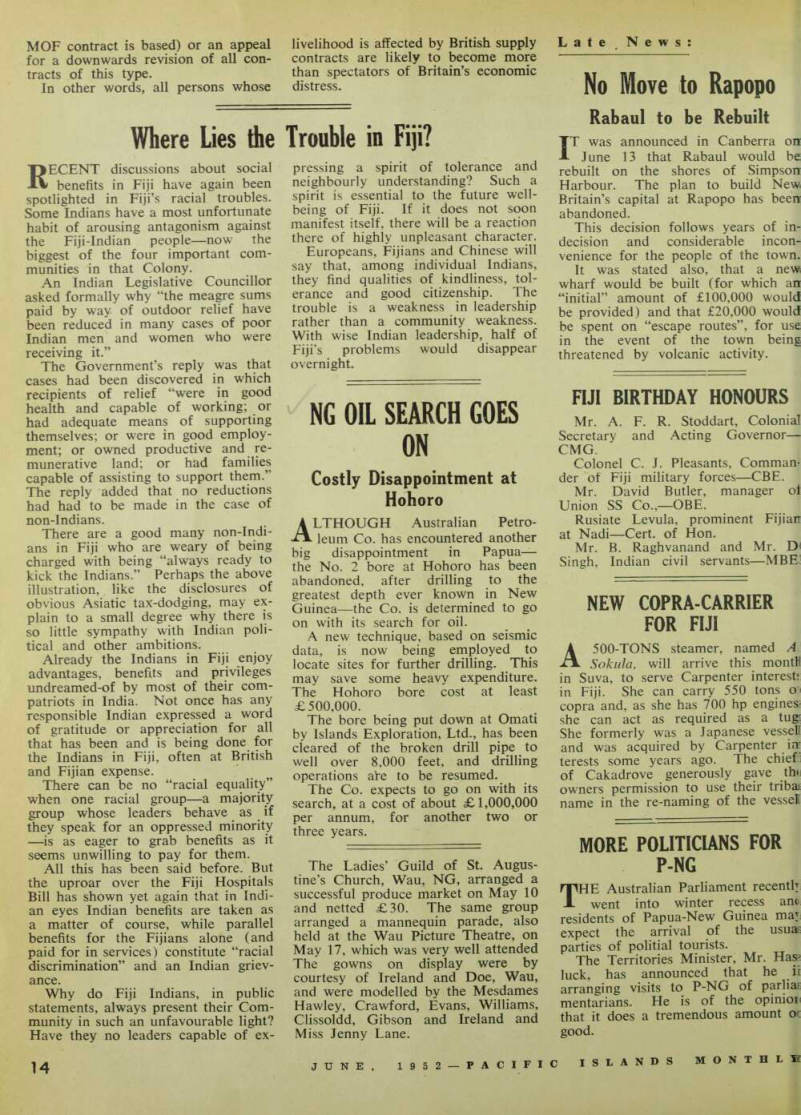
MOF contract is based) or an appeal for a downwards revision of all contracts of this type.
In other words, all persons whose
livelihood is affected by British supply contracts are likely to become more than spectators of Britain’s economic distress.