How Came the Chinese
pp. 106-107 · Read in the full issue
In New Guinea?
THE statement, frequently made, that the German Government is responsible for the establishment of the now large and growing Chinese community in New Guinea is chal lenged by an old New Guinea resi dent, Mr. H. L. Schultze.
Mr. Schultze says that the Chinese who were admitted to New Guinea by the Germans, were limited strict ly to a few general traders—Ah Tam, Ah Kun and a third man who oper ated in a big way at Madang. These Chinese traders were allowed to bring in as employees a limited num ber of their fellow countrymen.
Nothing was done about the Chinese community while the coun try was under Australian Military occupation (1914-1921); but in 1921 the newly-established Australian Ad ministration interpreted the immigra tion laws of the Mandate in such a way as to permit the free entry of Chinese—and the Chinese, both men and women, entered freely for a couple of years.
It was this immigration, and not the handful of Chinese found there in 1914 which provided the basis of the present Chinese community.
After a couple of years the Australian Administration became alarmed at the influx of Chinese and withdrew the general permit to enter, and allowed entry thereafter only in par ticular cases, such as the close rela tions of Chinese already established.
‘Make Use Of New Guinea
Chinese’
“I think that Australia could turn the Chinese community of New Guinea into a helpful asset, instead of regarding the Chinese there as a ‘problem’ ”, said Mr. F. J. Macken zie, in Sydney recently. He was for merly manager of the Rabaul branch of the Commonwealth Bank.
“You cannot now get rid of the Chinese community, even if you wished. They are there to stay, as traders, artisans, planters, profes sional men. A wise Administration would appreciate the potential value of this human material, and would encourage the Chinese to regard New Guinea as their own country, and to give to New Guinea their personal loyalty and service. They could help very much in the task of settling and governing the country. Otherwise, if they are regarded as a community element without any fixed home, they might feel that they have no com munity obligations.”
to one member from each profession, art or line of business. Quota operates in USA, Canada, Mexico and Australia.
Sister Kathleen Gallagher of the Rabaul European Hospital arrived back from leave on the March Bulolo.
Torrential rains in Wau District, NG made havoc of vegetable gardens, races and roads in March-April. On March 25 the Big Wau Creek rose nine feet, washing away everything in its path as it changed course several times.
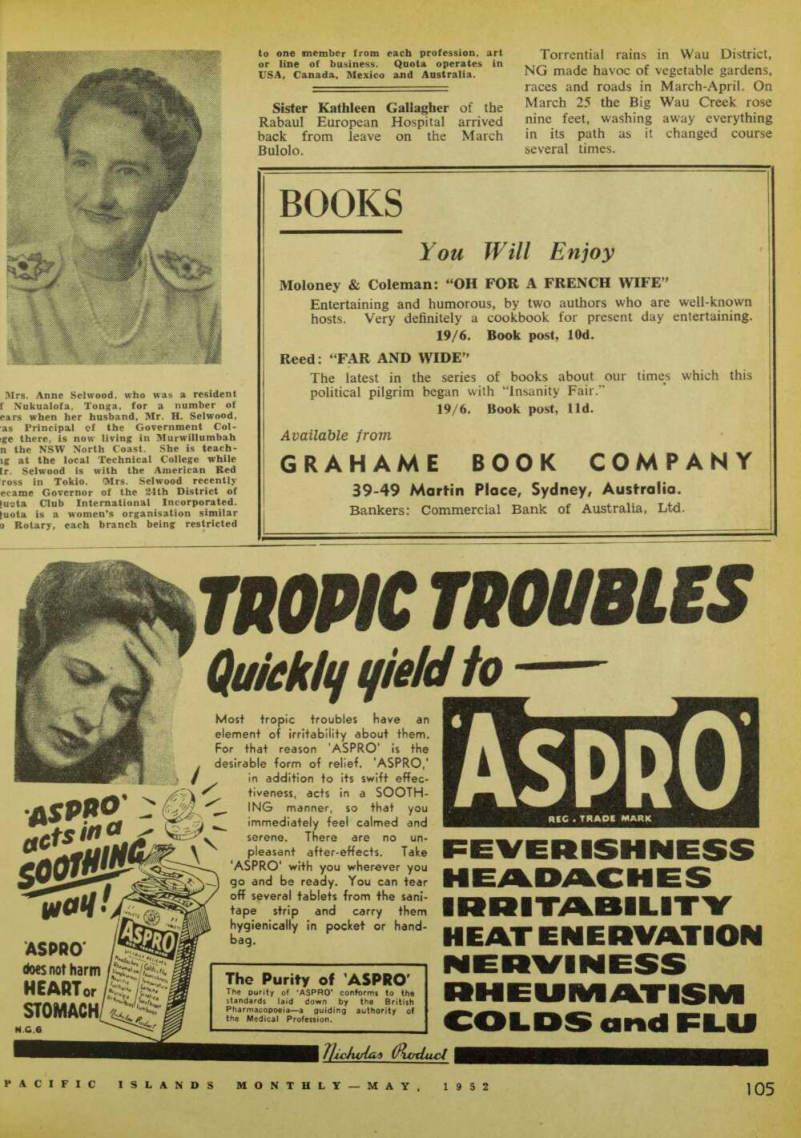
Mrs. Anne Selwood, who was a resident f Nukualofa, Tonga, for a number of ears when her husband, Mr. H. Selwood, as Principal of the Government Col ige there, is now living in Murwillumbah n the NSW North Coast. She is teach ig at the local Technical College while lr. Selwood is with the American Red ross in Tokio. Mrs. Selwood recently ecame Governor of the 24th District of [uota Club International Incorporated, [uota is a women’s organisation similar o Rotary, each branch being restricted