Islands
Pacific
Monthly
May, 1952
Vol. XXII. No. 10.
DfsfĎF
for transmission by post as a newspaper ]
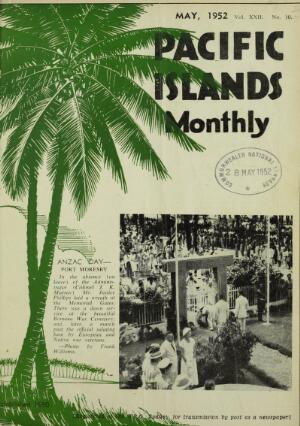
Anzac Day—
Port Moresby
In the absence (on leave ) of the Adminis trator (Colonel J. K.
Murray ) Mr. Justice Phillips laid a wreath at the Memorial Gates.
There was a dawn ser vice at the beautiful Bomana War Cemetery; and, later, a march past the official saluting base by European and Native war veterans. —Photo by Frank Williams.
Advertisements & other items, pp. 2-4 (2 items)
I U Points
a ton \ 2 V A “Qantas Islands Air Services save me weeks of travel . . . and the service
is simply wonderful”
QANTAS
SERVED BY QANTAS; Abau • Aitape Aiyura • Angoram • Arena • Awar Baiyer River • Banz • Bena Bena Brisbane • Buin • Buka • Bulolo • Cairns Chimbu • Daru • Deboyne Lagoon • Dumpu Esa'ala • Espiritu Santo • Finschhafen Garaina ® Garoka • Gusap • Honiara Inus • Jacquinot Bay • Kaiapit • Kainantu Kavieng • Kerema • Kerowagi • Kieta Kikori • Kup • Lae • Lake Kutubu • Lake Murray • Lindenhafen • Losuia • Madang Manus • Maprik • Mini * Moewe Hbr Mount Hagen • Nadzab • Nondugl • Norfolk is. • Noumea • Ogelbeng • Port Moresby Queen Carola Hbr. • Rabaul • Rockhampton Samara! • Suva • Sydney • Talasea Torokina • Townsville • Vella Lavella • Vila Wabag • Wabamunda • Wana • Wau Wewak • Woodlark Is. • Yandina • Yule Is.
Fly Qantas to Japan, Hong Kong, Manila and, in association with 8.0.A.C., to Malaya, India, Pakistan, Indonesia, Lebanon, Europe.
U.K.
AIR NETWORK LINKS
OVER a;
I U POINTS
IN NEW GUINEA
AND PACIFIC ISLANDS
WITH AUSTRALIA . . .
Now operating over 11,000 miles of tropical air routes, Qantas Air Services provide fast, regular and time-saving flights to more than 70 points (listed here), with special charters to any
recognised landing area.
You enjoy air comfort and hospitality at its finest when you fly by Qantas —Australia’s International Airline —hacked by 31 years of tropical
flying-
FLY
QANTAS
— there's a World of difference
QANTAS EMPIRE AIRWAYS LTD. fi»c. Queensland)
our
can Iron Better with a
Yc V
ema
n The big glass-smooth ironing base 16 square inches of surface of the Coleman Self-heating Iron is double pointed and heavily nickel - plated to glide smoothly and easily ove r any fabric.
The Coleman Self-heating Iron lights instantly, makes and burns its own gas, permitting continuous ironing and the fount holds one pint of fuel, sufficient for hours. The body has a blue vitreous finish which is easy to clean and keep clean. With its rust-proof body and heavily nickeled ironing surface, the Coleman Self-heating Iron will last indefinitely and, because it heats itself, the ironing can be done anywhere, indoors or out-of-doors.
Representatives for the Pacific. Islands
-BasP" ROBERT GILLESPIE PL Y I™
Mob
a & as
One Machine, D .
to Cut the Posts
n AND Dig the Holes
N>.V
TWO MACHINES IN ONE - AND
Basic unit is the famous Mobilco mobile Circular Saw.
Mobilco indexing device lets you change from felling to cross-cutting position and turn the blade to any angle through 360 degrees. Perfect balance, lightness and pneumatic tyred roller bearing wheels make Mobilco amazingly easy to move and handle. With 42" blade it fells or cross-cuts trees to 3' 6" in diameter. Take it into the bush, fell, cross-cut, rip or trim. It cuts quicker and is faster between cuts than any other. Mobilco is powered by a 7 B.H.P. British air cooled petrol engine.
EACH THE FINEST OF ITS KIND
CHANGE TO POST HOLE DIGGER.
Property owners and fencing Contractors will save mrny man-hours with the new Mobilco Post Hole Digger Attachment to Circular Saw. You now have a machine that digs a 10" post hole through average going to a depth of 2' 8" in fifteen seconds. You can also attach the Mobilco-Sher Power Drill which drills pests for wire. The Post Hole Digger is just as easily moved and operated as the Circular Saw. Saw, Post Hole Digger, and Post Borer make a complete fencing system. Each machine a quality Mobilco product to cut down labour and build .up output.
CIRCULAR SAW OWNERS
Owners of the Mobilco Circular Saw can convert it into a complete fencing system at moderate cost with this new Post Hole Digger Attachment. Post Boring Attachment may also be purchased.
BORE POSTS FOR WIRE
Fast vibrationless Mobilco-Sher Post Borer drills a I" hole through hardwood posts at great speed. It is driven by the 32 volt 500 Watt Mobilco-Electro generator attachment. On 20 feet of light flex. It gives freedom of movement.
EASY TERMS
AH Mobilco machines are available on a sound system of time payment.
This enables you to make a moderate deposit, take delivery of your machine and pay off the rest out of increased earnings. All machines carry the complete Mobilco 6 months* guarantee.
BILCO
MOBILE INDUSTRIAL EQUIPMENT
HEAD OFFICE: 410 WHITEHORSE ROAD, MITCHAM, VICTORIA. WU 1081 CITY OFFICE: 252 SWANSTON ST., MELB. TELEGRAMS “MOBILCO” MELB. CENT. 4799 Sydney Branch; 47 South Parade, Campsie. 'Phone LF4209. After Hours XV1733.
S.A.: Industrial Sales and Service, Dows Road, Cudmore Park, S.A.
W.A.: Industrial Sales and Service, Belmont Avenue, Belmont, W.A.
Tas.: Industrial Sales and Service, 3 Elizabeth Street, Hobart, Tas
LTD.
MC29PX
1
C I F 1 C ISLANDS MONTHLY -MAY, 1952
Shipping Tie-Tables
There now are comparatively few ship ping lines running on regular time-tables In the Pacific Islands. The following time tables are omy approximately correct— they are subject to much alteration at short notice:—
Sydney-Suva-N. America
Canadian-Australasian liner Aorangl (17,500 tons) maintains regular two monthly sailings—Sydney-Auckland-Suva- Konolulu-Victorla-Vancouver, and return
Sydney-Papua-N. Guinea
MV Bulolo, modern liner, sails about wery six weeks: Sydney-Brisbane-Moresby- Samarai - Lae - Madang - Rabaul -
lamarai-Moresby-Brisbane-Sydney.
Last departure from Sydney April 26.
MV Malekula will leave Sydney on day 21 for Samarai, Rabaul, Manus, dadang, Lae, Samarai and return to Sydney.
Details from Bums Phllp & Co. Ltd. 7 Irldge Street, Sydney.
Zealand-Fiji-Samoa-Tonga
Motor vessels Tofua and Matua. from Jew Zealand, serve Suva (Fiji), Nukua 3fa and Vavau (Tonga), Niue Is.. Pago 'ago (American Samoa), Apia (Western iamoa). Tofua leaves Auckland for any r all of above ports at approx, five weeks itervals. Matua calls at Wellington and yttelton (NZ) and supplements Tofua’s chedule in Islands, calling at ports as irected by owners. (Owing to hurricane damage to Fiji anana plantations. Matua was with rawn from service in March and will bt mployed elsewhere until May. when the osition will be reconsidered.) Tofua scheduled to leave Auckland 11 voyage late May or early June.
Details from Union 88 Co.
I. Zealand-Cook Is.-
Niue-Samoa
Old MV Maui Pomare (40 passengers) alntarns fairly regular service between uckland and Rarotonga (Cook Islands), V Samoa) atiVe CallS at Niue and Apia Details from Union Steamship Com iny or Department of Island Territories r elllngton, NZ.
Sydney-New Hebrides-BSI*
Rabaul, Etc.
MV Malalta will make a round trip at out 2-months intervals from Sydney to >rd Howe-Norfolk Is.-New Hebrides >rts - BSI ports - Bougainville - Rabaul * imarai-Sydney.
Next sailing about end of May Details from Bums Philp & Co 7 ridge Street, Sydney.
Sydney*N. Caledonia-Tahiti
Vessels of Messageries Marltimes Line, coming from Marseilles, via West Indies and Panama, call about every . six weeks at Papeete, Vila (New Hebrides), Noumea and Sydney, and return by same route. Details from Messageries Mari times.
Small motor-ships Polyneslen (Messa geries Maritimes) and Neo Hebridais (H.
C. Sleigh, Ltd.) maintain fairly regular service between Noumea and Sydney.
N. America-Fiji-N. Hebrides,
Etc.
Norwegian motor vessel Thor I. carry ing cargo and passengers (and shortly to be replaced by the new and faster Thorsisle) maintains a regular service between North American ports and French Oceania, Samoa, Fiji, New Cale donia and New Hebrides.
Details from General Steamships Cor poration Ltd., 432 California St, San Francisoo,
Rms Aorangi
5yd. ..
May 15 Sept. 25 Nov. 27 Auck.
May 19-20 Sept. 29-30 Dec. 1-2 Suva ., May 23 Oct. 3 Dec. 5 H’nTu , . May 30 Oct. 10 Dec. 12 Vlct. ..
June 5 Oct. 16 Dec. 18 Pane. .
June 6-12 Oct. 17-23 Dec. 19-24 Vlct. ..
June 12 Oct. 23 Dec 24 3’nTu . June 19.
Oct. 30 Dec. 31 3uva ..
June 28 Nov. 8 Jan. 9 Auck. ..
July 1-3 Nov. 11-13 Jan. 13-15 3yd. ..
July 7 Nov. 17 Jan. 19
Airways Time-Tables
Trans Pacific Services
1. Australia (or NZ)-Fiji-
Hawaii-N. America
By Pan-American Airways
With Strato Clippers, using Sleeperettes and Berths Thur. and Mon.—Sydney-Nadi (Piji)- Canton Is.-Honolulu-S. Prancisco-Seattle- Portland.
Sun. and Thur.—Return via same route.
Sat. - Auckland-Nadi-Canton-Honolulu-S.
Fran.-Seattle-Los Angeles.
Tues.—Return by same route.
By British Commonwealth Pacific
Airlines (Bcpa)
Wed. and Sat.—Sydney-Nadl (Fiji)-Canton Is.-Honolulu-S. Francisco-Vancouver, don. and first Thur.—Dep. southwards, same route. On second or alternate Thursday, flight commences at S.
Francisco.
Pues.—Dep, Auckland-Nadi-Canton-Hono lulu-8. Francisco-Vancouver. ’ri-—Dep. Vancouver and S. Francisco alternatively; thence same route to Auckland.
By Canadian Pacific Airlines
(Cpal)
Jternate Friday (May 23, June 6, 20 etc.) —Sydney-Auckland-Nadl (Fiji)-Canton Is.-Honolulu-S, Francisco-Vancouver.
Jternate Friday (May 30, June 13, 27 etc.) —Return by same route.
Sectional Services In
Pacific
2. Sydney-New Guinea
Service by Qantas Empire Airways
Northwards
Tuesdays, Saturdays (Skymaster) Depart: Arrive: 'dney, 7.45 pm Brls.. 10.30 pm rls., 11.40 pm Moresby, 6.30 am (Wed., Sun.) oresby, 7.30 am Lae 8.50 am Connects at Lae with DC3’s for Wau ilolo (Wed); and (Sun.) Rabaul, via Lae!
Mon., Thor.,* Frl. (DC3’s) dney, 8.30 pm Brisbane, 11.30 pm •isbane, 12.30 pm Rockhampton t Tue., Fri.,* Sat, -ckhampton, t Townsville, 5 am iwnsville, 6 am Calms, 7.10 am Ims, 8.20 am Moresby, 11.50 am
Moresby, 12.20 pm * Lae, 1,40 pm Lae, 3.30 pm (Tue.) Madang, 4.15 pm • Cargo service only. This departs Moresby at 12.50 pm Fridays and arrives in Lae at 2,10 pm. t Optional call.
Southwards
Wednesdays (DCS) Madang. 7 am Lae, 8.15 am Wednesdays (DCS) Wau, 11.30 am Lae, 12.35 pm Wednesday,* Thursday (DCS) Lae, 5.45 am Moresby, 7.05 am Moresby, 7.35 am Sydney, 10.15 pm Via Cairns, Towns., Brisbane, with optional call at Rockhampton. ‘Cargo service only.
Monday (DCS) Rabaul, 7 am Moresby, 10.20 am Moresby, 10.50 am Cairns, 2.10 pm Cairns, 3.10 pm Towns, (over „ night), 4.30 pm Towns., Tues., 8,15 am Brisbane, 1 pm Brisbane, 1.45 pm Sydney, 5 pm Wednesday, Sunday (Shymaster) Lae, 10.30 am Moresby, 11.40 am Moresby 12 .40 pm Brls., 7.10 pm Bns., 8.25 pm Sydney, 11 pm
3. N. Guinea Internal
Services
Operated by Qantas
Lae-Mancs (Dcs)
Every Wednesday.
Dep. Lae, 8 am; Plnschhaven. Rabaul Kavleng. Manus (3 pm).
Returns Saturdays (dep. 8 am), via Kavleng and Rabaul; optional call at Plnschhafen; arr. Lae, 2.45 pm
MORESBY-DARU (Catalina) Via Yule Is., Kerema, Wana (optional), Kikori, L. Kutubu.—Every alternate Wednesday; returning same day, (May 17, 28 etc.).
MORESBY-EAST PAPUA (Catalina) t Alternate Monday.—Dep. 9 am—Samarai- Esa’ala-Loulsa (overnight) (May 12, 26 etc.).
Alternate Tuesday.—Return to Moresby, via Deboyne Lagoon and Samarai.
Moresby-New Brit Ain -
Bougainville
In Alternate Weeks, (May 5, 19 etc.). by Catalina.
Alternate Monday.—Mor.esby-Samarai-Esa’ala-:Losuia-Rabaul.
Alternate Tuesday.—Rabaul - Talasea- Moewe Hbr.-Jacquinot Bay-Rabaul with optional call at Lindenhafen.
Alternate Wednesday.—Rabaul-Q, Carola Hbr-Buka-Kieta-Buin and return Witb optional call at Inus.
Alternate Thursday.—Rabaul - Losuia-Esa’ ‘ ala-Samarai-Moresby.
Lae-Madang-Wewak-Manus
Kavieng-Rabaul General
Service
Every Monday and Thursday by DCS.
Native traffic, not recommended for Europeans.
Central Highlands (Dhb4)
Tuesdays.—Madang (7 am) to Goroka.
Kainantu, Aiyura, Arena, as required, then returns to Madang (noon).
Thursdays.—Madang (7 am) to Wabag- Baiyer R., Hagen. Optional: Kerowagi.
Chiinbu. Returns to Madang (noon).
Fridays.—Lae (6.30 ato) to Wabag, calling at any of: Nadzab, Arona, Aiyura,. Kainantu, Bena Bena, Goroka, Chimbu, Kup, Non dugl, Banz, Minj, Mt. Hagen, Ogelheng, Baiyer R.. Wabamunda, Wabag. Return to Lae (6 pm),
I Lae-Garaina (Dhb4)
Tuesdays.—Departs 7 am; returns 9 am.
Lae-Bulolo-Wau (Drover)
Dep. Lae, —Tues., Fri., Sat.—3 pm.
Dep. Wau.—Tues., Fri., Sat.—Direct to Lae.
Services By Mandated Airlines
With headquarters at Lae, this company runs regular services for passengers, freight and mails to all New Guinea settlements.
4. Dutch N. Guinea-Darwin
By Netherlands Government, with DCS Weekly service, between Darwin and Biak.
Also, new KLM weekly service, calling at Biak, on flight between Manila and Australia.
5. N. Guinea-Solomons
Operated by Qantas • Each Monday (DC3).—Lae (dep. * am) - Finschhafen - Rabaul - Torakint (Bougain.) - Vellalavella - Yandina - Honiara (BSI) (arr. 4.25 pm).
Each Tuesday.—Honiara (dep. 7 am)- Yandina - Vellalavella-Toraklna-Rabaul Finschhafen-Lae (arr. 3.15 pm).
6. Indo-China-Brisbane-
N. Caledonia
By Air France, Monthly.
DC4 (Skymaster) dep. Saigon, May 2S and every 28 days thereafter fo: Labuan-Darwin-Brisbane-Noumea, am return.
Australian agents: Messageries Maritime!
7. Sydney-Lord Howe Is.
By Trans Oceanic Airways, with Flying boats Regular twice weekly service.
8. Sydney-Norfolk Is.
By Qantas, with Skymaster Alternate Thursdays, (May 8, 22 etc, returning same day.
9. Sydney-New Hebrides
By Qantas, with Sandringham Flying-boats: (May 13, S? etc.).
Depart: Arrive: Sydney, Alt. Tue., Noumea, Alt. Tue., 6.30 am 3.30 pm, (Night stop).
Noumea, Alt. Wed., Vila, Alt. Wed., 8.30 am 11.05 am Vila, Alt. Wed. Santo, Alt. Wed., 12.5 pm 1.20 pm Santo, Alt. Thu., Vila, Alt. Thu., 6.00 am 7.15 am Vila, Alt. Thu., Noumea, Alt. Thu., 8.15 am 10.55 am Noumea, Alt. Thu., Sydney, Alt. Thu., 12.30 pm , 7.45 pm Additional services operate subject to the ipproval of the Governments concerned.
10. Sydney-Noumea-Suva
By Qantas, with Flying-boats, Weekly Depart: Arrive; Sydney, Thur.. Noumea, 3.30 pm 6.30 am (overnight stop) Noumea, Pri., 8.30 am Suva, Pri., 3 pm Suva, Sat., 6 am Noumea, Sat.,.
T . 10.30 iam loumea, Sat., Sydney, Sat., 12.30 pm 7.45 pm
11. Auckland-Norfolk Is.
By NZ National Airways, with DC3’s (undays. —Prom Auckland, returning same day.
Alternate Wednesdays.—From Auckland returning same day. See also table No. 8.
12. Sydney-Auckland
Tasman E. Airways, with Solents
Dep. Sydney Wed., Sat.. Sun., 12 milnight; Wed., Sat., 7.30 am.
Dep. Auckland, dally, except Wed. and Sunday, 8.30 am.
Australian bookings: Qantas or TAA.
13. Sydney-Wellington
Tasman E. Airways, with Solents Dep. Sydney, Mon., Tue., Thu., Pri. at 10.30 pm, Dep. Wellington, Tue., Wed., Pri., Sat. at 10.30 am.
14. Melbourne-Christchurch
Tasman E. Airways, with DC4 Skymaster Thurs.—Dep. Melb., 10.25 pm; arr. Gh’ch., 8.15 am next day.
Pri - — De P ; Ch’ch., 11 am; arr. Melb., 5.35 pm.
15. New Zealand-Fiji
Tasman E. Airways, with Solents.
Dep. Auckland June 3,7, 10, 17 and 21.
Return to Auckland on following days.
Depart; Arrive: Auckland, 7 am Suva, 2 pm Suva, 8 am Auckland, 3 pm
16. Auckland-Fiji-Samoa-
Cooks
By NZ National Airways Corporation Alternate Sundays by DCS, via Norfolk Island, Nadi (Fiji), Faleolo (W. Samoa), Aitutaki (Cook Is.).
Depart: Arrive: Auckland, 9 am. Norfolk Is., 12.55 pm Norfolk Is., 2 pm Nadi, 8.40 pm Nadi, 9.45 am Mon. Paleolo, 3.30 pm Sun.
Faleolo, 11 am Mon. Nadi, 2.45 pm Tues.
Nadi, 9.45 am Wed. Paleolo, 3.30 pm Tues Paleolo, 8 am Wed. Aitutaki, 1.50 pm Aitutaki, 2.50 pm Rarotonga, 4.05 pm Rarotonga, Bam Pri. Aitutaki, 9.15 am Aitutaki, 10 am Faleolo, 3.15 pm Faleolo. 7.45 am Sat. Nadi, 11.30 am Sun.
Nadi, 5 am Mon. Norfolk Is,, 10.55 am Norfolk Is., 12 noon Auckland, 4.50 pm Mon.
All times local standard time.
17. New Zealand-Chatham Is.
Tasman E. Airways, with Solents.
No further flights will be operated until the 1952-53 summer period. For any in formation required apply to TEAL head office
18. Tahiti-Cook Islands
By Tahiti Airways, of Papeete Once monthly, from Papeete to Aitutaki (Cook Is.) with mails and passengers returning same day.
19. Auckland-Tahiti
Tasman E. Airways, with Solents.
TEAL service. Auckland-Suva-Aitutaki- Papeete, will be operated with Solent aying-boats once every two weeks. Depart Auckland, Tues. 7 am; arrive Suva, U)0 pm. Dept. Suva (Wed.), 10 pm; press International Date Line; arr. Aitu iakl, 7.20 am Wed. Leave Aitutaki 10 20 im; arrive Papeete 3 pm. Return by
SSWSS.S7 a,t ' prldar - leavlnB
The next flights leave Auckland May (7. June 10 and 24.
Pending provision of necessary facilities, ■k®. at A P ia (Western Samoa) is being Knitted.
20. Micronesia
Civilian services, based on Guam, using -engined amphibious Catalinas. run re- KrtiiLc? 0 £ or ? r (Palau) - Y ap (West *™Unes). Truk (Central Carolines), onape (E. Carolines). Majuro (Marshalls) nd Saipan (Marianas). Details from rans-Ocean Airlines, Guam, via Honolulu
21. Fiji Internal Airways
By Fiji Airways, with twin-engine de Haviland Rapides Suva-Nadi & Lautoka:—Twice daily service.
Suva-Labasa;—Daily except Wednesday.
Labasa-Suva;—Dally except Sunday.
Nadi & Lautoka-Labasa:—Every Wed nesday.
Labasa-Nadi & Lautoka;—Every Monday.
Approximate Airways Fares
The following figures are not guaranteed accurate, but they are approximately correct. Details should be obtained from the Air Company named in the Table Unless otherwise indicated, figures are In Australian currency.
Mr. H. O. E, Palmer, manager of the Gilbert and Ellice Colony Whole sale Society, with his wife, reached New Zealand from Tarawa on short furlough recently. While Mrs. Pal mer remained in NZ to undergo a minor operation, Mr. Palmer made a quick trip to Australia to interview applicants for the recently-advertised post of assistant manager for the G. & E. Wholesale Society. He returned to Auckland in early May and will stay in NZ for a month, to be present at the marriage of his only daughter, Delma Margaret, to Mr. Alfred John Lock, of Stanley Bay, Auck land. The wedding will take place at the Naval Chapel, Devonport, on June 14.
Prom Sydney To—
single Moresby . £46 11 o actum £83 10 0 Table
Ino.
2, 2a.
Lae ,. 55 7 0 99 13 0 2, 3 Rabaul .. 64 19 0 116 19 0 2. 3 Honiara,
Esi ..
80 7 0 114 13 0 5 Vila. N.
Hebrides 46 15 0 84 3 0 9 Noumea, NC . . . 39 8 0 70 19 0 10, 9. 6 Norfolk Is. 25 0 0 45 0 0 8 L. Howe .
It) 16 0 21 12 0 'i Nadi
(Pud •
60 10 0 108 18 0 Suva (Fiji) • 58 3 0 104 14 0 10 Auckland 47 6 0 84 2 0 13 Wellington 47 6 0 84 2 0 13 Chnstch. (from Melb.) . 52 18 0 95 5 0 14
Honolulu . 225 9 0 405 16 0 I S. Fran’co 279 1 0 502 5 0 1 Vancouver 279 1 0 502 5 0 1 Papeete (via Suva direct) . — 207 13 0 19
Prom Auckland To—
Table Single Return No.
Norf. Is.
£14 0 Onz
Less 10% 11, 16 Nadi (Fiji) . 31 0 0 .. 1. 16 Suva (Fiji) . 31 0 0 .. 16 Samoa 39 10 0 16 Cook Is. 45 0 0 16 Suva (direct) 31 0 0 ,, £55 16 0 15 Papeete 93 15 0 168 15 0 19
Advertisements & other items, pp. 5-12 (9 items)
3
ACIFIC ISLANDS MONTHLY MAY. 1952
Pacific Islands Transport Line
Owners: Thor Dahls Hvalfangerselskap A/S Sandefjord, Norway Regular Freight and Passenger Service between Pacific Coast Ports of U.S.A. and Canada and
TAHITI SAMOA FIJI NEW CALEDONIA
NEW HEBRIDES
GENERAL STEAMSHIP CORPORATION, LTD.
General Agents 432 California Street, San Francisco 4, Calif., U.S.A.
Agents—South Pacific PAPEETE—Etablissements Donald Tahiti APlA—Morris Hedstrom Ltd.
SUVA—Morris Hedstrom Ltd. NOUMEA—Etablissements Ballande PORT VlLA—Comptoirs Francais des Nouvelles Hebrides
LONDON - SUVA
S£^
VIA
PANAMA
For Sailings and Further Particulars Apply To: BETHELL, GWYN & CO., BURNS PHTLP (SOUTH SEA)
138 LEADENHALL ST., CO. LTD.,
LONDON, E.C.3. SUVA, FIJI.
*55 C <?•
for
SCRAP METALS
HIGHEST PRICES F.0.W., NEW GUINEA
Shells Cartridges Copper Brass Radiators Cable Aluminium Lead Muntz Metal Steel Rails Pipe ★ Wilford Street, Newtown, N.S.W.
LA 5111 LA 5111
BRANCHES THROUGHOUT N.S.W., VICTORIA & STH. AUSTRALIA Leader of the Secondary Metal Industry for 30 Years Telegraphic Address: "SIMSMETAL," Sydney.
ANDREW DONOVAN
217 Second Floor, Victoria Arcade, AUCKLAND, N.Z.
Phone: 44-534.
SHIP BROKER, MARINE
INSURANCE BROKER.
DIRECT IMPORTER OF
MARINE ENGINES (Petrol
and Diesel) AND
EQUIPMENT.
REAL ESTATE AGENT.
All types passenger and cargo vessels offered at reasonable prices. Also fishing boats, keel and centre-board yachts, launches, sailing dinghies, runabouts and outboard motors.
New Marine Engines, Eco Pumps, Reverse Gears, Propellers, and all classes of Ship Chandlery always on hand.
RVJSTOH
LINCOLN ROLAN
Ruston marine oil engines have established a world-wide reputation for dependability In all classes of service. The range of propulsion engines covers high-speed and medium-speed types suitable for the propulsion of vessels of every class. i^° a d rl , Lf Vail ! TOm 22 to 3)650 BHP pressure charged). Illustrated Is (ype 3VSHM-34/37 o
CONTACT OUR ENGINEERS.
(CD. in
CUSTOMS ST. EAST,
AUCKLAND,
NEW ZEALAND.
Represented in Suva, Fiji, hy
COLONIAL MOTORS
N E y £ *he Eel
THIS
INTERESTING
AND
AUTHORITATIVE
BOOKLET
Should be in the hands of all who have made a Will or
are contemplating doing so.
Bums Philp Trust Company Limited will be pleased to forward a copy of their 20-page booklet, “Hands That Never Leave The Wheel”, to any executor or to anyone who is anxious to ensure that his or her estate is faithfully and conscientiously administered after death. It contains information of the highest value.
“Hands That Never Leave The Wheel” may be obtained from any branch of Bums Philp (South Sea) Company, Bums Philp (New Guinea) Company, Burns Philp (New Hebrides) Limited, or direct from the head office of this Company.
DIRECTORS:
James Burns.
P. T. W. Black.
Joseph Mitchell.
Eric Priestley Lee.
MANAGER: L. S. Parker.
SECRETARY: E. R. Overton, F.F.I.A.
Burns Philp Trust
COMPANY LIMITED
Executor • Trustee • Attorney
Head Office: 7 Bridge Street, Sydney.
Tel.: BU 5901 Box 543 » G- I *- 0 * N.S.W. Country Agencies at Armidale, Kempsey, Orange and Tamworth.
Also Registered Offices at Melbourne, Brisbane, Port Moresby ( Papua ), and Vila (New Hebrides) .
PRIVATE HOTEL,
Priory Road, North Sydney. >fK 9 nl J fi y e ml ° utes ’ drive across the Sydney Harbour /till i] Bridge from the City, “Bellhaven” Is quietly situated your rest is assured in this new, comfortably furnished and well serviced hotel.
Handy to transport for beaches, Olympic Pool.
Zoo, all sights, and Australia’s leading City of entertainment and night life—Sydney.
Modern Room or Suite Accommodation.
TARIFF FROM 16/6 PER DAY.
Manager : A. L. GUARD.
Write or Cable “Bellhaven,” North Sydney Phone; XA 1746.
We have pleasure in offering Latest Type
FULL DIESEL
SKANDIA ENGINES
MARINE AND STATIONARY
5 H.P. 450 H.P.
Rapid Starting from Cold. Starts and runs on lowest grade fuel oil.
EARLY DELIVERY COMPETITIVE PRICES
Particulars from:
NELSON & ROBERTSON PTY. LTD.
12 SPRING STREET, SYDNEY, AUSTRALIA.
Cable Address: “IVAN,” SYDNEY.
ivu jr- Mm- »/ The 2947 miles of the N.A.C. internal network routes are the highways to New Zealand’s scenic and sporting attractions.
Save travel time, see more ... fly for extra comfort with Offices and Agents throughout New Zealand and the South- West Pacific for the Dominion and South-West Pacific Air Network. / '
MARINE ENGINES
MORRIS VEDETTE' 4 Cylinder 6/12 h.p. Petrol or Kerosene MORRIS "NAVIGATOR" 4 Cylinder 12/24 h.p. Petrol or Kerosene MORRIS "COMMODORE" 6 Cylinder 20/40 h.p. Petrol or Kerosene CHRYSLER "CROWN" 6 Cylinder 45/102 h.p. Petrol CHRYSLER "ROYAL" 8 Cylinder 55/132 h.p. Petrol LEYLAND DIESEL MARINE 6 Cylinder to 125 h.p.
AMERICAN STERLING AND SUPERIOR DIESELS
Further 'particulars from the distributors :
LARS HALVORSEN SONS PTY. LTD.
WATERVIEW ST., RYDE ( "gs** ). N.S.W.
Telegrams: Halvorsens. Sydney. -Phone. Ey „ e 7#5
• LARGE RANGE OF BOAT FITTINGS
BUILDERS OF HALVORSEN BOATS
STEEL BUILDINGS
® * T 8 PURP° SE
for evERV r
A
THE
REVOLUTIONARY
CLEARSPAN BUILDINGS
Rise to a clear working height from 30 to 40 feet under the unique clearspan arches, which can be supplied in spans from 130 ft. to 300 ft. to any length which is a multiple of 12 ft. Ideal for AIRCRAFT?
HANGARS, ASSEMBLY WORKS. STORES, etc.
Wm
THE CLEARSPAN “R” SERIES BUILDINGS
are available from 40 ft. to 102 ft. wide. The steel spans have no interior supports or cross ties and provide floor space with unbroken working height up to 30 ft. Any length which is a multiple of 15 ft. can be supplied.
RIGIFRAME SEMI-CIRCULAR STEEL BUILDINGS
with no interior columns or supports of any kind, is particularly suited for THEATRES. CHURCHES, FACTORIES, STORES, GO- DOWNS, etc. Standard Size:—lo2 ft. long x 40 ft. wide x 20 ft. high.
Length can be increased in multiples of 6 ft. as required.
A. J. AN PERSON
€ CO. PTY. LTD
Buildings by Standard Steel Co. are produced to an entirely new design to conform with most known building codes. They are fully tested for strength and rigidity and because of their lightweight segments they are particularly suited to areas where limited handling facilities are available. Structural members consist of latticed joists which effect a saving i? At ?t, eel of over 50 per cent - an d the EASE and SPEED with which they can be erected saves enormously on the cost of construction.
Covering is of new corrugated iron and this—together with all steel work—has been specially processed before being dipped in aluminium paint to prevent rust. They are also impervious to white ants, borers, termites, etc., and are ideal for
• GO DOWNS
• STORE SHEDS
• AIRCRAFT HANGARS
• FACTORIES
• HALLS
• CHURCHES
• THEATRES, etc.
A. J. Anderson & Co. Pty., Ltd., invite you to write, giving some indication of your requirement, and full information as to cost and delivery date, etc., will be forwarded bv return mail.
Head Office: SB-64 CARDIGAN ST. CARLTON. MELB.
Telephones ; Fi 4178. FJ *Bl4. FJ *Bl5
ADELAIDE ;
Managing Agent. : HANKS A CO. LTD . Cnr. Wright and Market Street.
Telephone ; Cent. *1»«. Cent. 4441
PERTH
Sole Distributors for STANDARD STEEL CO. PTY., LTD., manufacturers of Clearspan and Rigiframe buildings
4
MAV, 19 52- PACIFIC ISLANDS MONTHL
5
* CI F 1 C ' SL * N D « MONTHLY MAY, 1 952
6
MAT, 1952-PACIFIC ISLANDS MONTHL
7
ACIFIC ISLANDS MONTHLY-MAY. 1952
8
MAY, 19 52- PACIFIC ISLANDS HONTHL
9
ACJFIC ISLANDS monthly - may 1952
10
MAY, 1952-PACIFIC ISLANDS MONTHL
Index To Advertisers
A. & N.Z. Bank 132 Achun, G. . . 121 Akta-vite ... 75 Alois Akim . . 107 Aluminium Ltd. 88 Amplion Pty. .. 133 Anderson, A. J. ' 10 Angus & Robert son Ltd. . . 26 irdath Co. . . 62 Aspaxadrene . 33 Aspro ... 105 Jambridge, T. 50 lank of NSW 87 Sell, S. P. & Co. 30 ‘Bellhaven” . . 7 Jerry’s B. B’y’d 127 Jethell, Gwyn . 3 tlaxland Rae 131 tlundell Spence 122 torthwicks Pty. 78 lovril Ltd. . . 53 Tasso ... 90 iraybon Bros. 120 ristol-Myers . 79 Titish Friends 37 troomfields . 128 run ton & Co. 75 unting’s . 46, 89 urns. J. & Co. 5
•P. (Ng) ... 73
.P. (Nh) ... 77
•P. (Ss) ... 84
P. Trust Co. . 6 adbury-Fry 98 aine’s Studios 47 arpenter, W. R. & Co. 102, cov. iv. irpenter (Fiji) 125 irr, Pountney 117 assifled . 134-135 jlgate’s 25, 56. 74 ilman & Co. . 107 ilonial Meat . 116 ilyer Watson <NG> 58, 95 impagnie Pu Ofe .133 >rrie & Co. . 91 ammond Co. . 60 mningham, R.
H. Pty. Ltd. 26 rstex . . . H 9 ingar. G. & M. 11 maghy & Sons 23 maid Ltd. 42, 78 movan. A. . 5 mglass, W. c. 91 mlop Rubber 49 imore Farm 33 • Donald . . 82 rd Sherington 61 rsgren, H. . 49 irrett, D. M. 136 irrick Hotel 129 Ibey, W. & A. 32 llesple Bros. . 94 llespie Robt. 1. 40, 51, 104 llespie NG • • . 62, 115 llette Ltd. . . 96 ayva Liqueur 23 rdon Vale Co. • • . A 101 ugh & Co. . 57 ahame Books 105 P.H. (Suva) . 12 ove, W. H. & Jons Ltd.. 30, 86 & R. Pty. . 39 Worsen Sons 9 inz & Co. . 39 llaby, R. & w. 43 rco Pty 58, 112 rcules Co. . 103 Hand Rusk . 41 rlicks Ltd. . 80 mphreys & JcConnell . 47 geia Co. . . 100 test Pty. . 108
Is. Electric Co. 93 Is. Industries . 113 Jackson, S. W. 134 Karp, Tulk Co. 32 Kennedy, Capt. 128 Kerr Bros. Ltd. 81 Kerry, M. Pty. 35 Kodak (A/asla) 29 Kolynos Inc. 44 Kopsen & Co. . 119 Kraft Foods . 81 Launch for Sale 128 Lillis Co. .’ 110 Macintyre, T. . 46 Mac Robertson’s 45 Mcllrath’s Ltd. 36 Majora Paints . 28 Mendaco . . . 124 Millers Ltd. . 108 Mobile Equip. . 2 Morris Hedstrom 22 M. (Aust) . 109 Mungo Scott . 77 N. & R. Ltd. 7, 99 National Instit.
Visual Learn ing 31 Nirex Pty. Ltd. 59 “Nixoderm” . . 11l Nordman, O. . 133
Nznac ... 8
Oliver Britstand Distributors 38 P.A. Airways . 24 Pabco Products 114 Pinkettes ... 57 P.I. Society . . 51 P.I. Trans. Line 3 Qantas . . cov. ii Qld. Insurance. . 35 Quirk’s Co. . . 92 Ransomes Co. . 42 Refrigerator In stallation Co. 41 Reed, Wm. E. 129 Riette, A. . . .45 Riverstone Co. 106 Robinson, G. H. 97 Rohu, Sil . . . 89 Scott, J„ Ltd. . 86 Seward Ltd. . . 53 Shell Co. . . 63 Sherwin-Williams 64 Simpson Bros. . 36 Simpson, Wm. 55 Sims, A. G. . . 4 Smith Copeland 76
S.M.P. Co. . . 52
Spartan Paints 124 Spruso Co. . . 29 S. Ltd. . . 112 Stewarts-Lloyds 94 Sthn. Pac, Ins. 99 Stinsons (Fiji) 93 Sullivan, C., Ltd. 90 Tait, W. S. . .54 Taylor & Co. 104 T. . . cov. iii Thornycroft Co. 126 Tilley Lamps . 54 Tillock & Co. . 85 Tongan Photos 63 Tooth & Co. . 123 Turners & Growers Ltd. 37 Tyneside Eng. . 83 Vacuum Oil Co. 130 Valiant Rum . 82 Ventura Co. 61, 136 Vessel For Sale 127 Vincent’s APC 118 Vi-Stim ... 117 Warnock Bros. 100 Wiles Mfg. Co. 34 Williams’ Pills .124 Wills Ltd. ... 48 Winns Ltd. . . 25 Winstone Seeds 121 Wise Bros. . . 97 Woods’ Cure . 11l Wrigley’s Ltd. 50 Yorkshire Ins. . 85
Advertisements & other items, p. 13 (2 items)
11
ACIFIC ISLANDS MONTHLY MAY, 1952
The “Shave”
What makes
More
Versatile!
because it's better on the hillside and just as good on the flat !
The Super “Shave” ploughs in hard, sloping, soft or marshy ground. The “Shave” will not side-slip, no matter how steep your ground may be. In fact, the “Shave” Super Reversible Disc Plough can go anywhere and do what bigger and more expensive ploughs cannot do! The discs of the “Shave” plough roll over obstructions, rather than jump, thus leaving no unploughed patches. It can be used as a single, double or three-furrow plough and is extremely light on horses.
Dangar Gedye & Malloch Ltd.
10-14 YOUNG STREET, SYDNEY.
Cables: “DANGARS.**
In This Issue:
Editorial: Dismal outlook in the World .. .. 13 What is Purpose of P-NG Cus toms Inquiry? It Could Mean Income-tax 15 Editors’ Mailbag 16 Avarua Has Waterspout . . 17 Louisiades Battered By Cyclone 17 Another Aspect of Recent Buka Case .. 18 MV Lolowai Ashore 18 Do You Remember? 18 Wool Spinning in New Guinea 19 £100,000,000 of Salvage of!
New Hebrides! 20 New Phase in War about
Cheng-ho .. .. . . 20
The New HCWP—Honiara Not in Favour as H.Q. 21 End of Queer Wardist Regime in P-NG—Tribute to Col. and Mrs. J. K. Murray 21 NZ Interested in Guam . . 26 Territories’ Talk Talk . . 27 Much Movie Making in Fiji . . 30 Advisory Council Survey in BSI 31 Fiji too. Lived Beyond 1951 Income .. .. 33 14 Awards and Some Omissions —Mt Lamington Disaster in Papua .. .. .. .. .. 37 Oceanic S.S. Company Loses More Money 39 Qantas Sandringham on P-NG Outport Survey 41
Suva Housing Settlement for Fijians ■ - 42 Nadi’s Third Runway 43 10 Years Ago—What Really Happened in the Coral Sea .. 45 A Nominated Executive Coun cil not for W. Samoa . . .. 49 Western Samoa May Get a New Liquor System 51 Native Rice-Production in P-NG—Land Rights and European Settlement 53 Pacific Air-Fares Go Up . . 57 Kava is Bad for You—or Good 59 Rubber Outlook Gloomy 61 Fiji Trade Unions Federate 63
Magazine Section—
The Canoe-Builders 65 Crossquiz 66 Tropicalities 67 Tahiti’s Fashoda 69 How Whalen Populated the Ninigos 71 Jubilee for Dr. Fox 81 More Money for P-NG Copra 82 P-NG Experiments with Village Councils 83 Racial Sensitiveness Leads to Incidents in Fiji .. .. 85 Australia is now Seeking Cocoa 87 Not all Plain Sailing for RSYC 89 Fiji Health Stamps—Anti-TB Campaign—Only Partial Sue
cess 91 Administration-Mission Fric tion in Education Field . 93 Samoan MLA’s Resent News paper Attacks .. .. .. 95 Costly W&H Experiment on Manus 96 Second Drover Goes into Sea —Presence of Mind Saves Three Men .. 97 Should Fijians “Hunt and Kill” in Malaya 103 How Came the Chinese to New Guinea? .104 For Pacific Radio Amateurs .. 107 What Next in Dutch New Guinea? 111 Acute Shortage of Rice in BSI ll4 Important Development in Search for Gold in Fiji .. 115 Anzac Day in the Islands 117 South Pacific Commission — Ninth Session— US New Guinea’s New Timber Co. 127 Notes from Tahiti . . . . 123 OBITUARY: Capt. K. McPher son; Mr. G. Gray; Mr. Davis Wood; Mr. L. N. Bean; Mr.
I. D. Moore; Mrs. A. T.
Anderson; Miss A. M. Rice 124-125 News of the Small Ships .. 121 Fiji Broadcasting Commission Plans 135 BSI Methodists’ Golden Jubilee 135 Commercial Markets etc. .. .. 13<
Advertisements & other items, p. 14 (2 items)
12
MAY, 1952 PACIFIC ISLANDS MONTHL
te V,*.aS“? vs?
sW U 3 the social Shea the V P ■ direct «otej.
G^an a PPii Pac *” eu7a abie Ca ti ot} m m i t)^ m * situated
oT^ p^TuT^ h o^r***
° eatre «* ty . - J aZ’- , tr °PiGSL t, e . Xc eU en r for s 'l* by at . bidian a. CtoTe^f? ff **, b
te V,*.aS“? vs?
Pacific Islands Monthly
The Newspaper-Magazine of the'South Seas Distributed in AUSTRALIA , NEW ZEALAND and the following PACIFIC ISLANDS:
Australian Territories: Papua. Norfolk Is.
Cocos Is.
Aost. Trustee Territories; New Guinea. Nauru.
British Protectorates: Solomon Is. Tonga.
British Crown Colonics: Fiji. Gilbert & Ellice.
New Zealand Territories: Cook Islands. Niue.
N.Z. Trustee Territory: Western Samoa.
French Territories: New Caledonia. French Oceania.
Anglo-French Condominium: New Hebrides.
United States Territories: Eastern Samoa. Hawaii.
U.S. Trustee Territory; Micronesia (Caroline, Marshall and Mariana!.
Dutch Territory: Western New Guinea.
A Product of Pacific Publications Pty. Ltd., Union House, 247 George Street, Sydney.
Contributions:
Lrtlcles. Stories, and Photographs dealing srith Pacific Islands subjects are Invited and will be paid for on publication.
Subscription Rates:
n Australia and New Zealand, and Australian. NZ. and British Pacific Islands ... £l4 0 Tew Caledonia, Tahiti .. .. £ 1 7 0 Jsewhere .. .. 3Va US Dollars £ I 10 0
Telephones: Bw 5037. Bu 6082.
G.P.O. Box 3408.
Registered Address for Telegrams. Radio grams, and Cables: “Pacpub,” Sydney.
Editor and Publisher: R. W. ROBSON.
Assistant Editor: JUDY TUDOR.
Business Manager: SELWYN HUGHES.
Representative In London:
J. T. Wallis, Coronation House. 4 Lloyd’s Avenue. London. E.C.3. from whom may be obtained copies of Pacific Islands Monthly, Pacific Islands Year Book, advertising schedules, etc.
Agents:
See full list of Agents, arranged by Territories, on page 135.
Vo\. Xxii. No. 10.
May, 1952
PRICE: 2/- Per Copy.
Dismal Outlook In The
World
rHE outlook, both domestic and international, is ugly and de iressing. Well-balanced folk say iat this is the time for a little ptimism. It is hard to avoid the seling, however, that some sort of risis in human affairs is close.
Uneasiness is world-wide. The bief cause of international tension, f course, is very plain. The world’s revolutionaries, centred on nd directed from Moscow, com letely dominate the score of ations now flying the Red flag, nd they all are working fanatically, irough millions of hidden agents, 3 weaken the free nations from ithin, so that they can the more jadily destroy us, when the signal given. Only a fool would deny lis. The evidence is all around us, i weak and crooked politicians, in ustrial dislocation, economic coll ision.
The thing that is not so easy to :e, and the causes of which are enerally obscure, ds the resigned (difference of the better classes to hat is going on. There is no ex iosion of public anger against the >-called public men who are cy ically destroying our most cher hed institutions; no concerted tempt to clean up the politico :onomic mess within, so as to meet ic totalitarian threat without.
It is as if the people of all the Western Powers are saying, “Let us it, drink and be merry, for to orrow we shall be the slaves of ie Communists! ’
In the past, within living memory, there always hitherto has been a quick, definite reaction by the more intelligent and responsible classes against any attempt by the lower strata of human society to go on an economic or social rampage.
There has been no hesitation in de fending the conditions of life, and the public institutions designed for government, which we have evolved so painfully in two thousand years of sociological struggle. But to-day, outside the United States, there is not anywhere a sign that the majority of people are getting ready to resist, as a personal and patri otic duty, the thing that now, in huge and terrifying shape, threatens our individual freedom, and the human decencies.
Honeycombed by social and industrial saboteurs, the economy of most of the British nations, and of France and Italy, seems to be collapsing before our eyes. Britain herself is in a de plorable condition, and getting worse. The swing-over from the muddling Socialists to the Conserva tive Old Guard was too little and too late. No effective remedy is in sight for the facts that 45 million people cannot live on that small is land unless they export hugely; that their already inadequate markets are being seized by a restored Ger many and Japan; that they are be ing forced to carry again the in tolerable burden of heavy ar
maments; and that the industrial masses there have been taught in seven years of fumbling Socialism that they need not work the long, hard hours and make sacrifices that arc their only hope of salvation.
France is in no better condition.
Italy is worse—it seems likely that that over-populated nation, in the coming general election, will swing over to Communism.
The industrial masses throughout the “free world” are screaming for bigger rewards, shorter working hours, extended privileges. Even the United States, our only hope among the nations, is at this moment convulsed by strikes in her vital steel and oil industries. The world’s population is increasing by leaps and bounds, while the means of feeding and sheltering the people become less, instead of more. The pi:iful little men who, through the political machines, have forced themselves upon us as national leaders are, for the most part, run ning around wringing their hands, babbling platitudes and appealing to their swarms of useless Planners.
Controls and Planners make a recovery through fundamental eco nomic laws—based upon human selfishness, trade competition and supply and demand—practically impossible. Each Planner demands a Control; each Control begets two more Controls.
While we place our faith in pro fessional politicians. Planners and Controls, little can be done to help the nation by our natural leaders—* men prepared to give public ser vice from a sense of duty, as a per sonal sacrifice, and without reward*
Many such men were available once, before the Parliaments sur rendered to the political machines and the caucus rooms.
THE nations, plunged by war and blundering politicians into this incredible confusion, might have clawed their way out again to com parative quiet and peace, were it not for Russia.
While, after 1945, we disarmed, Russia armed. While we set out on a wild, socio-political spree, which gravely weakened our economic structure and created intense bad feeling between classes, Russia cre ated her huge bloc of Communist nations, and threw her mantle all across Asia. While we gloried in our World War II victory, Russia got ready to give effect to the dicta of Lenin and Stalin, that the best way to destroy Capitalism and change the world’s living conditions, is to impose Communism upon the nations by armed force.
Russia got ready to fight; but the penetration of the free world’s economy by her secret agents, and her propaganda among the un educated industrial masses, have proved so effective that, lately, she has hoped altogether to avoid war.
If nothing is done to end this political and economic confusion among us, the Western nations will
simply fall into the maw of the waiting Communists.
That is why this moment seems so critical. Everyone talks of “the impending struggle of 1954,” when both sides will be ready for the test of armed strength. Many politi cians argue that when we are fully armed, Russia will avoid conflict.
Unhappily, while our military strength grows, our economic and political strength, and our national morale, become perceptibly weaker.
Russia, already our equal, at least, in divisions and planes, will be ready to use her Hydrogen bomb in 1954—tests of it are scheduled for next month. Russia is deter mined that we shall have no help from Western Germany or Japan— that grave communist rioting in Japan, and to-day’s friction on the Berlin Autobahn , are of Red origin.
If war is unavoidable—and this uncompromising clash of ideologies seems to make it so—it might be as well to have it now, before Western morale further deteriorates.
NORMALLY, there could be no doubt about the outcome.
Neither Russians nor Chinese ever have been noted for military prow ess; once keyed up to the job, the Westerners could beat them thor oughly in any kind of armed con flict, Both Russians and Chinese
have survived as independent nations, hitherto, because of theii endless masses of men, and the end less distances in their defended areas; But if this decay in Western morale continues—largely the re sult of conditions created by the Red bloc —the overthrow of Russia would not be a foregone conclusion.
The signs and portents are not reassuring. There is stalemate in Korea and Malaya; active friction at many points where the Red and the Western systems touch; almost intolerable and growing arrogance on the part of the Russians in places in Central Europe, especially Germany.
Some think Russia is embarrassed by growing resistance to her rule behind the Iron Curtain, and sc fears to fight. Others see no move by the West to precipitate the struggle because of the American Presidential election; America may want her new leadership established before resorting to action.
But, whenever it comes, and whatever the circumstances, posi tive action at last will be a relief, Since 1939, we have had 13 years of struggle, sacrifice, and snarling discontent. Is it too much to hope that, with the destruction of the Communist horror, poor old human ity again will know a period ol quietness and peace?
Ninth Session of South Pacific Commission
(Report page 119 this issue)
This group was photographed in front of the Pentagon Building, Noumea, New Caledonia, headquarters of the Commis sion, on April 28, when the Commissioners, Advisers and Principal Officers assembled for the Commission’s Ninth Session, which lasted for ten days.
The Senior Commissioners are in the front of the group. From left to right:—
Mr. H. H. Vaskess, CMG, QBE (in white suit), United Kingdom.
Dr. K. C. Leebrick (United States).
Mr. J. A. de Voogd (in dark glasses) (Netherlands).
Mr. J. R. Halligan (Australia).
Mons. R. L. Lassalle-Sere (France).
Mr. C. G. R. McKay (New Zealand).
Mr. de Voogd, who is Holland's Minis ter Plenipotentiary in Australia, was chairman of the Ninth Session.
The new Secretary-General of the Come[?] mission, Sir Brian Freeston, KCMC[?] formerly Governor of Fiji, is the tall ma[?] in the second row, between Messrs, d[?] Voogd and Halligan.
Inquiry
Purpose Of Customs
Is It First Step Towards P-NG Income Tax?
lITHEN the Customs Inquiry Com ** mittee, under the chairmanship Professor S. J. Butlin, and in structed by Canberra, began taking evidence in Sydney on May 4, few ?eople knew anything of the purpose tnd object of the inquiry.
It was officially explained that the Committee will consider what effect i Customs Union or free trade area vith Australia would have upon the :ost of living, industry and develop nent of the Territory. Having con idered. the Committee will report to he Commonwealth Government.
The obvious fact is that, if the lustoms Tariff is to be adjusted lownwards. so as to allow goods to ome in at reduced cost, revenue nust come in from another source; ind that, of course, would be taxa ion of incomes.
Some people see in this inquiry the irst definite and official step towards he introduction of direct taxation.
Vhat the majority are interested
in, however, is the effect of a “free customs union” with Australia. One Moresby retailer predicts—hopefully, perhaps—that like so many others, the report will be filed and eventu ally forgotten. He said that if a Cus toms Union were introduced, some departments in his store would thrive, while others would diminish in turnover.
But on the whole he was pessimis tic. “We are unable to obtain all our requirements from Australia,” he said. “With Australian protective tariffs operating in the Territory, prices of foreign goods would be be yond the reach of the consumer.”
Firms would have to increase clerical staffs to cope with compli cated Customs procedure if the Terri tory were to adopt the Australian Customs tariff said an agent. “A Customs tariff has two main pur poses: to raise revenue and protect industries. Here we have no indus tries to protect. It would hinder our progress to have manufactures shut out by a high tariff wall.
“What may be a good Customs pattern for an industrialised, white populated country, like Australia, is not suited to our requirements.”
Minister for Territories Hasluck has gone on record as saying he sees no reason why Territorians should be treated as “foreigners” in Australia.
He said he was amazed at the num ber of complex forms which had to be filled in by anyone travelling to and from the Territory. He thought this kind of thing should be reduced.
A few other things Territorians would like to see reduced are; Ex port levies on flour and soap sent to the Territory from Australia; embar goes on exports of cement and gal vanized iron; crippling Customs de posits on the entry of their cars into Australia when they go on leave.
These things might be straightened out by an all-out Customs Union with Australia.
But how unpopular would a Cus toms Union prove to be with Queens land banana growers or NSW trade unionists? Just one shipload of P & NG bananas or, say, some cheap manufactures made by native labour, and there would be cries of woe in Canberra.
For it is the Australian electorates which have the say in Canberra.
Territorians have none.
A Port Moresby auditor, Mr. S.
Fox, said that a Customs Union with Australia would have dangerous im plications, unless Papua and New Guinea were included as a new State of the Commonwealth. Otherwise, the Territory would get all the dis advantages of Union without any advantages. ,
M. Alfred Poroi, well-known and popular Mayor of Papeete, wearing the Medal of the Legion of Honour which has [?}ust been conferred upon him by the Republic of France, in recognition of [?]utstanding service. Under the direction [?]f M. Poroi, the charming town of [?]apeete has been improved in all [?]irections —and especially by the building [?]f fine new roads, bridges, public services [?]nd buildings.
Audrey
Why Little
Laughed And Laughed
WITH amazement and horror, Sydney’s Kai Viti read this in the Sydney Sun of May 8: • Schools in— the brewery Fijian children are doing their lessons in the breweries since the recent hurricane blew down most of the schools, says Mrs. G. Ongley, who came in by Pan-American strata clipper yesterday, from Suva.
“Desks, blackboards and maps have been set up in the breweries, which are strongly built and so stood up to the severe weather.
“There is a brewery in every small town” she added.
But Little Audrey laughed and laughed—because she knew that what Mrs. Ongley said was Bure, not Brewery; and that a Bure is a native house, built of native materials.
Mean Income Tax
P-Ng Customs Union
Could
TjHGHT companies trading in Papua-New Guinea combined to place before the Australian Customs Inquiry Committee, now taking evidence in the Territories, a series of reasons why there should hot be a Customs Union between Australia, Papua and New Guinea.
They presented a strong case against a Customs Union. The crux of it was in the following section, headed “Taxation”:— “If revenue, at present raised through import duties on goods from Australia, was forefeited or dispensed with, what means would the Ad ministration adopt to reimburse themselves for the revenue loss?
We can only assume this would be recouped by taxation.
“Development of the Territories would reach a point of stagnation if company or personal taxation was instituted in the Territories.
“In addition, it would probably lead to an immediate exodus of Europeans from the Territory, par ticularly the salaried class.”
Economy drive, or scraping the bottom of the barrel; The P-NG Treasury in April decided that it could no longer pay out £lO a year for prizes to European schoolchildren.
Advertisements & other items, p. 17 (1 item)
15
ACIFIC ISLANDS MONTHLY MAY, 1952
The Editors' Mailbag
Hermits Wreck —
True Version
IN January PIM (page 114) was told a widely accepted story of the old wreck that lies on a reef at the N-W entrance to the Hermit Atoll, centre of Heinrich Rudolph Wahlen’s pre-World War I “business empire”, north of New Guinea.
Mr. Wahlen, writing himself from Hamburg, says that the story was more fancy than fact; he gives some interesting details of what actually happened. His letter reads in part: “The name of the steamer was Herzog Johann Albrecht and it be longed to the New Guinea Co. . . . and was named after the then Presi dent of the Deutsche Kolonialgesell schaft in Berlin. At that time I was still with Hemsheim & Co. and the wreck happened before 1900.
Hemsheim's sailing schooner Welcome, about 80 tons . . . having left the Ninigos with a full load of beche-de-mer for the Hermits, stranded early in the morning . . near Mono Island.
After the cargo was saved the crew and supercargo remained on Mono whilst Captain Buck sailed in a ship’s boat to Madang for help.
The New Guinea Co. at once des patched the Herzog Johann Albrecht and, reaching the N-W passage early in the morning, the captain was blinded by the sun and the vessel touched the reef . . . and shortly after a heavy roller swept them right up on the reef.
When the bad news reached Madang the North German Lloyd sent a message to rescue both crews.
“When I established myself in the Hermits in 1902 the great N-W pas sage was flanked by two great water marks” says Mr. Wahlen “and these marks, together with the electric lights of the Wahlenburg (home stead) facilitated in a large way the entrance to the harbour, even by night.”
Inquiry From Colorado
THIS is from a former Yank soldier: “Can you put me in touch with a Robin McKay or Alistair Mac Lean, or an old rascal named Bill Money, a gold-miner, all of whom I knew in New Britain during the war in 1944? *1 was a platoon leader in the 185th Infantry of the 40th Division then, and used to run patrols from
Talasea, on the Willaumez Peninsula, via PT Boat and LCM, up to Ula moma and Open Bay. They were Allied Intelligence Bureau scouts (first two) and Money was the ALB Liaison officer with our regiment.
“Last I heard from McKay, he was in Bougainville running a plantation.
Mac Lean probably is back in Rabaul, and Money is at Kavieng. Old Bill, by the way, claims to have fired Errol Flynn off his plantation at Kavieng.”
The men named—all well-known to PlM—are invited to get in touch with Mr. James M. Flinchum, United Press Association, 650 150th St., Denver, Colorado, USA. Jim Flin chum is a well-known newspaper man. Maybe, he wants Bill Money to give him more details of that Errol Flynn story.
That Record Fish
A READER commenting on our April story of big-game fisher woman Mrs. Kathleen Hassall and her 5421 lb. black marlin, for which she was accorded women’s world re cord, says that it probably all hinges on the gear used. (We understood that Mrs. Caroline Guild, once of Tahiti, was unbeaten champion, be cause her black marlin, also landed in NZ, had been officially weighted as 823 pounds).
Mrs. Hassall’s fish was caught on a 49-thread line to comply with in ternational standards and our reader suggests that Mrs. Guild’s gear may be did not comply.
Such distinctions are probably im portant in the game-fishing world, but 823 pounds of black marlin seems a whale of a lot of fish to us, even if it had been caught with a clothes-line.
Feldt was there—in Mufti
THERE was rather a quaint side light at the ceremony in New stead Park, Brisbane, on May 3, when Queensland’s memorial to the American forces who landed there ten years ago, en route to the libera tion of New Guinea and the South Seas, was formally unveiled (says a correspondent).
General Eichelberger, an honoured guest, spoke briefly, modestly and impressively. He praised the services rendered by Australian servicemen, and he especially mentioned the part played in that tough campaign by the
Coast Watchers, nearly all of whom were Islands residents.
And there, standing inconspicuous among the spectators, and in mufti, was Eric Feldt, former New Guinea official, who earned fame as the officer in charge of the Coast Watchers dur ing those critical years 1942-44. He had not been invited to join the large party of VIP’S at the ceremony— some of whom played an exceedingly modest part in the war—but, being now a resident of Brisbane, he went along to join in the tribute paid to former American comrades. Bad management!
British—or What ?
The booklet, Introducing the British Islands, was never intended to be a work of reference—it was one of a series planned to catch the attention of casual readers, and en courage them to seek more authori tative books about the British Colonial Empire.
This explanation is given by Mr.
J. K. Stone, of Suva, when referring to our review of the booklet, pub lished in March PIM. Mr. Stone wrote a large part of the booklet.
The PIM pointed out that the booklet professed to deal with “British Pacific Islands”, but did not deal with Papua, New Guinea, Nauru, Norfolk Island, Cook Islands and Samoa, all of which have the effrontery to include the Union Jack in the flags which they fly from official mastheads.
Mr. Stone quotes from page 6 of the booklet: “The British Empire in the Pacific . . . does not include the island territories of Australia andl New Zealand, although these, of course, like those countries them selves, are within the Common wealth.”
Which does not quite answer our point. Are not Papua and Norfolk: and the Cook Islands—leaving out! the Trusteeship countries, with their questionable status—“ British Pacific: Islands”? If they are not, what are: they?
Partly Solved
The Brisbane Courier Mail of May, 7 noticed the paragraph in the; April PIM, about the plaque inscribed “Memento, British Exhibition* Wembley, 1924-25. The Hon. A. J.
Jones, MLA”, found in the debris oft Rabaul by the small son of Mrs.
V. A. Cooper; and the inquiry as Ur the identity of Mr. Jones.
The columnist said: “Sure, that’s the late Alf. Jones,: ex-Lord Mayor of Brisbane, who re-'
(Continued Col. 1, Next Page.)
Continued From Previous
Page
nesented Queensland at Wembley, lut how his plaque came to be up n the jungle is just one of those dscinating little mysteries ..."
The family of the late Mr. Jones •robahly will communicate with Mrs. hooper.
\ Voice From ‘Before*
A New Guinea old-timer doesn't ike it, either: I am scribbling this on my knee tear the fire, and wondering if hirgatory can take the form of a Melbourne winter . . .
I saw to-day a spray of frangj ►anni, price 3/6. And once we valked on a carpet of them! . . . ivery issue tells of another old riend passing on—the Islands that ve loved are fast going . . . T uppose this is nostalgia!
Took* Pirates in Vila
From an Australian woman who yassed through Port Vila (New Hebrides ) on a French liner: “We took two Jeeps, with Ton inese drivers, and set off to see Jndine Bay, and we were thrilled nth everything—until the Tonkinese rivers bailed us up half-way, and /ouldn’t take us to Undine Bay, or ack to Vila, until we paid them lore. It was our first taste of the otorious pirates of the Pacific!”
When this was written (in London n April 4) the New Hebrides Government bad closed down on the really ‘Tonk taxis,” in an effort > regulate fares, and the Tonkinese rivers—the whole 19 of them— 'ere on strike.
Avarua Has Waterspout
NOT to be outdone by New Hebrides, Fiji and Papua in natural phenomena this hurricane >eason, Rarotonga, Cook Islands, produced a waterspout and what is Jescribed as a tornado, in mid-April.
The waterspout was about 150 /ards in diameter when a mile off shore and then, from what can be leduced from the sketchy reports, >assed inland near Avarua, the chief Own, as a tornado that wrecked hree houses, killed one person and njored six. It cut a path about 200 fards wide for half a mile. Fortun itely the area was sparsely populated.
The Maui Pomare which was in he roadstead was undamaged.
Cyclone
Louisiades Battered By Cyclone Eight Lives Lost
Port Moresby, May 5
DR. J. T. GUNTHER, who returned to Moresby from Misima on April 27, praised the work done there during the April cyclone by Mrs. R.
M. Geeland, wife of the ADO at local administration headquarters, Bwagoia.
Dr. Gunther, P-NG Director of Health, spent six days investigating damage and relief work in the Loui siade Archipelago.
The Geelands are a couple in their early twenties, and have a two-year old baby- Theirs was one of the only two houses left standing. Inside it crowded Bwagoia’s 20 Europeans, and about 71 natives anl half-castes.
Dr. Gunther said that Mrs. Geeland calmly went about her work, and fed the people with hot soup..
“It was a miracle that no Europeans were killed,” said Dr. Gunther. “The cyclone struck without warning short ly before midnight on the Thursday and reached its height at 1 a.m. on Friday. By that time it had flattened Bwagoia.”
People ran from their houses in blinding rain and screaming wind as roofiing iron was flung through the air. Coconuts were tossed like balls on the wind, and coconut palms were uprooted.
Dr. Gunther said that six natives were killed when one tree crashed onto a native bouse, A huge wave washed a seventh, a native baby, from the verandah of its home.
He described Bwagoia as being “like the outskirts of Mt. Laming ton.”
Dr. Gunther and Mr. Alan Cham pion, District Commissioner, Samarai, inspected the damage. They travelled on board the trawler Managuna, cir cumnavigating Misima, proceeding east to the Reynard Group, west to Deboyne, and south to Sudest.
Damage on most islands was severe, but the Catholic Mission at Nimoa escaped almost undamaged.
Damage in the Reynard Group, how ever, was very great The cyclone destroyed all houses, palms and gardens on Brooker and Mortorima Islands in the Calvados Chain, leaving the natives without food or housing materials. Dr. Gun ther said that many of the 1,600 natives in the Calvados Chain would have to be supplied with food until gardens could be replanted and come into bearing.
Papua-New Guinea is officially
outside the cyclone area, although something close to it is not unusual in the area embracing the archi pelagoes and from Samarai to Mores by. Big blows in this area are usually euphemistically called “the tail-end of a cyclone.”
But Misima’s April blow was the real thing and the most destructive storm on record.
The Methodist Mission which suf fered heavily from Fiji’s January hurricane, also lost heavily in Misima.
According to the Leeton Irrigator, of NSW, the town’s Apex Club was addressed recently by Mr, James Charan, of Suva, Fiji. Mr. Charan, who said he was a citrus-grower in Fiji, is gaining experience on a Leeton orange-orchard. The paper says: “He stressed the fact that practically all the businesses in Fiji are controlled and conducted by the natives themselves; while many Fijians, both men and women, have entered into the professional field of medicine and law.”
Irritation Among The
Mink
SYDNEY is laughing but sym pathetic about this one: US General Robert L. Eichelberger and his wife have been official guests of Australia for Coral Sea Week and on the last night of their visit were guests-of-honour at Sydney’s top flight social event, the Coral Sea Ball.
Next morning readers of one of the dailies were amazed to read in the social column that Mrs. Eichelberger wore a cape of “imitation mink” over her lace ball gown. It was put down to either unnecessary tactlessness or sheer cattishness on the part of some female journalist. However, it appears that that was not the case at all.
What the General’s lady wore was a cape of “mutation mink”— some thing that is bred true to colour and so good that it does not even have to be dyed but the mere male com positor who set up the story just be fore the paper went to press, knew little about fur and decided there was no such animal as a mutation mink.
So in it went as imitation.
We hope that Mrs. Eichelberger has an exaggerated sense of humour. For any ordinary female who as much as owns a square inch of mink, to have it described as imitation in a paper that boasts of having the lar gest morning circulation in NSW, would just be the unkindest cut of all.
Advertisements & other items, p. 19 (1 item)
17
ACIFIC ISLANDS MONTHLY MAY, 1982
Another Aspect
Recent Buka Case:
Letter to the Editor
THE latter part of an article in February PIM, about prosecu tions of a native, Siarua, employed by Mr. Archer, of Tame Plantation, calls for some comment.
The District Services are working under bad conditions, shortstaffed and with a heavy paper war thrown in their lap, and we could be more tolerant than quite a lot of us are.
In this case, had positions been reversed and Siarua belonged to some other plantation, and it became known to Mr. Archer that he spread false information regarding this alleged murder, and no action had been taken by District Services, Mr.
Archer would have been the first to castigate the officials for not doing their duty. Siarua was charged under a wrong section of the Act and had this mistake not been made by the officials he would certainly have been found guilty. District Services did their duty in investigating on infor mation supplied; had they ignored it, further trouble might have eventu ated. 1 take a dim view of the naming in your paper of the official con cerned, as this officer cannot defend himself in the newspapers. Your paper is read by many natives, and such reporting tends to lessen very considerably the authority of the
District Services—something . which
cannot be afforded in these times of “sophisticated” natives.
I am, etc.,
G. Mackenzie.
Tulaen Plantation.
Buka. 7/4/52.
New Tax Plan For
Ocean Is.
UNDER agreement made with the Administration of the Gilbert and Ellice Islands the British Phosphate Commission on Ocean Island, and all employees thereof, have been re lieved of the obligation to pay cus toms duties on imported articles, and certain other fees and taxes.
In return, the BPC pays to the Administration a sum of £40,000 Aus. per annum, and in addition a royalty of 6/- Aus. per ton on all phosphate rock exported from Ocean Island. . • The Commonwealth Director of Civil Aviation, Air Commodore Cobby, paid a Short visit to Norfolk Island in May. f
Mv Lolowai Ashore
From Our ■ Own qQrlfespondent
Santo, May 8.
THE Burns Philip inter-island motor-vessel Lolowai —formerly the well-known Stella Maris , owned and operated by the Roman Catholic Missions in New Guinea—ran ashore on Ambryn Island last week; and advices received to-day show she is in danger of becoming a total loss.
Other small vessels stood by and, with tides becoming higher, she should have been towed off easily enough; but a southwest gale came up, and drove her further on the beach, broadside on and listing sea wards, and her crew were forced to leave her on the evening of the 6th.
The wind dropped on May 7, when preparations were made to unload cargo rapidly and remove heavy machinery, in the hope of towing the ship off. She is holed, and has taken in much sand; and
sand-pumps are being hurriedly des patched. But bad weather is threatened.
She was recently refitted, in Sydney, and, refrigeration phambers added.
Mr, F. A. . Harper, Assistant In spector, has been visiting the branches of the Bank of New South Wales in Port Moresby, Lae and Rabaul, this month..
Lolowai at Cairns when she was still called “Stella Maris”
Do You Remember?
According to our issue for that
month. May, 1932 was a pretty
dull month. There was not even a
funny story to break the grey
monotony of planters, Administrators
and traders sitting dolorously wring
ing their hands at the gloomy eco
nomic picture. Neither did New
Guinea’s flourishing gold-mining in
dustry seem to make anyone happy.
It was just woe, woe, woe ...
Western Samoa had had about six years of what were called the “Mau troubles.” It was 2Vz years since the bloody clash between the Mau and Government which had resulted in the death of High Chief Tamasese and a dozen others. Someone writing in May ‘32 said, “Some officials have suggested that the Mau is dead. Not so. To-day it is passive, obstinate, useless—but 95 per cent, are still Mau and I suppose they will go on with it . . . No one in Samoa takes any real interest in native affairs or welfare, except to collect revenue or mete out the law.”
Those malaria cures! We reported with gusto: “Quinine for prevention is now replaced by a hew • synthetic compound called Plasmoquine which is of Contin ental origin . . . fqr preventive purposes, quinine should be discarded in its favour. If plasmoquine does all that is claimed for it, an attack of malaria may well be regardejd in the future as the result of carelessness.” ... • * ■; “■The Lieut.-Governor • of Papua. Sir Hubert Murray is op 10 months leave and will probably proceed to TLondon. It is thought, in semi-official quarters, that as he has now' celebrated his 70th birthdqy he is probably giving thought to retire ment at’ the end 6’f ; this leave period.”
(Sir Hubert was evidently of different opinion. He did not retire then but died, still in harness, in Samaraij in 1940).
A Fiji planter reader wrote: “Indian labour for the Solomons need not be viewed with apprehension. Fiji can be quoted, as a good: example of where the experiment of introduced Indian labour has been a success.
“While a good number now occupy a considerable area of crown land, others are storekeepers, engineers, motor car drivers. Think of all the extra revenue they represent in taxes, land rent, cus toms dues, to say nothing of income tax and residential tax of £1 per head!” * * * The first shipment of gold from Bulolo* Gold Dredging Ltd’s New Guinea property had arrived in Sydney. It amounted to 640 ozs. * ❖ The copra market, we reported, was lifeless and dull. London price w r as about £14/10/- per ton—a fall of £3 since the previous February. And the London price of rubber was three and seven-eighths pence a pound for the best para and less than 2d for plantation smoked. (In May 1952 there is something near to calamity in Malaya where the • price has fallen ■ to about 3/7 Vz per pound). ❖ ❖ * However, if Island. produce prices were' low, planters could comfort themselves i that Other prices corresponded. If they could scrape together the boat fare to Sycfney they could live for about 15/- per day.'v&ne of Sydney’s leading pubs adver tised itJia-t rooms with running H. &• C.i telephone and reading light were 7/- per night; breakfast 3/-, luncheon . 2/- and.. dihheV B/-: What' was more, a uniformed jjnet all boats. ' Those were -the ■ days before Liquor Inquiries and wheij the customer was sometimes right.
Advertisements & other items, p. 20 (1 item)
18
may, r -FAC i f't c 1 islands monthly'
New Guinea
Wool Spinning In
Sequel to Introduction of
Sheep . .
WHEN Miss W. M. Archer, Handcraft Officer of the P-NG Department of Education, on May 5, distributed a “Wool Workers Circular” to a number of com munities in the Highlands of New Guinea, an interesting new stage was reached in the introduction of sheep to that recently discovered area.
The NG Highlands were dis covered by the Leahy Brothers and some Administration officials only 20 years ago. They are cool, fer tile uplands—a vast system of pleasant river valleys—and are in habited by a considerable popula tion of primitive people.
As yet, they are unroaded and undeveloped. Only planes can get in over the rim of mountains. A few Europeans have settled in se lected places.
Some three or four years ago, Mr. E. J. Hallstrom, a wealthy Sydney philanthropist, decided to introduce sheep to this region. He was cordially supported by Admin istrator Murray. Sheep are living, breeding and wool-producing quite satisfactorily now at Nondugl, in the centre of the Highlands. Some of the white settlers also are ex perimenting with sheep.
It is part of the plan that the natives shall be taught to weave the wool, for their own use. In this, the planners have had the co operation of the Europeans, and of the Education Department. Miss Archer recently, has been all over the Highlands, introducing the idea of spinning plus simple spinning wheels and technique, to the settlers, missionaries, District officers and village headmen. Despite the primitive character of the people, and the absence of even Pidgin as a means of communication, she seems to have had a good deal of success and encouragement. She hopes that spinning of clothing, blankets, etc., from Highlands wool, will spread from the High lands all over P-NG.
An instruction organisation, with some equipment, has been set up in the following 12 centres in the Highlands:
Agricultural Stations: Nondugl,
Baiyer River, Goroka.
Government Stations: Mt. Hagen.
MISSIONS: Kabioufa and Bena Bena (Seventh Day Adventist).
HOSPITALS: Baiyer River (Baptist Mission); Goroka (Dept. of Public Health).
LEPER HOSPITALS: Goroka (40) Dept, of Public Health; Togaba (200) Seventh Day Adventist.
Private Enterprise: Kuta—Mr.
Danny Leahy.
The following persons have assisted the plan in the Highlands: Mr. & Mrs. Ned Blood, Nondugl.
Mr. BUI McGregor, Livestock Station, Baiyer River.
Mr. Danny Leahy, Kuta, Mt. Hagen.
Mr. & Mrs. Cole, Government Station, Mt. Hagen.
Mr. & Mrs. Thrift, S.D.A. Mission, Kabioufa.
Mr. & Mrs. Howell, S.D.A. Mission, Bena Bena.
Mr. & Mrs. Bell, Goroka.
Mr. & Mrs. Gow, Public Health Dept., Goroka.
Miss Baines, European School, Goroka.
Mr. J. Leahy, Goroka.
Mr. & Mrs. B. Gibbes, Goroka.
Mr. & Mrs. Schindler, Aiyura, via Kainantu.
Increased South Pacific
Air Services
To provide for tourist traffic dur ing the winter months, TEAL have announced that the present weekly service between Auckland and Suva will be increased to three flights
fortnightly from May 26.
TEAL, expressing satisfaction with
passenger traffic offering on the new Coral Route (to Tahiti) also has announced that, as from the above
date, flights through from Suva via
Aitutaki to Papeete will be made
fortnightly, doubling the present
schedule.
As yet no date can be set for including Apia in the Coral Route service, where works remain to be done on the alighting area.
Origin Of Fiji Copra
WRITING from Taveuni, Mr. W.
G. Mac Kay challenges a state ment made on behalf of the Fiji Development Fund and published in February PIM that native Fijians produce nearly two-thirds of the Colony’s copra—3o,ooo tons p.a., worth about £1,500,000.
Mr. Mac Kay says that only 15,000 out of the Colony’s annual 35,000 tons come from the native Fijians— the remainder is the product of Europeans, Euronesians, Indians and Chinese. He thinks the error has been made because some officials are inclined to describe all copra which comes in through the smaller trading stores as native copra, when much of it has a different origin.
Mr. Mac Kay has shown us an in teresting analysis of Fiji copra pro duction, including an estimate of pro duction on every non-Fijian planta tion. According to this, the following are the biggest annual producers (over 300 tons) in Fiji: Kanacea, Mango, Vunelagi, Sele Levu, R.
Tarte, Valen Tarte, Ura, Morris Hedstrom, Mua and Nareka, Nagau sau and Nacaulai, Mitchell’s Gamia, Laucala, St. Hilliers, Vuna Vasa, Kwong Tiy Co. Peterson Estate, Son gola, D. Simpson, Cicia, Naitaba.
The biggest individual producers appear to be Sele Levu, and the Messrs. Tarte.
Mr. Y. Hoyshang, a director of Kwong Tiy & Co. Ltd., of Suva arrived in Australia in April, by P.A.A. clipper, on six months’ leave.
In his absence Mr. Y. S. Hing will replace him.
A group of well-known Indian businessmen in Fiji, photographed recently at the residence of Mr. and Mrs. S. Pratap. The gathering was in honour of Mr. A. Sub baith Subbaih, General Manager of the Indian Overseas Bank Ltd., who was visiting Fiji. He is seated in the centre.
Dollars!
One Hundred Million Dollars!
Estimated Value of War Stuff Dumped in N. Hebrides
MOST people have heard of Manus, and how the Chifley- Evatt Government of Australia re fused to deal with the Uuited States Government, after the war, so that that huge base, and the almost price less equipment it contained, was either sold for a song to the Chinese, or pushed into the sea, or destroyed.
Now we have the even more fan tastic story of Luganville, in Santo, New Hebrides. The Evatt-Chifley Government is not the only one which can be described in the light of after-events as a hairy goat. The New Hebrides Administration also deserves the appellation.
At Luganville, on Santo, the Americans built up one of the big gest machinery and vehicle parks in the Pacific. In this elaborately equipped rear base they had 10,000 technical troops, miles of buildings and stores, seven telephone ex changes, four hospitals, foundries, workshops, cinemas, power-stations— everything.
When the war was over, they valued it low and, according to Osmar White, who investigated the thing for Melbourne Herald, they offered it to the NH Administration for 8 cents in the Dollar. The French-British government hummed and hawed, and argued.
The Americans lost patience. They built a ramp on Million Dollar Point (east coast of Santo) whereby to push stuff over into the sea, and they used a fleet of ships to take heavier equipment for dumping further out.
Thus they destroyed plant and equip ment perhaps worth 100 million dollars; —enough to have put back bone into the economy of all the islands in the SW Pacific. Osmar White says it included:— Hundreds of brand-new jeeps, tractors, trucks, graders, power shovels, generators, mobile laundries and cookhouses; thousands of crates of radio and electrical equipment, machine tools and parts, engines, dockyard and aerodrome equipment.
Now, several years after the tragedy, Mr. S. Goodwin, of Manly, Sydney, and his Salvage Exporting Co., are completing arrangements with the NH Administration under which, on a royalty basis, they will go to Santo in July or August, and try to salvage a lot of this stuff.
They will have to use a big staff and
expensive equipment, but they have an enormous field to work on. At Million Dollar Point, and within three miles thereof, there is 100 million dollars’ worth of machinery, etc., plus the remains of an American battleship, President Coolidge, 17,500 tons, which was sunk there.
Experience has shown that, if such machinery is sunk deep enough—at least 150 feet—it may stay immersed in salt water for a long time without corrosion. The Salvage Co., with luck, could reap a rich harvest. And the NH Government, which could have had the lot in 1946 for some thing like a bagatelle, now will meekly accept a royalty on the value of the stuff recovered.
Degener And De Bisschop
New Phase in the Long War of the Junk Cheng Ho
THE Cheng Ho war is on again.
It has raged, intermittently, ever since World War II ended, and the United States Navy handed over the vessel to Mrs. Anne Archbold and her agent, Dr. Otto Degener, of Honolulu.
The famous junk is registered in Papeete, and has been in the waters of French Oceania in recent years.
Dr. Degener claims he is entitled to resume possession of her in July, 1952.
A few months ago, he got ready to begin certain proceedings in Tahiti. He appointed Oscar Nord man, of Papeete, as his legal agent, and he made formal application for a passport visa, to enable him to visit New Caledonia and Tahiti.
The French Consul-General in San Francisco gave him a visa for New Caledonia, but refused one for Tahiti.
The belligerant Dr. Degener at once went on the warpath, in full panoply. He has prepared, in French, a complete history of the Cheng Ho case, and sent copies of this to all members of the French Parliament. He has asked his Con gressman to help him, and at this moment he is in Washington, insist ing on his right to go to Tahiti and fight his case in the law courts of Papeete. The story of the Cheng Ho is worth re-telling.
She was built in Hongkong in the late 30’s regardless of expense by Mrs. Anne Archbold, American millionaire and patroness of science.
Above the waterline, she is a typical Chinese junk. Below, she is a luxury
yacht, powered by two HOhp diesel engines. She is 99 ft long.
Before the war, she provided trans port for scientific expeditions in which the Archbolds were interested, and in that connection she visited many lands, including New Guinea and Fiji. Dr. Otto Degener, famous botanist, was with her in Fiji.
When war came, Mrs. Archbold sold the luxury junk to the US Navy for one dollar. After the war, the Navy returned her to Dr. Degener, as Mrs. Archbold’s agent in Honolulu, and solemnly received one dollar. Mrs. Archbold agreed to arrangements under wh ; ch the vessel became the property of Dr. Degener.
DR. DEGENER decided he should want the Cheng Ho occasionally for scientific purposes, but that otherwise she might as well earn her keep. He knew a colourful French man named Eric de Bisschop, who had been a French Consul and, during the war, a Vichy man.
Between them, they formed the Cheng Ho Trading and Exploring Co., incorporated in Honolulu in July, 1947.
Dr. Degener sold the ship to the company, which had Mrs. Eric de Bisschop as president and Dr.
Degener as secretary-treasurer, to trade between Hawaii and French Oceania. In the final agreement, Degener was to receive 4,353 dollars; had the right to make one round (Continued on page 132)
Mr, and Mrs. de Bisschop
trip in the ship each year for scientific purposes; and the further right to purchase the vessel for 15,000 dollars in July, 1952.
Under the command of Captain de Bisschop, the Cheng Ho sailed from Honolulu in November, 1947.
This picturesque French sailor and writer had been frequently in the Pacific news.
In 1935, he built a two-hulled South Pacific type canoe in Honolulu and, with a crew of one, took her under sail to France, via the Cape of Good Hope—a remarkable feat When war came, he was French Consul in Hawaii; and he got himself into the bad graces of the Allies by adhering to the Vichy Administration.
After the war, he acquired a beauti ful South Pacific Island (Eiao, in the Marquesas) and a beautiful wife —the former Constance Constable, a talented artist. It is not clear how it happened, but it presently appeared that de Bisschop had acquired most of Degener’s shares in the Cheng Ho Company, and he, William Scholti and Harry Brookes between them hold the majority of shares.
Soon after her first arrival in Papeete, the Cheng Ho was registered under the French flag, with Captain de Bisschop as owner. This started the trouble.
F MEDIATELY after the Cheng Ho returned to Honolulu, on July 31, 1948, Degener issued a writ! of attachment. He claimed that only 500 dollars of his 4,353 dollars had been paid—he sued for the balance.
The minority shareholders (some half-dozen, including Degener) took
The junk Cheng Ho.
egal action to compel the three najority shareholders to give an .ccounting; two Hawaiian crew-men edged a special claim; and eight 'ahitian members of the crew sued or wages due.
From then on, the Cheng Ho was under restraint” frequently before arious Hawaiian Courts—and was ot kindly regarded by the judges, /ho found the Co’s, legal and nancial affairs “extraordinarily omplicated”.
In November, 1948, one Court rdered that the Cheng Ho should emain in Honolulu, pending litiga on. A judge said: “I don’t want hat ship to sail until I see the new egistry act.” Captain de Bisschop xplained that the registration of the hip in Tahiti in his name, instead f that of the Co., was due to a lerical error in the office of the jovernor to Tahiti; and every effort /as being made to have the error orrected.
Eventually, when she got away rom Honolulu to Oceania, the 'heng Ho stayed in the Southeast 'acific. We do not know how the isputes of 1948-9 eventually were djusted. But Dr. Degener claims lat he has certain rights, upon /hich he insists.
“I do not now own the Cheng Ho ,” said Dr. Degener, in Honolulu last month, “but I do own the option to purchase her in July, 1952, for 15,000 dollars. Also, the Co owes me 3,000 dollars, and has not even once paid the interest due on that sum.”
It is expected that the ‘‘liaison officer” with the Fiji Rugby Team during its Australian tour will be
Mr. Ken Sands, who formerly prac tised as an accountant in Suva, and now resides in NSW. Mr. Sands was prominently connected with Rugby football during his residence in Suva, and he speaks Fijian.
Mr. W. Schleoscntr, assistant manager of a rubber plantation at Sangara, Papua, who was awarded the George Medal for bravery in the Mt. Lamington eruption, was on leave in Australia in April.
The New Hcwp
Honiara Not in High Favour as HQ
P|ESPITE official reticence regarding the probable future organisa ion of the High Commission for the Western Pacific, the pattern is be oming clearer.
The Governor of Fiji ceased to be ligh Commissioner for Western ’acific in April. The present Secre cy, Mr. Chamberlain, whose head uarters are in Suva, is acting as HC. ’he newly-appointed HC, Mr. R. C.
'. Stanley is believed to be on his ray to the South Seas, but the date f his arrival has not been nnounced.
Several months ago, plans were foot to make an early transfer of he Commission’s headquarters to [oniara, in the Solomons; from which oint Solomons, Gilbert and Ellice nd British side of the New Hebrides ould be administered. But it was >und impossible to provide the neces iry accommodation in Honiara in me; so HCWP headquarters will jmain in Suva for a time—some ly, two years.
HCWP now is really feeling the andicap imposed by the hurried, ill ivised decision to establish adminis ative headquarters, after the war Honiara (Guadalcanal’s north aast). If the excellent, but war iasted port of Tulagi had to be aandoned, there were several places i BSI where a completely sheltered art could have been secured, plus ifficient flat country to provide an r-strip.
Honiara is only a partly-sheltered >rt; the last of its war-built wharves is collapsed; and big ships now are fliged to use Tulagi, 20 miles away, his makes it very difficult to trans it material and personnel for the ilarged “capital.” Little wonder at the new HC is in no hurry to ) there.
Henderson airfield (on Guadal nal, behind Honiara) is being pre yed to receive the big 4-engined aft of Qantas, who propose to co >erate with the new HCWP by nning a service from Lae (New uinea) via Honiara and Nauru to irawa (Gilbert Islands).
Mr. G. Buscombe of the Depart ed of Civil Aviation, Norfolk Is nd, is taking a 3-months course in elbourne. He will later be joined i the mainland by Mrs. Buscombe, d they will holiday in New Zealand fore their return to Norfolk in ptember.
End Of Queer Wardist Regime In
Papua-New Guinea
And a Tribute to Colonel and Mrs. J. K. Murray
WITH the retirement of Colonel J. K. Murray, on June 30, there comes to an end a remarkable phase in the administration of Papua-New Guinea. There is in it a lesson for everyone interested in the government of a primitive* tro pical territory.
As a man, a responsible citizen and a scholar. Colonel Murray won for himself a high place in the regard of Territorians: within those limits, no Administrator there has been held in greater esteem. But as an Administrator, trying to re concile his humanitarian ideas and his stubborn political principles, with the raw facts of Papua-New Guinea conditions, he was not happy, either in his own mind or in the sight of spectators.
One of the most freakish things in the history of Australian Govern ment was the appointment of Mr.
E. J. Ward—that ornament of the extreme Left—as Minister for Territories. Ward probably had never even seen a coconut tree or a Melanesian; but (after the manner of all Socialist planners) he im mediately and confidently set about the creation of a new heaven and earth for Brown Brother, and the extermination of the vicious pro fiteers who had “enslaved” him.
The rest is history. Ward’s more active association with the Terri tories really ended when the Tim ber Lease Scandals forced him into a year’s savage defence of his Min isterial reputation and his connec tion with New Guinea. Although he was washed clean by the Royal Commissioner, it is not forgotten that it was Ward’s close companion ship with racketeer Jock Garden which brought about this, the most troublesome incident of his career.
VIZARD, in his unfamiliar Terri tories job, rightly decided that he should be assisted by a council of research and planning; but, in the manner typical of this queer politician, his set-up consisted en tirely of academicians of known
Socialistic inclinations—anthropolo
gists, students, legal luminaries, and what not. During the war period, with commissions ranging from colonel downwards, complete with priorities and emoluments, these people ranged all over Eastern Aus tralia and the Southwest Pacific, planning the new Melanesian Em
pire in Papua-New Guinea, for the liberation of Fuzzy-Wuzzy and the glory of Ward. There was not one proved business-man or one ex perienced Territorian among all the planners.
Most definitely, the original plan with which Ward proceeded to take over Papua-New Guinea from the Army had no provision in it for the encouragement of private en terprise. One Government set-up was to compulsorily acquire all the produce of the country, and be re sponsible for the distribution of all goods; another was to own and operate all shipping; the employ ment of natives was to be most rigidly controlled. Planters and miners were to be allowed to return to their properties, but under con ditions which would curb severely their nasty habit of making profits.
Nominally, the whole plan was based on the welfare of Papua-New Guinea natives. Actually, it simply was an example of how an imprac tical Red politician, given unlimited power, would set up the complete Socialist State.
TO implement this plan, Ward chose Jack Keith Murray, a Queensland Professor of Agriculture, who had come into Army organisa tion with the rank of Colonel. He was an active member of Ward’s Research Council and, when the first School of Pacific Administra tion was set up in Canberra to train personnel for the Islands, Murray was its first Principal. Murray is an academic Socialist and, when Ward sent him to Port Moresby to take charge of the Administration, he made no secret of his political views.
There was dirty work—not by J.
K. Murray—in order that this appointment could be made. When the Japs invaded in 1942, the Hon.
Leonard Murray was Administrator of Papua and, on the restoration of Civil Government, Leonard Mur ray was entitled to return to his job. Most surprisingly, Ward made against Leonard Murray some strange charges of failure to co operate with the military authori ties in the confused days of early 1942; and appointed a Royal Com missioner to inquire into the charges; and, when he got the latter’s re port, he pushed Leonard Murray in to retirement and thus cleared the way for a combined administration
id the introduction of J. K. Mur y.
Australian Socialists stayed - in office until the end of 1949, id Colonel Murray got a clear run r four or five years. The Terri ries picture was startlingly Red at st but, as Murray came face to ce with the hard facts of human lure and economic law, and Ward came preoccupied with the Timber :ase scandal, the roseate hues )wly faded out of Administration.
Colonel Murray is a man with a dl-trained mind and notable for icompromising honesty; and as ne passed and he found it im issible to reconcile his practical ex rience with his political principles, amended his principles. The adual change in administration was rceptible, over the years. Much of ? original trading plan was aban ned: the native labour conditions axed; and the attempt to make i-transport a State monopoly was own overboard.
ATE in 1949, the Australian 1 Socialist Government was voted t; and Mr, Spender took over rritories with a policy that was finitely anti-Socialist and pro vate enterprise. But Mr. Spen ds eager plans and promises were mted on the non-co-operative >nt and slow-moving machinery the P-NG Administration. >lonel Murray may have learned the hard way—much of the tility of academic Socialism; but donel Murray is a very stubborn in, and he had around him a mber of officials who had gone New Guinea with him, with ailar ideas. The Spender plans >bbled and sagged.
An explosion in Canberra was waited. It did not come. The zzle was explained when it be me known that one of Ward’s t acts before leaving office in 49 was to appoint Colonel Mur / to the Administratorship for e years. There was a stalemate for months while some important ngs happened, at the highest r el. , The frustrated Mr. Spender went into diplomacy, and Mr. Paul isluck became Minister. Mr. Reg. illigan moved up a couple of ps to another field, and the corn tent Mr. Lambert became the De rtment’s Secretary. Mr. D. M. eland, with a remarkable reputa n as an organiser and director tough jobs (including the Terri ies) became Assistant Adminis ter.
Thenceforward, at an accelerating tempo, there were developments of importance in P NG, especially in the direction of encouraging private enterprise to go in there to establish new industries.
So far, there seems to be too much talk and not enough practical ac tion—too many busy planners mak ing reports and shaping theories, and not enough of those hardworking, hardboiled lads who must follow the profit motive if any real pioneering is to be done—but that is another story.
Colonel Murray’s decision to re tire now, two years before his term expires, is an honest and logical de cision, If New Guinea’s position, in relation to Australia, had been the same now as it was in 1945, Colonel Murray might have justi fied his retention of office, however embarrassing to the new Ministers, He went to New Guinea to put limits on private enterprise and ad vance the welfare of the natives
md, whatever we might think of lis viewpoint and his methods, he ;ould have claimed the right to :arry on his job for the full term.
BUT the whole outlook has changed since 1945. The rise >f the Communist power, the rapid pread of the Red doctrines across Vsia, have created for Australia a ituation in which New Guinea must >e regarded as the South Pacific’s irincipal barrier against aggression —and all considerations must be übordinated to that.
Natives must be trained and new ndustries must be established for he encouragement of European ettlement, so that we may have, n New Guinea, an economy cal ulated to support a strong defen ive organisation. That envisages ;ovemmental policies and an ad ministrative set-up different to those /hich Colonel Murray took to P 'IG in 1945; and in now retiring rom a field that has been altered irofoundly by the Cold War, Colonel Murray acts in accordance vith the high principles and the lonesty which have distinguished im.
For the Ward set-up, which in reduced Colonel Murray to New Juinea, anti-Socialist critics (among /horn we number ourselves) have othing but dislike and contempt; ut Colonel and Mrs. J. K. Murray, 'ho undertook a difficult job at a lost difficult time and did not spare lemselves in carrying out their uty as they saw it, retire with the nqualified respect and personal king of practically every resident f Papua-New Guinea.
Advertisements & other items, pp. 23-26 (2 items)
21
ACIFIC ISLANDS MONTHLY MAY, 1952
Morris Hedstrom Limited
General Merchants, Importers and Exporters,
Shipowners, Plantation Owners,
Commission and Insurance Agents
HEAD OFFICE
SUVA, FIJI
Established 1868
SERVICE IN THE SOUTH PACIFIC
TERRITORIES
THROUGH our Large Establishments in Suva and our Numerous Branches, we distribute a wide and comprehensive range of General Merchandise and provide almost every kind of service. Our departments and associated businesses include;
DRAPERY
MOTOR SALES
AND SERVICE
TOBACCO
TIMBER AND
BUILDING
GROCERY
CONFECTIONERY
HARDWARE
ELECTRICAL
LIQUORS
DRUGS
Branches Throughout Fiji, Samoa and Tonga
There is a Branch or Agent of Morris Hedstrom Limited in every Town in the Three Territories. We are Sole Agents in these Territories for British Drug Houses Ltd.
Electrolux Ltd.
Ford Motor Co.
General Electric Co. Ltd.
Goodyear Tyre & Rubber Co.
B. A. Hjorth £r Co. (Primus Products) imperial Chemical Industries Ltd.
Morris Hedstrom Limited are LLOYD’S AGENTS in Fiji and Samoa.
International Harvester Export Co.
Matson Navigation Company Max Factor and Co. Inc.
Pacific Islands Transport Line Ransomes, Sims £r Jefferies Ltd.
Vacuum Oil Co. Pty. Ltd.
Yorkshire Copper Works Ltd.
IN AUSTRALIA:
Morris Hedstrom (Aust.) Pty. Ltd.,
Asbestos House, 65 York Street, SYDNEY
IN GREAT BRITAIN:
Morris Hedstrom Limited,
Barclay's Bank Buildings, 73 Cheopside, LONDON, E.C.2
KANGAROO BRAND
Ropes,
Cordage,
and Twines for every purpose Backed by 99 years of service Manufactured by:
M. DONAGHY AND SONS,
PTY. LTD..
Geelong: and Sydney.
Fiji Representatives:
PEARCE AND CO.
LIMITED
P.O. BOX 237, SUVA
SUgV4
SCOTCH LIQUEUR
m Warm and genial, friendly and kind, a drink to linger over ... on all occasions of hospitality. if i - St
RONALD MORRISON & CO.LTD. EDINBURGH
Free Sleeping
Accommodations to U.S.A.
0 4 Your berth Strata On pressurised "Strata” Clippers you have your choice of a full-size berth or Pan American’s exclusive Sleeperette* Service free to the U.S.A.! Whichever you choose, you have it all to yourself! You don’t have to share your accommodations when you fly Pan American. Pan American’s famous Clippers is yours alone!
Sleeperettes give round-the-clock comfort.
By day, relax in lounge-chair ease, have twice the usual leg room. At night stretch out to full bed length. For reservations to the U.S.A., London, or anywhere in the world, call your Travel Agent or Pan American. * Trade Marks, Pan American World Airways, Inc.
Paw America i\[
WORLD'S MOST EXPERIENCED AIRLINE
Pan American World Airways, Inc. Ltd. Incorporated in U.S.A.
Agnes of Makogai
Legion of Honour for Mother Agnes of Makogai
rwas announced in Suva on May 3 that the Rev. Mother Mary Agnes, member of the Congregation of Missionary Sisters of the Society of Mary, who retired after 30 years of active service as Sister-in-Charge of Makogai leper station, Fiji, has been made a Chevalier of the Legion of Honour, by the French Govern ment.
Mother Agnes was awarded the MBE in 1937, and she retired at an advanced age two years ago. She is a native of France. She still lives at Makogai.
Request to Roman Catholic
Readers
We have received the following
letter from Mr. H. Rowan Hamilton,
54a, Lansdowne Road, Ball’s Bridge,
Dublin, Ireland:
An International exhibition of photos of Sanctuaries of Our Lady, will be held shortly in Ireland and England. One copy of each photo received will be given to The Vatican, another to Dayton Uni versity for next year’s USA Exhibition.
I would be grateful to any reader who could loan me photos or negatives of Sanctuaries of Our Lady, in the Pacific Islands. The photos will be copied and returned and airmail postage refunded.
Sister K. Jouherf, returned to
Wau, New Guinea, on the March
“Bulolo” from six months holiday
spent in Australia. She has again
taken up her duties as Senior Sister at the Wau Hospital.
Advertisements & other items, p. 27 (2 items)
25
ACIFIC ISLANDS MONTHLY MAY, 1952
Bouquet
i % I KEEP FRESHER! First, Bathe. Then shake Cashmere Bouquet Talcum all over th body. How fresh it leaves you. And cool! Divinely cool.
FEEL SMOOTHER! Pamper the sensitive . spots with extra Cashmere Bouquet Talcum. Its silken sheet of protection insures you against chafing.
STAY DAINTIER! If, an inexpensive luxury to use Cashmere Bouquet Talcum lavishly and often. Giver your person the fragrance men love.
A I***"*
Cashmere
Bouquet
Talcum
with the fragrance men love
CASHMERE BOUQUET COSMETICS INCLUDE
FACE POWDER, POWDER BASE, LIPSTICK,
ROUGE, CAKE MAKE-UP & BEAUTY CREAMS
cc 12 /102 a. ———
WINNS
Cater for Trade with the Pacific Islands, and do a big mail order trade with Islands residents.
Send for our comprehensive Mail Order Catalogue of MEN'S,
WOMEN'S AND CHILDREN'S WEAR, HOUSEHOLD
DRAPERY, etc.
THE BIG FRIENDLY STORES
The weather makes us all wear clothes Outside our proper skins But it’s common sense that tells us To buy our clothes from Winns.
We play our game with a big friendly grin but behind it all is the solid punch of fair play and the friendly service of Winns.
WINNS LIMITED
16-30 Oxford Street, G.P.O. Box 1602, Sydney, N.S.W., Australia.
Tahiti’S Administrative
Chiefs
Papeete, May 1.
THERE is a report current that the present Governor of French Oceania, M. Petitbon, will complete
his term here in July, and move on to another post in the French Union.
M. Petitbon arrived in 1951, and is Tahiti’s 78th Governor.
Other high officials who are be lieved to be moving on soon include M. Maisonnat (Chef de Cabinet), M. Ziegler (Chef des Affaires Poli
tique) and M. Sabourraud (head o: the Customs).
Nz Interested In Guam
Auckland, May 4.
NEW Zealand manufacturers anc exporters are showing a keer interest in Guam (PIM April, page 15), since Governor Carlton Skin ner recently pointed out that Ameri can Pacific territory is one of Nev Zealand’s closest dollar markets.
Large numbers of inquiries have been sent to Guam’s Department ol Commerce. It is believed that it Guam can provide the incentive, the necessary shipping connections can be provided.
NZ firms would be happy to see Guam (and its dollars) as a Far East clearing house, in preference to do ing direct business with the East.
New Job For Fiji “Cats”
THE well-known New Zealand Air Force Catalina flying-boats, soon to be replaced by Sunderlands, are to return to NZ from their Islands base at Lauthala Bay, Fiji, to form a new Territorial Air Force squadron based on Auckland. The old Cata linas have served the Islands well in many an emergency.
Advertisements & other items, p. 28 (2 items)
Angus & Robertson Ltd.
DON’T MISS THESE
THE RIDGE AND THE RIVER.—By T. A. G. Hungerford. Australia’s finest fighting novel—the explosive story of a Commando Patrol in the Islands in World War 11. 16/- (post 6d).
AUSTRALIAN SETTING.—By George Farwell. A vivid picture of a magnificent country—history, geography, natural resources, agriculture and industry. Illustrated. 18/9 (post lid).
ANGUS & ROBERTSON LTD.
89-95 Castlereagh Street, Sydney, Australia. 66-68 Elizabeth St., Melbourne, Australia.
AT CAST ! A Communications receiver designed
with YOU in mind
The
s' i / n i £5l mmm
• TIP-TOP BRITISH CONSTRUCTION YET
AMAZINGLY LOW IN PRICE!
• TROPIC PROOFED THROUGH AND
THROUGH!
You may find it hard to imagine that a communications receiver of first-class British construction could be the lowest-priced top-performance receiver on, the market! But it’s a fact. 1 WhafS more, the new EUidystone “740" is specially designed to meet the exacting requirements of tropical users, with a host of exclusive features: • Tropicalised throughout, components, hidden wiring. with heavily rust-proofed extra ventilation, etc.
*O.B. MELBOURNE
SUBJECT TO
CHANCE WITH-
OUT NOTICE
PROg
% m • Adaptable to 6 volt battery or electric operation. • Features BFO for morse reception and switch-controlled noise limiter. • Loudspeaker independent of housing. • Wave range from 30.6 MC/S to 620 metres in 4 bands, with astounding selectivity.
Our illustrated technical leaflet will be supplied upon request.
Sole Australian Factory Representatives.
R.H.CUMM INGHAM pty.itd
118 WATTLETREE ROAD, ARMADALE. 5.E.3. CABLE “CUNNIG” MELBOURNE TELEPHONE UY6274
Territories Talk-Talk
By Tolala
CONGRATULATIONS to the re- J cipients of decorations for “erup on bravery”: the George Cross, six ißE’s five MBE’s, a George Medal id the BEM make an appreciative jsture for the nasty Lamington ffair in January, *5l.
A Tasmanian “bush wireless” tells ic that Administrator Murray’s visit > the Legislative Council in Hobart as for the purpose of studying pro cure. It may not be surprising, lerefore, to see a few changes in le Legislative Council at its next iceting.
Sydney papers are carrying tender ivertisements for 51 tons of native vist for spread delivery, wanted by le PNG Administration.
What is going to be the position f the Territories regarding the new nport restrictions? Can they be pplied to the Trusteeship portion? lo doubt there may be conflicting pinions on this. If the natives have ) consume their own “brus” it will e as bad as club wallahs having to hange from Scotch to Australian hisky—than which I can imagine othing worse.
It’s a pity that the Territory’s rain Trust, with all its available dentists, cannot produce a twist ibacco palatable to the native taste, hey’ll have to take a leaf out of the ite George Murray’s book, as re ited in the Quinine story (April IM, p. 89) and send some scouts 3 Virginia, or wherever the Yanks oncoct the ever-popular twist, and urloin the recipe. Time and again ttempts have been made in TNG to ansform the real good tobacco leaf ito twist, but without success. Terri- Drial economists would do well to ork out a solution and save dollars, ven as the Bulolo pine is saving ollars for Australia by replacing JS timber as storage battery separa 3rs.
New Guinea has always prided it slf on being outside the hurricane elt; but the Louisiade cyclone which id such damage in the Misima area n April 28 rather refutes that idea, nd will make those people who gurney abotft in sniall launches in >pen seas somewhat apprehensive. !ut then old-timers have been saying or the past thirty years: “The easons are changing.”
New targets of production have been set by the Commonwealth Government for PNG, and the aim in copra for the 1957-58 period, I notice, is 90,000 tons. That might sound a lot, but actually it is only 1.000 tons more than was produced in Papua and TNG 19 years before, or in the 1936-37 period. Papua then exported 13,000 tons and TNG 76.000 tons. They should be able to do better than that with all their
native co-operatives functioning and copra the price it is.
Still, if the price holds, 90,000 tons, at around £.90, is not to be sneezed at—providing, of course, the £A is not further depreciated.
Five years is a long time and, by then, we might be working in a United Nations currency, or the rou We, or the dollar—or even native shell money, To assist in this target a repre sentative of the Department of Terri tories has been admitted as a mem ber of the Australian Agricultural Council, which has previously con sisted of only State Ministers for
Agriculture and the Federal Ministe for Commerce and Agriculture.
I notice the targets do not includ< tea or rice, or even desiccated coco nut. Gold, oil and timber couh also have been mentioned. It is al part of a Five Year Plan (nothing t( do with Stalin’s) to add a mere £10( million to Australia’s export income NSW Minister for Education Hef fron is the latest anthropologist t< mount the soap box and tell peopk they should not segregate the colouret races. It occurred at the opening o a school at La Perouse, where botl European and aboriginal pupils wouk attend. Said he: “Some white peopk would desire that aborigine children and even aborigine adults, should b( segregated . . . The treatment ol aborigine people in Australia doe; not reflect credit on any of us. Som< people still refuse to accept abori gines as equal human beings.”
It has certainly taken the peopk of NSW a long, long time to moutl such expressions of sentiment, but ai the moment the Bill of Humar Rights, with criticism of the Soutl African Segregation policy appear; to be a popular item of interest.
To my (no doubt) somewhat simple mind it appears that had the Aus tralian Government been given it; own abos to look after under the League of Nations, or Trusteeship ol UNO, there would have been all the fuss in the world made about them —regardless of cost, But there is another aspect ol the whole question which seldom seems to be ventilated. Europeans talk of segregating the dark races— the sovereign and the servile. How do we know the dark races wish to be absorbed in our so-called Western civilisation?
I think we often kid ourselves that natives are breaking their necks to absorb our culture, our methods of government and our moral standards.
There may be some in NG who de sire to assimilate our way of life, and only too ready to absorb our moral standards, but I am prepared to say there are far more natives (and I am talking of NG) who prefer their own moral standards, but are pre pared to tolerate the Whiteman’s dominance for the sake of those material gains such as medical ser vices and varied foods.
As for natives absorbing the white man’s moral codes: to me, that is a retrogressive step, based on primitive native standards—and I do not refer to present day natives, who have assimilated Western morals and who (Continued on Page 109)
are continually being charged with rape and stealing in the Territories’ sea-ports. I refer to the old tribal customs—enforcing a stern regard for private property, whether it was the neighbour’s pig or wife, and where the penalty—in most cases death —was sufficiently severe to act as a deterent.
Those who have lived among pri mitive natives have come to respect their standards of morality as com pared with those of Western civilisa tion. I know of many an old-timer who would have no compunction in leaving his wife on an island with primitive natives, but would think twice about it if more civilised be ings were about.
The extent to which our civilisa tion has penetrated in PNG seems apparent in a Sydney press statement about Tommy Otari, “the only fuzzy wuzzy to box in Australia.” He was reported to be at the Sydney Show in a well-known boxing troupe. Is this the Government’s idea of education for the natives?
Bits and Pieces: Margaret Cilento bas been holding an art exhibition in Sydney recently. A bit too modern for my old-fashioned ideas, though it was well received ... A native welfare conference opened at Noumea under the SPC on April 28 . . • “Fortify New Guinea,” says US 3eneral Eichelberger. Billy Hughes was saying the same thing back in 1937.
Advertisements & other items, pp. 29-30 (1 item)
J. C. Merrillees Pty. Ltd.
LATEST ICE-CREAM UNIT
FOR RABAUL
Supplied by J. C. Merrillees Pty. Ltd., Islands Agents, of Sydney, this satin-finished stainless steel Ice Cream Dispensing and Hardening Cabinet, manufactured in Australia by Kasper Refrigerators Pty. Ltd., will shortly be installed at the new Rabaul Butchery and Freezer establishment, New Britain, T.N.G., owned by Mr. Con Pappas. © © © *£s ISLANDS STOREKEEPERS AND TRADERS! Increase your sales and turnover by installing one of these modern Ice Cream Making and Dispensing Cabinets—specially insulated for tropical conditions and self-contained with refrigerator unit and electric motors (to suit your local power supply).
Send All Inquiries and Orders to
J. C. MERRILLEES PTY. LTD.
104 HUNTER STREET, SYDNEY, N.S.W.
Phone: 8W6064. Cables “MERRILLEES”, Sydney.
/ / 0 9 o
MAJORA PAINTS
Tropical Climates are particularly severe on paint.
That is all the more reason why you should choose a paint fully capable of standing up to such severe conditions and of protecting your property from deterioration. Therefore, make your choice
"MAJORA."
Remember, there is a "MAJORA" Paint product for every surface, whether interior or exterior.
For Information and Colour Cards
Unquire :
burns philp &
CO. LTD.
Scholarship Winner
In Sydney in May, from his coun try home in Mapleton, Queensland, was Mr. F. J. Mackenzie, who was Commonwealth Bank manager in Rabaul when the Japs invaded in 1942. With A. J. Gaskin and a couple of others, he escaped captivity and the Montevideo Mam holocaust by walking rapidly away along the
South Coast, where they were picked up by seaplanes. War over, “Mac” went back to the Territories for a few years, as finance member of PCB, and he retired in 1950. He is an outspoken admirer of the quali ties of Assistant Administrator D. M.
Cleland, with whom he was closely associated in PCB.
Eileen Theresa Gordon, younger laughter of Mrs. D. M. Gordon, of Bris [?]ne, and the late Mr. L. Gordon, of [?]kon Plantation, New Ireland, who is [?]e 1952 holder of the NG Memorial [?]holarship. She was born in Kavieng, attends All Hallows Convent, Brisbane.
Constable Joni Atobe, whose photo appeared in the November, 1951, PIM, has been awarded a bronze medal and certificate by the Royal Life-Saving Society, London, for his heroic rescue of an Indian child who had fallen from the Sigatoka Bridge, Fiji-
Mr. Terry Wiliams, former gradu ate of the Fiji Central Medical School and a well known AMP in the Cook Islands, where he was well liked, is now a member of the Auck land Watersiders Union, earning— as he points out—rather more than he ever earned as an AMP.
Advertisements & other items, pp. 31-32 (2 items)
29
ACIFIC ISLANDS MONTHLY MAY 1952
Sfjpo
pnuce up on
/Zi 0 JJL, »
J/our flaw
SPRUSO LIQUID, SPRUSO UQUIDSHEEN, and SPRUSO
CRYSTALLISED SHEEN.
SPRUSO is the best selling Hairdressing in Australia TRADERS: write for samples.
SPRUSO COMPANY, Redfern, New South Wales, Australia
By FLASH.
U
. or By FLOOD
make Indoor Snapshots To-night
Tonight or any other night, you’ll get more enjoyment from your camera by making Kodak Indoor Snapshots. It’s really very easy . . . and great fun, too.
For FLASH you’ll need a Kodak Flasholder for your Brownie E, Brownie Reflex, Duaflex or Kodak “A” camera, and a few flash bulbs.
For FLOOD a few photoflood globes in reflectors and Kodak Super-XX Film are all you need for tip-top indoor pictures.
Get the full story on the equipment and “know how” in the free Kodak folder “Snaps Around the Clock.” Write to-day for your copy.
KODAK DEALERS THROUGHOUT THE ISLANDS , g!^S£“ l N 3&.
• Buying Agents for Island Clients. • Graymarine Diesel Engine Parts. • Trochus and Green Snail Shell. • Islands Products sold on Commission.
INQUIRIES CORDIALLY INVITED
STANLEY P. BEL & COMPANY
Exporters, Importers, Ship Brokers fir Agents
ASSOCIATES OP;
Henderson Trippe (Philippines) Inc.
Henderson Trippe Shipping Co. Inc. (Manila, Hong Kong, Tokyo, Baltimore).
173 EAGLE STREET
BRISBANE, AUSTRALIA
Cables: “Pacent, Brisbane.”
Much Movie-Making In
Fiji
SUVA, April 22.
Headquarters of the wame Bros, film company which wil make His Majesty O’Keefe later thi: year in Fiji will be the Deuba Bead Hotel, which is to be enlarged u accommodate the visitors, and Mr R. A. Hewlett, Tourist Officer a Nadi Airport, will be liaison office] to help the producers with the en gaging of local talent, labour anc transport. About the same time Mr and Mrs. Harlo Brock, of Viking Pasadena, will be ir Fiji to make a travel film in colour The O’Keefe film will be made somewhere along the Singatoka coasl which escaped damage in the January hurricane.
Star of the film will be Holly wood’s Burt Lancaster.
Miss Elizabeth Hennings who has designed the costumes for many J Arthur Rank productions, will be in charge of costumes.
She has been visiting her parents, Mr. and Mrs. G. Hennings ol Naitauba, Lau Islands, since January but will shortly leave for Hollywood.
Advertisements & other items, p. 32 (2 items)
30
MAY. 1952 PACIFIC ISLANDS 3IONTHLY
W. H. Grove
>mm
IJJ
GROVE
geilDSKfcS ir ’ ■?? . 1 ■&i»DS Tf»
W. H. GROVE
& SONS LTD.
P.O. BOX 490, AUCKLAND,
NEW ZEALAND.
ISLAND
MERCHANTS
REPRESENTING
ENGLISH
MANUFACTURERS
THROUGHOUT THE
PACIFIC ISLANDS
In Fiji as:
W. H. GROVE & SONS
(FIJI) LTD.
Office and Sample Room: Bank of New South Wales Chambers, Suva, Fiji.
Council Survey In
Solomon Is.
Honiara, May 6.
HHE first meeting of the British L Solomon Islands Protectorate dvisory Council for 1952 was >ened in Honiara by the Acting esident Commissioner (Mr, P. ughes) on May 6, Members of the Advisory Council is year are— Non-official Mr. L. F. ill, The Yen. Archdeacon H. V. C. eynolds. Mr. K. H. Dalrymple ay, Mr. R. L. Dethridge and Mr. . H. Kuper. Official: Mr. W. T. harles (Judicial Commissioner) [r. P. A. Richardson (Secretary to overnment) Mr. P. M. Smith Acting Accountant-General) Dr. W. . McDonald (Acting Senior Medi ll Officer), Native members: essrs. C. Vouza, G. M., W. Paia, Sitai and M. Talasasa.
The Resident Commissioner, in his jening address, read a message from e Acting High Commissioner for Astern Pacific and briefly sum arised events in the Protectorate /er the last twelve months.
He referred to the rise in the S.I.P. copra pried which now stands £63/10/- at Honiara and £63/15/- Yandina; and to the recent storm image which swept away the re taining wharf at Honiara, as a msequence of which Tulagi has icome the port for Honiara’s ever ts shipping. He mentioned the re setting of Gizo, in the Western slomons, as a port of entry and the sit of a Banks Line vessel to Gizo i March.
The Resident Commissioner also >oke of the possible re-opening of art of the old American aerodrome ; Henderson Field to enable land igs to be made by Qantas four igined aircraft as part of a projected :rvice from Lae to the Gilbert and llice Islands Colony.
He gave a brief sketch of the ctivities of Government departments uring the year, and spoke of the :ute staff shortage in almost every apartment, which is making it ex emely difficult for present staff to sal with the work required to be ane, and the problem of obtaining mior officers with technical know dge for Departments such as Public /brks and Lands & Mines, He said lat the new Commissioner of /orks, Mr. O. G. Chapman, was spected to assume duty during me. The Protectorate seemed now, )r the first time, to be entering on period of considerable develop lent.
The Advisory Council adjourned
until May 8, to enable Non-Official and native members to submit the Address-in-Reply and to consider the papers which had been put before them.
Old And New Personnel
The Resident Commissioner (Mr.
H. G. Gregory-Smith) left for England on April 1. Mr. Peter
Hughes assumed duty as Acting Resi dent Commissioner. Mr. Hughes will go to England on leave on May 13 and then Mr. P. A. Richardson (at present Secretary to Government) will act as Resident Commissioner.
Mr. E. J. H. Colchester-Wemyss, Superintendent of Police and Prisons, 8.5.1. P. departed for England on
leave by Qantas on April 1. Mr. J L. Bergelin (formerly Inspector ot Labour) is acting in his place.
Recent arrivals for the Folia Department are Inspector J. Bucking ham, and Sub-Inspector A. L Lindley, both from the United King dom. Sub-Inspector J. F. Semple and Sub-Inspector Bradley arrived b> Qantas on May 5.
Mr. E. V. Lawson has beer appointed Secretary-Accountant ol the 8.5.1. P. Copra Board and wili take up his new duties on June 1 Mr. Lawson is at present Islands Manager of the Fairymead Sugar Co at Yandina. He came to the Pro tectorate in 1947 as Manager of the Government Trade Scheme and ir 1951 went to the Fairymead Co.
The new 8.5.1. P. hospital vessel M. V. Betua, arrived in Honiara ir April and is regarded by the Medical Department as admirably suited foi her job of carrying supplies, ferrying patients and taking medical officers to outlying islands. Betua will visit Tikopia in May, in company with M. V. Margery, to take building materials and supplies to that remote Polynesian island," which suffered heavy damage in the recent strong North-west blow.
Advertisements & other items, pp. 33-34 (1 item)
In Five Hours
GOOD MEMORY GUARANTEED
WITHOUT STUDY OR PRACTICE
TYPICAL
SUBSCRIBERS
THROUGHOUT
THE WORLD
LEVER BROS.,
LTD.
DALGETY & CO.
NATIONAL CASH
REGISTER CO.
GENERAL
MOTORS LTD.
ASPROS, LTD.
P. & O. SHIP-
PING CO.
NATIONAL BANK
BANK OF SOUTH
AFRICA
“Controlled-visualisation” is the scientifically
correct method of harnessing and controlling the natural faculties which govern your memory.
Any mentally sound person MUST remember if he applies these faculties as directed. The explanation is that you both leam and remember through your mind’s eye by means of visualisation—a natural faculty which you and every other normal person possesses. You are visualising UNCONSCIOUSLY all day long. When you know how to aoplv this simple mental process CONSCIOUSLY, you can remember virtually at
sight, anything you want to—studies, business
appointments, facts, figures, things you have to do, details of a speech, the fall of cards, music,
racing data, and, valuable accomplishment,
PEOPLE’S NAMES.
THOS. COOK &
SONS.
GOODYEAR
TYRE CO.
UNION CASTLE
SHIPPING CO.
BARCLAY’S
BANK.
COLONIAL
MUTUAL LIFE
FARMERS’
TRADING CO.
SINGER SEWING
MACHINE CO.
STANDARD
TELEPHONES,
LTD.
LEWIS BERGER
& SONS.
RONEO, LTD.
HADFIELDS,
LTD.
ALLEN &
HANBURYS
BANK OF N.Z.
BRITISH
GENERAL
ELECTRIC.
TEXAS OIL CO.
KODAK, LTD.
ARTHUR YATES
& CO. (N.Z.).
HENRY BERRY
& CO., LTD.
SHELL CO.
PRUDENTIAL
INSURANCE.
Young and Old Benefit Alike
In its two-part course on “Controlled visualisation” the National Institute for Visual Learning tells you in simple, everyday language how, irrespective of your education, age, or occupation, you can instantly file mental impressions in your mind, and recall them when wanted —that is—
HOW TO REMEMBER.
Neither Study Nor Practice Required
Part One covers memory generally, and takes about 2Vz hours to read. Neither study nor practice is required.
Simply put the principles into practice and you will find by actual test that you can instantly remember at least eighteen out of twenty totally unrelated things after reading or hearing them once. Part Two also takes about 2V2 hours to read. Then, provided you apply the principles laid down, you are guaranteed that you will be able to recall the names of at least eighteen out of twenty people introduced one after the other.
Obtain Particulars No Obligation
We offer to send you explanatory literature on d-visualisation” without any obligation “Controlledto you. Included in it are a few of thousands of M letters (with full names and addresses) sent us * by well-known people and firms all over the + world, expressing astonishment at the results they so easily and quickly obtained. < You need a good memory. “Controlled- *
TEAR
visualisation” will quickly give you one. Write for full particulars, /
now! USE THIS FORM. OFF AND
/ POST
The National Institute for
Visual Learning
NATIONAL INSTITUTE FOR
VISUAL LEARNING.
Operating in England, America.
Canada, South Africa, Australia.
7th Floor, Daking House, Sydney
s If coupon been used S address inquiry to: —
Box 280 G.P.0.,
Sydney.
Box 280, G.P.0.,
Sydney.
f Without obligation to me, please * send me by return, full details of “Controlled - Visualisation,” under plain cover. I enclose lb oz. Air Mail postage. (Local stamps accepted.) Name (clear) Full Address
VICTOR KARP, TIM & CO.
350 George Street,
SYDNEY, N.S.W., AUSTRALIA.
EXPORTERS AND
MANUFACTURERS' AGENTS
Specialising in : Foodstuffs of all descriptions, Wheaten Products, Semolina, etc., Potatoes, Onions, Dried Peas, Jam, Canned Fruits, Canned Vegetables, Dairy Products, Wines, Cordials and Liqueurs.
ENQUIRIES INVITED
Cables: “ VICTORKARP ” SYDNEY.
-{ to °*t 1) the
IsK
GILBEY’S
' 4 A - c,tB^ Helb ouk Ne ■ S*Dh Ey
fIR/SB
A N£ <?MS* Address all enquiries to W. & A. GILBEY LTD.. 33 Rossl/n Street. West Melbourne.
Fiji, Too, Lived Beyond Its 1951 Income
Trade Position Now Spotlights Indian Population Problem
SUVA, April 24, piJI received a jolt in the Govern ment statement, issued this month, at in 1951 imports exceeded ex >rts, in value, by more than .2,000,000.
This is the largest trade deficit in e Colony’s history, and it is only e sixth time in the present century at there has been a deficit. The evious largest gap was £577,000 1944.
In 1951 imports totalled 9,300,000 (£2,300,000 more than 1950), and exports £7,300,000 early £500,000 below 1950).
The Comptroller of Customs says at the decline in the total value of ports was attributable mainly to icreases in exports of sugar, gold id canned pineapples. These three mmodities accounted for a drop £1,200,000 compared with 1950. cports of coconut oil, copra, coco it meal, bananas, and biscuits in eased, and there was a larger re port trade with other Pacific is ids.
The drop in the value of sugar ports was due partly to a smaller ne crop and partly to the fact that e CSR Cos. had 41,500 tons of gar still awaiting export at the end 1951, compared with only 8,435 tis at the end of 1950. This differ ce of 33,000 tons was worth about 1,190,000, which accounts for more m half the adverse balance of ide.
The increased value of imports was e to higher landed costs, to the ing of orders outstanding in itain and Australia, to the reopen l of pre-war supply sources such Belgium and Japan, and to the :t that supplies generally were >re readily available.
The Comptroller of Customs, how -r “doubts whether all these fac s account entirely for the trade Scit of £2,055,147.” He says it unless there is an early and sub ntial increase in the exports of ; colony’s principal products, fur :r trade deficits are bound to occur, rticularly when the present high ces for Fiji produce start to fall.
Editorial; How Will Fiji
Close the Gap?
ECAUSE of long-term contracts with the British Government there mot be any abrupt falls in the :es received for the Colony’s main •ducts; but, because of a tendency
to recession in the free world prices of raw materials, at the present time, it may be difficult for Fiji to make up her trade deficit by increasing her exports.
Fiji’s current adverse trade balance has increased the misgivings of some of the Colony’s residents and gener
ally they do not like what they see of present-day trends in the Group.
The whole of the Colony’s income comes off the land, or out of it. There are no secodnary industries. The basic problem is therefore one of land, its use and its ownership.
The population of Fiji is now around 300,000, about half Indian.
Home production of food has not, however, kept pace with population increase, with the result that food stuffs at inflated prices must be im
ported to bridge the gap. If exports can be increased to pay for this, all will be well. If they cannot be in creased, then Fiji must produce more food for itself, stabilise its popula tion or accept a lower living standard.
Indications at present are that the post-war era of ever-increasing prices for raw materials and primary pro duction is coming to an end. If that is so, and Fiji’s export income be :omes more or less stabilised, the rest is a simple matter of mathe natics. The more people there are :o feed the less there will be for jach one.
The high and increasing Indian lirth-rate is the crux of the Colony’s nain problem. The so-called “In lian Problem” is something that ;very non-Indian is prepared to dis cuss. Everyone has a theory as to vhat the Government should do ibout it. But the Government appears o have no ready-made formula for lealing with it except to sit pat and, tided by present land regulations vhich, in effect, severely restrict an ncrease in Indian holdings, let eco lomic pressure take its course. And his may be as good a solution as my.
In an interview last year, a high lecretariat official was asked: Has he Government any plans for the conomic future of the Indians—in hort, a solution of the “Indian Prob em?”
The official thought this very funny.
Ask God,” he said. “He might know tow to solve it—l don’t.”
It has been suggested that matters vould be helped if an immediate conomic survey of Fiji’s potentiali ies in land and future production yere undertaken immediately. But urveys, of themselves, have never telped anyone. People do not pro luce more because they are told to lo so. If you supply a Pacific Is ander with easy money he will buy ffiite bread from the Chinese baker md canned corned-beef from the rade store. If the source of easy loney dries up he does not have to e told to go home and cultivate his aro patch—he goes of his own ccord. The same applies to all eoples, white, brindle or black.
In the easy post-war years of boom nd-bust the fundemental truth that : you don't produce you don’t eat as been easily overlooked.
Fiji’s adverse trade balance this ear probably does not mean much lore than that—in common with lost other countries—a period of ad istment is at hand. Unless bolstered y Government grants and sub dies, Fiji imports must soon align lemselves with Fiji income.
Sergeant Major Sailosi Vatubua, a well known and respected officer of the Fiji Military Forces, was the first casualty of the 1st Battalion when he died of an illness at Singapore in February.
On April 29, two other members of the Battalion died in Malaya as a result of a car accident. They were Cpl. A. W.
Bucknell of Lautoka and Pte. Hawea Turagavakacegu of Lau.
Captain Ken Nicholson, of Qantas Empire Airways, son of Mr, and Mrs. W. T. A. Nicholson of Suva, is the first Fiji born Captain of an overseas airliner. He was one of the
men who enlisted in Fiji during the war for service with the RAF and as a Squadron Leader saw service in Sandringhams in Coastal Command and later in Burma.
Advertisements & other items, pp. 35-38 (4 items)
33
iCIFIC ISLANDS MONTHLY MAY. 1952
Cole’S Popular Day-Old Chickens
Bred in the Tropics—Suitable for any climate. High Grade Pure White Leghorns and Vigorous, Easy-to-rear Crossbreds: R.I. Red x W.L., New Hampshire x W.L. or Australorp x W.L. all Queensland Govt. Blood Tested and despatched with Health Certificates, etc.
Price: £9/-/- per 100; £4/17/6 per 50; £2/15/- per 25- All plus Airfreight and 8/- per 100 packing. Available July to October.
Full rearing and feeding instructions sent with chicks.
Ed. Cole, ENMORE POULTRY FARM, Pease Street, Cairns,
Queensland.
Price 14/6
4SPAX
Length. inches.
Price 14 6
4SPAX
Length inches.
And NOW the Aspax
POCKET Atomizer
The Pocket Atomizer is HALF the size (overall) of the standard spray; this means glass part and rubber bulb (NO TUBING
ATTACHED).
Price (without liquid)—l4/6.
Can be carried unnoticed in the handbag or vest pocket.
The modern idea about Asthma is that it is not a disease, but a psychological inconvenience: so that, should you visit a theatre, public meeting, races, etc., the very fact that you have the “magic” with you, etc., is sufficient to ward off an attack, in many cases. You see the sense in that, don’t you?
Though Asthma itself is not looked upon as being a disease, it may be caused by a heart, lung, kidney, or stomach condition, etc., which only your doctor can diagnose, of course; the result is expanded capillaries of the mucous membrane.
Asthma, Hay Fever, Catarrh. Bronchitis, Sinus, Antrum, etc., are therefore akin in so far as they are all associated with inflammation of the mucous membrane.
MODERN MAGIC
ASPAXADRENE
is an atomized inhalant—“touches the spot” and so relieves in seconds.
Tra la tuta mondo oni, nun, uzas. la enspirdan medikamenton, Aspaxadrene.
Standard Set, Complete With Liquid. 28/6. Liquid Refill. 12/6.
Pocket Atomiser, 14/6 (no liquid.) From all Chemists and Islands Stores (in Papua-N.G., Mr. T. W. Johnston, Chemist, Pt. Moresby, has full supplies, including spare parts), or from
A. H. CRUNDALL SS?
Box 58, Prahran, Victoria, Australia.
we build m STtEL
V/t
THE
'WILES" PRE-FABRICATED STEEL SHED
Originally designed as Hay and Implement Sheds, these “Wiles” Prefabricated All-Steel Buildings have been adapted to 101 uses. They are supplied framework only, or roofed with “Wiles” Steel Tiles, or complete or partially covered with corrugated iron and with standard doors and windows.
This type of building is available in any length in multiples of 10 ft. with a span of 20, 30, or 40 ft. with 10, 11 or 12 ft. columns to eaves. Packed in easily handled sections which can be erected with “meccano-like” ease. i
Ideally suited for use
as an implement shed.
WILES" ALL-STEEL HOUSE PRE-FAB
Why keep on waiting for scarce materials when this well-designed, prefabricated, all-steel Home of 4-rooms (plus bathroom and landing) can be erected by unskilled labour almost immediately on your block. Write or cable today for full details to ensure earliest delivery.
From £1.300.
THE "WILES" ALL-STEEL PRE-FAB
GARAGE
With the simple instructions supplied, an adjustable spanner and screw driver, you can erect this “Wiles” Prefabricated All-Steel Garage in two days. It is 18 ft. 1 in. by 10 ft. 4 in. with 6 ft. 5 in. columns to eaves—9 ft. 4 in. high at apex. Roof of “Wiles” steel tiles with clip-on attachments is child’s play to fix. Price £134/8/- at factory.
WILES
A “WILES”
STEEL GARAGE
CAN BE
ERECTED IN
2 DAYS BY
UNSKILLED
LABOUR!
Manufacturing Company Limited.
Manchester Street, Mile End South, Hilton, S.A.
REPRESENTED IN EVERY STATE • WRITE FOR NAME OF NEAREST AGENT.
QUEENSLAND
INSURANCE
CO. LTD.
(Incorporated 1886 In Australia).
.Assets Exceed £7,000,000
Head Office:
QUEENSLAND INSURANCE
BUILDING, 80-82 PITT STREET.
SYDNEY.
Specialists in South Sea Fire, Marine & Accident Insurances Apply to:— FIJI. —Branch Office: J. F. Drury, Manager.
Burns Philp (South Sea) Co., Ltd.
VlLA.—Burns Philp (N.H.), Ltd.
Comptoirs Prancais Des Nouvelles Hebrides.
NOUMEA.—L. & W. Johnston.
NEW GUlNEA.—Manager for the Territory of New Guinea and Papua, W. A. Anderson.
PORT MORESBY—SAMARAI—LAE
—MADANG—RABAUL.
Burns Philp (New Guinea), Ltd.
PAGO PAGO.
Burns Philp (South Sea) Co., Ltd.
G. H. C. Reid & Co.
OTHER SOUTH SEA ISLANDS.
Burns Philp (South Sea) Co., Ltd.
Also to any of the Company's Offices in Australia or N.Z.
Save £
£ £, All progressive Storekeepers and Merchants trade through
M. KERRY PTY. LTD.,
369 GEORGE STREET, SYDNEY.
Cable address: “MARNIKAY,” Sydney.
Contact your local representatives: a. McDonald, box 14, apia. western samoa.
C. L. HARRISON, BOX 413, SUVA, FIJI.
Or direct to us.
IT’S BALANCED!
IT’S TESTED!
• to give sure
Baking Success
No ordinary flour this SIMPSON’S FLOUR! Simpson’s Self-Raising Flour is blended and balanced especially for fine baking. And to make doubly sure of this quality, it is PRE-TESTED in the Simpson Test-Kitchen before ever it is packaged. For the BEST results ALL the time use:—
SIMPSONS c/-' FLOUR
Manufactured by Simpson Bros. Pty., Ltd., Brisbane, Queensland.
O
34
MAY, 1952-PACIFIC ISLANDS MONTHL
35
ACIFIC ISLANDS MONTHLY MAY, 1952
‘Acting’-8
AT the present time, in the South Pacific, there are: Acting Administrator of Papua- New Guinea.
Acting Resident-Commissioner ir British Solomon Islands.
Acting Government Secretary, BSI Acting Governor, Fiji.
Acting Colonial Secretary, Fiji.
Acting Treasurer, Fiji.
Acting High Commissioner foi Western Pacific.
Acting Resident Commissioner Gilbert and Ellice Colony.
There are also several “Actings' in minor posts.
It is probably a record in South Pacific history.
M. Roger Perraud, former manage] of the Tahiti Government rest-house “Fare Rau Ape,” in the mountain: behind Papeete, is now manager o] the Regent Milk Bar in Auckland M. Perraud went to New Zealand a: a member of the crew of the Orohem several years ago, and was for < time chef in a Rotorua hotel.
Advertisements & other items, p. 38 (2 items)
36
MAY, 1952 PACIFIC ISLANDS MONTHL
Mrllfulfil oWer thc Suggestions
ITlvlll dill 5 for Your Next Grocery Order
Canned APRICOTS, 16 oz. tins, 22/- doz.; 30 oz 35/6 doz.
Canned PEACHES, 16 oz. tins, 23/6 doz.; 30 oz., 39/- doz.
Canned PEARS, 16 oz. tins, 26/- doz.; 30 oz., 44/- doz. (All above are New Season’s—Good stocks available) “Solpak” PIE APPLES, 28 oz. tins ..43/6 doz.
“Big Sister” DATE PUDDINGS, 12 oz. tins 31/6 doz.
“Tom Piper” PLUM PUDDINGS, 12 oz. tins 22/6 doz.
“Letona” GREEN PEA SOUP, 16 oz. tins 15/- doz.
“Gartsides” ASPARAGUS SOUP, 16 oz. tins 16/6 doz.
“Raleigh” MUSHROOM SOUP, 16 oz. tins 21/- doz.
“Raleigh” OYSTER SOUP, 8 oz. tins . 13/6 doz.
FISH CUTLETS, 8 oz. tins, 30/- doz.; 12 oz. .. 37/6 doz.; 16 oz 45/- doz.
“Mcllrath’s Hot Shake” PEPPER SUBSTITUTE, 4 oz. jars 5/3 jar.
“Edgell’s” DICED POTATOES, 16 oz. tins 27/- doz.; 30 oz 44/- doz “Kraft” ICE CREAM MIX, 4 oz tins 17/9 doz.; 12 oz 42/- doz.
“Kraft” CHEDDAR CHEESE, 12 oz.
tins 37/6 doz.
Choice PORK SAUSAGES, 16 oz. tins 35/6 doz.
“Riverside” HAMBURGER STEAK, 16 oz. tins 35/6 doz.
“Edgell’s” BRAISED BEEF STEW,
16 oz. tins 34/- doz.
“Victoree” Choice PLUM JAM. 24 oz. tins 23/- doz.
“1.X.L.” SWEET CORN, 8 oz. tins .. 19/6 doz.
“Yoga” First Grade CEYLON TEA, 6 lb. tins—Unsurpassed flavour (plus export levy at 2/6 per lb.) 4/5 lb.
“Meadow Lea” TABLE MARGARINE, 2 lb. tins, 6/- per tin 71/6 doz.
“Milne’s” 3-Year-Old WHISKY, case lots, ea. 1 doz. x 26 oz. bottles .. .. 60/- case “Milne’s” DRY GIN, case lots, ea, 1 doz. x 26 oz. bottles 47/6 case “Simond’s” XXXXX Strong PALE ALE, case lots of 4 doz, x 23 oz bottles .. 35/- doz.
A full range of general groceries always available at competitive prices. Plain and Self-Raising Flour available in 25 lb. new lever lid tins. Sugar in 35 lb. new lever lid tins. A full range of Penfold’s, Lindeman’s, Seppelt’s and Hardy’s Wines available. Also Scotch Whisky, Rum, Gin. Brandy, Liqueurs at Ex-bond Prices.
MeTT DATH’<t DTV ITD 202 Pitf Sf-# s y dne y< Austral.
MtILfMR In. O I 11a MJ 1 mJw Cable Address: “Rotunda,” Sydney ALL PRICES F. 0.8. SYDNEY AND SUBJECT TO STOCKS AND MARKET FLUCTUATIONS
14 Awards and Some
Omissions The Mt. Lamington Disaster In Papua
rHE Queen has approved 14 awards for services during and subsequent to the eruption of Mt.
Lamington in Papua in January, 1951.
They are:—
George Cross
Mr. G. A. Taylor, vulcanologist of ■he Minerals Resources Board at Port Vloresby.
Elis citation said, in part . . . “He lisplayed continued conspicuous courage in circumstances of extreme Janger ... he journeyed on foot : requently into the danger area and nade regular inspections both by air and land.”
0.8. E. (Civil)
Mr. T. J. S. Arthur, Regional Director, Department of Civil Avia- Jon, Port Moresby.
Sister P. M. Durdin, a nursing lister at the Anglican Mission at [sivita, Papua.
Mr. L. J. Hart, a lay brother of the Dhurch of England Mission at San kara, Papua.
Mr. F. H. A. Kleckham, an agri cultural officer in the Department of \griculture, Port Moresby.
Mrs. Barbara Lane, a member of he Isivita Mission staff.
The Rev. G. Porter, the minister it the Isivita Mission.
The citations to Sister Durdin, Mrs. Lane and Mr. Porter said that ;hey remained at their posts at the nission treating wounded, burying ;he dead and evacuating wounded and others. Mr. Hart continued several lays after the eruption to collect the vounded and homeless around Higa :uru and to send them to safety. Mr.
Kleckham, as well as evacuating people from the devastated area, icted as guide to the vulcanologist.
Mr, Arthur’s “organising ability, ;echnical knowledge and zeal resulted in the maximum safe use of airfield facilities.”
M.B.E. (Civil)
Mr. J. J. McKee, D.F.C., a Qantas filot.
Mr. J. R. Rose, a Qantas pilot.
Mr. C. E. Searle, a plantation jwner, of Awala, Papua.
Mr. I. C. Taylor, a Qantas pilot, labwau Tomnavadila (Elliott Eli jah), a native employed by the Papua- New Guinea Administration.
The Qantas pilots flew the vul
canologist on his daily inspections; they took “great personal risks outside the normal line of duty.”
Mr. Searle, a plantation owner of Awala, remained at his radio keeping contact with Port Moresby despite stone and pumice dust showers, labwau Tomnavadila accompanied Mr. Kleckham into the eruption zone evacuating wounded natives.
George Medal
Mr. W. Schleusener, Sub-manager of a rubber plantation at Sangara.
Mr. Schleusener, his citation says, remained at Sangara plantation after the eruption, collecting bewildered natives. Ele entered Higaturu with
Mr. C. Champion in search of sur vivors.
B.E.M. (Civil)
Les,ie To P ue ’ a nati / e guide, who accompanied Mr. Taylor throughout " 1S 'work- RESIDENTS of Papua-New Guinea will be suitably gratified that the bravery of these men and women
during Papua’s worst disaster has been officially recognised.
There are never awards of this sort without some heartburnings and some glaring omissions. The omis sions are glaring enough in this event, and residents naturally wonder why. Most of the recipients of awards are not administrative officials.
It may be, therefore, that some Can berra VIP has decreed that in the higher ranks of the P-NG Service, there is no need for public acclaim.
Four names which are conspicu ously absent from the above list are: Mr. Ivan Champion, Assistant Director of District Services, who was placed in complete charge of the rescue operations. He walked miles in the devastated area, did not sleep for days and did an outstanding job.
Mr. Claude Champion, of the Government Secretary’s Department, brother of Ivan Champion, who was the first man into Higaturu, and who worked until he literally fell from exhaustion.
Dr. John Gunther, Director of Health in P-NG, who was one of the first on the job. He personally took charge of all medical work and re mained continuously on duty for days until every casualty had received attention.
The Administrator, Colonel J. K.
Murray, who was one of the first in the devastated area and who stayed there doing as much as anyone.
The work of these men, and others, did not end when all survivors had been got out of the devastated area.
The work of establishing thousands of bewildered natives (and in the Lamington area they are tradition ally the most untractable people) in large, semi-permanent camps, caring for them, feeding them, planning their future was a task that was long and arduous. The size and scope of this phase of the Lamington disaster has probably not been sufficiently appre ciated by the general public.
Advertisements & other items, pp. 39-40 (1 item)
Turners & Growers Ltd.
FRIENDSHIP SOCIETY.
BRITISH FRIENDSHIP
SOCIETY, 231 Baker Street, London. N.W. 1., England.
Founded 1940. Members everywhere. Write for particulars.
TURNERS & GROWERS Ltd.
Wholesale Fruit & Produce Merchants Auckland New Zealand ,V.
S I 19$ t MWra l £?«ff NTs .-a
ESTABLISHED 1895.
EXPORTERS OF NEW ZEALAND PRODUCE
POTATOES. ONIONS. GARLIC.
VEGETABLES. APPLES.
FRUITS IN SEASON.
All Inquiries to Our Export Organisation :
Turners Supply Company Limited
POSTAL ADDRESS:
Box 1370, Auckland, N.Z.
CABLE ADDRESS:
“TUSCO,”
Auckland.
SEND TO-DAY FOR THE FREE
OLIVER “OC-3” TRACTOR FOLDER i
f *T . V 1 $ Q G E NEW COLOUR FOLDER GIVES ALL DETAILS OF THE
AMAZING OLIVER “OC-3”!
Amazing is no exaggeration where the Oliver “OC-3” Crawler is concerned.
Owners are constantly surprised at the BIG jobs that this SMALL but powerful tractor can do: like top dressing on steep New Zealand hill country; moving surefootedly through swampy land; filling in eroded gullies (with the “Imp Dozer”); making fire-breaks ... there’s no end to the uses of the versatile “OC-3” ! m Oliver “OC-3”
With Imp Dozer And this is amazing, too: the “OC-3” pulls 3,940 pounds—more than its own weight . . . with a drawbar h.p, of 21.85 and a ground pressure of only 5.72 p.s.i.—less than half the foot pressure of a 200 lb. man . . . All this, with fuel economy, with tracks that can give you many years service. Get the facts—in the free “OC-3” Folder—send the coupon to-day.
NEW GUINEA COMPANY LIMITED
Rabaul, L?.e, OVladang, Kavieng. Associated Companies: J. R. CLAY & CO., Port Moresby; W. R. CARPENTER & CO. (Solomon Islands) Pty. Ltd., Tulagi.
SEND THIS COUPON FOR FREE OLIVER
“OC-3” FOLDER
New Guinea Company Ltd..
Mango Avenue, Rabaul. N.G.
Please send me, free, folder on Oliver “OC-3” tractor.
NAME
ADDRESS
PIM 552
No Cargoes for Fiji?
WHEN the freighter Nairnbank left Sydney for Fiji, April 23, it was noticeable that she was high out of the water and carrying little if any cargo. She was to load copra for Europe in the Fiji Group.
Mr. Harold Cooper, well-known representative of the well-known Is lands merchants, Nelson and Robert son Pty. Ltd., left Sydney on the April Bulolo. He will visit the com pany’s clients in Papua-New Guinea before returning to Sydney head quarters.
Advertisements & other items, p. 40 (1 item)
38
MAY, 19 52 PACIFIC ISLANDS MONTHL
More Money
Oceanic Steamships Lose More Money Fate of Mariposa and Monterey
THE Oceanic Steamship Company,
subsidiary of the Matson Steam ship Co., continued to lose money in the year ending March 1952 in spite of increased business on the San Francisco - Australasian route where its freighters are employed, and in spite of increased freight charges.
It was expected, however, that a US Government subsidy would in future put the service on a paying basis and the immediate future was held to be “promising.”
The re-entry of Oceanic to the trans-Pacific passenger trade and the present and future of the pre-war liners Mariposa and Monterey are still shrouded in mystery.
Three executives of the company visited Australia and NZ at the end of 1951 and were apparently en thusiastic for the re-entry of their company into the Pacific passenger trade. They were reported to have said that the Mariposa and Monterey were “out”—that the US Govern
ment had bought them for troop transports; and that new ships would be built for a specialised passenger service that would not carry cargo.
It was suggested that these ships would be built in Japan.
However, it appears now that the re-entry of the Oceanic Steamship Company into the Australasian pas
senger trade is as far away as ever; and that the largest part of the loss sustained by the Company in the past year was depreciation on the Mariposa and Monterey which have not, as yet, been bought by the US Government or anyone else.
It is stated in the latest report that the US Government is “deter
mined” to buy the ships as soon as the necessary funds are available.
It is now five years since reconver sion work was halted on these liners.
Every few months, rumours as to their fate circulate freely, but in the meantime they lie in some US Pacific coast port serving no other purpose but a depreciation entry in the Company’s books. In a post-war world that was (if not still is) starved for shipping, the whole situa tion appears absurd.
Advertisements & other items, pp. 41-42 (1 item)
soap
Executive Training
ior Business ...
from its years of intimate association in the training of “top’* executives, and from the results of latest research from all world sources, the H.R.L has now made available the Business Administration Course and Service.
This H.R.I. training for executives does what any one man could not do for himself in a comparable period of time. It offers the opportunity to learn first-hand the latest method of procedure of companies actively engaged in business today, and covers those business subjects which every executive must master under the departments of PRODUCTION, DISTRIBUTION, FINANCE
AND ADMINISTRATION.
★To executives—and near executives—we extend a cordial invitation to write or ivire for more detailed information. No obligation is incurred.
Hemingway Robertson Institute
(Founded and owned by Hemingway & Robertson Pty. Ltd.) Consulting Accountants Professional Tutors 126 BARRACK HOUSE, 16 BARRACK STREET. SYDNEY 126 BANK HOUSE - BANK PLACE - MELBOURNE a
You can taste
that something extra
soap
Y.
Wato s oup ST
P.S. NOW IN 2 SIZES
16 oz. and 10 oz. t: C X That's why we put it there !
We take great pains to make Heinz Tomato Soup so rich ... so thick ... so creamy . . . that once you taste it, you'll always want Heinz.
H. J. HEINZ CO. PTY. LTD. 478 Bourke Street, Sydney. FA 8181
Q 100% WATERPROOF
0 SHOCK-PROTECTED
0 ANTIMAGNETIC
Q SELFWIN DING
J 18".
MULTI FORT
DISTRIBUTED BY
ROBERT GILLESPIE PTY. LTD., SYDNEY
Through:—SUVA: T. C. Widdowson . . . SAMOA; S. V. Mackenzie & Co. Ltd. . . . COOK IS.: United Island Traders . . . TONGA: P. Bhagwan . . . PAPUA; Steamships Trading Co. Ltd. . . .
NEW GUINEA: Robert Gillespie New Guinea, Ltd.
Fiji’S Wild Game Safe
-For Time Being
SUVA, April 22.
ALONG campaign to save wild game birds in Viti Levu from extinction has at last had some success—with the aid of the January hurricane.
The Government has prohibited the shooting of game birds in Viti Levu for two years. The ban, which applies to the Fijian wood pigeon, the barking pigeon, the fruit or chili pigeon, wild duck, quail, teal, wid geon, curlew, plover, snipe, tattler, sandpiper, godwit and jungle fowl, has been imposed “to give the birds time to recover from the damage done to their living and feeding grounds by the hurricane.”
By far the worst culprits have been a number of people who possess cars but no sense of responsibility. Round about May, almost any Sunday, one may see cars dotted along the high ways in the forested hill areas, and bands of armed men prowling about with furtive expressions while occasional policemen fight a strenuous but losing campaign to keep a check on individual “bags.”
The result has been that pigeons are now a rarity in some areas. We can hope that the current ban on shooting these birds is not just another idea that fails for lack of
rigid enforcement.
Qea Sandringham On
P-Ng Survey
In April, a Qantas Sandringham flying-boat was making a survey of Papua-New Guinea outports from Daru to Bougainville which are usually serviced by the Company’s Catalinas.
It will not be known until May whether this type of aircraft will be suitable for these services but Qantas is anxious to give outport residents the benefit of improved flying facilities if possible.
Outport residents, for their part,
are keen to have the Sandringhams.
It means more comfort, more pas senger space and more cargo.
Residents have been invited to inspect the Sandringhams during the survey and some have been taken for courtesy flights.
Dr. T. G. Hawley, Government Medical Officer, Western Samoa, was recently acquitted of charges of negli gent driving and driving at an ex cessive speed by Chief Judge Mar sack and a Jury of four at the Apia High Court. The charges arose out of an accident which caused the death of a 5-year-old boy on March 9.
Advertisements & other items, pp. 43-44 (1 item)
CoMsircam Refrigerators
Now Available For the Islands
HOLLAND RUSK
and Allied Products We manufacture Holland Rusks, Butter Johns, Speculaas, Jubilee Par-T-Pack, Almond Rings, Breakfast Cake, Edam Cheese Crunches, Cocktail Buttons, Celery Rondelles, etc. Individually packed and shipped in sealed tins and cases for the Tropics.
Write for Price List.
"HOLLAND RUSK"
32 PARRAMATTA RD., STRATHFIELD,
SYDNEY, N.S.W,
On sale at Colyer Watson (N.G.) Ltd. stores, or order from your favourite Agent.
CoMsircam Refrigerators
>/C N.S.W. Representatives: \\) (O Refrigerator Installation and Service Co. Pty. Ltd. )V ?( > 8 Bridge Road, Glebe, Sydney. ))\ 7 ( > Cables and Telegrams “Colstrim,” Sydney. S ) /
ALL EQUIPMENT ENGINEERED SPECIFICALLY FOR
TROPICAL CONDITIONS.
We specialise in the following: Ice Cream Cabinets for transportation.
Hardening and storing of Ice Cream. All types of food storage Cabinets and Refrigerated Glass Display Showcases, Milk Bars, Deep Freeze, Water Coolers and Domestic Refrigerators. Prefabricated Coolrooms and Freezing Rooms. All mechanical equipment available for electric (all voltage) or engine driven operation. Carbonators: Crown Filling, Syruping and Sealing Machines. Commercial-type Water Coolers for precooling of water for aerated drinks.
All enquiries through your Island Trader will receive our prompt attention.
p^m i There is a Ransomes Mower for every phase of grass cutting. They are built for long-life service and maximum efficiency. Full details gladly supplied by Agents, or on application to Makers.
RANSOMES SIMS &
JEFFERIES LTD.
Ipswich, England.
Agent:
MORRIS HEDSTROM LTD.,
Suva. Lautoka. and Ba.
BEST OF ALL
Kansomes Motor Mower, 16 in. and 20 in. li Kansomes Gazelle 18 in. cut.
Fijian Workers
New Settlement for Suva’s Fijian Workers
AT Samabula, three miles from central Suva, the first of several housing settlements for Fipian fami lies in the Suva area is being con
structed. An entrance road has been formed and the frames of 16 Fijian type houses are already up.
It is intended to establish between 80 and 100 Fijian families on this Crown land settlement. Water and sewerage systems are now being in stalled, communal lavatory blocks are being built and communal shower rooms and laundries have been planned. Each house will be 18 ft. by 12 ft. and have a separate kitchen.
It is probable that this scheme has been speeded-up by the January hurricane, but the housing shortage, especially in the case of lower-paid Fijian workers, was more than acute before the storm. Since the hurri cane more than 300 Fijians have been living at the former Army camp at Samabula and these will be among those to be accommodated at the new settlement.
The establishment of even 100 families at Samabula is only a be ginning, but it is encouraging as the first tangible sign that a move is at last being made against the evils of slum conditions and exploitation by slum-landlords.
The Right Rev. S. G. Caulton, M.A., Bishop of Melanesia, with headquarters in the Solomon Islands, arrived in Auckland, in March.
Advertisements & other items, p. 44 (1 item)
A. B. Donald Ltd.
RAROTONGA COOK ISLANDS
Telegraphic Address: “DONALD, RAROTONGA.”
General Merchants (Wholesale Cr Retail) and Shipowners—lmporters Cr Exporters
—Branches Throughout Cook Islands
Fire, Marine Cr Motor Vehicles Insurance Agents for Yorkshire Insurance Co.
Lloyd's Agents
Agents and Distributors for; ENGLAND.—Austin Cars & Trucks, Pye Radios, Dunlop Rubber Co., Ltd., Vauxhall Cars & Trucks, R. A. Lister & Co., Ltd., Phillips Cycles, Marples Tools.
C.S.A.—Remington Rand Corp.. Radio Corp. of America, Champion Spark Plug Co., Firestone Tyres, General Steamship Corp.
NEW ZEALAND.—Vacuum Oil Co. Pty., Ltd., Petroleum Products.
AUSTRALlA.—Wunderlich, Ltd., Cement Asbestos Products.
NORWAY.—O. Mustad & Sons, Fish Hooks.
SWEDEN.—B. A. Hjorth & Co., Primus Products.
Sydney Agents:
BURNS, PHILP & CO., LTD.
Head Office:— A. B. DONALD LTD., Auckland.
Associate Houses:—
ETABLISSEMENTS DONALD TAHITI,
Papeete, Society Islands.
DOMINION FRUIT CO., Suva, Fiji Islands.
CODES: Bentley's Complete Phrase, Acme
London Agents: San Francisco Agents; BURNS. PHILP & CO., LTD. BURNS-PHILP CO. OF SAN FRANCISCO INC.
Nadi Airport Prepares
For Comet Airliners
SUVA, April 22.
NADI international airport is to be equipped with a third runway and full facilities to cope with the British Comet jet airliners which are expected to be introduced to the trans-Pacific service by CPAL later -his year. That a third runway was feasible was decided at the fourth inference, held at Nadi, of the South Pacific Committee on Air Navigation md Ground Organisation (CANGO) between April 17 and 22.
CANGO will recommend four nain points to the South Pacific Air [Yansport Council which will also neet at Nadi, in June. They are: 1) The third runway, with slight dterations to the direction proposed n the original plan. (This runway vill meet all Comet requirements and vill carry virtually all the Nadi traffic, :xcept in unusual wind conditions). 2) A master plan is proposed to :over the whole airport area. (3) Adequate ground and air naviga ional aids to be provided. (4) The instruction of new buildings, ser vices and amenities and the improve nent of some of those already exist ing.
The CANGO delegates, represent ng the United Kingdom, Australia, ''Jew Zealand and Fiji, unanimously xpressed the opinion that their Nadi onference had been the most suc essful to date.
It was originally estimated that kadi’s third runway would cost C 1,300,000. But the new alignment 5 expected to result in a considerable aving.
[?]Ngvr’S Easter
[?]Anoeuvres In
[?]Abaul Rain
RABAUL, April 26 A THREE day excercise was held locally by “B” Coy, PNGVR, luring the Easter holidays.
The objects of this exercise in luded practice in the command of patrol by junior leaders, familiar sation on the part of all ranks with tie terrain surrounding Rabaul, and urvival in the field under semi imgle conditions.
The weather co-operated admirably -brilliant sunshine for the first day, ollowed by approximately six inches •f rain in the next 14 hours.
All ranks survived and learnt much •f the physical conditions that may •e encountered in war.
Anzac Day In Rabaul
RABAUL, April 25, THERE were two notable features in the observance here of Anzac Day.
Standing on a spot over which victorious Japanese were swarming exactly ten years ago. Pastor Judd, of the SDA Mission, giving an address to ex-servicemen, Scouts, Cubs, Girl Guides and Brownies, em phasised the dangers to New Guinea that lay in the way in which the Communist philosophy was being accepted in overcrowded Asia.
Three native buglers, at the con clusion of the 30 minutes’ ceremony, sounded the Last Post.
Advertisements & other items, pp. 45-46 (1 item)
For Quality and Flavour
PACIFIC ISLANDS
YEAR BOOK, 1950
Price: 25/- per copy.
Add postage, etc. (Within the British Empire, 1/3; Foreign. 2/6.) (In U.S.
Currency: $3.50, Including postage.) This standard reference book of the South Seas, with 500 pages and maps, is available at all Islands stores or direct, from:
PACIFIC PUBLICATIONS
PTY. LTD.,
247 George St. (P.O. Box 3408), Sydney.
For Quality and Flavour
be sure its
MEATS
Famous in the Pacific
for over 50 years
P UAKATORO
APINGA TIKAI
IE
PISUPO LOLOLO
TELE
R.& W. HEUABY LTD
AUCKLAND
NEW ZEALAND
buiamakau
VINAKA SARA
PUAATORO
N U M ERA HOE
92% of dental-decay bacteria in
the mouth destroyed by KOLYNOS-
the —i -<r i yZT \ dental cream so* li , 11 % 1 mm A V.
Kolynos is the most active dental cream yon can use. As you clean your teeth, you can watch Kolynos at work . . . bubbling away with energy. And each busy Kolynos bubble contains special ingredients which destroy harmful mouth acids —and kill dental bacteria. Scientific tests made at famous North American and European Universities prove that Kolynos destroys up to 92% of bacteria in the mouth which cavese dental decay! o A / New beauty in your smile plus a sweeter, purer breath! These glorious, active Kolynos bubbles give a new sparkle to each tooth ... leave your entire mouth cleansed and purified. / YOU save money. So highly concentrated, one tube of active Kolynos lasts as long as two tubes of ordinary toothpaste. You need only half an inch of Kolynos on your brush.
Change to KOLYNOS —
the dental cream
K/52-3
Happened in the Coral Sea
Ten Years Ago: What Really Happened in the Coral Sea
TEN years ago, during March, April, May and June, there occurred in the Southwest Pacific a series of confused battles, of the significance and result of which we then had only a vague idea.
To-day, seen against the back ground of the Pacific section of World War II (1942-45) we know that that series of battles saved Aus tralia and the South Pacific Islands from Japanese invasion, and set in train a chain of events which ended in the overwhelming defeat of Japan.
This month, Americans and Aus tralians are celebrating the victory of the Battle of the Coral Sea (May 3-8, 1942). By itself, that battle, while very important, did not mean very much; but now as we see it in con junction with several other battles, we realise what it meant.
The speed of the Japanese thrust southwards across the Pacific was amazing. Pearl Harbour, in early December, 1941, marked the opening of the war. Within three months, the Japs were in posesssion of all Southeast Asia, Malaya, Netherlands Indies, Philippines, New Guinea
( T ePt H aP e U V Bismarck Archi pelago, and Solomons They had created a huge base at Rabaul. It was to be the spring board for their attack on Australia and New Zealand. If they held the latter, they bestrode the world — they controlled the Pacific and the United States could not reach India, or Africa, or the Middle East, except through the Atlantic. They planned to seize Australia before the Americans could recover from the shock of Pearl Harbour, and get around south by west to the help of the British Pacific countries.
The only thing that equalled the speed of the Japanese was the speed of the Americans. They anticipated Jap strategy. Their forces were pouring into the Southwest Pacific in March, before the Japs were properly set for their deadly spring from the Rabaul base. first Jap thrust from Rabaul A came early in March, 1942.
Our reconnaissance planes dis covered that important Jap naval forces, with many transports, had
arrived at Lae and Salamaua—the first big move against Port Moresby and Torres Strait.
An American-Australian fleet, headed by two big carriers (Lexing ton and York) was off the Queens land coast. The two carriers went into the Gulf of Papua, and 100 of their planes flew straight across the
Owen Stanley Range and fell like hawks upon the surprised Japs.
The execution was terrific. The Japs occupied both Lae and Salamaua, but their transports, equipment and warships were so badly
smashed that they had no sting left for the advance on Moresby.
The Japs re-grouped. During April, they massed troop-carrying and naval forces in the vicinity of Truk and Rabaul. At the end of
April they moved southwards, in a two-pronged thrust—one prong through the Solomons and the other towards the archipelagoes directly eastward of Papua.
Three or four American-Aus tralian fleets were cruising in the Coral Sea, generally between Southern Solomons and the Queens land coast.
The first of the Jap naval forces of the eastern prong arrived in Tulagi harbour (Solomons) on May 3.
They were observed and reported by scout planes from the carrier York town, at the head of a fleet led by Rear Admiral Fletcher. Fletcher consulted with Rear Admiral Fitch who, with carrier Lexington and another American fleet, was not far away.
Before dawn on the 4th, the two fleets were 100 miles west of Guadal canal. Their planes arrived with the daylight over Tulagi. Not one Jap
ship escaped damage—l 4 warships
and transports were sunk by dive bombers and torpedoers there in the harbour. That blunted the eastern prong of the enemy thrust. The Americans lost three planes.
BY now, we knew that powerful Jap forces were moving into the Coral Sea. Two Jap fleets of war ships and transports, with two
carriers, direct from Rabaul, were located in the Papuan archipelagoes.
Another Jap force, headed by the Shoho, newest and largest Jap carrier, came southwest into the Coral Sea, around the southern Solomons.
The American-Australian fleets in the Coral Sea, with the carriers Yorktown and Lexington , moved into positions suitable for air attack.
During May 5,6, 7 and 8 the two huge forces searched for and fought each other with their planes. The Americans were aided by shore based American and Australian planes, from the North Queensland coast.
Our forces sank the Jap carriers Shoho and Shokaku and severely damaged Zuikaku, sank three or four heavy and one light cruiser, and sank and wrecked numerous trans ports, many of which they found near the Louisiades—they seemed to have had a base at Deboyne Lagoon.
The Japs got in some heavy blows —they sank the valuable carrier Lexington, damaged the carrier Yorktown, and sank some small ships and we lost 66 planes.
But the western prong of the attack, which clearly was directed at Port Moresby, was completely smashed—the remnants of the enemy fleets limped back to Rabaul and the Caroline bases. fpHAT was the Battle of the Coral J- Sea, fought entirely with planes —the warships were never nearer each other than 180 miles. Com bined with the Battle of Huon Gulf (early March) and the First Battle of Tulagi (May 4) it spelled the first great defeat suffered by modern Japan. It was the actual turning point of the Pacific War.
It was confirmed, a month later, in the Battle of Midway Island, when powerful Jap naval formations, trying to intercept American forces with an eastwards thrust, lost all their carriers (four) and a large number of valuable warships.
For a year after that, the enemy fought strongly and savagely in the Solomons and in New Guinea, and gained minor successes; but hence forth he was fighting a losing war.
American air and sea-power was built up irresistibly. By the end of 1943, General MacArthur was ready with his islands leap-frog strategy.
The enemy’s islands fortresses, built at such incredible cost, became his prisons and his tomb. Eighteen months later, he surrendered un conditionally.
The Huon Gulf-Tulagi-Coral Sea- Midway Island phase was the turn ing-ppint of the Pacific War.—RWR.
Advertisements & other items, pp. 47-48 (1 item)
Columbines
A. RIETTE
16 Bridge Street, Sydney.
BU 2562 BW 2619.
PACIFIC ISLAND
MERCHANTS
Experienced
BUYING SERVICE.
Original Invoices supplied.
All Island Produce Sold on Commission.
COLUMBINES
the richest
i
caramels
of all!
Made by Agents for Butter-rich”
Glucose-rich”, “ Flavour-rich Each “Columbine ? is individually wrapped for freshness and protection.
The Great Name in Confectionery Pacific Islands: S. E. TATHAM & CO. PTY. LTD. 178 Collins St. f Melbourne - 73 York St. f Sydney
I illi
mmi if tiMSfT
m
KaPINT
I PINT
Vi BALL
Va BALL
! BALL TINS
A. ft BUNTING LID.
SAMARA), PAPUA
Select your own musical
programme with an
AUTO-TABLE CONVERTOGRAM
Just plug in and your radio
becomes a radiogram
“NATIONAL BAND” Auto-Table Convertograms are fitted with latest pattern Garrard Automatic Record Changer, which automatically plays eight mixed 10-inch or 12-inch records of any make and in any combination. High fidelity magnetic pick-up, with rotating head. Needle cups for new and used needles. Cabinets are of delicately grained and matched walnut, beautifully polished in medium or light colour to choice, measuring 14i in. high, I6i in. deep, 2H in. wide. The motor board slides forward to receive records immediately the door handle is pulled ... a slight push and the unit returns to its place inside the cabinet. Model 80 for A.C. Mains 100/250 Volts, 50 Cycles.
Manufactured by National Band Gramophone Co., London.
A. H. BUNTING LTD., SAMARA), PAPUA.
Also procurable from Bunting's, Lae.
F. 0.8 .. Samarai, £35
Drain, Dad
Don’T Go Down The
RABAUL, April 15.
RABAUL citizens are having drain trouble.
It was reported at the April meeting of the Rabaul Advisory Council that in recent weeks, three different people had fallen into the town’s drains during the hours of darkness and had sustained various
injuries.
The District Commissioner’s atten tion was drawn to these facts and guard-rails were suggested as a remedy.
Mr. B. C. Cartland, Chief Lands Commissioner in the Gilbert and Ellice Islands Colony, is to act as Resident Commissioner at Tarawa, after the Acting RC, Mr. J. R.
Keegan, goes on leave this month.
Mrs. Cartland was in Sydney in April, visiting their children, who are at school in NSW.
Advertisements & other items, pp. 49-50 (1 item)
A Complete
FOR BEST RESULTS, send us your
DEVELOPING. PRINTING, ENLARGING
AND COPYING FROM OLD PHOTOS;
also OIL COLOURING.
Mail orders solicited.
CAINE’S STUDIOS, SUVA
Box 8, Suva, Fiji. (Est. 1904). Phone 68.
A Complete
Personalised Buying
SERVICE
. . YEARS OF EXPERIENCE GIVING RELIABLE SERVICE TO PACIFIC ISLAND ACCOUNTS . . . . EXCLUSIVE REPRESENTATIVES FOR MANY U.S.A. AND
CANADIAN MANUFACTURERS AND SUPPLIERS IN THE
PACIFIC AREA . . .
Merchandise Shipped Promptly and Direct from Supplier to You (Original Supplier’s Invoices with All Orders) NO ORDER TOO SMALL OR TOO LARGE
• Foodstuffs and Groceries
Flour, Powdered and Condensed Milk—Dried, Fresh and Canned Fruits, Vegetables, Fish, Macaroni, etc.
© Building and Construction
Lumber (Redwood and Pirl, Galvanised and Aluminium Sheets, Steel Products, Rods, Bars, Pipe, Roofing, Paints, Cement, etc.
© HUMCO Fabricated Steel Buildings
Any Size for Storage Warehouses, Go Downs, Barracks, Shops, etc.
Fireproof—Earthquake Proof—Termite Proof. Low in Cost—Easy to Erect. Also HUMCO FABRICATED STEEL SHELTERS. Panel Constructions—All Sizes from 12 ft. x 14 ft. x 8 ft. up. Complete with Doors, Windows, Ventilators—Erected in a Jiffy.
• Machinery
Mining, Power Units, Gas, Diesel, Electric, Tractors, etc.
• Motor Equipment and Accessories
New and Used Cars and Trucks—All Makes; Parts and Accessories, Batteries, etc,
© Chemicals—Dyes—Petroleum Products—Textiles—
Sundries—Notions—Films Drugs Miscellaneous
HUMPHREYS & McCONNELL
210 California Street, San Francisco 11, California, U.S.A.
Cable: “HUMCO”
SEND US YOUR PROFORMA ORDERS WITH SPECIFICATIONS. WRITE FOR
OUR 1952 WORLD MAP CALENDAR. FREE.
m *»t
Capstan is a grand tobacco for all occasions Capstan’s own blend of fragrant Virginia tobacco —either fine cut or flake cut — cannot be equalled.
CA PS TA N
FINE CUT or NAVY CUT TOBACCOS
2088-3.52
Nominated Executive
Ccl. Not
For W. Samoans
APIA, April 10.
OFFICIAL and Ministerial wishes to the contrary, the Legislative Assembly of Western Samoa is determined that members will choose their own Executive Council and not have members of it nominated by the High Commissioner.
This was a matter taken up, without avail, with the New Zealand
minister, Mr. Webb, during a recent visit to the Territory, but at the March-April sitting of the Assembly, after a heated debate, a motion was carried by a large majority that European and Samoan members of the proposed Council should be chosen by appropriate sections of the Assembly.
A clause in the draft proposal for the constitution of the Council, that the High Commissioner should have authority to terminate the member ship of any member, was also deleted.
Kiwi Association of Moresby
The Rev. S. G. Andrews, M.A., Dip. Ed. formerly Principal and Act ing Chairman of the Wesleyan con gregations in the Davuilevu Dis trict, Fiji, has been appointed General Secretary of the Methodist Church in New Zealand. He assumed duty on March 1.
Some of the 42 New Zealanders who attended the Kiwi Association’s dinner in Hotel Moresby, Port 'Moresby, on March 27. -Photo by Papuan Prints.
Hundreds of Suva people laughed when, in the course of an excellently staged local revue (“Easter Parade”) it was suggested that Suva was like Hollywood because everybody was “acting” . . . The Acting Colonial Secretary (Mr. R. M. Taylor) has gone to England en route to his new
post in Rhodesia. And that means yet another move round of high officials, some of whom are already “acting.” An increasingly critical public is audibly wondering whether the Colonial Office expects Fiji to run smoothly with what at times is virtually an Acting Government.
Advertisements & other items, pp. 51-52 (1 item)
Aftatjpfy
SOUTH SEAS ISLANDS
PHOTOS, Zi in. x 4£ in.
No. 1 set of 12 Tropical Scenes.
No. 2 set of 12 Girls in Ceremonies.
No. 3 set of 12 Children at Play.
Set of 12 photos, SI. 00 (7/3 Samoan, N.Z., Stg.; 8/9 Aust.).
No. 4 set of 50 assorted, $4.00 (£l/9/- Samoan, N.Z., or Stg.; £l/15/- Aust.).
POSTAGE PAID.
HENRY FORSGREN
STUDIOS
Apia, Western Samoa.
DUNLOP
Aftatjpfy
v M M..
The only tennis racket featuring
“DDRAPLAS” OVERLAYS
"DURAPLAS" is ten times stronger than normal wooden overlays. No warping or cracking.
"DURAPLAS" is bonded at the throat and shoulders to give you strength where all the strain is taken.
For EXTRA speed, EXTRA strength, BETTER play . . . use a
DUNLOP
Wimbledon's most popular racket tor over 30 years.
DUNLOP RUBBER AUST. LIMITED (Inc. in Vic.).
LITTLE MOTHER
[ '* ls * GI
good CHILDREN JUIC
fruit every DAY. " & o v £ vS as
CIO
All children love Juicy Fruit. Reward them with this delicious flavour So good for teeth.
New Ireland’s 1914 Disaster
“It is sometimes stated by high officials that there has been a marked decline in native population in New Ireland” writes Mr. O. L. Schultze of Kavieng, New Guinea. “It is true that, compared with the figures of the German time, the population of New Ireland to-day is not what it ought to be. But that is not due to social causes. It is the direct result of a most disastrous drought, which lasted for 8 months in New Ireland in 1914. It caused enormous damage to food crops, with the result that a large section of the native popula tion simply died from starvation.
“There seems to be no official re cords of the disaster. The German administration ceased in 1914, and administrative records were not kept again until 1921, when the Australian Civil Administration began to func tion. There are only few and frag mentary records of what happened in the Territory of New Guinea dur the seven years of military occupa tion. There seems to be no official record, accessible in the usual way, regarding the 1914 drought.”
Mr. H. McGrath, headmaster of the Boys’ Grammar School, Suva, Fiji, is spending long leave in the United Kingdom.
Advertisements & other items, p. 52 (1 item)
Tony A. Bambridge
Head Office Quai Du Commerce Papeete Tahiti Telegraphic Address “Tony Papeete.”
General Merchants (Wholesale and Retail) and Cinema Proprietor Importers and Exporters Ship's Consignee Tourist Agent Branches: CIRCUIT CINEMATOGRAPHIQUE DE TAHITI, IMPRIMERIE DE TAHITI, CENTRE DE
MUSIQUE ET DE RADIO DE TAHITI.
Agents and Distributors for
FRANCE:
Cognac Martell.
Vin D’Alsace Geyl and Bastian.
Vin D’Algerie Andre Vigna.
Champagne Bollinger.
Sauze Perfumes.
“Vitelloise” Aerated Water.
Musique Et Radio Journal.
U.S.A.:
The Goodyear Tyre and Rubber Export Co.
De Vry Corporation.
United States Motors Corporation.
Irwin Paint Co., Berkeley.
ENGLAND:
Gillette Razor and Blades.
AUSTRALIA:
Amalgamated Wireless Ltd. (A’sia)
NEW ZEALAND:
Westfield Freezing Co. Ltd.
REPRESENTED IN ALL PARTS OF THE WORLD London Agent: Maisonneuve.
Sydney Agent: Robert Gillespie Pty.
Ltd.
San Francisco Agents: William Dimond Co.
Grover C. Elam Co.
Agents in Prance: Societe G. Jarre, Paris.
A. Blckart, Marseille.
M. Tempier, Marseille.
Agent in New Zealand; L. D. Nathan and Co.
Liquor System
Samoa May Get A New Liquor System
1F suggestions made by Mr. Powles, High Commissioner in Western Samoa, are accepted by the NZ Territories Minister, Mr. Webb, Western Samoa’s liquor-permit farce may come to an end.
In recent months it has become a world-wide joke that Western Samoa, technically “dry”, in a year manages to consume 2,000 gallons of whisky, 1,000 gallons of gin, 30,000 gallons of beer and hundreds of gallons of other intoxicants, all for “medicinal purposes.”
There are no licenced hotels in the Territory but approved residents and visitors may purchase liquor from government store after being issued with a medical certificate by a doctor.
The present farce is said to be a legacy from the old League of Nations Mandate system whereby there was, or was supposed to be, total prohibition. The new United Nations Trusteeship agreement ap parently allows for more latitude and control is fully in the hands of the administering authority—New Zealand.
Mr. Powles has suggested the appointment of a NZ magistrate as a Commissioner of inquiry to receive evidence from members of the community as to their views and suggestions. The Commissioner’s report will go before the Legislative Assembly and then to the Minister with a request that amending legis lation be enacted by the NZ Parlia ment. , Mr. Powles said that the reforms that were contemplated would not mean a flood of alcoholic liquor into the Territory.
Although blame for Samoa’s comic opera liquor set-up has been laid at the door of the League of Nations and its “total prohibition”, there obviously must have been other minds at work. New Guinea was also a C Class Mandate and supplying liquor to natives there was, and is, an offence. But licensed hotels have always functioned, there is no liquor prohibition on anyone except the natives and the results have certainly been no worse than in Samoa. The worthy gentlemen of Wellington and probably the Mis sions must be held to blame for the Territory’s quaint liquor laws. The same laws apply in NZ’s other Pacific possession, the Cook Islands,
which never has been a Mandate or a Trusteeship territory.
As far as the future is concerned, it is safe to assume that the Missions, which have a great influence in Samoa, will do all they can to prevent restrictions on liquor sales being removed.
Mr. L. W. Beach, formerly a car penter connected with the extensive Methodist re-building programme now taking place in New Britain, has returned to Sydney to prepare him self for candidature for the ministry.
Captain E. R. Johanson, for many years commander of the Trans-
Pacific liner Monterey, and an old and honoured servant of the Matson Line, now has retired from the sea, and settled down in California.
Advertisements & other items, pp. 53-54 (1 item)
Robert Gillespie Ptv. Ltd.
The Pacific Islands Society
(Founded 1937).
Visitors from the Pacific Islands to Sydney, or persons interested in Islands affairs, are invited to communicate with the Honorary Secretary of the above Society which was formed to constitute a social centre for those interested in the Pacific Islands.
Regular meetings and social gatherings, w T ith lectures, are held at History House, 8 Young Street, Sydney, on the fourth Wednesday of each month, at 8 p.m.
Address for coresspondence:—
THE PACIFIC ISLANDS SOCIETY,
Box 3434, G.P.0., Sydney.
H n Pi 0 A *r
GIVE FULL
LIGHT
AIR
ith Year-round
eather
otection This ultra modern window comprises a series of glass blades swung one above the other and inclinable to any angle.
Air entering the room is diverted towards the ceiling thus preventing draughts. AGCO Supaluvres have all the advantages of other louvre windows plus exclusive features.
The specially designed rain guards cannot be fouled by the glass holders and provide flush finish so that fly screens, curtains or blinds can be attached. By an automatic locking device AGCO Supaluvres can be locked open in four positions, thus eliminating rattle and are also fitted with rack and pinion movement. All exposed surfaces are made of rust resisting zincanneal metal.
For Verandahs, Sun-rooms, Lounge-rooms, Kitchens and Laundries Illustrated leaflet, price list and installation instructions on request.
Sole Agents for South-west Pacific:
ROBERT GILLESPIE PTV. LTD.
540 PITT STREET, SYDNEY S 2
BUY ONLY THE BEST!
Riverside Products are Available Now for Immediate Shipment in the Following Varieties and Packs: — Curried Beef, 16 oz.
Stewed Steak, 16 oz.
Corned Beef Hash, 16 oz.
Beef Steak Pudding, 16 oz.
Steak & Vegetables, 16 oz.
Boiled Beef & Carrots, 16 oz.
Braised Steak & Onions, 16 oz.
Luncheon Beef, 16 & 12 oz.
Boiled & Roast Beef, 16 & 12 oz.
Corned Beef Loaf with Cereals, 16 & 12 oz.
Sheep Tongues, 12 oz.
CANNED MEATS
Address All Inquiries to: —
SYDNEY MEAT PRESERVING CO. (LTD.)
(ESTABLISHED 1870)
Parramatta Road, Auburn, N.S.W. —P.O. Box 40, Auburn Phone: UX6611. Cable Address: “Meatwalk” Sydney.
Guinea
Native-Grown Rice Production In Papua-N.
Minister on Land Rights and European Settlement
WHEN he returned to Australia at the end of April from a visit to several Papua-New Guinea dis tricts—and especially the mainland regions embracing the Markham, Ramu and Sepik river systems, be tween Lae and the Dutch border— the Minister for Territories (Mr. Paul Hasluck) made some important statements about the agricultural de velopment of the Territories.
He said he had been “greatly im pressed” with the way the native village communities were becoming interested in the growing of new crops —especially rice—and the use of implements and processing machines. The Administration would give every encouragement and active help to this and allied projects.
Rice production in native villages for local use could expand over the next few years from a few hundred tons a year to some thousands of tons, said the Minister.
At present Papua-New Guinea made an annual demand on Australia for roughly 15.000 tons of milled
rice, chiefly for native labour. The first target would be to meet local needs from local supplies in various districts. With increased production, the village people would eat more rice themselves. Incidentally, the re lationship of the new crop to native health was already discernible in the bright appearance of the people in the rice-growing and rice-eating villages.
While the importance of village agriculture was great, it could not alone meet all the opportunities for
agricultural development in New Guinea. He was looking to the in dividual settler and the big planta tion companies for a substantial contribution of capital, enterprise and work to increase production.
Over years, the Territorial Depart ment of Agriculture had gained a considerable knowledge of what would grow, and how; and this in formation was freely available. The Department was beginning to pro duce larger quantities of seed and other planting material. This year, Garaina agricultural station had dis tributed hundreds of pounds weight of tea seed and thousands of tea plants were available from imported seed.
Seed and planting material for rubber, fibre crops, coffee, cocoa and
rice were being provided. The Department, as circumstances warranted, would provide specialist staff to help promote particular For example, he had approved the calling of applications for 13 technical and scientific officers whose principal duties would be in relation to the establishment of a fibre industry.
He had been greatly encouraged to find that some sections of private enterprise were ready to join with the Government in the pioneering stages of this work He hoped to see this spirit ot selt nelp extend, tor example, to the development of machinery for cultivation and pro cessing best suited to the Territory.
Available Land
Land was the key to agricultural development. The land policy of the Government, which fully recognised the rights and interests of the natives and safeguarded those rights and in terests by strict rules regarding land acquisition, was well known and would not be varied.
There were, however, areas of waste land unclaimed by natives, other land unwanted by them and unnecessary to their needs, which could be bought from the native owners subject to the statutory safe guards, as well as some lands al ready owned by the Crown.
After some disappointing delays, due to the difficulty of finding quali fied personnel, earlier decisions in tended to make land available were now being put into administrative effect, A Land Titles Commissioner and a Native Lands Commission were beginning to function as statu tory bodies, and a Land Settlement Board had been created administra tively in the Territory.
The Minister repeated that the policy of protecting native interests, both present and future, would be strictly observed but, consonant with that policy, the occupation and the use of land by Australians would be facilitated. This was in the interests of the native as well as the Euro
pean, and was an essential part of the process of the advancement of the native people, the widening of their standards of living.
Insofar as development added to their opportunities and the raising of the income of the Territory, it would also help to sustain the very great social expenditures that would be ne cessary on behalf of the natives in the coming years.
On his tour the Minister (who was accompanied by Mr. D. M. Cleland, Assistant Administrator) personally inspected various areas in the Mark ham Valley, the Ramu Valley and the Sepik. He stated that, in general, policy would be to try to open up those unused lands, already known to be suitable for commercial crops, to which access by road or sea could be given within a reasonable time.
Besides the areas mentioned he had, on previous visits, seen other areas which could meet this requirement.
Advertisements & other items, pp. 55-56 (1 item)
tasty sandwich
BOOKS TO READ
THE PACIFIC ISLANDS (D. L. Oliver) .—Here is the story of the peoples of an Oceanic Eden and of what alien civilisations, religions and wars have done to them. With decorations and maps. £2/1 2/6. Post 1/3.
TRANSFORMATION SCENE—The Changing Culture of a New Guinea Village (lan Hogbin).—What has happened to the old native culture? This book discusses the subject fully. M;any illusts. £2/10/-. Post 1/3.
THE TECHNOLOGY OF A MODERN STONE AGE PEOPLE IN NEW GUINEA (B. Blackwood). —An account of the methods used by a modern Stone Age people in making tools, weapons and articles of domestic use. Illust. £l/1/-.
Post 7d.
Free lists of Australiana and Pacific items, new and second-hand. Thousands of books in stock. Also Microscopes from £2 to £l5O. Surveying Instruments, Binoculars. Magnifiers, etc. Lists on application.
N. H. SEWARD PTY. LTD., 457 Bourke St., Melbourne, Aust.
BOVRIL
makes a
tasty sandwich
A sandwich made with Bovril is a real meal in miniature. Everyone enjoys the rich beefy flavour and goodness of Bovril. And they can enjoy it often one 4 oz. bottle of Bovril makes over 100 delicious sandwiches.
K\ '•..1 ; 1%:
BOVRIL
PUTS BEEF INTO YOU
AGENTS ; BURNS, PHILP (NEW GUINEA) LTD.
Established in 1890.
The Ancient House Youthful Vigor W. S. TAIT & CO. PTY. LTD.,
8 SPRING STREET, SYDNEY, N.S.W.
General Importers and Exporters
INDENT AGENTS—BUYING AND SELLING AGENTS—with
over 60 years experience of the requirements of the South Sea Islands and in the disposal of their produce at best prices.
We Live to Serve and Serve to Live
T,iLLE Y^Bk L A M PS
BURN
ORDINARY
KEROSENE
epg
m Hk
BURN
ORDINARY
KEROSENE
THE QUEEN" TABLE LAMP
300 CANDLEPOWER
THE GUARDSMAN" STORM LANTERN
300 CANDLE POWER
"THE VICTOR" HANGING LAMP
300 CANDLE POWER
REPRESENTATION:
AUSTRALIA & NEW GUINEA: T. H. Bentley, Pty. Ltd., 123-125
William Street, Melbourne, C.l.
FIJI: Mr. K. Witherington, 2 Burns Philp Buildings, Suva.
The Real Problem in
Editorial Note
The Real Problem in N. Guinea
THE Minister’s statement and assurances are something that the Territorians have been waiting for for years. Of all the develop ments possible in New Guinea agri culture, none would have greater significance economically, politically and culturally, than the production there of tens of thousands of tons of rice.
But when the Minister discusses the Territories’ most vital problem— how best to encourage rapid settle ment there by Europeans—he be comes vague, and lost in the mists of his own pious wishes. He seems to be more concerned with political assurances about protecting the land interests of the natives than with the practical question of how private enterprise is to be encouraged to develop New Guinea’s resources quickly, if plenty of suitable, cheap land is not made available. His references to “waste” and “un wanted” lands are not enough.
Within the huge islands of New Guinea, New Britain, New Ireland and Bougainville there are almost in calculable areas of cultivable land, and no more than 1,300,000 natives in the whole Territory. In the Netherlands Indies there was a much smaller area, and still there was plenty of land for half a million Dutch and some 70 millions of Indonesians.
In the opinion of most practical observers. Administrator Murray, and now Minister Hasluck, have
been displaying an almost ridiculous sensitivity on the subject of native land rights. They need a clear vision for the big—and, for Aus tralia, the strategically important— task of developing New Guinea; and it would be a national tragedy if they allow their vision to be dis torted by the bowlings and posturings of the political freaks on the Trus teeship Council of the United Nations. New Guinea cannot become Australia’s defensive bul wark against Asia if it has only an economy based on a primitive native peasantry.
Australia has a job to do in New Guinea. Availability of land and labour is vital to that job. Adequate
land and labour can be provided without prejudicing the interests of the natives. But if Australia, in formulating her New Guinea policies, takes too much notice of the calcu lated criticisms of Moscow and Costa Rica and Iraq, then she will surely make a colossal mess of her tropical administration.
Seven years have passed since the Axis surrendered. Soldier settlement in New Guinea, on an organised plan, is still only a pipe dream.
Verbum sapienti sat est!
A son was born to Mr. and Mrs.
Noel Hewlett, of New Guinea Gold fields, Wau, NG, on April 1.
Advertisements & other items, pp. 57-58 (1 item)
"Phoenix." "Wallis."
Petrol
Engine
Driven.
GOOD-WIN
f m ZI2/24
PORTABLE
LIGHT
DUTY
BREAKERS ARE
IDEAL FOR CRUSHING
CORAL FOR ROADS, ETC. RANGE;
8 in. x 5 in. (jaw size), £732. 10 in. x 7 in., £748. 12 in. x 7 in., £948. 14 in. x 7 in., £1,026. All F. 0.8. Sydney.
From Sole Agents for Australia and Pacific Islands for:
"ALLEN." "BRAY." "GOODWIN."
"PHOENIX." "WALLIS."
Materials Handling.
Plant and Machinery for Hoads, Quarries, Gravel Pits,
Builders and Contractors. Available for immediate
delivery ex-stock Sydney or United Kingdom port.
Spare Parts available ex-Stock Sydney.
Address: BOX 4134, G.P.0., SYDNEY. N.S.W., Australia.
Telephones: BW 2233, BW 1509, BW 1545, BW 7005.
Cables: “SUNSIM,” SYDNEY.
Doctors Prove Palmolive Soap
can bring YOU ... ,
In 14 days!
•r m
Not just a promise
but a proved plan!
THIS IS ALL YOU DO:
Wash your face with Palmolive soap. Then, for 60 seconds, massage your clean face with Palmolive’s soft, lovely lather.
Rinse! Do this twice a day for 14 days. This cleansing massage will bring your skin Palmolive’s full beautifying effect. Begin it to-day!
Regular size, Economy Bath Size,
You too CAN LOOK
FOR THESE COMPLEXION
IMPROVEMENTS IN 14 DAVS
V Fresher, brighter complexion!
Less oiliness!
If Added softness and ▼ smoothness!
If Fewer tiny blemishes - ▼ incipient blackheads! if Complexion clearer, ” more radiant!
Pl/I*l
Peril in the Night
THE mysterious loss of the Tahiti schooner Tereora, recalled in PIM March issue, arouses timely comment on the well established Islands-schooner custom of “saving the kerosene.”
Back in 1938, the writer was Radio Officer in a smart new British cargo vessel, sliding along at 12 knots on the run from Panama to Auckland.
The custom was, on nearing the end of the last radio-watch of the day, to whistle up to the Third Officer to switch on the coffee pot, then go up to join him at supper on the wing of
the bridge.
Late that afternoon we had passed close to Rapa Is. The night was over* cast and particularly dark, with a moderate breeze. No dangers to navigation now were expected nearer than the New Zealand coast.
We had a good look-out posted in the crow’s-nest on the foremast— and we were leaning over the bridge watching the white of the bow-wave.
Suddenly the look-out rang the bell for danger right ahead. At about the same moment, before any possible action could be taken—and before it was even realised what was happening—there was a terrific thundering of flapping canvas as we took the wind out of the sails of a small sailing vessel, whose boom scraped the length of our ship as we swept by.
The incident was all over in less than a minute—and just how narrowly that schooner escaped de struction, out there on the open ocean far from land, the owners will never know. There wasn’t a flicker of light aboard.
Several years later, inquiries were made of seafaring men in Papeete, to see if anyone could recall the incident—as the schooner was no doubt out of that port and bound possibly to Rapa from Tubuai or one of the Australs—but no one had heard of it.
The practice of extinguishing the side-lights and mast-head light (where used) to save kerosene or battery power, is just about universal in the Islands—the idea being that the look out on the schooner will always see the lights of a large ship long before it approaches them, giving ample time to light up—so why waste kerosene!
The only weakness in the theory is that there never is a look-out on a schooner—only a look-out-man, and he’s always asleep.—lPS.
Air-Fares Go Up
THERE has been an overall in crease in trans-Pacific airfares in recent months, and, in the cases of Australia-New Guinea and trans- Tasman, the increases have been sub stantial. .
The air companies blame higher operating costs and high cost of avia tion fuel.
Effective from April 15, fares from Sydney to Papua-New Guinea have increased as follows: Sydney-Mores by, £46/11/- (formerly £39/5/-); Sydney-Lae, £55/7/- (£4B/15/-); Sydney - Rabaul, £64/19/- ;£5B/10/-).
From May 15, airfares between Sydney and Auckland or Wellington and between Melbourne and Christ :hurch on the services run by Tas nan Empire Airways, Ltd., will be ncreased by 20 per cent. They will low be £47/6/- single, £B4/2/- -eturn. (Old fares £39/8/- and £7O/9/-).
In recent months, due apparently
to slight adjustments in international exchange, airfares between Sydney and Nadi, Fiji, and Sydney and Suva have been increased by a few pounds—about equal to 5 per cent.
However, there has been a sub stantial increase in the fares charged by Canadian Pacific Airlines, Ltd.
The CPAL fare, Sydney-Nadi, is £72, as against about £6O by other operators. CPAL say that the in crease has been forced upon them since they began operating via New Zealand, instead of Sydney-Nadi direct, and that they were willing to carry Nadi passengers at the old fare but the other operators objected on the grounds that as CPAL had in creased the distance flown by over 10 per cent., they must charge more.
This increase will virtually wipe CPAL out of the Sydney-Fiji trade as there is no advantage for the Aus tralia-Fiji passenger to fly via Auck land. CPAL planes stay only one hour to refuel in Auckland, and that in the middle of the night, and ow ing to the agreement whereby TEAL
has the monopoly of trans-Tasman traffic, CPAL passengers cannot break their journey there.
Later this year, of course, CPAL will be using Comet jets, and even with the deviation to Auckland, will be able to clip several hours off the present Sydney-Nadi time of about eight hours. For people in a hurry this may outweigh the extra £.12 in fares. (Fares quoted in Aust. £).
Mr. N. B. Blood, of Nondugl, Central Highlands, New Guinea, has been awarded a rare decoration—the Silver Linnean Medal—by the Swedish Academy of Scientists, for valuable assistance given a Swedish expedition. Mr. Blood recently assisted Count Nils Gyldenstolpe, a noted Swedish ornithologist, who went to the Central Highlands on a collecting expedition.
Advertisements & other items, pp. 59-60 (2 items)
57
ACIFIC ISLANDS MONTHLY MAY. 1952
E. 1 Gough S* Co.
HERE’S HELP
For A
Persistent Worry
CONSTIPATION, fore-runner of many troubles, affects people of all ages and walks of life and causes much annoyance and worry.
When the bowels refuse to work naturally and regularly, the body absorbs poisons from the waste that remains in the system. Constipation brings sick headaches, biliousness, coated tongue and unpleasant breath, flatulence, loss of appetite, blemishes and other troubles which quickly upset your health and wellbeing.
These troubles are easily corrected by safe, gentle Plnkettes for you and all the family. Pinkettes are simple to take; and do not have harsh after-effects which can be dangerous. Being compounded of harmless vegetable ingredients only, Pinkettes act in Nature’s way. Thousands and thousands of people have found Pinkettes the ideal laxative, because they are not habit-forming and the dose Is reduced as they make you regular. Always at chemists and stores.
Keep heat and
Glare ou
Let cool,
fresh air
rx o r n*; s - Cheaper to Inttal than ANY ofhtr Und of WINDOW £
ULm
iL mm All the ventilation you need without any dangerous glare.
Fitted with non-actinic glass which absorbs the sun’s heat and leaves you only the light. Imagine how they’d improve your nursery or verandah—cheaper than ordinary windows!
Cooper Adjustable Louvres are manufactured by F. W. GUESSING Pty., Ltd., Sydney, Australia. Always Insist on genuine COOPER LOUVRES— they are clearly branded.
ADJUSTABLE GLASS LOUVBSJ
N.
IMPORTANT!
F. MALONEY & CO.
are Papua-N.G.
agents.
Write them for : Rapid Concrete Brick Machines and
STORMPROOF LANTERNS
PORTABLE STOVES
HEATER-COOKERS
PRESSURE RANGES
TABLE LAMPS
STANDING LAMPS
MADE BY
m Kerosene Appliances.
Exporters Importers
E. 1 GOUGH S* CO.
. Manufacturers’ Representative Suppliers to Leading Pacific Island Firms. 1 BOND STREET, SYDNEY, AUSTRALIA. Box 3615 G.P.O. Tel. 8U2159 Cable address: “SEAFOODS.”Sydney. Code: Bentley’s.
Uechtritz-Harris Wedding
TV TISS Mary Louise Harris (Marylou) wore a white lace and tulle gown and three tiered tulle veil held by a pearl coronet for her marriage to Mr. Alfred Max Parkinson Uechtritz at St. Francis Xavier Church. Rabaul, NG. on April 26.
She is the only daughter of Mr. C.
G. Harris of NaKuru, Kenya, and Mrs.
U. Harris of Rabaul. The bridegroom is the son of the late Mr. and Mrs. P. K.
Uechtritz, formerly of Sum Sum Plantation, Rabaul.
The misses Wyn Ann Legge and Pat Ives were bridesmaids and Sharon Whaley and Allannah Parker were flower girls, and the two pages were Christopher Diercke and Anthony Parker.
In the absence of her father, the bride was given away by Mr. Arthur Savage; the best man was Mr. R. Sutherland and the groomsman was Mr. J. Carroll.
One hundred guests were entertained later at a reception at the St. Francis Xavier Hall.
Both bride and groom come of pioneer stock. The first plantation in the Bismarck Archipelago was made by Richard Parkinson at Ralum in the Gazelle Peninsula in 1882, whilst in the 1920’s, the then newly-wed Harris couple began carving Biua Plantation out of the jungle that was Djaul Island. There are still Parkinsons on the Peninsula (the newlyweds will live at Sum Sum) and, after much negotiating, Biua is once more Harris property.
Mr. Jack Thurston of Drina Plantation, when toasting the couple, spoke feelingly of the help and hospitality afforded him in his early, battling days by the Harris family and Peter Uechtritz.
HERCO
for the skin
Herco Skin Lotion contains Olive Oil and Lanolin, the two Ingredients known to Science as being the best to protect and soften the skin and guard against soreness and roughness. • Use Herco Lotion from the top of your head to the tip of your toes. • Stocks available at your usual WHOLE-
SALER or BURNS PHILP and MORRIS
HEDSTROM, Suva Fiji.
0 0 0
THE PERFECT SOAP FOR ALL PURPOSES!
RENTAL is the ideal soap for the whole family—because it will not harm the most sensitive skin. Hands stay smoother —sheets keep whiter, colours stay brighter when the washing is done with RENTAL. Even the most delicate fabrics retain their loveliness when RENTAL is used.
Pacific Islands Distributors :• D* cS
PRO i
I
A HD
f(Td l l
fOR
COLYER WATSON PTY. LTD.
22 BRIDGE ST.
SYDNEY
Or Good For You
Kava Is Bad For You—
Fiji Society Proves Only That Opinions Differ
SUVA, April 29.
TAKING up a debate that has been going on in erudite circles for 150 years, the Fiji Society has been looking into the medical aspects of yaqona (kava in Poly nesia).
Kava-drinking and its effects have been part of the stock-in-trade of travel writers and tourist-folders for several generations, and a great deal of drivel has been written on the subject.
Dr. A. S. Frater, president of the Fiji Society, has been experimenting and has come to the conclusion that the diuretic effect of yacona has been over-estimated but that there is room for more study of its effects as a local anaesthetic and soporific.
What is more, he is inclined to sup port the much-derided claim that yaqona in large doses “goes to the legs”. (Ratu George Cakobau long ago came up with the theory that the cause of any European instability after a yaqona ceremony was the un wonted ordeal of sitting cross-legged on the floor for long periods).
Dr. Frater opens up a new vista of argument by ?. statement that he has found that the entire nervous system is affected and that the sensory responses are impaired.
When addressing the Fiji Society, Dr. Frater produced photographs and a Suva pathological laboratory report to show that there is a strong resemblance between “Kani”—the scaly skin sometimes noticeable on inveterate and long-established yaqona drinkers—and ichthyosis. He pointed out, however, that ichthyosis is an incurable skin disease, whereas a kani patient can be completely cured in four months by strict regulation of the amount of yaqona drunk, plus a full diet.
Dr. Frater said that he could not state the actual cause of kani, but it could be a vitamin deficiency due to a lack of absorption which in turn was due to the effects of a prolonged excess of yaqona.
In a subsequent discussion by members of the society, Mr. A. H.
Lester claimed that there was a dis tinct difference between a yaqona brew made from a dry root and that made from a green root. He held that the dry root was non-soporific and constipating, while the fresh root was soporific and laxative. An
other speaker disagreed and said that the only difference was that dry root yaqona was more concentrated.
The alleged antiseptic qualities of yaqona, the danger of spreading TB by the use of a common bilo (coco nut drinking-cup) and the strong Fijian belief that yaqona-drinkers escaped comparatively lightly in the 1918 influenza epidemic, were among the. points mentioned in the discus
sion, during which Mr. Lester was heard asking whether the human stomach received a yaqona-coating similar to that acquired by a long used tanoa (wooden yaqona bowl).
Nobody mentioned the tourist idea of kava, which is probably based on the inspiration of an American play of 50 years ago. This play, (Bird of Paradise ), featured kava as a sort of concentrated wood-alcohol.
The qualities of yaqona vary in different parts of Fiji. The brew concocted in some of the western districts of Viti Levu often has a slightly fuddling effect on European heads—a point on which most Fijians concur.
Advertisements & other items, pp. 61-62 (1 item)
Will Ship
s m ei
the Goodsl
INIREX Pty. Ltd.
545 George Street, Sydney.
FOODS: Tinned, Butter, Malted Milk, Peaches, Pears and Apricots. Confectionery and all Grocery Lines.
S.R. Flour, Semolina, Atta Flour.
WE SUPPLY: Rope, Glass, Motor Bikes, Mirrors, Radios, Shoes, Furniture Fittings, Ship’s Anchors, Fancy Lines, Textiles.
OVERSEAS AGENCIES: From U.K., U.S.A., Italy,
Switzerland and Germany.
Every enquiry attended to.
WE TAKE PERSONAL PRIDE
AND INTEREST IN MEETING
YOUR REQUIREMENTS.
Bankers: COMMERCIAL BANK OF AUSTRALIA
LTD.
COMPTOIR NATIONAL d’ESCOMPTE
DE PARIS.
THE NEW
CRAMMOND
For Every Need
In Home Entertainment
★ 5,6, & 7 VALVE, DUAL AND TRIPLE WAVE
DRY BATTERY OPERATED RECEIVER
★ This receiver is designed primarily for powerful reception on both Broadcast and Shortwave bands in country areas. It is appreciated that in some distant localities Broadcast reception is almost impossible during the summer months, and the Shortwave bands must be used for this period. With this fact in view, the CRAMMOND PORTABLE has been built for continuous and reliable service through all climatic conditions. All the components are specially treated for trouble-free service in tropical areas.
Write to-day and place your order, or ask for fully illustrated booklet on the New
CRAMMOND PORTABLE.
CRAMMOND RADIO
TROPICAL DIVISION
8 QUEEN STREET . BRTSBRNE
Rubber Outlook:
Gloomy
In a survey of the rubber outlook in the March issue of New Com monwealth (which incorporates Crown Colonist ), the future of the natural industry for British Com monwealth producers is held to be “unrelievedly depressing.”
This opinion is apparently based on the inevitable outcome of the in evitable war between the natural and the synthetic products, a circum stance that has until now been staved off by one factor or another.
After 14 months of “price-freeze,” the United States has come back into the natural rubber market but this is not expected to help the posi tion much, as the trade believes that US strategic stockpile buying will cease about the middle of this year.
The British Government still main tains control of the consumption of natural rubber—rather oddly in the circumstances, comments New Com monwealth—but even if demand were permitted to take full charge of the situation, the natural industry would not be much better off because it cannot compete with synthetic in any price war. Synthetic is kept at 13 US cents per lb. below world price for natural rubber.
The American synthetic industry
has none of the problems of British Commonwealth producers in Malaya where banditry has forced the price of production up. And anew and important rival in the natural field is Indonesia where currency revalua tion and increased production has aided that country’s rubber industry.
American production of synthetic rubber is expected to be 900,000 tons in 1952, about a third greater than in 1951, but although consumption of rubber is increasing in the US, the consumption of natural rubber is not expected to expand. This, says New Commonwealth, must cast gloom over Malaya and the Sterling area generally.
Although rubber plays only a small part on the overall economy of the Pacific Islands, it is important in
Papua where it is the most valuable export. All of Papua’s rubber goes to Australia but past history has shown that in slump periods it has never been able to compete in price with Malayan rubber unless bolstered by Government levies or taxes. If the future for Malayan rubber is gloomy, then the future for Papuan rubber is in a similar sad state.
How rubber prices have slumped from the peak prices of about 16 months ago, is shown in Londort quotations in November 1950 of about A83d per lb, and in the quota tions of April 1952, when prices were down to A40fd per lb. (In Brisbane, in May, Colonel Murray, P-NG Administrator, ad vocated an Australian guaranteed price for Papuan rubber. He said
that if this were done. Papuan production would speed ahead. Unfortunately, the Australian economy can no longer afford the luxury of artificially maintained prices. Australians are told every day by someone that P-NG could supply all tropical needs, but John Citizen, who is still taking a hiding from inflated
prices, is not going to be interested, if he has to pay more for the privi lege of buying NG-grown. P-NG probably could in time supply all Australia’s tropical requirements, but a qualification should be added to all these statements:— if the Terri tory can produce them at world prices).
Advertisements & other items, pp. 63-64 (1 item)
Island Merchants
FIBRE TRAVEL and ATTACHE
CASES OF ALL QUALITIES!
In sizes to serve all needs and at prices to suit all types of trade Write for full particulars to—
FORD SHERINGTON LTD.
Makers of Globite, Airway and Fordite Travel Cases.
Kippax St., Sydney, Australia.
VENTURA TRADING CO. PTY. LTD.
26 BRIDGE STREET, SYDNEY.
ISLAND MERCHANTS
O All Classes of Merchandise Purchased at Lowest Wholesale Prices. • Original Invoices Supplied to Island Clients. • Island Produce Sold on Commission. ® Suppliers of "Goodyear" Tyres, Batteries and Automotive Products. • Island Distributors for Armstrong- Siddeley Diesel Engines. Mercedes- Benz Diesel Marine Engines.
We invite your inquiries for goods of all description—Prompt and careful attention given to all orders and inquiries.
CABLES:—"VENTURA/ 1 SYDNEY.
Ardath Cigarettes, freshly imported from England, are made from the finest Virginia tobacco. The Puria cork tips ensure perfect flavour and hygiene.
Ardath
CORK TIPPED CIGARETTES
Manufactured in LONDON by ARDATH TOBACCO CO. LTD.
Juventin-Grolez Wedding
Mademoiselle Doris Juventin, daughter of an old Tahiti family, was married to Monsieur Jean Grolez, of Lille, in the Catholic Cathedral, Papeete, on November 27, 1951. This photograph shows the bridal party leaving the church.
Advertisements & other items, p. 64 (1 item)
Robert Gillespie (<*-) Ltd.
*Masse
gallery
Buy a Masse battery and enjoy carefree motoring. There’s no better battery made than Masse.
Sturdy, husky plates, supercol separators, hard rubber containers, all made in the Masse factory ensure you the utmost in battery life.
You can recommend Masse with complete confidence.
SERVICE STATION
I Masse Batteries are Tigers for Work'
AGENTS FOR NEW GUINEA AND PAPUA:
ROBERT GILLESPIE (<*-) LTD.
LAE AND
RABAUL
And Re-elect Non-Unionist President
Fiji Trade Unions Form Federation And Re-elect Non-Unionist President
SUVA, April 30. rRTIFIED by a message of be nignity from the Fiji Commis sioner of Labour (Mr. C. S. Reay), the Fiji Industrial Workers’ Congress has just completed its first annual meeting.
Some people see in this federation of Fijian. Indian and other trade unions a national calamity, that may lead to storms and stresses parallel with the upheavals that occur in Aus tralia, New Zealand, Great Britain and the United States. But there has been nothing as yet, in the sober, moderate and dignified conduct of the congress to cause alarm.
Mr. Reay’s message summed up the congress as “a logical develop ment of the trade union movement in the Colony,” which had his support. He added that the federation will be the proper channel for dis cussing with the Government (and with any federation of employers which may emerge) labour issues of general application.
The Commissioner strongly com mended the work of the first presi dent. Mr. Ami Chandra, MA, Dip, Ed. (NZ), a non-unionist “whose work for the trade union movement has been selfless and whose motives and methods are in striking contrast to those of certain demagogues whose names have figured prominently in the trade union field overseas.”
An indication of the growing pres tige of the federation was given by the secretary of the large and capably-organised Fijian Stevedores’
Union (I. N. Daveta), who said that it was likely that at its next general meeting his union would decide to join the federation.
Among the strong unions which have already linked up are the Fijian Mine Workers, the Public Works De partment Employees, the Chini Maz dur Sangh (Sugar Labour Union), the Fiji Airport Employees, the Fiji Tim ber Workers and the Commercial Employees.
Mr. Ami Chandra was re-elected president and two Fijian officials, Basilic Mata and Tomasi Vunisina, were elected vice-president and secre tary-treasurer respectively.
Apart from those inclined to panic prematurely, moderates of all races are likely to regard the development of the federation with varying degrees of sympathy. The Congress has taken up such questions as the basic
wage (if such a thing exists in Fiji), pay according to the value of work performed, the training of workers for higher positions, and the housing of workers.
The only people likely to be agitated by this opening of questions which for some ten years have been causing a good deal of underground ferment, are the minority groups, European and Asiatic, which favour
cheap labour, and hang the conse quences.
At present all the indications are that Fiji’s trade union set-up will stay firmly on the rails so long as it is met with reasonableness and toler ance.
Advertisements & other items, pp. 65-66 (1 item)
The maker
ART POSTCARDS OF TONGA
Per Dozen (Including a Tin-Can Mail Cover), Postage Paid: 6/- (or one US Dollar).
TONGAN PHOTOS BUREAU,
Nukualofa, Tonga
The maker
rear
approves
X , *' '< ' y >s * : ' , "•* :. * '/"”S
AL 515 J
M - - ■k 1 i ■4S*»B as
Exit
RAIN...
Enter
SUN..
SHERWIN-WILLIAMS PAINT
gives year-round protection I
Paint, without doubt, is the property owner’s greatest single ally against the destructive climate of the tropics. A wise choice of paint, Sherwin-Williams for example, will forestall almost indefinitely the revages of rot and corrosion.
4 TIME-TESTED SHERWIN-WILLIAMS QUALITY PAINTS
S.W.P.
Rugged all-weather outside paint gives lasting protection to exposed wood and metal.
SHERGLOSS
Glossy, durable outside paint that holds its lustrous sheen under the most adverse weather conditions.
SUPERLAC
Glossy enamel for interior woodwork and furniture.
Easily applied, leaves no brush-marks.
MATONE
Interior matt finish oil paint for walls and ceilings will not flake or mildew.
Washable.
Distributors: COLYER WATSON (N.G.) LTD
Magazine Section
The Canoe Builders
THE shark-fishing season is about to commence along the north east coast of New Ireland. Every young buck in the district professes to look forward with much eagerness to this exhilarating pastime.
But the canoes all belong to the old men, who are not as keen as they used to be; anyhow, their canoes are nearly all old and cracking up.
Savak, of the village of Fisoa, a man of middle age and large family who has had a canoe-making log in his banis (enclosure) for many moons, decided to take the bull by the horns and get the job completed.
The matter was decided for him, really, by the fact that his protege, a Tabar Island man named Lupui, and a great hunter, had that morning brought in two bush pigs that he had
speared.
This relieved Savak of the rather irksome job of netting fish on the reef for the big kaikai that must be provided when a number of men gather together to work on another’s canoe. The pigs brought in, and the workers invited to assist, Savak’s women were despatched hurriedly to the taro patches, and very soon they
were all squatting down over the mumu stones (native stone oven) preparing the taro-cake for the show.
It was at this stage that I, the in quisitive European who had settled amongst them and been with them in all their native pursuits for the past 6 months, arrived on the scene.
Counting those present, I found them to number 14, of whom three were actually working, old Melake and Baia chipping at the log—laboriously hollowing it out —Mairum nearby. 1 pointed out to Savak that it was surely a bit expensive having 14 men present with only three working.
“All ’e helpim me”, he assured me.
“And you yourself?” 1 questioned.
In utter bewilderment Savak looked at me. “But I don’t have to work”, he said finally. “I provide the kaikai ” —his idea of providing the kaikai apparently being that another chap should hunt the pigs (the dog certainly belonged to Savak, so he had some claim to them), his women-folk cook them and the taro, a third man butcher and prepare the pigs. And (he hoped) I should provide the tobacco.
All parts of the schedule went
OUR editor, who sometimes stores things away in a sort of literary deep-freeze, recently came upon this Island vignette in i filing-cabinet where it has lain for almost 20 years. It is dated October, 1932.
Apart from the fact that the large ocean-going canoes which were then fal ling into disuse are probably used even less today, it could have been published now, 20 years later, without any com ment. However, it is interesting to note that the author is still in Papua-New Guinea, much better known to-day than he was then. He is Mr. W. C. Groves, Director of Education in the Territory.
In October, 1932, he wrote from Fisoa Village, New Ireland, where he had gone six months previously on a fellowship to do anthropological field work and. as he says in his story, he had not until then seen anything of native village life.
The photograph, too, is an old one. We published it in our issue of August, 1932.
according to plan, except the last.
It was not my canoe, after all.
The scene of this working-bee, as the afternoon progressed, became interesting—more to the psychologist than the anthropologist.
Bokaf lies asleep on the sand, his belly full of pig after the first issue; Savak moons around, still explaining that his job is to entertain the workers; Balasam sits sucking his empty pipe, saying quite honestly and deliberately that he is there as a Saturday afternoon onlooker and critic. Mairum—the butcher—is busy disembowelling the second pig. tearing the innards out in a pool of blood; the dog stands expectantly by, tongue hanging out, eyes appealing, tail wagging its pride of achieve ment.
A group of young men arrive and dump young green drinking coco nuts called Kulaus. Miraculously, Bokaf awakens. Balasam finds his pipe no longer interesting; he picks up a native axe and pretends to chip at a part of the canoe. A slut dog comes near a dirty Kanaka mongrel, and handfuls of sand thrown at it drive it away.
Takmangaf, Savak’s flabby breasted, perspiring daughter, blouse discarded, bearing away the pig in its carved parts, comes over and pulls Savak’s pipe out of his mouth, going off sucking it herself.
Savak’s wife Avali, also sweat covered from the heat of the mumu oven, comes across and dumps their naked 1-year-old grandchild in his lap. Savak shouts out plaintively for
Sea-going Canoes
Bavas, his son-in-law, who fails to respond.
By now, everyone is drinking kulaus : all work has ceased. After a short swig at a kulau myself, I move off. As I go, I hear the ill used Savak saying complainingly: “How can a Kanaka be expected to build a canoe, and catch sharks for kaikai, when he has to do his women’s work as well as his own?”
Though I haven’t seen a great deal of native life before, I have no diffi culty in seeing a certain, similarity between this Kanaka scene and the domestic life of the Europeans of suburbia.
Dr. Carl Cilento, was married to Miss Diana Maitland, at St. Augus tine’s Church of England, Hamilton, Brisbane, on April 16. Dr. Cilento is the second son of Sir Raphael and Lady Cilento who are still affec tionately remembered by the older generation of New Guinea residents.
Sir Raphael was at one time Director of Public Health in New Guinea.
Crossquiz -No. 29
(Solution on Page 78)
Across
I. —Which is the most southern county of England? 7. —What musical in strument is used for military signals? 8. —Of which country is Managua the capital city? 9. —What is the name of the duration or terms of tenure? 10. —Which is the most famous cricket ground of England? 11. —What word would describe an act contrary to nature, reason or common sense? 14.—What energy is released in the fission of an element? 16. —What is a period of time remarkable for important events? 17. —Who is the gloomy dean? 19. —Which great Eng lish poet wrote “The Ring and the Book”? 20. —Prom a religious point of view what is a wilful violation of law?
Down
I.—What is the standard unit of luminosity? 2 - —Which old musical instrument can fulfil the office of a magistrate? 3. Who was the chief of the “Lake Poets”? 4. What system of calculation was in vented by Napier? 5. What was the name for the ancient Irish writing?
6. —What is the name of a musical composition set to a poetical story? 7. what island group does Majorca belong? 12. —Which planet was discovered by Sir William Herschel? 13. —Who wrote “The Sentimental Journey’’? 14. —What was the name of a stuffed leather jacket worn under a coat of mail? 15. —ln what sarcastic form of speech or writing is the real meaning contra dictory to the expression? 18.—What international organisation re placed the League of Nations?
Rabaul, 68 Years Ago
By F. T. Goedicke Van Asten
When I arrived in New Britain In 1884, by S.M.S. Albatross, (Com mander Count von Baudisin) as an assistant to Mr. von Ortzen the Imperial German Commissioner for the Bismarck Archipelago, there were only 18 Europeans and 7 Samoan half-castes in the whole of New Britain and New Ireland.
In Mioko, in the Duke of York group, there was the German firm DHPG, with a manager, a clerk, a captain and an elderly man who was carpenter, boatbuilder and yardsman.
In the Duke of York islands there was Rev. Dr. George Brown.
On the Gazelle Peninsula, starting from the coast of the St.
George Channel, were three stations —Mouten, a Belgian; Dupre, a Frenchman and Behrens, a Ger man. All three had been members of the ill-fated “Marquis de Ray” expedition.
A few miles further on was Ralum, a trading station run by
Mrs. Farrell, formerly Mrs. For sayth, nee Emma Coe; she was called “Queen Emma’’ many years later, when she married Captain Kolbe.
When Farrell left New Britain to live m Sydney, Emma sent for her three sisters, Emy, Lily and Essy and her two brothers, Jerry and William. She also sent for Mr.
Richard Parkinson (who was married to her sister Phoebe) to be her manager. It was Parkinson (the writer of “Thirty Years in the South Seas”) who laid the founda tion of Emma’s wealth. He bought hundreds of acres of land from the natives for a mere song and planted coconuts, cotton, broom corn.
There was no trading station, nor any elaborate bungalow at Ralum at that time; but Emma and her family held open house for every visitor. They were enter tained by Emma’s sisters, fa’a Samoa dances, songs and the making of Kava.
Close to Ralum was Tobeliro, and a mile further on was Raluana where Rev. Rickards and his wife resided. Further on was Kinigunan, station kept by Mr. Robson; and in Matupi was the firm of Herscheim and Co.—with a manager, a clerk, a captain and a yardsman.
Beyond the Mother and Daughter volcanoes was Fatavul, where Bruno Rau kept a station, A few miles further was Kabakuda, and Charley Cook, one time proprietor of the International Hotel in Apia, Samoa.
Close by was the Catholic Mission, presided over by Father Gramalge.
In Kabaira, the German Firm’s best station was closed, as just prior to my arrival, Rob. Foelme had been killed by the natives of Kabaira.
There were no Europeans in New Ireland in 1884-1885. There had been a Tongan halfcaste, Jerry Nolans, trading in Nusa, New Han over for a Captain Levinson.
Nolans killed Captain Levinson. A German warship took Nolans to Nukualofa and handed him over to the Tonga Government, which exiled him to Nomuka-Eiki, a small island in Haapai.
The British Consul in Tonga made inquiries and found that the killing of Captain Levinson had been an accident, in self defence, and that the blame rested with Captain Levinson. The Tonga.
Government then released Nolans, who went to Nukualofa and became a first-class carpenter. It was Nolans who built the first hotel in the Tongan Islands, on the recom mendation of Mr. Charley Baker.
Premier of Tonga. It was a large two-storey house, and was a white elephant from the day it was built
(Continued on next page )
until it was torn down.
If I was 68 years younger I should like to take a trip to New Britain, and see all the changes made in those 68 years.
At that time there was no cash in circulation among the natives only Diwara, a shell-money. The natives of New Britain were still cannibals and had no use for kero sene, matches, salmon, corn beef, biscuits, sugar or drapery. The principal articles they required were twist tobacco, clay pipes, small mirrors, jews-harps, knives and axes.
Emma Farrell’s brothers and sisters were all the children of Jonas M. Coe, American Consul in Apia, but by different mothers.
Parkinson told me that Coe had been a great “Faith Healer” and believer in Brigham Young, the Mormon. I lived at that time at Tobeliro, next to Parkinson and Emma Farrell, and I was almost a daily visitor, playing cards for twist tobacco with the Coe family.
Tropicalities
“Communist” Godwits
AMUSEMENT was caused in Aus tralia in March by a Queensland politician who protested against pro tection of “Communist Godwits” which, he declared, fly down from Siberia each northern winter, fatten themselves on Australian crops, then return from whence they came, leav ing Australian farmers,the poorer for their visit.
This outcry raised a smile from Dr. R. A. Falla, noted ornithologist of the Dominion Museum, Welling ton, NZ, who hastened to point out that, far from the vast majority of Godwits which visit Australia and NZ being Reds, they actually are Yanks from Alaska. These Pacific Godwits migrate south via several routes as widely separated as the Cook Islands and Indonesia. But the Yanks far outnumber the Com munists in the great annual migra tion.
Grapes In; Trains Out
JOHN MASIVE of Bena Bena, NG Central Highlands, and Karese Manovaki of the Solomon Islands, raised about £6,000 for the SDA Mission during their recent three months in Australia. They toured with Pastor Eric Boehm, making appeals for funds, addressing meetings in Pidgin English (translated
by Pastor Boehm) and acting play versions of native life.
Before they left for home they visited the Sydney Royal Show and spent three weeks in Brisbane.
In Masive’s opinion the best things Australia has to offer are ice-cream and grapes. Could be.
Manovaki said that he did not like Sydney’s trains—“ . . . All the time stand up; no can sit down!” How true.
Honolulu Wash-Day
USUALLY, when the editors re ceive an old-time story from Oscar Nordman, in Tahiti, they read it carefully—so that they can pro duce it as their own at private parties —and then they tuck it coyly away in the wpb. But we’ll pass this one for publication.
Many years ago, when the Oceanic liners were running through Hawaii, one of the first to come aboard at Honolulu was Poco, a comely lass from Rarotonga, and a skilled laun dress. She was well paid to do the captain’s washing.
On one ocasion, the captain was a man who knew no Polynesian, and he asked Oscar Nordman, then one of the Purser’s staff, to come along and interpret Poco for him.
Business finished, the skipper showed a personal interest in Poco, and asked questions about her.
Captain (to Poco): Are you mis sionary? Do you go to Church?
Poco: From my waist up I am missionary. From my waist down I am no missionary.
Poco was half-way down the gang way before Oscar, with characteris tic tact and discretion, had completed the translation.
Dense Dogs And Swarming
Butterflies
FOND parents and relatives who send the letters of their travel ling offspring to the local paper probably should be publicly sup pressed. But the results—when in terpreted by the provincial press of Australia—bring a little golden sun shine to this dark world.
Recently a young man (a fellow feeling leads us to suppress his name), who went to the Wau district, NG, wrote to his people in the Bowral district of NSW and the local
newspaper made this out of it:— “He declares in his letter that there is a marked similarity be tween his present abode and this district, even to the point of the dense and numerous dogs to be encountered there.
“Mr. X, who was always in terested in our native fauna and flora, states that the beauty and colour of the island flowers are amazing. The butterflies are enormous and their colouring magnificent, and when they swarm resemble a giant rainbow in colour.”
Well, they say first impressions are always sharpest. We would like to bet that when he has been there two years the dense dogs and/or fogs will be remembered only for their nuisance value and the flowers and butterflies will have shrunk to quite normal size.
Fiji Legend
WHEN in Fiji some years ago, I visited Taveuni and the many places of interest there. On a plateau there was a small lake with clear water and near the edge of the lake a beautiful orchid was growing. An inscription near the plant said “Tangi Moce” (Crying Sleep).
I asked the Fijian girl who was with me why such a rare flower should have the name of Tangi Moce and she told me that years before whitemen went to Fiji a powerful Chief lived on the island, and had a lovely daughter, Tarana, who was loved by all. When her father told her she was to marry an old chief of another island, she re fused, saying that he had already many wives and that she did not like him.
Tarana’s heart had already been given to Saki, a commoner of the hills, and often when the moon was bright, she and four maids would creep away to meet him. This was madness on Tarana’s part, for one of the maids was jealous and informed her father. He, in a great rage, sent men to spear Saki and they let his body fall into the lake.
So, when Tarana and her maids went to the meeting place Saki was not there. Fear filled Tarana’s heart and she ordered the maids to return and tell her father that she was going into the hills to find Saki.
When they had gone she looked into the lake and there saw Saki’s body.
She dived in and brought him to the edge and pulling some of the flowers she decked her hair. She put lov ing arms around Saki, rolled into the
(Continued on page 72)
lake and lay there to drown.
When the maids informed the Chief that Tarana had gone he was angry and fearful. He hurried to the lake with some of his men and there saw the two lovers at the bottom of the clear water. The men brought them to the Chief and with cries he tried to separate the bodies but could not.
A grave was made near the orchid which grew at the side of the lake and the Chief told his men the orchid should be named “Tangi Moce”. Years later the inscription was placed on the plant, the roots of which grow intertwined, like the forms of Tarana and Saki.—VIOLET
Langdale.
Pitcairn Isolated?
WHO says Pitcairn is isolated?
The following large passenger liners are expected to call there dur ing May: Rangitane, Rangitata, Ruahine, Gothic, Motaroa and Corinthic.
Radio New Zealand, the New Zealand national short-wave station, keeps Pitcairn informed well in ad vance as to what to expect, and when.
More On The Coconut
Pearl
F ATELY a Sydney resident, havread our “debunking” of coco nut pearls (February, p. 61) hastened to bring one along for our inspection, just to prove that there are such things after all.
The pearl in question is of perfect drop shape, about 3/Bths of an inch long and i-inch in diameter at the shoulder; and, apart from a few rust coloured flecks on one side, is of a dead-white colour, completely lack ing the usual lustre and translucence of a good oyster pearl. It is un doubtedly a very fine coconut pearl, and was brought from Thursday Island about 20 years ago.
But, on the question of what a coconut pearl really is, we now quote from an acknowledged authority, Louis Kornitzer, who, after many years as a pearl buyer in all parts of the world, has written the following in his autobiography, “Pearls and Men,” published in 1935: If anyone tells you that he owns a coco-nut pearl, you need not dis believe him, though his treasure has certainly not come from the coco nut palm. For, in some parts—though why I do not know—the white variety of conch-pearl is so called.”
Kornitzer says that conch-shell
pearls are common on the Indian coast, off Florida, and in the Baha mas. They are usually pure white, or pink with white, irridescent speckles.
Pending the arrival of any sworn affidavits from coconut producers to the effect that pearls are a profit able sideline of their copra driers, we respectfully suggest that Dr. R.
M. Stevenson, MD, PhD, FRS, writer of the article quoted in February, has himself been misled by the name and that there is emphatically no such thing as a pearl from a coco nut.
Pig, Outward-Bound
THE master of the Fiji Medical Department’s work-boat Vuniwai reported encountering an unusual seafarer on the ocean last January.
While en route from Beqa to Kadavu the Vuniwai overhauled a prime porker, headed for an undis closed destination and two miles from the nearest land. The skipper was decent enough to give the daring mariner a lift to Kadavu. Passengers are still speculating as to whether the passage was inspired by the migratory urge, the memory of a Porkeress residing on Viti Levu, or a belief in suicide. Just what the Fiji sharks were doing on that day re mains a mystery.
Operation Mystery
IT is calculated that something like a mile of sausages flew by TEAL Solent from Auckland to Suva in early April. There was a whole ton of them and sausage experts say that that means 10,000 individual sausages each measuring, on an aver age, six inches. Work the rest out for yourself.
The übiquitous sausage usually goes by the name of “snag” in Aus tralia but we understand that in more refined countries they are sometimes called “mysteries.” Australian varie ties are both a snag and a mystery but even when manufactured by the local butcher are now in the million aire class.
Suva must be mighty fond of them to go to the length and expense of air-freighting. Must be expecting an influx of wealthy dollar tourists this year.
Nasty British Trick
BURSTING with what he appar ently believed was an almighty scandal, a Fiji Indian wrote a letter to the local press alleging that the Government of Fiji was using hurri cane relief funds to replace Govern
ment officials’ cars which had been wrecked in the hurricane.
The correspondent added that In dians in New Zealand who had made relief donations had said that they intended their money to go to Indian sufferers and “not to provide cars for English people.” It was, he claimed, another example of the way in which the English grabbed from the Indians.
Almost simultaneously came publi cation of a Government denial, which stated that relief funds had been used for nothing of the sort. Two or three officials, who were on duty during the hurricane, had lost their cars. The wrecks had been sold, and the Government had advanced (not given) enough money to buy replace ments. (The officials, presumably, had had advances to buy cars in the first place). Relief funds had noth ing to do with it.
The general impression is that if another one like that comes up, a curious, mushroom-shaped cloud may be expected to rise- from the Govern ment Buildings.—J.K.
Tahiti Please Note
TAHITI and other Pacific “Para dises” trying to promote tourist traffic might take a cue from Japan.
A tourist restaurant in the pearl ing centre of Mie conceived the bright idea of putting an occasional valuable pearl in the soup. This was so successful that a rival concern organised an even brighter idea; Patrons are invited to chalk their name on a live oyster shell. A seed pearl is then inserted, and the shell put back in the sea fronting the res taurant. The patron is then invited! to return in a few years to collect; his pearl.
A Difference In Titles
IN Auckland, in March, when the; Anglican Bishop in Polynesia,, the Rt. Rev. L. S. Kempthorne, metJ the Bishop of Melanesia, the Rt. Rev..
S. G. Caulton, a curious difference; in titles was noticed. The former is* the Bishop in Polynesia: the latten {he Bishop of Melanesia. The ex planation is quite interesting. Whenr Bishop Kempthorne was in Sydney ini mid-1945 attending a conference of) Pacific Bishops, he said that hiss diocese was one of about 1\ million r square miles—most of it sea; it took) in Fiji, Samoa, Cook Island, Tonga,, Society Islands, Gilbert and and a few other oddments. Thee “In” was used originally to show thee French administrators that the Bishopc had no territorial ambitions—that! he was in Polynesia, rather than of! (Continued on page <4) (
Is It “L” Or “R”?
According to a newspaper report. Dr. C, E. Fox, of the Melanesian Mission, said recently that the correct spelling of the big island in the Solomons is Guadal canal “but in recent years the final letter has become T, because that is the way the Americans spelt it when campaigning there in 1942-43.”
This is a subject of argument, over the years. The Bishop Museum Index, published in 1900, says: “Guadacanar, the Guadacanal of Gallego and Mendana, who dis covered it in April, 1568.” Fairfield Osborn’s compilation, The Pacific World, published 1944, says: “Guadalcanal is really Guadalcanal meaning a dry river bed, and named after a city in Spain”, However, now that the name of the island has become part of the history of World War 11, there seems to be general agreement that it shall terminate with an “1”.
No Objections To These
Jap Migrants
WHILE the subject of admitting Japanese pearl shell divers is likely to remain a contentious one, Australians are welcoming another class of Japanese migrant with open arms—or mouths! The migrant? No other than the Japanese oyster itself.
It seems that, the famous “Sydney Rock” having refused to thrive south of the N.S.W.-Victoria border, Aus tralia’s Department of Scientific and Industrial Research has turned to Japan for the Pacific oyster (Gryphea gigas) which the Americans since the war have already successfully trans planted to the U.S. Pacific Coast.
First unsuccessful attempt to bring the Pacific oyster from Japan was in 1940. Then came the war, and the experiment was halted until 1947.
Then 15,000 seed oysters, brought south in a cooler at 50 degrees, and hosed at frequent intervals, arrived in fair condition, 60 per cent, sur viving the voyage. Sent by air to Oyster Harbour, near Albany, W.A., , and to Pittwater, Tas., they were planted out.
The West Australia crop promptly died, but the Tasmanians thrived to produce new generations in the past three summers, in the cold southern waters.
More parent oysters will soon be coming from Japan to extend the beds which give promise of a pros perous new industry for the Southern State. Tasmania already is famous for its scallops, which are found often on the menus of leading hotels and restaurants in the other State capitals.
Bosun Bird
V. N. Serventy tells us something of the:
THE old-time sailors gave the Bosun Bird its name because it was said to have a marlin-spike in * ts tad - .
The marlin-spike referred to the two tail streamers, shown clearly in the photograph above as the birds come in to land. They are two 18inch long feathers, projecting from of the tail.
Three kinds of Bosun Bird are known and of these, two occur off me Australian coast. The White- 1 ailed species breeds on cliffs on many of the islands of the South- West Pacific. The Red-Tailed prefers flat ground but is found in the same area The photographs are of the Red- Tailed kind.
The bird is easily recognised by its snowy white plumage, the daggerlike beak and the long tail streamers.
The feathers of the back are lightly powdered with a rosy flush which makes the creature one of the most attractive of the sea birds. In size, it is about the same as a domestic fowl- Around mating time, islands act as a magnet for these birds who suddenly appear out of the blue and quickly cover the whole available nesting area. Nest, however, is a bit of a misnomer as no building is undertaken as in the case with land bi rds.
First comes a vigorous courting. the males fighting for their mates, and then the happy couples settle down for a brief honeymoon, as shown in our top right picture.
Second—the result. The egg laid upon the bare ground. Once it
appears the toil becomes unremitting and many weeks elapse before family duties are over.
Third—Just sitting. Both Mama an( j p a pa Bosun take turns at sitting on t h e egg while the other partner g oes to search for food. About five weeks elapse before the egg hatches, Bosun birds are very clumsy on the ground and before coming in to l an d search the ground very carefully f or enemies. Once they are down, taking off again is a very laborious business. r TT j T u u . f° u ? h — : Happy day. ?! e ? g ? s hatched and a fluffy chick is the result. One parent guards the tiny ?“?? ster fi ? ile the other !s away catching fish.
Fifth Mama (or is it Papa?) and Junior, who now has consider ably less down and more feathers and a much bigger appetite. At this stage, mother and father are absent for lon g periods, only coming in to feed the youngster, Sixth—Junior now is about three months old and is almost ready to take the air. He has lost his down and has acquired his teenage plumage of black-barred feathers. He still looks quite different from his parents and will not have his full suit of snowy-white, with a rose-pink dusting on the back feathers until the next season.
Once he is able to fly, he deserts the dangers of the island for the safety of the sea. He will return only when nesting days commence in the following season. He will then be fully adult, So the cycle is complete.
Tahiti’S
Fashoda
A Memory of 1900 As Told By Grandma Julia Nordman To R. W. Robson
TO-DAY, the average Britisher can no more imagine his country at war with France than he can visua lise an armed conflict with the United States. The things which unite Britain and France are so many; and there are so few matters about which we might conceivably go a-feudin’.
But is was not ever thus. For a thousand years, up until the Battle of Waterloo, 137 years ago, Eng land and France were almost always fighting each other. A score of an cient saws and proverbs bear witness that an Englishman, when he thought of an enemy, thought of a French man, Frenchmen, no doubt, thought of Englishmen in the same way. In fact, if you go out to a pleasant corner of Tahiti you will find evidence that, only fifty years ago, French sentiment towards England was not exactly friendly.
There is an amusing and interest ing story here. It was told only the other day, at a gay party in Papeete.
Every year, on January 29, the Nordman family gather at dinner, to do honour to the birthday of Grand ma Julia Nordman. And on each occasion, old Mrs. Nordman tells the family a story, based on some event in her long life in Oceania. Last January 29, she was 87 years old; and she told this story of why an area in the Fautaua Valley is called “Fashoda” by some of the older families.
About the turn of the century, France and Britain had been squab bling over African colonial Terri tories; and there was an argument over one particular boundary, in Central Africa, which seemed to get under the skin of both English and French. When Kitchener defeated the Khalifa at Omdurman, the French evacuated Fashoda, a large town on the White Nile, 450 miles south of Khartoum. In 1899, Colonel Mar chant, a fiery Frenchman, reoccu pied Fashoda, and British forces, under General Stanley, approached Fashoda, with a view to throwing him out. There was intense feeling in Britain and France, and war was averted by a miracle.
TTHIS expectation of war was re fleeted in the French territory of Oceania. There was no Panama Canal then; Tahiti therefore was France’s most distant and isolated colony, and in danger of early seizure by the surrounding British.
But the Governor visualised no
tame surrender. Big guns were mounted on Faiere Hills, overlook ing Papeete Harbour. So that they might not be trapped in the coastal strip of Papeete, the Governor had a road constructed up the Fautaua Valley, and batteries were put in position there—and a suitable resi dence built for His Excellency.
All available men were drilled and trained. Preparations were made for a long resistanc. The whole popula tion was on the qui vive.
THERE came into Papeete a well known barquentine, the Tropic Bird, under Captain Jackson. Her English company knew nothing of impending war, and obviously could not care less; but the official French were suspicious and unfriendly.
But there was no lack of warmth in the welcome given certain officers of the Tropic Bird by Titi Peroni.
Since that day, fifty years have passed, and there have been many Belles of Papeete; but the veterans insist still that there never has been one to compare with the bewitching Titi, who was Belle of Papeete in 1900.
Titi spent that evening aboard the Tropic Bird. Relations were cordial; proceedings were convivial; the hos pitable bowl passed freely. Titi’s hosts found that her favourite bever age was rum; and so she got a lot of rum.
Titi told them that Papeete was ready to repel the English warships.
The Englishmen had been in out-of the-way places, and were surprised to hear of international tension. But they played up to Mademoiselle.
They assured her that when war came, they would personally invade Papeete and carry her off, as a special and cherished prisoner.
Titi reacted warmly to rum and affection. When, at a late hour, she left the ship, she pirouetted on the gangway, and staggered slightly on the wharf.
As she recovered, she faced the open sea. Then she stopped, as if shot, and stared wildly towards the Pass. Away out beyond the reef there was a double line of lights.
“Les Anglais! Les Anglais!” shrieked Titi, pointing wildly at the lights. Then she turned and ran swiftly into the town.
“La flotte Anglais!” she yelled, and in a few minutes she was surrounded by excited townspeople. Like wild
fire, the news spread that an English squadron was approaching the en trance to the port.
THE Governor took personal charge. Gendarmes tried to calm the excited populace. The naviga tion lights, giving the guide to the Pass, were extinguised; the town’s lights followed; persons were for bidden to smoke in the dark streets; the batteries were hurriedly manned.
It was a night of acute anxiety; but there was no sign of English ships.
The Governor became suspicious.
Whence had come the report of an approaching enemy? He got only a vague story of lights seen out at sea.
When dawn came, Papeete’s fisher men returned to port. Yes, they said, they had been fishing off Papeete all night—a score or more of them. Each boat carried a light.
High officialdom cursed softly. The hurriedly organised defence personnel were sent home for some sleep.
Orders under which part of the gubernatorial establishment had been headed for the Fautaua Valley were cancelled.
Two officials presently tracked the story back to Titi Peroni, and then sought audience with her at her resi dence. But the Belle of Papeete was in no mood for interrogation. She insisted that she was very ill, and bore shrill witness to the foulness of English liquor. Yes, she had seen lights—millions of lights. But her head—it was of a painfulness in describable!
The officials shrugged, and left her. She should have been arrested; but, after all she was very charm ing, was their Titi—even under a hang-over induced by “Rhum Anglais.”
“And that is why that plateau in the Fautaua Valley, where the guns and the Governor’s residence were mounted, is still called Fashoda,” concluded Grandma Nordman, The next toast was “To 137 years of Anglo-French peace”—but they drank it in the good wine of France, and not in “Rhum Anglais.”
Mr. Kent-Hughes, Australian Minister for Works and Housing, visited Bulolo, travelling from Lae by road, on March 29. He was accompanied by Mr. D. Rooner, Director of Works and Housing, Port Moresby, and Mr. G. Griffiths of the same department from Lae. Wau residents were disappointed that the Minister did not visit Wau for any length of time, so that they could air their grievances.
Pacific
Cadet
Amusing Story From ‘Corona’ By Sir Arthur Grimble, KCMG
IWAS nominated to a cadetship in the Gilbert and Ellice Is lands at the end of 1913. The cult of the great god Jingo was as yet far from dead. Dominion over palm and pine (or whatever else happened to be far-flung) was still, for a vast number of Englishmen, the heaven-conferred privilege of the bulldog breed.
Your uncles all said you’d never be a leader, my boy, if you weakened on that point. The Colonial Office said, more guarded ly, that you could hardly pass your probation as a Cadet unless you showed qualities of leadership.
Did Downing Street mean the same thing as your uncles? Well at least my Resident Commissioner on Ocean Island did not. Not for Cadets, anyhow. He told me at our first interview that he didn’t want any of that heaven-born stuff from me, please. It would suit him best if I were to confine myself severely to learning just a few things not yet revealed to Cambridge or the Colonial Office.
I was the first of the species Cadet to be injected into the Cen tral Pacific, he continued: I should find a number of competent people more than eager to teach me what was truly what. By way of facili tating their business, he had de cided to make me everybody’s bottle-washer in turn.
I was a mild young man, and it was a great relief to me.
“Everybody” meant, first, the Re sident Commissioner, an expert on the Secretary of State’s business; second, the Chief Clerk, an expert on the Resident Commissioner’s; third, the Head Accountant and Customs Officer, an expert on the Chief Clerk’s; and last, the Officer in-Charge of Police and Prisons, who did practically everything for all of us but didn’t talk about it.
Between the four of them I was kept pretty busy at the various paper routines, but there were also outside jobs to learn. No Public Works Department existed in the Gilbert and Ellice Islands at that time. District Officers had to un dertake quite a number of small building ope".; dons for themselves, and the idea was to get me a bit educated in such matters before I began to run away with Empire building on a large scale.
It was a very good idea indeed, and I liked it, but it occasionally cost the taxpayers a lot of money.
Take, for example, the case of the Res’dency cistern.
Water was a problem on Ocean
Island, and they were trying to meet it when I arrived. One of the first odd jobs I had to learn was how to blast twenty foot pits in the rocky earth for laying down concrete storage tanks. The actual work wasn’t difficult. You got someone to drill holes in the rock; you pushed sticks of gelignite, with de tonators and fuses attached, into the holes; then you tamped them in, lit the fuses, and ran for your life, I chose the Residency back-yard for my first independent blasting operation, a tank had been ordered for it. My only real mis takes were that I chose a Satur day afternoon, warned nobody, and used 300 per cent, too much gelig nite. The immediate result was an explosion of volcanic force.
The surface of the back-yard rose bodily into the air, and boulders of gigantic size fell crash ing through the Residency roof into the dining room. The Resident Commissioner and his lady were taking their siesta at the time.
They addressed me at once, and both at once, from the verandah, in their underclothes. I could not help feeling that the things they said of me were extraordinarily true. It was time I learned about the Customs.
The Customs work on that reef bound island could be exciting, be cause it took in. as a side-line, the landing of mails and small cargo for the Government. Our boat’s crews were made up of hand picked Ellice Islanders. There are no better oarsmen in the world, and nothing less than all their skill was needed in rough weather. The ships lay out in an unsheltered bay; the entrance to the boat harbour was a narrow passage blasted through the reef, wide open to the ocean swells. In the wes terly gales that blew up between September and March, the passage became a hell’s cauldron of raging surf and snarling back-suck.
TWO days before Christmas, 1914, a trading steamer bound for the Gilbert Group came wallowing into the bay and sig nalled about 4 p.m. that she had on board a new porcelain bath and three cases of whisky for the Resi dency. Would we take delivery at once, please, as a westerly blow was starting and the captain wanted to make for Tarawa that night.
The boat-passage looked awful to me. I certainly should not have tackled it ordinarily, but, as a
matter of fact, the whisky wasn’t only for the Resident Commis sioner: it was for everyone on the Government Station. The cheeri ness of our Christmas festivities was at stake. I had in mind what my four masters would say to me if the stuff wasn’t landed. So out we went.
We found the porcelain bath al ready waiting for us in the ship’s slings. Have you ever tried to catch a bath in a boat from a ship that’s rolling twenty degrees? There it goes at one moment, hurtling up and away from you, as the vessel wallows to windward; and there it comes now, roaring down at you with the whole ship’s side, as she takes her leeward lurch. There’s just an occasional moment or two between rolls when you can snatch it on board without scuppering yourself.
We waited half an hour for our chance in that brutal seaway; but we did get away with it when it came, thanks to the superb boat’s crew. I was so braced with the thing that I actually enjoyed shoot ing the boat-passage on the way home.
“This is the life,” I thought, as I opened a note that was waiting for me on the boat-jetty. The Resident Commissioner had watched us through his telescope. He had written to congratulate and thank all of us. “And please,” his letter ended, “have the whisky brought straight up to the Residency, and join us in'a drink.”
It was the proudest moment of my life —except that the whisky wasn’t there. In the excitement about the bath, I had left the ship without it.
There was only one thing to be done.
Dusk was falling as we got out to the ship again. I was greeted by a torrent of abuse for holding her up, but we got the three cases aboard somehow. Then, off we started on the homeward pull . . . and we pulled, and we pulled, and we pulled, and we gained not a yard shorewards. No boat’s crew in creation could have made it against that current. We were in the wrong end of the tide-rip that was scouring the bay. We found ourselves being swept round a point into the open Pacific.
In the end, after dark, the ship had to take us all on board, and we slept the night there. It was only three o’clock the next after noon that the weather abated, and the captain got rid of us. The ship was standing away round the point as we landed.
“Well,” I thought, “we’ve done the trick anyhow. It’s Christmas Eve, and here we are with the goods,” Yes. that again could have (Continued Next Page)
iroved one of my life’s high noments —if the whisky had been here. But it wasn’t. The boat aptain and I scrabbled wildly hrough every nook of the boat, )ut it just wasn’t there.
And then the piteous truth came »ut. Two men of that devoted crew lad risked a lot the night before o get the liquor safely back on the hip when I had left the boat. }nly, they had forgotten to say o before our return to shore.
Not a thing more could be done ibout it now. There was the whisky nerrily steaming away to Tarawa.
When I got to the Residency, the rhole Government staff, with wives ittached, was waiting to greet me. rhey cheered me from the front teps as I approached. They lapped me on the back. They vere waiting to divide the whisky.
Vas it following me up at once?
JLy word, young Grimble, they aid, we’ll drink the first one for t>u when it arrives . . . but let he curtain fall.
Ninigos
H. R. WAHLEN tells How:
I Repopulated The
A COUNTRY’S greatest asset is its population. A heavy responsi bility lies upon a Government which bas to look after a population of un :ivilised natives, living under poor :onditions. As soon as such natives :ome into contact with the civilised vorld there is a decline in population, >wing to sickness not known before md brought in by the Europeans.
When I took over the Western islands of New Guinea, in 1902, most )f the atolls were very thinly popu ated, with the exception of Maty iWuvulu) and Durour (Aua) islands.
Fhe Hermit atoll, with its wonderful larbour, was in former years a head itation for whalers and, later on, the veil-known trading firm of J. C. jodefroy & Sons opened a trading tation there and recruited labourers or their plantations in Samoa.
Quite a lot of natives, who had >een in Samoa, were suffering from ;lephantiasis and other infectious ill lesses in the Hermits, as well as in he Anchorites; and when I arrived, mly 64 natives were living in the Permits, and 36 in the Anchorites— nostly in a very poor state of health, asked for advice from the medical
authorities and the opinion was that it would not be possible to raise the population again on these two atolls, so I left them alone.
IN the Anchorites only one child —a small boy of about 9 years, with the name of Bullukau—was living among the old people. I took him to Maron as houseboy for Wahlenburg. When I called again at the Anchorites the father of Bul lukau told me that his mother had died, and he handed over to me the well-polished skull of Bullakau’s mother and asked me to give it to his son Bullakau, which I did.
Bullukau took the skull, and wept bitterly. I put the skull on a cup board in my office where it stood high and dry. Always, when Bul lukau entered the office, he glanced with a smile at the skull of his mother, and he was very thankful that 1 looked after his mother so well.
In former times these Hermit people, like those in the nearby Admiralties, were quite an enter prising race. Many years ago a brigantine passed the Hermits and the captain went on shore with two of his sailors, to get fresh water. The natives killed them, and went on board and killed the rest of the crew.
After that, they took all the goods on shore, and sank the vessel. In Europe, the owners regarded the ship as lost.
The crime of the natives was dis covered by a trader of Godefroys’ when he found a small book, bearing the name of a sailor on the brigan tine. After his report, the German warboats Hyaene and Albatross bombarded the village on the island of Louf; but little damage was done, as the natives were hidden in the caves of Louf. When the sailors went on shore, they could not find
any natives. The only thing they
could do was to burn down the village. As the NW season was just starting, many natives died before the village was rebuilt.
T'HE natives of the Ninigo group -*• are similar to the Micronesian type. When I started the establish ment of plantations about 400
North of the New Guinea mainland, and some hundreds of miles westward of the Admiralty group, lie the Northwestern Islands—small, widely-scattered islands, chief of which are the three atoll forma tions known as the Hermits, the An chorites and Ninigo.
Until the turn of the century, the only contact which these islands had had with Europeans—whalers, casual traders, black birders—was represented by bloodshed, disease and depopulation. Then, exactly fifty years ago, they were adopted by a famous German planter and trader, Hein rich Rudolph Wahlen. For many years, he reigned there as uncrowned king. On Maron islet, in the Hermit atoll, he built a fine house, which he called “Wahlen burg.” Old hands still talk of his colour ful life, and his Eastern hospitality.
A few months ago, we discovered that Herr Wahlen was still alive, and a resi dent of Hamburg. He has survived two World Wars and, though advanced in years, he is well and a keen student of world affairs. Following an interesting correspondence, he has sent us this ar ticle. embodying some of his memories of the Northwestern Islands.
natives were living there, but I could engage only a few boys as labourers. 1 had to recruit natives from New Guinea—wild cannibals, who were greatly disliked by the Ninigo people.
I explained that I had to engage these wild people because there were so few natives in the whole Ninigo group for use as labourers.
I asked the chief, Hallokonin, why the women did not get more children, who would be labourers on the plantations later on, and in such a case it would be not necessary to recruit labourers in New Guinea, and bring these wild cannibals here.
Hallokonin became quite indig nant, and answered that this was not the fault of the men but of the women, who ate a fruit of the virgin forest and, after that, they would not get a child.
When I heard this I at once in structed my overseer, J. Devlin, an old, good-hearted Irishman, to find this most interesting fruit; but he was not successful as the women refused to bring it, “Well,” I said to Hallokonin, “the white man does not allow his wife to eat such fruit. If she does, she will be hanged.”
Hallokonin at once undertook to hang all the women of the Ninigo group.
When I interrupted, and pointed out that in such a case no more children would be born, he agreed again.
I then made the proposal that the {Continued on page 77)
vomen be invited to get children. I aid I would pay, for every child, ifter the birth, a sum of 5/- in ;oods.
Hallokonin became quite excited, md was sure that this was the emedy and that many children could >e expected. Every child born in the *4inigo group had to be considered is capital for me. The more natives n the group, the less labourers I had o recruit elsewhere.
After six months, I visited N ini go igain on my fine MS Maron, and vhen I came near the station, on he island of Longan, 1 saw many :anoes under sail for Longan. doming on shore, Hallokonin greeted ne on the pier, and was delighted o tell me that all the Ninigo women vere going to have children.
I followed him up to the station vhere about 50 women were lined jp. As I passed along the line, I vas convinced that Hallokonin had spoken the truth.
The next vessel brought a medical issistant to Longan, with orders Tom me to settle all the natives on me islet of the atoll, help them to mild houses and roads, control heir health, and encourage them to ncrease the population.
My experiment was a complete success. The fee I promised was paid as soon as it was due, and the latives were very happy.
SOME time ago, London friends sent me an article from the London Sunday Times, with a description of the Wuvulu (Maty) natives. These are Micronesians, mixed with Malayan blood. Al though the report in the Sunday Times is a little exaggerated these Wuvulu natives are indeed a wonder fully good-looking people. When I first landed there—after they had killed a trader—they called me “the man on board of a ship”—believing that, except Wuvulu and Aua no land existed elsewhere, and I had to live always on board of a ship. I brought iron tools to Wuvulu; up to then they used shell tools.
The salute of these Wuvulu folk was “Watschi watschi viga”, which means “I love you”. This is not the exact translation, but the meaning.
These natives lived in a paradise.
The men wore no clothes, the women only a leaf, like Eve, A red hibiscus flower, and frangi-panni in their long black hair made them look beautiful. The war cry of the
Wuvulu woman was love, love and again love.
Many natives were living there when I first visited the islands. But, on account of intermarriage, the race had degenerated, and had to be mixed with stronger races. I en gaged strong and big Solomon Islands men, sent them to Wuvulu, and married them to the pretty girls.
Both sides seemed very happy; the girls loved the strong men, and the boys the lovely girls. The rising
generation was a little bit darker, but stronger.
THE NG Government, said the article in the Sunday Times, is considering it must do something to stop the decline of the people. I must say it is rather late for this apprehension. The decline had al ready started in my time and since then—in the last 30 years—nothing seems to have been done.
The real weakness of New Guinea,
considered in relation to its great natural wealth, is its small popula tion. When development was planned in German times, we often debated as to where to go in the future for labourers for the planta tions and many proposals were made.
We thought we might allow the immigration of Chinese, Indonesians
and Indians, with the condition that they serve for three years as labour ers on the plantations and, if desired, they could then become landowners in Southern New Ireland where, many years ago, the Marquis de la Ray settlement was founded.
Or they could go to the Highlands of New Guinea. To-day, it seems
impossible to introduce these races, and the labour supply is getting more and more a very serious problem.
The Australian Government has; not done much to solve this question.
On the contrary, the official way of treating these NG people of the Stone Age has spoiled the natives altogether. When wages are asked of £4, and paid up to £2 per month, the profit of any enterprise will soon
iminish, and the development of the ountry will be prevented, so that it fill become a burden for the home ountry.
Since 1914, the conditions in the forld have changed altogether. New Guinea, at that time very little nown, now occupies an important osition as a defender of the Western ountries against the East. The line xtends from Japan through the 'hilippines and New Guinea to umatra and Ceylon.
Japan and the, Philippines are pro ved by USA. Australia, alone, annot protect New Guinea. Here, Iso, USA will have to help. USA, s the most interested Power in the acific, has to carry the greatest part f the burden involved in the defence f the Pacific.
Would it not be advisable to invite ISA to take an interest in the idministration of the Trust Terri >ry of New Guinea? Ought not the Americans to show some interest in le fate of Dutch New Guinea?
Advertisements & other items, pp. 73-76 (3 items)
71
ACIFIC ISLANDS MONTHLY MAY, 1952
72
MAY, 19 52 PACIFIC ISLANDS MONTHLY
TROPICALITI ES : ( Continued from page 67)
Burns Philp (New Guinea Limited)
General Merchants, Shipping, Customs and
General Agents
Head Office: PORT MORESBY, PAPUA
BRANCHES;
NEW GUINEA; Rabaul (Kavieng, Kokopo), Lae (Wau, Bulolo), Madang.
PAPUA: Port Moresby, Samarai.
AUSTRALIAN AGENTS:
BURNS, PHILP & CO. LTD.
All States.
LONDON AGENTS:
SAN FRANCISCO AGENTS
BURNS, PHILP & CO. LTD.
"London House," 35 Crutched Friars, E.C. 3.
BURNS-PHILP CO. OF SAN FRANCISCO INC.
510 Matson Building.
Queensland Insurance Co. Ltd.
REPRESENTATIVES FOR
Lloyd's of London.
Burns Philp Trust Co. Ltd.
Distributing Agents in the Territory of Papua-New Guinea for:
SHELL COMPANY OF AUSTRALIA LTD.
Petroleum Products
VAUXHALL MOTORS LIMITED
Vauxhall Cars and Bedford Trucks
THE ROVER COMPANY LIMITED
Landrovers and Rover Cars
A. J. ELLERKER
Blue Streak Power Chain Saws
THE COLONIAL SUGAR REFINING CO.
Caneite, Asbestos Cement Sidings, Asphalt Floor Tiles
GENERAL MOTORS CORPORATION
Cars and Trucks
HARRY FERGUSON LIMITED
Ferguson Tractors and Equipment
CROSSLEY BROS. LIMITED
Crossley Marine & Stationary Engines
IMPERIAL CHEMICAL INDUSTRIES
Pharmaceutical & Agricultural Chemicals, Corrugated Perspex
JOHN FOWLER & CO. (LEEDS) LTD.
Fowler 95 H.P. Diesel Crawler Tractors
(But amyou/tv u) —^
7^ V / m in A bap wav, judy! can you TELL MB WHY SALLY GA VE ME s 4 away/ j
SALLY SAYS BAP \
> BREATH /S REALLY K
SER/OUS AND A PERSON
7 OUGHT TO SEE H/S S
PE NT! ST y'
k RIGHT >
t „ V AWAY! )
DENTAL CPE A MCLEANS
/ OUR BREATH WHILE IT CLEANS
YOUR TEETH AND THE COL GA TE
> WAY OF BRUSHING TEETH
RICH T A PTER EA TING 5 TOPS .
TOOTH
f* 0B
PECA
BEST ;
K
J/MLOVES SALLYANPSALLY
'L OVES JIM COL GATE'S HAS /
CER TAINL Y PONE WONDERS
FOR HIM
d
Tests Published in Authoritative Dental
Literature Show That Brushing Teeth Right After Eating with
COLGATE DENTAL (REAM
STOPS TOOTH DECAY BEST I
Most thoroughly proved and accepted home method of oral hygiene known today.
Yes, and 2 years’ research V Use COLGATE DENTAL CRB AM showed the Colgate way TO CLEAN YOUR BREATH stopped more decay for more people than ever before reported in dentifrice history!
No other dentifrice offers such proof the most conclusive proof ever reported for a dentifrice of any type.
\F WHILE YOU CLEAN YOURTEfTH
anp help stop tooth
DECAY BEST
America s largest, Australia's largest, the World's largest selling dental cream
Control
Fiji Indians And Birth
LTOUNG Mr. R. B. Nathu, of Suva, ■- Fiji,—he is a staff man in an nport agency—made an interesting smark in Perth, WA, late in April, le had been to India to bring his oung bride back to Fiji, and he was iterviewed by a reporter.
Asked about trends in India, Mr. fathu said that the growing popula on was an ever-increasing problem lere. “The Indian Government is ow most active in encouraging irth-control, and it is becoming quite opular with the masses,” he added.
The gravest social and economic roblems are developing in Fiji be ause of the phenomenal birth-rate f the Indian community there. Al :ady, the Indian population (135,000) 10,000 ahead of the Fijian popula on. Sir Brian Freeston, the late rovernor of Fiji, caused a stir when e said, quite frankly, a couple of ;ars ago, that Indian birth-control ;emed to be the only solution; but ic idea is now receiving considera on in Fiji.
It must receive consideration soon, 3t only in India, but in Asia gener ly. Asia’s masses are now increas g far faster than the available food
supplies. At this moment a famine, caused by drought, is killing about five million people in India.
XI „ . “ , , The New Guinea Director of Forests, Mr. J. McAdam, told an Australian timber conference recently that ’ by su PP lyin g Australian storage battery-makers with 400,000 super feet of P ine «<*». f° r as separators, and for veneer, New Guinea had saved Australia at least 100,000 dollars. Without that pine f ro m Morobe, Australia would have
had to buy lumber from North America.
A total of nearly £.22,000 was collected in Papua-New Guinea for the Mt. Lamington Disaster Relief Fund. Most of this amount has al ready been paid out for the relief of dependents of the victims. Final dis tribution of the remaining funds is now in progress. Mr. Justice R. T.
Gore, who is the President of the Fund’s Committee, expects to make an announcement shortly about the winding up of the Fund.
Advertisements & other items, pp. 77-80 (5 items)
75
ACIFIC ISLANDS MONTHLY MAY, 1952
Not an ordinary Food Tonic-
SĎ
'AKTA-VITE' Nutritive Food Tonic is unique because it provides a tasty and easy way of adding four important vitamins —A, 81, C and D—to your diet. These vitamins, together with the nutritive properties of other ingredients in the 'AKTA-VITE' formula, are valuable as a tonic for— NERVSNESS, SLEEPLESSNESS, LASSITUDE, LOSS OF APPETITE, and other similar troublesome conditions so common in hot humid climates.
Delicious!
The vitamins are combined in delicious crunchy granules which can be taken with hot or chilled milk to make a pleasant drink, or used as sandwich filling, sprinkled on other foods —desserts, cereals, etc., or taken by itself off a spoon.
To preserve the vitamins, 'AKTA- VITE' should not be cooked with foods it is best added after cooking. • O =
Ethical Division NICHOLAS PTY. LTD
Contains the 4 vitamins essential
10 6000 NUTRITION and GLOWING HEALTH
Each two teaspoonfuls of 'AKTA-VITE' contain— Vitamin A 2000 International Units Vitamin Bl 300 International Units Vitamin C 300 International Units Vitamin D 1000 International Units % plus calcium, phosphorus and carbohydrate.
Melbourne, Sydney, Brisbane. Adelaide and Perth.
AEPS
Every item in the wide range of "Aberdeen" Canvas Goods is specially treated in manufacture to give the same long service in tropical and sub-tropical regions that has made the name "Aberdeen" famous on the mainland.
"Aberdeen" Canvas Goods are made from special sturdy materials and thoroughly proofed against mildew and rot.
They'll last you for years ... so be sure to specify "Aberdeen"—the brand that caters specially for island conditions.
"Aberdeen”
your guarantee of quality
CAMP STRETCHER
Strongly made from specially selected seasoned wood with heavy canvas top.
Very comfortable—folds compactly for easy storage.
FOLDING CANVAS CHAIRS
Made from selected seasoned timbers and strongly reinforced with rust-proof metal stays. Heavy canvas back and seat.
Folds easily and compactly.
CAMP OVEN
from heavy gauge metal, the Aberdeen" oven fits on top of any standard primus or pressure stove. Good capacity—complete with tray and shelf
FOLDING TABLES
dy tables made from selected well-seasoned timbers with special hardboard top. Patented leg brackets permit easy folding so that table occupies minimum space when not in use.
LAMPS
STOVES
Special "tropic" and "Far East" lanterns with full capacity tanks—two sizes available. "Aberdeen" Brightest Stoves in either single or double burner styles are rapid-heating and adjustable kerosene burning.
CAMP MATTRESS
These beds are specially made for the tropics with heavy waterproofed canvas back. Generously padded with wool flock they make a very comfortable bed either on the ground or stretcher.
’ ABERDEEN" TARPAULINS
Sturdy, mildew-resistant "Aberdeen" Tarpaulins are available in a variety of weights and sizes to suit any job where an effective waterproof covering is required. They will not crack or leak and are absolutely waterproof.
SERDEEN
WATERPROOF CLOTHING
"Aberdeen" waterproof clothing is strongly made and reinforced giving best protection where it's most needed.
The materials used are feather-light and absolutely waterproof—ideal for the tropics. A complete range available, from capes to walking coats.
If unobfainable locally write to-day for full details to
SMITH COPELAND & CO. PTY. LTD.
33 REGENT ST.. SYDNEY, AUSTRALIA
MAKERS OF FINER CANVAS GOODS FOR OVER 57 YEARS S. 20. 24
BURNS PHILP (New Hebrides) LTD.
Registered Office: VILA, NEW HEBRIDES.
Branch Office at SANTO.
Exporters* Importers and General Merchants,
Commission, Shipping and Customs Agents.
Representatives for BURNS PHILP TRUST CO. LTD., QUEENS- LAND INSURANCE CO. LTD., and LLOYD’S OF LONDON. Agents for SOCIETE DES PETROLES SHELL DES ILES FRANCAISES DU PACIFIQUE, and numerous overseas manufacturers of all classes of merchandise.
Sydney Agents: BURNS. PHILP & CO.. LTD., 7 Bridge St.
San Francisco Agents: BURNS-PHILP CO. OP SAN FRANCISCO INC., 215 Market St.
London Agents: BURNS. PHILP & CO., LTD., 35 Crutched Friars, E.C.3.
& *vOUR o A
PACIFIC-
“BLUE SUPERB”
Fine and All Good Bakers Use “Blue Superb” Flour Contact Your Local Agent: C. L. HARRISON TRADING CO., Suva, Fiji.
A. McDONALD, Apia, Western Samoa (For Samoa and Tonga).
MUNGO SCOTT PTY. LTD.
Flour Millers, Smith St., Summer Hill, Sydney, Australia.
A. B. DONALD
LTD.
AUCKLAND, NEW ZEALAND
ISLAND TRADERS AND GENERAL
MERCHANTS
P.O. Box 1509. Cables and Telegrams: “Kingdom,” Auckland.
77
PACIFIC ISLANDS MONTHLY MAY, 1952
HOW I REPOPULATED THE
N INIGOS
(Continued from page 71)
Solution to Crossquiz
Page 66
Let tjom Home, aMjc
Protect its attractive exterior against nature's destructive forces with Borthwicks "AB" paint, specially fortified for tropical weather resistance.
You'll find lasting satisfaction in its color permanency and mellow, even weathering. borthwicks
HIGH
GRADE
4 i am m % i m t > REINFORCED HOUSE PAINT CONDITIONED FOR THE TROPICS Morris Hedstrom (A u s t.) Pty. Ltd. Agents for
BORTHWICKS PTY. CO., SYDNEY
Suppliers to Defence Specifications.
[?]Lora-Belle, The Bride
Doll
"AO you remember Christine? She is -‘'the creation of Miss Alice M. Booth f Sydney and we told you about her Everal years ago.
Christine, of course, was a doll and in er little book about her. Miss Booth jld up-and-coming young needlewomen f seven or eight or 10 or so how to dress er. There were patterns for her out t and stitch-by-stitch directions, hristine was a great success.
Miss Booth has now brought out an ther little book which she has called Here Comes the Bride,” which is about bride-doll called Flora-Belle—a seven r eight inch tall, blonde beauty who an be bought in places like Woolworths >r about 3/-. The life-story of Flora lelle and something about her young wner, Minna, is all there and so are atterns for Flora-Belle’s wedding dress nd trousseau and fur topper and going way dress and hat, plus directions for ewing them.
Miss Booth’s Christine had . the blessing f Education Departments in Australia nd found its way into British and Linerican schools and even Buckingham ’alace. Flora-Belle should be a similar access. Miss Booth’s books were •rimarily designed for sick, crippled or utback children but the reaction of most ittle girls (and big ones) on receiving it dll be to hunt out mother’s scrap-bag nd get going with scissors and needle.
Here Comes the Bride is 4/3 (Aus ralian) post free. You may buy it from diss Booth direct. Her address is PO Box 3, North Sydney, NSW.
M. Charpon, Inspector General of
’ublic Education in New Caledonia,
isited Fiji and Tahiti in April.
NGG Progress
WAIT, April 16.
Two directors of New Guinea Goldfields Ltd., Messrs. G. Cowper and G. Carter, accompanied by their wives, recently visited Wau on business.
For the first time in the company’s history, meetings were held locally and several decisions reached.
The company is progressing with work
on the cyanide mill and extra bungalows for married men will be built near the Golden Ridges mill. When extra miners are engaged it is hoped to raise the monthly output considerably.
Dr. lan Schneideman has been appointed a Medical Officer under the Melanesian Mission, and will take up duly at Fauabu, Solomon Islands.
Advertisements & other items, pp. 81-82 (2 items)
79
•ACIFIC ISLANDS MONTHLY MAY, 1952
I Pan A
..-A V/ A. <0 S' * y# o o A. if fo* m W
TAKE THIS
MOST IMPORTANT STEP
TO KEEP TEETH SPARKLING WHITE
use
I PAN A
TOOTH PASTE
Doctors and dentists all agree that gum troubles are the cause of most tooth extractions. That's one important reason why you should always use IPANA the tooth paste that keeps both teeth and gums clean and healthy. IPANA gives Easting radiance to your smile—because it pro tects as well as cleans your teeth to sparkling whiteness.
Sold Everywhere
£OO SPARK*- 6
TO y ou* SMIU,
A PRODUCT OF BRISTOL-MYERS
She’d never heard of
m Of®
yet it teas stealing
her youth anti beauty
DOCTORS AND NUTRITION
EXPERTS agree that although we v are blessed with an abundance of f°°d, “Hidden Hunger” is far more P' common than most people realise.
' They say also that you can satisfy your hunger by having three meals every day and still not satisfy your body’s needs. When we eat the wrong kind of foods, or not enough of the right kind, then we suffer from “Hidden Hunger” and our body is still hungry for certain essential food elements. This means that while we may not feel actually ill, tee are never really well and seldom look our best. i
Your Children
and "HIDDEN HUNGER"
Do they suffer from “Hidden Hunger”? If they are faddy and pick and choose at their food then they are not getting the most good from the food you supply. They tend to tire easily . . . become “grizzlers” and fall behind. So give them Horlicks every dav.
Horlicks guards against "HIDDEN HUNGER."
Made with milk, Horlicks is a complete, Balanced Food.
You must have nourishing food, to guard against “Hidden Hunger”.
However, with today’s rising costs it is not always possible to have the right kind of foods your body needs. That is why Horlicks is so necessary in your home.
Horlicks contains full-cream milk and the nutritive extracts of wheat, flour and malted barley. Prepared
drink HORLICKS
and guard against
with milk and enjoyed between meals, and just before bed at night, Horlicks supplies the essential nutritional elements your body needs every day to guard against “Hidden Hunger”. * * *
FOR DEEP. REFRESHING SLEEP..
a cup of hot Horlicks before bed relaxes your body, soothes your nerves, and induces deep, restful sleep. Off you go ... to replace lost energy and wake really refreshed.
Ini-lb. and 1-lb. TINS im
COPYRIGHT
I
Practical Planting in NG
Book Review:
WITH commendable enterprise,
Mr. A. Richards, of Rabaul, has produced a book entitled Practical Planting in the Territory of New Guinea. Something of the kind has been in demand for years—planting is the chief enterprise of New Guinea, and there is no text-book on
the subject.
Mr. Richards’ book consists of over 100 pages reproduced from typewriting, and it supplies a great deal of information relating to the technical side of planting, and the practical economics of copra produc tion. Most of the book is devoted to coconuts, but there are sections dealing with cocoa and coffee. There are all sorts of practical hints for the planter, ranging from the feeding of labour to the elimination of pests.
The author has some interesting notes on the life of a coconut palm.
He says that in suitable soil, the palms will bear for a hundred years.
But in clayey coil, and on the sandy islands, like atolls, their life is com paratively short. He says that 64 per cent, of coconut plantation losses are due to unsuitable soil.
He calculates that under to-day’s conditions it costs £13,585 to plant up 700 acres' of coconuts and bring them to the 9-years stage, less what ever the palms produce after they reach the age of 7 years and begin bearing. It costs now, to produce copra, about eight times what it cost pre-war, and the quality is lower.
He lists 20 pests which attack coco nuts, and the method of dealing with them.
The book does not appear to be on general sale, but inquiries may be directed to Mr. Richards, in Rabaul.
Plant-Champion Marriage
HPHE wedding: of Miss Ivane Champion, second generation Anglo-Papuan, and Mr. Harry Plant, of the Department of District Services, P-NG, took place at St. Stephens Cathedral, Brisbane, on April 16.
The bride who wore a gown of white satin and silver lame and a veil of Limerick lace, Is the daughter of Mr. and Mrs. Ivan Champion of Port Moresby, and a grand-daughter of Mr, H. W.
Champion, who now lives in Sydney but was Government Secretary of Papua in the days when Sir Hubert Murray was Lieutenant-Governor. The service which H. W. and his sons, Ivan and Claude, have given to the Territory has been tremendous and Ivane herself carried on the Champion tradition when, after the Mt. Lamington eruption in January, 1951, she assisted with the nursing of victims and evacuees in the camps set up in the area.
Jubilee for Dr. Fox
[?]ervice and Adventure With Melanesian Mission
HHE Rev. Dr. C. E. Fox who has 1- just completed 50 years of active rvice as a Melanesian Missionary the Solomons, will receive a suit )le presentation at a Missionary lly in Auckland, this month.
Dr. Fox, when he first joined the lission in 1902, seemed of a delicate mstitution and unequal to the strain t life in the tropics; but now, after ) years’ work—mostly in the mala al regions of the Solomons—he still active and looking forward to iany more successful years as a mis onary and scientist. For not only he a cleric but also a scientist, hose knowledge of the Melanesian iople—their customs, folklore and nguages—has gained him renown.
The chief reason which created in >r. Fox the desire to know more aout his Melanesian friends was the isit of Dr. Rivers, a Cambridge "ofessor, who went out to the iission to study the kinship systems : the Melanesian peoples. Dr. ivers was helped over the language arrier by Dr. Fox, who acted as his iterpreter, and, in his turn, Dr. Fox as thus able to acquire a vast know
ledge of hitherto unsuspected native lore and customs—and a wish to learn more.
Dr. Fox’s subsequent research reached a climax when he went com pletely native, and exchanged places and all his worldly goods with a San Cristoval man. As he has written: “Got an old razor for my Gillette,
lost my pipes, hat, shoes, clothes, European food, cooking utensils, to bacco, gun and money. On the other hand 1 gained the aforesaid razor, sufficient clothes, 2/6, a clay pipe, a yam garden, various coconut trees and property in hand.”
Thenceforth, he lived completely on native food, smoking their to
bacco and wearing neither hat nor shoes. He was even employed, for one month, as cook on a plantation, living with the boys and receiving the same food and conditions.
All these things happened many years ago; but they have filled Dr.
Fox with a deep understanding and love of his Melanesian friends. His
writings on their customs and the vocabularies of their most obscure dialects which he has compiled, bear witness to this.
Now that he is growing old, and his eyesight has lost its keenness, his friends are arranging a presentation to commemorate his jubilee of self less service.
Advertisements & other items, pp. 83-84 (2 items)
81
ACIFIC ISLANDS MONTHLY— MAY, 1952
Kerr Bros. S
G.P.O. Box 3838, Sydney.
ISLAND MERCHANTS SINCE 1895
Over 50 years old, hut as young as ever and eager to serve you.
Cocoa Beans. Copra, Coffee and all Island Produce Sold on Commission.
All merchandise purchased at best wholesale prices and original invoices supplied.
Use Our Co-operative Specialised Overseas Buying Service.
KRAFT
... famous for flavour,
nourishment, and economy
IN TINS FOR
TROPICAL CONDITIONS
Kraft Cheddar is packed in special hermetically sealed tins to provide perfect protection in tropical climates.
No need for refrigerated transport, nor worry about spoilage in transit or infestation truly ideal packs for Island markets.
Now available in handy 4Js oz. and 12 oz. cans for domestic use, and in 5 lb. cans, easily opened with key and roll-off strip, for stores, hotels and restaurants.
Kraft Cheddar is ideal for sandwiches, salads, and for cooking. It is rich in high quality proteins, vitamins A, B 2 and D, plus the valuable milk minerals, calcium and phosphates.
Export Division
KRAFT FOODS LIMITED
Riverside Avenue, AAelbourne, Australia
CHEDDAR
ETABLISSEMENTS DONALD TAHITI
HEAD OFFICE—QUAI DU COMMERCE—PAPEETE.
Telegraphic Address: “DONALD, PAPEETE.”
General Merchants (Wholesale £r Retail) 6* Shipowners
Importers & Exporters
Branches Throughout the Marquesas Islands. 111/ A ASSOCIATE HOUSES: A. B. Donald, Ltd., Auckland Lloyd S Agents New Zealand; A. B. Donald, Ltd., Rarotonga. Cook lslands; Dominion Fruit Co., Suva, Fiji.
Agents and Distributors -for:
FRANCE: Hennessy Cognacs; Marie Brizard & Roger Liqueurs; Charles Heidsieck Champagnes; Perrier Water; Gruber Beer.
NEW ZEALAND; Vacuum Oil Co. Pty., Ltd., Petroleum Products.
SWEDEN: Hjorth & Co., Primus Stoves.
U.S.A.: General Steamship Corp.; Radio Corp. of America; Brown & Williamson, Ltd.; Cigarettes: Lucky Strike, Wings, Old Gold; Champion Spark Plug Co.; Rainier Beer.
ENGLAND: Reckitt & Colman (Overseas), Ltd.; Phillips Bicycles; The Bank Line, Ltd.
Sydney Agents: BURNS, PHILP & CO., LTD. San Francisco Agents: BURNS- PHILP CO. OF SAN FRANCISCO, INC. London Agents: BURNS, PHILP & CO..
LTD. Agents in France: HARTH & CIE, PARIS; A. BICKART. MARSEILLES.
Papua-N. Guinea
More Copra Money
For
AS about one-third of the copra produced in Papua-New Guinea now is consumed in Australia, there was considerable interest in the latter’s Territories when the Terri tories Minister, on April 30, made this announcement: “An increase in the shipping freight rates for copra from Papua and New Guinea to Australia, from May 1, 1952, necessitates a revision in the prices of copra supplied to Australia. The new prices will be (per ton, ex-ships’ slings, Sydney): Plantation hot air, £9l/15/-: F.M.S. £9O/15/-; Smoke-dried £9O/2/6.”
All the P-NG copra not consumed by Australia is taken by Britain under the 9-years Ministry of Food contract at a price returning the planter £6B-£69 Aus. per ton. But the copra sold in Australia gives him an even better price; and the new price of around £9l should net some thing more than the MOF rate.
The world copra market remains low and lifeless. But the coconut planters in the British islands are well protected, for a year or two, by the once-criticised MOF contract.
Advertisements & other items, p. 84 (1 item)
Valiant
★ A good rum should be Fully Matured in the Wood, Pleasantly Aromatic and, of course.
Smooth on the Palate
PURE
u Is a very good rum indeed, as one sip will tell you
P-Ng Experiments With
Village Councils
rHE Papua-New Guinea Village Councils Ordinance came into existence in 1949 and since then a lumber of Village Councils have ieen set up, mostly in the more idvanced areas around Port Moresby and Rabaul.
The term “Village Council” is somewhat misleading as, in practice, he Council consists of representa tives of about 22 villages and it has been suggested that Area Council vould have been a more accurate term.
These Councils are designed as a first step towards democratic, self government and it is too early yet o say whether they are likely to be a success or a failure in this regard.
Fhe die-hard conservative element in he Territory—which is the majority —will probably see nothing good in them; and those whose brain-children they are, probably say that if we are ;o give more than lip-service to this idea of ultimate self-government for P-NG natives, then we have to start somewhere and Village Councils are is good a way as any.
The Councils are designed to supersede the old system, inherited from German days, of government appointed village luluais and tul-tuls .
Fhese men were, in effect, a liaison between the Administration, or local Europeans, and the villagers. Theo retically, they probably had some sort of village responsibilities, such as seeing that their underlings kept the roads cleared, but their civic •esponsibilities did not weigh leavily upon them. A peaked navy alue cap with a red band was handed aut as a badge of office and this, perched on top of a mop of fuzzy tiair, was the only outward manifesta tion of authority.
If a European wanted any carry ing done, houses built or jobs of that sort, it was the local tul-tul or luluai he saw about it. He “greased” his hand with money or trade goods and then it was left to the luluai to brow beat or persuade the villagers into ioing the job. How successful he was iepended on his own personality md standing in the village; judging ay some results some of these Gov ernment appointees were, indeed, prophets without honour on their awn stamping ground.
Not even the most ardent hankerer ifter the good old days can claim nuch for the luluai and tul-tul sys :em. However, it is early days yet ;o say whether the more positive
Council system is the logical step to self-government either. It has some features that are already causing mis givings in some quarters.
Councillors are elected annually by all who have paid their taxes.
Elections on Western pattern are a revolutionary step in the Melanesian scheme of things. Traditionally, the headman of a village became so because he gave bigger and better
(Continued on page 101)
easts than anyone else. He was able o give feasts because he grew more ood than anyone else and he grew nore food because he was more en erprising and energetic or, one way »r another, got more people to toil or him: the old story of any suc essful man, white or coloured.
He was not formally elected; over he years he became to be regarded as he head man of the community and le remained so until some other nan, more enterprising and energetic, ook his place.
What are now considered to be he desirable qualifications for Village Councillors is not clear, but the dethodist Mission, which is watching he new experiment with interest, eems to have some doubts about his aspect. In an article in a recent Missionary Review, the Rev. R. S. irown, has this to say: “A disappointing feature of the rst elections has been the number of nembers elected who are not of the ighest moral calibre. In some cases [responsible young men have been lected, and their progressiveness is •ften not related at all to the culture nd traditions of the life of their icople.”
Misgivings
Mr. Brown’s misgivings seem to be •orne out by the fact that, as re >orted in PIM and some Australian iewspapers, one of the first efforts •f one of these Councils was a desire o change the old matrilineal system •f inheritance to a patrilineal system, f any European had had the teme ity to suggest this, every anthropolo ;ist in the world would have creamed his head off.
A European Assistant District )fficer has been appointed to over se the work of the Councils. He rill attend meetings and instruct ouncillors, but the idea seems to be o hand over as much local govern rent to the Councils as possible, fhey will raise their own taxes and >rovide from them for village im novements such as education, sani ation, road maintenance, various milding projects and the payment )f councillors and a council clerk.
Taxes at present are £4 per mnum for every adult male and £1 )er adult female if she wishes to lave a vote. Even in these days, £4 s a considerable sum for a native to ind and the paying of it will mean lardship for some. Mr. Brown luotes the case of pastor-teachers, laying that this sum is a quarter of heir yearly salary and they cannot
afford to pay it. They hesitate to go before the court of appeal that is provided, as they feel that this is humiliating —New Guinea natives have an acute sense of what they call “shame” and what an Oriental would probably call “face”—and the Mission finds itself in the position of having to find the tax for them.
What do the natives themselves think of the project? According to Mr. Brown, who has made a study of it, some are fearful of the power of the Councils once they become firmly established. Others feel that it is good to have money at their own disposal for some of the things for which they have long been impatient —education, for example. However,
as Mr. Brown remarks, they have yet to find that money will not cure all and although they can build the village schools there is, as yet, not enough trained teachers for all.
The experiment is an interesting one and although it has already attracted the attention of the calamity howlers, and been decried as window dressing for UN, it is one that is best regarded with an open mind at this stage.
P-NG is at least 50 years behind Fiji in this attempt at local native government although it is as well to remember that Fiji had a more homogeneous society on which to build in the first place, and that such Western democratic principles as
iave been adopted, have been modi ied and absorbed gradually, not hrust suddenly upon the Fijians by mtsiders.
Advertisements & other items, pp. 85-86 (1 item)
facts aie«i figures nboiit
“WHERE THE TRADE
WINDS BLOW 5 ’
A COLLECTION of fascinating tales and sketches of the South Pacific Islands by R. W.
ROBSON and JUDY TUDOR.
Well Bound and Profusely Illustrated.
Price: 7/6 (Posted 8/6 or $1 U.S.) From any large book store, or from Steele’s Book Store. Suva, or from —
Pacific Publications Pty. Ltd.
Union House. 247 George Street, SYDNEY.
facts aie«i figures nboiit
CHULA CO I*ll A OIIYING
The grower has a choice of a wide range of machines, of varying output, from \ ton of high grade copra every 24 hours, which is the output of the smallest Natural Draught dryer, to 2 tons the daily output of the largest Power Driven Model.
If you would like to know more about Chula Copra Dryers and other machinery for the plantation, please write to
TYNESIDE FOUNDRY
& ENGINEERING CO. ITD.
Established 1898.
Elswick, Newcastle -on - Tyne, England.
Telegrams <f- Cables: Foundry, Newcasfle-on-Tyne."
Codes: ABC nth d- 6th Editions.
CHULA COPRA DRYERS
WITH
OUTPUTS PER 24 HOURS
Model VND 2,000-2,500 nuts Model NDO • i«l 3,000-3,500 nuts Model BDO 6.000 nuts.
Model BDI
uni
10.000 nuts Are you growing
RUBBER?
If so, let us supply you with the latest Huttenbach Rubber Machinery as supplied to Malayan Rubber Estates.
BURNS PHUP (SOUTH SEA) CO. LTD.
Registered Office: SUVA, Fiji.
Code Address: “BURNSOUTH.”
GENERAL MERCHANTS AND SHIPOWNERS
BRANCHES:
Fiji:-
Suva.
Levuka.
Lautoka, Labasa.
Ba.
Sigatoka.
Tavua.
Rotuma Island.
Samoa:-
Apia.
Pago Pago.
Tonga
Nukualofa.
Haapai.
Vavau.
Norfolk Island. Niue Island.
Agents for:— • Queensland Insurance Co. Ltd. Qantas Empire Airways • Shell Company (P. 1.) Ltd. • Burns Philp and Go. Ltd.
ALSO
® Stewarts & Lloyds (Aust.) Pty.
Ltd. & Ardath Tobacco Co. 9 Charles Hope Ltd. —Cold Flame Refrigerators. • Jantzen (Aust.) Pty. Ltd. • Associated British Oil Engines. 9 Ferguson Tractors (Exp.) Ltd. 9 Standard Motor Co.
9 Voigtlander-Photographics.
9 Dunlop Rubber Co. Ltd. • International Harvester Co. 9 Mullard (Overseas) Ltd. • Helena Rubenstein's Cosmetics. • McLeay Duff & Co. (Whisky). • Marie Brizard & Roger (Liqueurs). • Slazengers Ltd.
Customs and Forwarding Agents
Shipping Agents for
SHAW SAVILL. 8.1.5. N.
BANK LINE. MESSAGERIES MARITIMES.
AGENTS THROUGHOUT THE WORLD
'lncidents' in Fiji
Racial Sensitiveness Leads to 'lncidents' in Fiji
Prom Our Own Correspondent
Suva, Apl. 26
Occasionally, minor incidents in Fiji open things up to a considerable extent. Trivial enough in themselves, they built up into an indication of an increasingly precar ious balance between the com munities which may be upset at any time by stupidity, prejudice or just plain greed.
Example I: Since the hurricane, Vukulau Island—normally a popular meeting-place for Suva yachting and aunch parties—has been officially dosed, because the storm left virtu illy none of the essential amenities.
During the Easter week-end, it is re sorted, a dozen or so Europeans dsited the island for a short period md, while there, objected to the anding of an Indian launch-party; sut made no objection when a second European party arrived. Aggrieved, he Indians lodged a protest, which irew an official statement that the irst European party, as far as was mown, was at Nukulau without per
mission, and in any case had no vestige of authority to decide who should or should not land. As the first party included some quite well known people, the story does not tend to improve inter-racial relation ships.
Example II: When making a small purchase in a Chinese cafe an Indian blithely told the shopkeeper’s wife to “enter” the cost. The Chinese woman refused, on the ground that the purchaser was unknown to her, al though he claimed to have had business dealings with her husband.
At this the Indian (slightly the worse for liquor) abused her with that un pleasant arrogance that causes a lot of anti-Indian feeling among all races, and informed the cafe at large that (a) he had travelled round the world, (b) he could buy up any Chinese in Suva, and (c) he wanted to know why that particular establish ment treated Europeans, Fijians and Chinese alike, but not Indians. A Chinese youth advised the heated gentleman to answer (c) for himself —and the situation became heated, with interested Chinese moving up from all directions. Realising that in a matter of seconds he would be helped out with no regard for dignity, the Indian produced an impressive roll of notes, paid the required 2/8
for his purchase, and removed him self in a silence that seethed with hostility. The Chinese smiled im passively at all and sundry.
Example III: Flickers of Chinese- Indian antagonism crop up with increasing frequency. An Indian, buying half a dozen eggs (even at upwards of 6-/ a
dozen, eggs are often unobtain able at Suva nowadays) was exercised by doubts as to their fresh ness. The Chinese vendor said tersely: “I bought them from one of your people—if any are wrong, blame the Indian!” Later, to a favoured European buyer of eggs he said: 'lndians make trouble all the
time . . . These eggs all right, but I’m not sure about two I gave that Indian!”
Example IV: People who fondly imagine that Asiatic Communism overlooks Fiji might be interested in an assortment of outrageous Red propaganda (in English) which was wrapped around a parcel from a
Chinese shop. When a protest was made to the shopkeeper, he insisted that the paper had come from Hongkong as packing. Oddly enough, the same sort of thing sometimes comes through the post, from Peking, to Indian addresses in Fiji. It is un officially hinted that officials at Suva are now keeping an eye out for this sort of thing, possibly at the behest of the police.
Indians And The Police
A distinctly Leftist Indian publi cation in Fiji has demanded official information as to why ceremonial police occasions at Suva are usually almost exclusively Fijian.
The official reply will doubtless be a model of diplomatic suavity which will please nobody. The factual truth would be simply that Indians are not included in Fijian police guards of-honour and so forth for pretty much the same reason as Indians were not included in the First Battalion for Malaya.
The idea of a mixed Fijian and Indian guard-of-honour is not acceptable. There is a point in the fact that some people (including Indians) ask whether a proportion of the recent Indian additions to the police force at Suva—most of them incredibly youthful-looking light
weights—are worth the expense of heir costly uniforms and equipment.
In 1947 there was a Government jroposal to bring to Fiji a number )f Indian Army loyalists to serve as ndian policemen. This was squashed lat by Indian political opposition in Fiji. The question remains: Why?
The situation, like most inter acial situations in Fiji, is thorny, rhere was European and Fijian :riticism of the fact that the First battalion’s embarkation parade hrough Suva on January 8 was leaded by two Indian traffic police nen on motor-cycles.
Advertisements & other items, pp. 87-88 (2 items)
85
ACIFIC ISLANDS MONTHLY MAY, 1952
dunl Matyl
THE
YORKSHIRE
INSURANCE
CO. LTD.
(Incorporated in England)
ALL CLASSES OF
INSURANCE
Including Fire—Accident—Guarantee —Motor—Workers—Marine Island Representatives: PORT MORESBY . . E. A. James RABAUL G. B. Black LAE . New Guinea Industries Ltd.
MADANG . R. Macgregor MANUS . . Edgell & Whiteley Ltd.
SUVA Williams & Gosling Ltd.
NOUMEA . Y. Mortensen
NORFOLK ISLAND A. E. Martin
In the Tropics, successful Home Baking
is done this way—never fails
k It’s as easy to make delicious cakes, scones and pastries in the Tropics as anywhere else if you use Aunt Mary’s Baking Powder. The reason is this—Aunt Mary’s comes to you in an airtight can, so is always fresh; its strength never varies.
That’s a point of great importance anywhere, but especially in the Tropics. With Aunt Mary’s you use any good, ordinary flour, economical in price. Use Aunt Mary’s Baking Powder for better results every time.
dunl Matyl
Cream of Tartar BAKING POWDER,
SEND 1/6 FOR AUNT MARY’S NEW RECIPE BOOKbfty carefully selected recipes—old favourites, cakes, scones, buns, tartlets, biscuits, etc. Post free for 1/6.
TILLOCK & CO. PTY. LTD., BOX 189 G.P.0., SYDNEY.
Scott’s “Renown” Brand Rope,
Cordage and
Binder Twine
Cable Ropeyard Sydney.
of Every
Description
MANUFACTURED AT
MASCOT, N.S.W.,
by
J. SCOTT
PTY. LTD.
Head Office and Store
163 CLARENCE STREET,
SYDNEY,
N.S.W.
W. H. GROVE & SONS LTD.
Established 1896.
Island Merchants
16-18 FANSHAWE ST., AUCKLAND.
Telegraphic and Cable Address: “Grove,” Auckland. P.O. Box 490, Auckland, New Zealand.
Entrust your requirements to the firm with more than 50 years' practical experience in the Island trade.
REPRESENTING ENGLISH MANUFACTURERS
THROUGHOUT FIJI, SAMOA, TONGA, NEW HEBRIDES, NEW CALEDONIA, SOLOMON ISLANDS, SOCIETY ISLANDS, COOK ISLANDS, NIUE, ETC.
SHIPPERS OF ALL CLASSES OF NEW ZEALAND MANUFACTURES AND PRODUCTS SPECIALLY PREPARED FOR THE ISLAND TRADE WE HANDLE ALL KINDS OF ISLAND PRODUCE.
IN FIJI as : W. H. GROVE & SONS (FIJI) LIMITED.
Office and Sample Room; Bank of New South Wales Chambers, Suva, Fiji.
Seeking Cocoa
Australia Is Now
Coffee And Peanuts
FMPORT restrictions in Australia L have created there a keen demand or coffee, cocoa and peanuts from lie unrestricted Papua-New Guinea larket. Imports of coffee and cocoa rom other sources have been cut to 0 per cent, of the “base-year” re tirements; so the other 40 per cent, ow are being sought in Australian 'erritories.
Importers state that an excellent rade ©f Robusta coffee is being ch ained from New Guinea; but they mphasise, for the benefit of any new xporters entering the field under the resent market stimulus, that the pro uce must be shipped in clean, un ainted sacks. Jute flour bags, which re said to be available to the trade 1 the Territory, are ideal and have een approved as satisfactory by the )epartment of Agriculture.
Importers also stress that prices aid are according to quality. They oint out that a number of traders ealing in native-grown coffee are mding the produce forward in an ncleaned and unhusked condition. l little extra work in shipping the offee in a marketable condition ould pay traders through the better rices realised.
Peanuts are also coming forward om New Guinea; but although the uality is readily saleable, samples Jen in Sydney certainly did not com are with Kingaroy (Q), or Northern iyers (NSW) peanuts, which are ringing l/6d per lb. in shell, f.o.b. risbane. Nevertheless, the demand keen and New Guinea peanut rowers will find a ready sale for ieir produce at prices depending on le availability of the Australian crop.
Cocoa and coffee prices are quoted n the last page of this issue.
Samoan Murderer
Executed
APIA, April 5.
The execution took place at Vaimea prison on April 1 of Fa’ase’e Fa’agase, convicted murder. The sentence was pronounced by Chief Judge Marsack in February and
confirmed by the Governor General of NZ.
This is the first execution in Western Samoa since 1928 when a Chinese was hanged for murder.
Mrs. A. Wilson, wife of the Ad ministrator of Norfolk Island, re turned to the Island recently after a lengthy visit to Victoria.
Advertisements & other items, pp. 89-90 (2 items)
87
ACIFIC ISLANDS MONTHLY MAY, 1952
Trade
A
To promote
The Bank of New South Wales offers these services:— • Introductions to importers and exporters in oversea countries. • Credit information about residents of those countries, with whom you may wish to trade. • Facilities for making payments abroad and for receiving payments from overseas. • Arrangements for business visits overseas.
Consult any branch of the
BANK OF
NEW SOUTH WALES
FIRST AND LARGEST COMMERCIAL BANK IN THE SOUTH-WEST PACIFIC.
HEAD OFFICE: SYDNEY, AUSTRALIA.
Islands Branches : FlJl.—Suva, Lautoka, Ba (Agencies at Nadi Airport, Vatukoula).
PAPUA.—Port Moresby. NEW GUINEA.—Lae, Rabaul. (Incorporated in New South Wales with limited liability.)
y ■ -o ; 4i- < [l ‘■" , * **■r iv«
TfflTTPn
>'|tf"" , -Mi.»/
aw»M mm ini
(Incorporated in Canada) Principal British Commonwealth Distributor of Aluminium Ocean House, 34 Martin Place, Sydney, N.S.W.
An ALUMINIUM LIMITED Company
PLAN
for a house a day
A typical standard Aluminium Frameless Tropical House is contained in a single case measuring 11' 9" x 3' 2" x 9" and weighing approximately 1,000 lb. It is light, easy for transport and inexpensive.
Four men should be able to erect an average standard house in a day with the few simple tools which are supplied.
This compact, light and low cost tropical house has the many advantages associated with aluminium buildings. It is resistant to vermin, fungus, and damp, while its
high reflectivity keeps the interior cool
and comfortable in tropical climates.
SALES AGENTS:
New Zealand— RICHARDSON. McCABE & CO. LTD.
Wellington, Auckland, Christchurch.
Fiji, Western Samoa and Tonga —MORRIS HEDSTROM LIMITED. Suva, Fiji.
Territory of Papua-New Guinea —BUßNS PHILP (NEW GUINEA) LIMITED. Port Moresby.
Cook Islands— A. B. DONALD LTD., RAROTONGA.
Cook Islands.
French Oceania— ETABLISSEMENTS DONALD TAHITI.
Papeete, Tahiti.
New Caledonia and New /Hebrides —AGENCE ALMA, Noumea. New Caledonia.
LONDON
MONTREAL
CALCUTTA
SYDNEY
KARACHI
Not All Plain Sailing
For Rsyc
SUVA, April 5.
rHE 18-footer sailing champion
ships to be held in Suva in early une are causing headaches for the loyal Suva Yacht Club which will >e official host to the 80-odd visiting achtsmen from Australia and New Zealand. .
There is a big scurry around to ind billets in private houses for the isitors—regular tourists will be tak ag up much of the space in Suva lotels, which since the hurricane are wo less in number.
The RSYC has a membership of everal hundred Europeans and part •uropeans but a large proportion of hem are more interested in the club s a social centre and take no part i sailing events.
The Government last year turned own the club’s application for sub tantial financial help with the 18ooter contests, but has now made £.200 donation towards expenses, although all citizens wish the RSYC /ell with its big event, the cost of ving is an effective curb on the enerosity of individuals.
Canoe Races ?
Mr. Stanley Mayne of Suva has roposed that, parallel with the 18-
footer championships, there should be a series of sailing canoe events for Fijians. There is an encouraging degree of interest in the suggestion.
However, most of the sailing craft presumably would have to come from the Lau Group, as canoes, sail ing or paddling, seem to have faded
Moresby
Wedding
Mr. and Mrs.
Harry Edwards after their marriage at Port Moresby on March 29. The bride, who was Miss Audree Whittington, wore a pale blue nylon frock and cocktail hat with shoulder length veil. Mr. Ed wards is P-NG representative for the Shell Co. —Photo by Papuan Prints.
out around Vtii Levu. The last of the big canoes is said to have been built around 1913. Old-timers re member when canoe races were a regular thing on Suva harbour but no one seems to know why they stopped holding them.
Advertisements & other items, pp. 91-92 (2 items)
89
ACIFIC ISLANDS MONTHLY MAY, 1952
A. H. Bunting Ltd.
OUR HANDS MAKE GOOD ARM S.
For your Fishing and Shooting Wants Consult Us.
Lithgow .22 Cal. Repeating Rifles .. .. £l5 15 0 I Post Lithgow .22 Cal. Single Shot £B2O (Extra (Prices Subject to Change Without Notice.) SI L ROH U, 143 ELIZABETH STREET, SYDNEY.
A. H. BUNTING LTD.
SAMARAI PAPUA
Branches at: ORO BAY AND POPONDETTA.
iAMARAI AGENTS FOR:—
Vacuum Oil Co. Pty., Ltd.
South British Insurance Co.
National Mutual Life Association
SOLE AGENTS IN PAPUA/NEW GUINEA FOR:
Polarizers (U.K.), Ltd.—Polaroid Sun Glasses.* C.S.A. Industries, Eng.—Dual Freeze Refrigerators.
Webley & Scott, Ltd.—Shot Guns, Air Pistols, etc.
E. K. Cole, Ltd., London.—“Ekco” Radio Receivers.
“Getula.”—Nylon Monofilament Fish Lines.
Davison Paints, Ltd., N.S.W.—Paint for Tropical Conditions. • Trade mark patented In U.S.A., Great Britain, and other countries.
REGULAR SUPPLIES OF EASTERN GOODS
WHOLESALE & RETAIL MERCHANTS IMPORTERS PLANTERS
See how It shin
BRASSO
The quality Metal Polish J X
Plans (or Wishful Thinking)
For Suva Hotels
SUVA, April 10.
SUVA speculation constantly re verts to the hotel situation.
What the hurricane left of the Club
Hotel is now being removed, but! the owners, Morris Hedstrom Ltd., have made no announcement about what is going to happen next.
It is believed, with some founda tion, that the new building, when it materialises, will be at least of five storeys—some reports hint at even seven—and that the plans; have been completed for several: weeks.
Silence about the future building on McDonald’s Hotel site also re mains unbroken. The Melbourne* the oldest of Suva’s venerable hotels* which lost its balcony on the Vic toria Parade side, is being repaired.
High Prices for Norfolk
Bean Seed
Norfolk Island, April 16.
PRICES recently received for local bean-seed sold to Australia averaged between £8 and £9 per bushel.
A fair yield here is 15 bushels of seed to the acre which means that Norfolk’s biggest cash crop has paid] well this year.
A daughter was born recently to< Mrs. Secomb and the Rev. Howard] Secomb, Principal of Tupou College, Tonga.
Advertisements & other items, p. 92 (2 items)
90
MAY, 1952 PACIFIC ISLANDS MONTHL
C. Sullivan (Export) Pty. Ltd.
HEAD OFFICE
379 KENT STREET, SYDNEY, N.S.W.
Telegrams and Cables: “CHASULL,” Sydney. Telephone: BX 6381 (6 lines).
And at Melbourne, Victoria —Brisbane, Queensland.
Associated Companies : C. SULLIVAN (PACIFIC ISLANDS) LTD., Suva, Fiji.
C. SULLIVAN INC., 230 California Street, San Francisco, U.S.A.
Over 30 Years' Pacific Island Experience
Expert Buying Service
Original Invoices Furnished
Overseas Indents Arranged
BEST PRICES FOR COPRA, COCOA, SHELLS AND GENERAL ISLAND PRODUCE
Fiji Health Stamps
And The Anti-TB Campaign Only A “Partial Success”
SUVA, April 8.
Health Stamps for 1952-53 are likely to be delayed because le London printers are snowed nder with British Commonwealth sues bearing the portrait of the new »ueen.
The closing date of the competi on for new Fiji Health Stamp esigns has been extended until uly 15.
The first issue of Health Stamps i Fiji produced only £2,000 —for le War Memorial Anti-TB Cam aign. This revenue could have een doubled if the stamp cam aign had been effectively organised nd publicised. For many years nnual NZ Health Stamp issues have burned huge sums for the establish lent and maintenance of health amps for children.
Fiji’s stamps, appeared without ny of the trumpeting that is profit bly employed in the neighbouring lominion. There was no launching iremony and it seemed that official om could not care less about the hole business.
Apparently it was nobody’s busi ess to set about selling the stamps i quantity to people who could fford to use them in quantity.
The first Health Stamps were an nfortunate anti-climax to the over helming enthusiasm which, in 1949, reduced more than £60,000 from eople of all races for the Anti-TB ampaign.
What is more disturbing is the fact lat in the last two years the amount f solid, official information about le whole campaign has been ex emely meagre.
Editorial Note: There appeared ) be the normal amount of nthusiasm around Suva post-office ist September when the health tamps went on sale for the first me. The population of NZ is six mes that of Fiji—and the letter- Titing proportion of the population ifinitely greater in NZ. At all vents, postal rates have now become o high that most people are hard ut to it to patronise Her Majesty’s iails at all, much less pay a sur harge in the name of charity. It 'Quid, however, be interesting to now more about the Fiji anti-TB
campaign. A reader who is in terested in the Tamavua TB Hospital near Suva gives a picture of condi tions there that contrast strangely with the magnificent TB hospitals that have been established by the repatriation authorities in Australia and New Zealand. There apparently has been unavoidable delay in pur chasing certain equipment in Fiji, but it should not be forgotten that the important time for a TB sufferer is the present, and that the delights to come four or five years hence are not likely to do him much good or interest him very much).
Dr. Samiuela Taumopcau. a young Tongan medical practitioner who arrived in Sydney in April on leave intends to spend some time on post graduate studies in surgery and medicine.
Advertisements & other items, pp. 93-94 (2 items)
91
ACIFIC ISLANDS MONTHLY MAY. 1952
Tomato Sauce
Telephones: B 9573, B 6232.
Telegraphic Address: Corrientes, Brisbane.
CORRIE & CO.
Douglas M. Corrie, Robin M. Corrie, Stock and Sharebrokers. (Established 1877).
Members Brisbane Stock Exchange.
Scottish Union House, Eagle St., Brisbane.
FOUNTAIN food products are famous throughout the South Pacific for their consistent quality and suitability of packing for tropical conditions.
You are assured satisfaction when you specify FOUNTAIN brand.
Trade inquiries are welcome and all orders are promptly despatched.
'A ms m m vs M mm
TOMATO SAUCE
W.C. DOUGLASS L'— D
FOVEAUX ST. SYDNEY AUSTRALIA
OTHER
FAMOUS
FOUNTAIN
PRODUCTS
FRUIT
CHUTN
57rfHEN TISIEP
at **TJ«*‘**
in vouf? couNTi?y home
X u I $
ELECTRICITY
t s
FROM THE WIND
WITH QUIRK’S WIND-DRIVEN LIGHTING PLANT
Away from the hustle and bustle of city life . . . yet you can enjoy all the comforts of modern electrical appliances by Quirk's. Radios for hours of entertainment, fans for cool comfort and cake mixers, vacuum cleaners, dishwashers and washing machines to save you time and work. They’re all operated by electricity FREE from the wind with a Quirk's Wind Driven Lighting Plant.
This plant provides economical electricity for all your lighting and household appliances.
A gentle wind—that no other model will respond to—operates the new threeblade propeller and as the wind velocity increases the blades automatically feather, reducing strain on tower and plant and maintaining a steady continuous charging rate.
Draw your electricity direct from the generator while the plant is charging and from the batteries when the wind is low. Moreover, this NEW Windlite does not require lubrication for five years.
There are fwo models: The 1,000 waft unit for 32 volt and 50 volt house lighting systems, and the 1,500 waft for 32 volt, 50 volt and 110 volt systems.
Obtainable from
QUIRK’S VICTORY LIGHT CO.
229 Castlereagh Street, Sydney - ■ Phone: M 3114
Administration-Mission Friction
Possible in Education Field
SUVA, April 21.
CRITICISM of the secular system J of education in many Fijian :hools is voiced by the Rev. Dr. A. . Cato, in the Fiji Witness, a lethodist Mission journal.
Quoting the 1946 Education Plan, 'r. Cato says that “it is unworthy of ritish administration and also un ientific to generalise for the whole olony and for all races”.
The section of the Plan referred to ates: “No Government teacher ould be permitted to take part in :ligious instruction in any school ive at the direction of the anager, and then only in schools mtrolled by the missions or schools ith a religious background”.
Dr. Cato says that for the Indian immunity with ks ancient and corded- systems of belief, there iay be some justification for this •onouncement; “but for the Fijian jople, with their old, unwritten and )w disintegrating ancestor-worship, ith their request, in the Deed of ession, for the promotion of hristianity, such avoidance of the lallenge to educate for complete, /ing is indefensible”.
The fault with the administration, e writer continues, “lies not in a ommunistic opposition to religion at in a more deadly neglect of 99 He expresses the opinion that if e tragedy of open conflict between ijians and Indians should occur, a ajor contributing factor would be he premature, un-British neglect of asitive Christian education for the ijians”; and adds that a large amber of British educators realise _at knowledge alone is no guarantee : right conduct, and “do not advo ite a policy of least resistance sat- Pactory to short-term Government ficials who may not stay long aough with the educands to face the timate consequences”.
Editorial Note
Methodists now are a strong - force in Fiji, as in Tonga. They ive been responsible for an lormous amount of well-organised ork among the Fijians, and they aim that a majority of the Fijians )w are adherents of the Methodist hurch.
The important part taken by the irious Churches in the various in the “Europeanisation”
P the natives now poses, for the
respective administrations, a problem of peculiar thorniness.
The Churches, having done so much of the work that should origin ally have been done by the responsible Governments, are in clined to be resentful of any invasion of their domain by the administrations. The latter, under a new world-wide conception of their obligations towards subject peoples, now plan to introduce far-reaching
systems of secular education; and they are finding it exceedingly diffi cult to plan such systems so that they may be adjusted to the mission controlled education systems, which necessarily are very closely allied with religious instruction of diverse kinds.
The statements of Dr. Cato indi cate that great wisdom and caution must be exercised by the Govern ments concerned, if bitter friction is to be avoided. If the teaching of only one religion or sect were in volved, a solution should not be difficult to find. The Governments are not anti-religious. The trouble
is that there are so many different kinds of religious teaching, and each is so jealous of the other, and so ready to defend its established interests, without compromise.
It is not a pretty picture; and it reflects unflatteringly upon the
Western civilisation which we are asking the Pacific Islanders to accept.
The Yen. Archdeacon and Mrs. A.
E. Teall, Lolowai, New Hebrides, arrived in Sydney, in March, and went on to Tasmania, on leave.
Advertisements & other items, pp. 95-96 (2 items)
93
ACIFIC ISLANDS MONTHLY MAY, 1952
Islands Electric Co.
SUVA: Phone 536 (2 & 3 rings). LAUTOKA: Phone 69.
ELECTRICAL ENGINEERS, CONTRACTORS, SERVICEMEN
AND SUPPLIERS OF THE FIJI ISLANDS.
Experts in: Ship Electrical Installations, Repairs and Overhauls. Electrical Trades Contracting. Magneto, Motor, Armature, and Electrical Winding. Refrigeration Repairs and Servicing. Lighting Plant Overhauls and Repairs. Automotive Electrical Repairs.
Manufacturers of: I.E.C. Batteries for Cars, Trucks, Radios and Heavy Duty House Lighting Systems.
Agents for: Quirk’s Victory Light Co.; Liverpool Electric Cable Co.; J.
Wernard & Co., Commutator Manufacturers; General Dry Batteries (Aust.) Pty. Ltd; F. C. Lovelock Pty. Ltd., Refrigeration Supplies; Opalescent Light Co.; Mordiesel Engines.
CABLES: “ISLECT,” SUVA OR LAUTOKA. P.O. BOX 464, SUVA.
Enquiries Welcomed. Country Clients and Shipowners especially catered for.
PHY
UT
FULLY
TROPIC ALIS ED.
ENGLAND’S LARGEST
EXPORTERS OF HOUSEHOLD
RECEIVERS.
AVAILABLE.—S. V. Mackenzie & Co. Ltd., Apia, Samoa. William Finau, Nukualofa, Tonga. N. O. Carlson, Vavau, Tonga.
TAI6O.—A.C. 100-
240 Volts. 9-Valve Bandspread.
TUI6O.—A.C., D.C.
10-Valve.
T 8153.
Vibrator spread.
TUIS4.
Bandspread D.C.
AC 160. 153—154.
SOLE DISTRIBUTORS:
STINSON STUDIOS
Suva. Box 130. Fiji.
(HD Stewarts and Lloyds (Australia) pt y . Ltd.
Manufacturers of "S&L" PIPES and FITTINGS for GAS, WATER, STEAM and other purposes.
AND Distributors of:
GALVANISED IRON; BOLTS and NUTS; ELECTRODES
and WELDING EQUIPMENT.
Stewarts and Lloyds (Australia) Pty. Ltd.
Fiji Agents:
BURNS PHILP (S.S.) Co. Ltd., SUVA
Sausage King Pulls Out
Of New Guinea
MORESBY, April 30.
HOUSEWIVES in Port Moresby were very unhappy to hear from Mr. A. W. Anderson that his butcher shop would be closed as soon as present stocks are exhausted.
This will leave the town’s meat supply once again in the hands of the Port Moresby Freezing Company and although P.M.F. now is in a position to give a good service—they have recently opened a modern shop which facilitates the handling of long queues—monopoly in any business is not good for the customer.
Mr. Anderson, well-known in Syd ney as a sausage manufacturer and meat-packer, has some unusual ideas, but he established his new meat business in the Territory after the war because he “liked the Territory” and Territory housewives generally have liked his service.
He says now that the business is not paying—the third new P-NG in dustry in recent weeks which has put up the shutters with the same reason.
Coconut fibre, desiccated coconut, now meat. A sign of the times.
Advertisements & other items, p. 96 (1 item)
Nchor
Gillespie’s Anchor Flour is milled from selected high quality Australian wheats and is enfolded for purity. Its consistent high quality has made it the best-known, most asked-for brand of flour in the Islands. (Entoletion is a special new purifying process which reduces the risk of insect infestation).
FOR
GILLESPIES
NCHOR
FLOUR
GILLESPIE BROS. PTY. LTD.. ANCHOR FLOUR MILLS, SYDNEY G. 1.97
[?]Amoan Mla’S
[?]Esent
[?]Ewspaper’S Attacks
CONSIDERABLE sharp criticism ■J of the Samoan Legislative ssembly by the weekly newspaper ulletin is given piquancy by the icts that the newspaper is owned by ic Hon, E. F, Paul, one of the uropean MLA’s, and is edited by a Dung man who has not been long lough in the Territory to have ;arned much of its history and >cial background.
The Bulletin says that the Assem [y has failed to gain the full interest id confidence of the majority of ic people; but supplies little to ibstantiate the statement.
There was an unhappy incident tely when the High Commissioner Mr. Powles) inadvertently made se of an expression which the ssemblymen regarded as casting an npleasant reflection upon the amoan people generally. When the tter adopted a resolution censuring te HC, the Bulletin rather savagely >ok up the cudgels on behalf of the te HC, whereas it easily could have lured oil upon troubled waters.
As a further step towards self ivernment, Samoa is to have an xecutive Council. The Samoans id Europeans of the Assembly are most unanimously of opinion that ich section should have the right to ect its representatives on the Execu ve Council, instead of the appoint lent being made on the High Com lissioner’s nomination; and they old strongly that the HC should ot have the right to terminate xecutive Council appointments, at is discretion.
Maybe, on the basis of systems perating elsewhere, there is some ling to be said in favour of the [C’s claim; but the fury with which ic Bulletin has said it loses some of s effect when it is remembered that ic Bulletin’s owner is Mr. Paul, who 'aims that, because he topped the .ssembly election figures, he should atomatically become a European jpresentative on Exco.
It is rather a pity that these petty lings should poison the atmosphere f the new legislative machinery, ecause the Assembly, now it is in its jeond 3-years term, really is doing n excellent job, and giving impres ve evidence of the local com munity’s capacity for self-govern lent.
At first, proceedings were some what hampered by the Samoans’
traditional habit of long-drawn-out and flowery oratory and leisurely political debate; but, in a surprisingly short time, both Samoans and Europeans have learned that, in these days, the call is for summarised statement, logical thinking and reasonably quick decision. With commonsense, and under high official encouragement, the Assembly is
showing that it can be of real help in the task of government, Assemblymen rather resent the newspaper’s irresponsible and unhelp ful attacks, because the establish ment of the newspaper was so largely assisted by the action of the Government (endorsed by the Assembly) in paying several hundreds of subscriptions.
Advertisements & other items, pp. 97-98 (1 item)
Colyer Watson (Osss.) Ltd.
Wholesale and Retail Merchants—Sawmillers and Timber Merchants
—Plantation Proprietors and Managing Agents—Ship Owners—
Shipping, Insurance and Customs Agents—Plantation Suppliers- Exporters of Island Produce.
AGENTS FOR:
Australia-West Pacific Line.
Canton Insurance Office, Ltd.
Union Assurance Society, Ltd.
Aust. T. & G. Mutual Life Society, Ltd.
New Britain Shipping & Docking Co. Ltd.
Qantas Empire Airways Ltd.
ASSOCIATED WITH:
Colyer, Watson Pty., Ltd., Sydney, Melbourne, Brisbane.
Colyer, Watson & Co., Ltd., Wellington, Auckland.
Christchurch.
DISTRIBUTING AGENTS IN NEW GUINEA FOR:
Hillman, Humber, Sunbeam-Talbot, Chrysler and Plymouth Cars.
Commer, Karrier Fargo Trucks. and Sherwin-Williams Paints.
Mullard Radios.
Prefect Refrigerators.
Aladdin Lamps.
Willys Overland Jeeps. Anchor and Tiger Beers.
G.M. Marine and Industrial Engines.
Olympic Tyres and Cables, Snowflake Unsweetened Evaporated Milk.
Pental Soaps.
Hygeia Dissolvenators.
COLYER WATSON (oSSS.) LTD.
d RABAUL « MADANG • KAVIENG •
ALL OVER THE WORLD
Good mornings begin with Gillette
When Blue Gillette Blades shave the gay Spanish face They clearly reveal the world’s handsome race, So now every male looks smoother and neater, A joy and a boon to the fair senorita.
The up-to-date, wellgroomed men of Spain, in fact men all over the world, know that Blue Gillette Blades ensure the smoothest and most comfortable shave. And because they last so long, they are moneysavers too. Use a Blue Gillette Blade in a Gillette Razor they’re made for each other.
Blue Gillette Blades
BLUE
Gillette £
Costly W & H Experiment
On Manus
IT was reported in Australian news papers in April that service build ing teams will take over from the Department ' of Works and Housing on Manus. This will not surprise P-NG residents who have thrown no bouquets towards W & H since they began operations in the Territory after the war.
W & H costs in Manus have been about twice that anticipated and only a fraction of the work scheduled to be done has been completed. One reason given for the huge unanti cipated cost is that W & H men had to build their own accommodation before they could do anything for anybody else.
A survey has shown that W & H men on service building projects have cost about £6O per week for pay, fares and allowances.
Only about 10 per cent, of the work expected to be completed for the RAAF by June, 1951 has been completed, and as a result the air' force has had temporarily to abandon the idea of making a large permanent: base on Manus.
Treasury officials are reported to be “gravely concerned” over the economic aspect of Manus. Resi-| dents of Papua-New Guinea who have for years been complaining at the cost and inefficiency of W & H operations probably find a certain amount of sardonic amusement in the Australian Government’s new discovery.
Another Kokoda Trail Trek
MORESBY, April 30.
EASTER saw a repeat perfor mance of the Christmas march over the Kokoda trail but only one of the first party appeared with the second: Colonel Peter Maddern, Commanding Officer of the PNGVR, who led both parties.
The Easter trek was done in re verse i.e. from Kokoda, and took five days 12 hours.
There were no casualties beyond a few sore feet.
No trace has been found of William Kolydenka, an A.P.C. em ployee, who was reported missing after leaving from Napa Napa, in Papua in a 12-foot dinghy on April 11. It is believed that he intended to make for Taurama Beach, but met next day natives found an empty* dinghy. An air and sea search wasi made without results.
Advertisements & other items, p. 98 (1 item)
96
MAY. 1952 —r PACIFIC ISLANDS MONTHL
Quick Action Saves
Crash Victims [?]econd Drover Down in Sea off NG
Port Moresby residents had some crowded hours of excite ent in mid-April. In the middle of e adventure they sat as quietly as issible in a rubber dinghy, made for T), but apart from this hiatus the bole thing was carried through with e speed characteristic of the air ;e.
The men were Captain C. R. Hib ;rt, acting Regional Director of Lvil Aviation, P-NG; Mr. T, P. ruery, acting safety officer of the me department; and Mr. L. Sheedy, the Attorney General’s Depart ent.
Their April adventure went some ing like this: 3.30 p.m., April 16—Leave Wewak a de Havilland Drover plane, loted by Captain Hibbert, for omote (Manus). 4.30 p.m.—Without warning and ith loud explosion, port propellor eers off bearings, cuts fuel line, ars through cockpit and breaks ibbert’s foot. Two other motors
stop, and Hibbert slumps over con trols. 4.31-35 p.m.—Druery leaps to cockpit, pulls dazed pilot clear, takes controls, pulls plane out of screaming dive and although he has not before piloted Drover makes perfect land ing in sea. Sheedy inflates two-man rubber dinghy.
4.49 p.m.—All aboard dinghy; plane sunk; tourniquet applied to Hibbert’s leg. 4.45 p.m.—Sheedy and Druery at work on portable radio transmitter.
Distress signal picked up at Momote, 90 miles away and at Wewak. RAAF crash-boat and Qantas DC3 alerted. 6 p.m.—Qantas DC3 locates ding
y just before dark. Crash-boat on s way from Manus. Qantas planes eep watch over dinghy and guide ;scue boat. 3 a.m., April 17—RAAF Crash nat arrives and picks up three men om dinghy. Heads for Manus. 10.30 a.m.—Three men arrive in ort Moresby having flown from [anus by Catalina. Hibbert taken • hospital.
Captain Hibbert arrived in Sydney id was taken to a private hospital i April 21.
Courage, presence of mind and flcient air-sea rescue organisation ived the day for these men.
This is the second Drover plane i crash in the sea off New Guinea, ast year a Qantas Drover crashed T Lae and the pilot and five pas ngers were killed.
Advertisements & other items, pp. 99-100 (2 items)
97
ACIFIC ISLANDS MONTHLY MAY, 1952
“Purity”
WISE BROS. PTY. LTD.
10 MARTIN PLACE, SYDNEY.
Flour
“TURTLE”
Sharps Agents:
PEARCE & CO., SUVA, FIJI.
G. H. ROBINSON EXPORTS & IMPORTS PTY. LTD.
Pacific Island Traders and Merchants.
Sole Distributors of Bradford Commercial Sellers on Commission of all kinds of Vehicles, Jowett Javelin Cars and Uni- Island produce—Cocoa Beans, Green porn Diesel Engines—(Franchises avail- Snail, Copra, Fungus, M.O.P. Shell, able in certain Pacific Groups.) Trochus Shell, etc.
Agents in London and Manchester for the Disposal and Supply of Produce and Special Requirements.
EVERY ATTENTION GIVEN TO ORDERS IRRESPECTIVE OF SIZE Make use of our 30 years’ personal experience and direct your inquiries to: G. H. ROBINSON EXPORTS & IMPORTS PTY. LTD.
51 MACQUARIE STREET, SYDNEY. Telephone: 8W4575.
Cables: “SUNRISE,” SYDNEY. Postal Address: Box 3317, G.P.0., Sydney.
There's a glass and a half of rich,
full-ere am milk from Tasmania's richest
dairying districts in every half pound of
Cadbury's Dairy Milk Chocolate
j LK M % oh TPhat s the secret of the smooth, creamy flavour and nourishing goodness of Cadbury’s Dairy Milk Chocolate Cadbury’s insistence on only the choicest ingredients, consistent high quality, and careful manufacture have won a world-wide reputation for Cadbury products.
Cadbury s chocolates are wrapped in moisture resisting paper and especially packed for tropical conditions.
An order placed with us nominating your usual agent will receive our prompt attention.
CAD BURY-FRY-PAS CALL PTY. LTD.
212-218 York Street North, Sydney And you should try these other
Dairy Milk
combinations . .. milk mv\ i
MILK FRUIT & NUT
CadVmvys\\
CSEEHA \1
NVST MWXI
CHOCO*-*Tt V
cldburys nut mTlk j
NUT MILK
BRAZIL NUI
MILK CHOCOVMI
brazil nut milk
BVOC*
TOASTED ALMOND
For those who hke dark Chocolate ff/s
CAOJH
and sustaining
CW7/KP/*
Moresby Town Plan
Moresby, May 1.
HHE latest of a long line of Town L Plans had been presented to the 3rt Moresby Advisory Council and as being discussed in April.
This newest plan provides for a 3pulation of 7,500 (present 4,000) id is thought the best to date.
It leaves the holdings of commerce rtually untouched. Projected re imptions were bones of contention previous plans.
Another Malaria Drug
Coming Up
There is another anti-malaria drug on the way up. This one is American, in the experimental stage only, and is called hydroxychloro quine. It follows quinine, plasma quin, atebrin, paludrine chloroquine and several other post-war variations, of which we have lost count.
It soon will be impossible for dwellers in the South-West Pacific to have a legitimate case of fever—and this no doubt will be regarded with mixed feelings by old-timers who have made good use of the affliction in the past.
Hydroxychloroquine is at present being tried out on the dog. But scientists think that it now can be promoted from animal tests and given to human sufferers of acute malaria. It is said to stay longer in the blood plasma and in higher con centrations than other anti-malaria concoctions.
There was a mild scare when in April medical authorities closed the Port Moresby European school after an outbreak of impetago. About 30 per cent, of the school’s 120 children contracted the disease which, if not treated, can cause boils and leave
facial scars similar to chicken-pox.
The outbreak was arrested and the school was reopened in a couple of days.
Mr. W. A. Hayden, who has been a resident of Lae for 16 years, re turned home in April after receiving medical attention in Sydney.
Advertisements & other items, p. 101 (2 items)
99
ACIFIC ISLANDS MONTHLY MAY, 1952
Kelson
Specialising in Pacific
Island Insurances.
FIRE—MOTOR VEHICLE—MARINE
—HULLS *AND CARGO-
EMPLOYER’S LIABILITY.
BONDS—in accordance with Administration Ordinances —COPRA Insured from drier to buyer—and all other classes arranged at lowest current rates.
Established Agencies throughout the Territory of Papua and New Guinea.
Managing Agents; New Guinea Co., Ltd.
Island Representative: G. D. A. Kent. Rabaul Branch.
Southern Pacific Insurance
co.. LTD.
Head Office: 60 Hunter St., Sydney.
KELSON and ROBERTSON Pty. Ltd
Established 1895.
ISLANDS MERCHANTS, IMPORTERS AND EXPORTERS
J 1 Merchandise purchased for Clients at Best Factory and Wholesale rices. Original invoices supplied. Cocoa Beans, Coffee Beans, Shell and all Islands Produce sold on commission.
Intrust Your Requirements to the Firm with the Record of Fifty-seven Years’ Faithful Service to Island Clients.
Representing throughout Pacific Islands ;
ENERAL MERCHANDISE.—
E. WHITE AW AY & CO., England.
KUNST & ALBERS, Germany.
AOIMER COMPANY. Italy.
INCOVER COMPANY, Italy.
CALVERT & COMPANY, Sweden.
KANEMATSU & CO.. Japan.
World Renowned
SKANDIA DIESEL ENGINES.—
BERGBOLAGEN, Sweden.
SHOT GUNS.—
EL TRUST, Spain.
BEER.—
HOLSTEN BREWERIES, Germany.
NANDR Quality Products.
OVERSEA INDENTS
ARRANGED
FOR CLIENTS.
Managing Agents : " Tusculum "
PRIVATE HOTEL
Potts Point, Sydney.
KELSON
& ROBERTSON
PTY.
LTD.
12 SPRING STREET, SYDNEY, AUSTRALIA.
Telegraphic address: “IVAN,” SYDNEY, ranch Office: Burke Building, Stanley Street, South Brisbane. Telegraphic Address “IVAN,” BRISBANE.
Money in Shark Livers
THAT there is money in shark livers of the right type is shown by a report from New Zealand that a shark recently caught off Stewart Island contained a liver weighing 24 lbs. and valued at £l5 Stg., delivered unrendered to the buyers.
The vitamin content is reported to vary widely with different species, however; and, in the case of shark oil produced in the Islands, the yield per shark of the more common varieties is not high and the vitamin content lower than from the cold water types. Great care must be taken in rendering livers to avoid
high temperatures and to extract all water which, if left, will cause the oil to go rancid.
Moresby’s £5,000 Swimming
Pool
MORESBY, April 30.
THE Port Moresby swimming pool appeal committee in April started an all-out drive to raise £5,000.
Headed by energetic Mr. Tom Flower, the committee is now run ning a weekly 10/- sweep on the main Australian race each Saturday and this is meeting with marked success.
So far, not less than £50 has been added to the fund each week from this source.
As soon as the fund reached £2,000 a start was made on the pool which is to be situated on Ela Beach at the foot of Lawes Road.
Veteran of the Morobe Goldfields, NG, Mr. O. P. Blanden, Mining Warden, departed in early April for three months leave with his family in Australia. Mr. Arthur Fry, Mines Inspector, who recently returned from six months leave, will relieve Mr.
Blanden.
Advertisements & other items, pp. 102-104 (4 items)
The Hygeia Dissolvenator
A Guaranteed Sanitary System
Approved by the N.S.W. Board of Health.
Established 1927.
No Water Supply Required
The Sewage matter is chemically transformed into 1 sterile solution which is absorbed by the surrounding soil.
NO FLIES—NO GERMS—NO
SMELLS—NO EMPTYING-
AUTOMATIC.
Any handy man can install.
Correspondence Invited.
HYGEIA SANITARY CO. PTY. LTD.
26-30 BRIDGE STREET, SYDNEY, N.S.W.
Phone: BU 2521 Cables: “Berbl” Sydney m
Warnock Bros. Limited
AUCKLAND, N.Z.
Manufacturers of well known brands of Laundry Soap
“KIA ORA” AND “NATURU”
★ Obtainable from Auckland and Island Merchants
101
PACIFIC ISLANDS MONTHLY MAY, 1952
P-NG Experiments With Village Councils (Continued from Page 83.)
Day=oid Chicks
SUPERIOR
February to December.
FROM BLOOD TESTED STOCK.
Rhode Island Reds Australorps
White Leghorns.
50. 100.
PULLETS £7/10/- £l5
MIXED (PULLETS
and COCKERELS) £4/5/- £8
COCKERELS .. .. £3/5/ £6
AIR FREIGHT EXTRA.
(100 Chicks—l 4 lbs.) TERMS.—S/- in £ Deposit and Balance 10 days before despatch or foil amount Prices subject to alteration on Day Old Chickens sent to Customers in Pacific Islands, Ceylon, Hongkong, Sarawak, Indonesia and throughout Australia for Government Departments and Poultry Farmers. All consignments are accompanied by a Government Certificate of Health.
Special hatchings of Chickens for overseas are arranged to time with departure of planes to ensure the shortest time of the Chick from the Incubator to the Customer.
GORDON VALE STUD
Epping Road, North Ryde,
Phone: BANKERS.—RuraI Bank of New South 1 with order. variations in costs of production.
A customer in South Australia, who received 3,060 Chicks in 1951, advises that 4 were lost in transit and 2% to 3% in brooding. He states: “Wonderful and satisfactory results.
Your prompt and business-like attention sure appreciated—believe me.
Would it be possible to increase my order for 1,000 per week to 1,500 Pullets and Cockerels per week for 2 to 3 months?”
FARM & HATCHERY
Sydney, N.S.W., Australia.
Ryde 30.
fales. Head Office, Martin Place, Sydney.
(4 cn/tj
cnqj
Model LKSSI . . . kerosene operated . . . with a simple precision built freezing unit
guaranteed for FIVE YEARS means:
SILENT SERVICE, ECONOMY, plus LASTING
CONVENIENCE and COMFORT.
The refrigerator safeguarding food and health in thousands of Pacific Island homes. Here is the latest model with that extra capacity so essential in the tropics with the features you have been waiting for: • Ivory exterior in gleaming oven-baked enamel BON- DERISED for rust protection. • Storage capacity 55 cubic feet (approx.). • Interchangeable shelves for your convenience with provision for upright bottle storage. • Four freezing trays—one with double capacity—s lbs. of ice per freezing— -80 cubes. • Ice cream and frozen desserts made the Electrolux way with the new Recipe Book • Economical fuel consumption—uses only 1.8 pints kerosene per day (approx.). •
EARLY DELIVERY.
Ask your local Electrolux Agent for further particulars now.
PAPUA —J. R. CLAY & CO. LTD.,
PORT MORESBY.
T.N.G.—NEW GUINEA CO. LTD.
Or write to the Distributors. m J rrnj w rfrrrrFrrrrl jrrm W. R. CARPENTER & Co. Ltd. 16 O’Connell St., Sydney
Should Fijians
Hunt And
Kill’ In Malaya?
Auckland, May 4.
rHERE has been strong criticism in Fiji of the new motto, “Hunt md Kill”, adopted by the Fijian Battalion in Malaya. A radio broad est from Suva on April 30 men ioning the motto, was from a record made by a member of Far East Land Forces Headquarters public relations >taff in Malaya.
Writing in the Fiji Times, a member of the Methodist Church !to which the majority of Fijians belong) protested against the motto md recalled a speech made in Aus :ralia ten years ago by the Rev.
Setareki Tuilovoni who said: “One hundred years ago missionaries came to Fiji and said to us, ‘No more war: Christians don’t fight,’; so there was no more war in Fiji until civilised people brought it back again.”
EDITORIAL NOTE— This is typi :al of the namby-pambyism which is the curse of the world to-day. The Malayan jungles are filled with murderers—human animals who :reep upon inoffensive and undefen ded people, and kill them without mercy, simply because the Muscovite Reds want it that way. The Fijian battalion was sent to Malaya as part of the free world’s effort to stop this horror. The only way to stop it is, with complete ruthlessness, to kill the murderers wherever they can be found, and drive them out of Malaya. If the Fijian jungle-fighters did not go to Malaya to “hunt and kill”, why on earth were they organ ised and sent off to that Country?
“Collapsed”
According to a recent Notice to Mariners, seafarers are instructed to take note that the Eua Iki Light, in the Tonga Group, has “collapsed”.
However, it is not likely to be greatly missed; as mariners who have passed it will recall it appeared to have the approximate strength of one fair average trade candle.
Mr. Robert C. Symes, member of the BSIP Legislative Council and an old-established planter in the Solo mon Islands, was in Sydney on a combined holiday and business visit in April and May.
Tropical Hfaith
Lectures
Missionaries and others who propose to live in tropical re gions, and especially in the Pacific Islands, have been invited to attend a course of lectures in Tropical Medi cine and Hygiene, at the School of Public Health and Tropical Medicine, University of Sydney. The lectures will extend from June 11 to August 8, and will be given between 2 and 3 p.m. on Mondays, Wednesdays and Fridays. There are no fees.
Persons interested should write to the Director of the School, Univer sity of Sydney (Telephone MW 1307).
Mr. Roger Gallyon arrived in the Solomons in January, from England, and took over the Melanesian Mis sion School at Pawa, in the absence of Rev. Derek Rawclitfe, who is attending a conference in the United Kingdom.
When Tofua sailed from Auckland late April, she took a consignment of 2,000 articles of clothing for dis tribution among Fijian hurricane victims, despatched by the Auckland Seventh Day Adventist Dorcas Wel fare Societies. Auckland Societies have recently despatched 850 gar ments to New Guinea for use where required.
A total of 7,000 first-day covers were cancelled by Apia Post Office when the new Western Samoan stamp issue came into use on March 10.
Mrs. S. Bronowski, of Port Moresby, after a brief visit to New Zealand, was in Sydney over Easter.
She expects to return to Papua shortly.
Advertisements & other items, pp. 105-106 (1 item)
Hercules
WONDER WHEELS N? I
The story of the name
u A m A / % •• 9/ *The very name Hercules stands for STRENGTH Of all the heroes of olden times, the strongest was Hercules. To-day the name still stands for strength unequalled, the famous Hercules cycle has proved itself the strongest in the world.
SOLD BY ALL LEADING DEALERS
Hercules
77te ff/tesfd/cyc/e To-cfoy
is 00/; THE HERCULES CYCLE & MOTOR CO. LTD., BIRMINGHAM. ENGLAND
EAS/15/65.
Allen Taylor & Co. Ltd.
COMMERCIAL ROAD, ROZELLE, SYDNEY.
Sawmillers and Wholesale Suppliers of Hardwoods for Constructional Purposes GIRDERS ... PILES .. . POLES . . . SLEEPERS, Etc.
Exporting to the Pacific Islands Since 1893.
All classes of merchandise purchased for Islands clients, throughout the South-west Pacific.
Islands produce sold on Australian and overseas markets on a commission basis. *
How Came the Chinese
In New Guinea?
THE statement, frequently made, that the German Government is responsible for the establishment of the now large and growing Chinese community in New Guinea is chal lenged by an old New Guinea resi dent, Mr. H. L. Schultze.
Mr. Schultze says that the Chinese who were admitted to New Guinea by the Germans, were limited strict ly to a few general traders—Ah Tam, Ah Kun and a third man who oper ated in a big way at Madang. These Chinese traders were allowed to bring in as employees a limited num ber of their fellow countrymen.
Nothing was done about the Chinese community while the coun try was under Australian Military occupation (1914-1921); but in 1921 the newly-established Australian Ad ministration interpreted the immigra tion laws of the Mandate in such a way as to permit the free entry of Chinese—and the Chinese, both men and women, entered freely for a couple of years.
It was this immigration, and not the handful of Chinese found there in 1914 which provided the basis of the present Chinese community.
After a couple of years the Australian Administration became alarmed at the influx of Chinese and withdrew the general permit to enter, and allowed entry thereafter only in par ticular cases, such as the close rela tions of Chinese already established.
‘Make Use Of New Guinea
Chinese’
“I think that Australia could turn the Chinese community of New Guinea into a helpful asset, instead of regarding the Chinese there as a ‘problem’ ”, said Mr. F. J. Macken zie, in Sydney recently. He was for merly manager of the Rabaul branch of the Commonwealth Bank.
“You cannot now get rid of the Chinese community, even if you wished. They are there to stay, as traders, artisans, planters, profes sional men. A wise Administration would appreciate the potential value of this human material, and would encourage the Chinese to regard New Guinea as their own country, and to give to New Guinea their personal loyalty and service. They could help very much in the task of settling and governing the country. Otherwise, if they are regarded as a community element without any fixed home, they might feel that they have no com munity obligations.”
to one member from each profession, art or line of business. Quota operates in USA, Canada, Mexico and Australia.
Sister Kathleen Gallagher of the Rabaul European Hospital arrived back from leave on the March Bulolo.
Torrential rains in Wau District, NG made havoc of vegetable gardens, races and roads in March-April. On March 25 the Big Wau Creek rose nine feet, washing away everything in its path as it changed course several times.
Mrs. Anne Selwood, who was a resident f Nukualofa, Tonga, for a number of ears when her husband, Mr. H. Selwood, as Principal of the Government Col ige there, is now living in Murwillumbah n the NSW North Coast. She is teach ig at the local Technical College while lr. Selwood is with the American Red ross in Tokio. Mrs. Selwood recently ecame Governor of the 24th District of [uota Club International Incorporated, [uota is a women’s organisation similar o Rotary, each branch being restricted
Advertisements & other items, pp. 107-108 (1 item)
AsprO
BOOKS
You Will Enjoy
Moloney & Coleman: “OH FOR A FRENCH WIFE’’
Entertaining and humorous, by two authors who are well-known hosts. Very definitely a cookbook for present day entertaining. 19/6. Book post, lOd.
Reed: “FAR AND WIDE”
The latest in the series of books about our times which this political pilgrim began with “Insanity Fair.” 19/6. Book post, lid.
Available from
GRAHAME BOOK COMPANY
39-49 Martin Place, Sydney, Australia.
Bankers: Commercial Bank of Australia, Ltd.
TROPIC TPOUBLCS
Quickly yield to
acts**
£oOfjSlt
i yoH 1 '
a N C 6
ASPPO
does not harm
HEARTor
STOMACH
Most tropic troubles have an element of irritability about them.
For that reason 'ASPRO' is the desirable form of relief. 'ASPRO,* in addition to its swift effectiveness, acts in a SOOTH- ING manner, so that you immediately feel calmed and serene. There are no unpleasant after-effects. Take 'ASPRO* with you wherever you go and be ready. You can tear off several tablets from the sanitape strip and carry them hygienically in pocket or handbag.
AsprO
RiC . TRADE MARK
IRRITABILITY
HEAT ENERVATION
The Purity of 'ASPRO' The purity of ‘ASPRO’ conforms to the standards laid down by the British Pharmacopoeia—a guiding authority of the Medical Profession.
EUMATISM
and FLU
llichuia* (ftuutluci
TAKE YOUR CHOICE . . .
. . , from this list of quality canned foods.
Packed by the largest meat-processing company
In Australia, the Imperial label brings you the Quality meats, right to your table—tasty hot meals and cold meats ready for any occasion.
Stock up with Imperial, the Flavour Sealed
Quality Foods.
HOT PACKS.
16-oz. Braised Beef Steak Stew. 16-oz. Steak & Kidney Pudding. 16-oz, Sausages & Vegetables. 16-oz. Steak and Tomato. 16-oz, Irish Stew.
COLD MEATS.
12-oz. Trim (Pork & Beef). 12-oz. Camp Pie. 12-oz. Corned Beef W/C. 12-oz. Taper Corned Beef. 6-lb. Taper Corned Beef W/C. 6-lb. Taper Corned Beef. 4-oz, Hampe. 4-oz. Beef Snack.
DRIPPING AND LARD.
1-ib. tins Lard. 16-oz. tins Dripping. 36-lb. Dripping.
CANNED FISH.
8-oz, Flair Fish Cutlets. 12-oz. Flair Pish Cutlets. ★ Norwegian Sardines.
SWEET PUDDINGS.
16-oz. Plum Pudding. 12-oz. Jam Pudding. 12-oz. Chocolate Pudding.
SAUSAGES.
16-oz. Beef Sausages. 16-oz. Oxford Sausages. 16-oz. Cambridge Sausages. 16-oz. Pork Sausages. 10-oz. Vienna Sausages.
SOUPS.
8-oz. Tomato Soup. 8-oz. Clear Beef Soup.
TONGUES.
12-oz. Sheep Tongues. 12-oz. Lamb Tongues. 12-oz. Calves Tongues. 2-lb. Ox Tongues.
MARGARINE
56-lb. Boxes Cake Margarine. 56-lb. Boxes Pastrv Margarine.
“RIVERMEDE” BUTTER.
56-lb. Boxes Bulk Butter. 16-oz. Pats Butter, i-lb. Pats Butter. 12-oz. Tins Butter. 16-oz. Tins Butter,
MILDURA FRUIT JUICES.
16-oz. Grapefruit Juice. 16-oz. Orange Juice. 16-oz. Grape Juice. 16-oz. Apricot Nectar.
CANNED FRUITS.
7-lb. Prunes. 16-oz. Grapes.
Other Canned Fruits as available. ★
CANNED VEGETABLES.
‘Gardside” Brand as available in season. 24-oz. 24-oz. 24-oz. 24-oz. 24-oz. 24-oz. 24-oz. 24-oz. 24-oz. 24-oz. 24-oz. 24-oz.
CANNED JAMS.
Gooseberry.
Blackcurrant.
Loganberry.
Plum.
Raspberry.
Apple Jelly.
Quince.
Quince Jelly.
Marmalade.
Sweet Orange.
Strawberry.
Redcurrant Jelly.
RIVERSTONE
MEAT
CO
PTY
LTD
CONNELL
STREET
SYDNEY
For Pacific Radio Amateurs
Conducted by Ex ZK-1-AC/VR-2-AK
Radio Skeds For Small Ships,
New Guinea/E Astern Australia.
Prom time to time we receive inquiries from yachtsmen and Masters of small ships in regard to radio-telephone skeds maintained by Islands stations. For the benefit of vessels proceeding to South Western Pacific waters we list the above.
Watch is in all cases maintained on 6280 k/cs and the coast stations reply on the frequencies listed.
Island Hams, for your own benefit make use of the Pacific Islands Net sked times, 0100/0700/1900 on all bands.
During the month I had an interesting letter from Roy Taylor, VK9AU, of Wewak, New Guinea, who apparently appreciates the idea of the PIM Ham Notes. I quote from his letter: “At present the Islands stations that I hear seem to have one of two ideas . • to work DX exclusively ... or to QSO the home town in VK. ZL or W. I have had very little success in contacting Islands stations, with the exception of KG6, signals from Guam being particu larly good around 0900Z. ... I am at present running about 60W phone and CW on 20 and 40, VFO . . . but will have
100 W and ... a more effective antenna soon.” So, gents, keep a look out for the voice of Wewak on the sked times.
We invite Hams in the Islands to write in with items of local Interest, especially regarding stations actually active and the bands they are using. News of what
Eastern Australia
Brisbane
Vib
6225 Continuous Traffic lists at: 0830Z & 2230Z Cooktown
Vic
6230 2000Z to 0900Z 0700Z &, 2200Z Rockhampton
Vir
6405 2200Z to 0730Z Except Sunday: 2330Z to 0300Z & 0400Z to 0700Z 0630Z & 2300Z Except Sunday:
C630Z & 2330Z
Sydney
Vis
6410 Continuous 0700Z & 2200Z Thursday Id. vn 6250 Continuous 0730Z & 2300Z Townsville'
Vit
6410 Continuous 0800Z & 2348Z
New Guinea;
Kavieng
Vjy
6225 Mon. to Fri.: 2200Z to 0200Z & 0400Z to 0615Z Saturdays; 2215Z to 0300Z Holidays: 2230Z to 2330Z Mon. to Fri.: 0548Z & 2248Z.
Sat. & Hols.: 2248Z only X.ae
Vje
6405 ■ Sundays closed Mon. to Fri : 2215Z to 0200Z & 0330Z to 0630Z.
Saturday?: 2200Z to 0300Z Sun. & Hols.; 2300Z to 2330Z Mon. to Fri.: 0600Z & 2300Z Saturdays: 2300Z Madang
Viv
6225 Same as Kavleng Mon. to Fri.: 0530Z & 2330Z.
Saturdays: 2330Z.
Holidays: 2300Z.
Port Moresby V1G 6225 Mon. to Sat.; 2100Z to 07302 Sun. & Hols.: 2300Z to 0300Z Mon. to Sat.: 0600Z & 2200Z Sun. & Hols.: 2300Z Rabaul
Vjz
6230 2000Z to 1400Z 0630Z & 2130Z Samarai
Vij
6410 Mon. to Fri.: 2200Z to 0215Z & 0400Z to 0630Z Sat.: 2200Z to 0300Z Hols.: 2300Z to 0000Z Sundays closed Mon. to Fri.; 0530Z & 2330Z Sat & Hols.: 2330Z Mon. to Fri.: 0610Z Wewak
Vjw
6405 Same as Kavleng & 2218Z Saturdays: 2218Z Holidays: 2230Z
goes on in your. Group is definitely in teresting elsewhere in the Pacific.
Island Hams in Sydney over Easter included VR2BJ and VR-l-D, according to" a local radio magazine, which also reports that Bill Scarborough, ZK2AA, Officer in Charge at Niue Island Radio, made a 50 mc/s 3,500-miles contact with VKSBC early this year. When Bill, with one of the rarest Pacific prefixes, paid a visit to the States last Y ear he was treated like a king in American Ham circles, it is said. Since his return with
large quantities of choice American gear Niue is becoming as well-known on the Ham bands as Honolulu.
Assistant Medical Practitioner Peni Vuiyale, of Fiji has been awarded a scholarship of £IOO stg., which will enable him to take a course ia anti- TB work in the United Kingdom.
The Government of Fiji has made him a special grant towards cost of passages, etc.
Advertisements & other items, pp. 109-110 (1 item)
CoVfl atlS
m F\N £
Telephone 136. Telegrams: “AKUN” RABAUL.
ALOIS AKUN & COMPANY
RABAUL, TERRITORY OF PAPUA-NEW GUINEA
Also at 180 NATHAN ROAD. KOWLOON. HONG KONG.
Planters and General Merchants
WE CARRY STOCKS OF:—
(1) Embroidered Silk ware, Carved Camphor-wood Boxes.
Eastern Fancy Goods. (2) The Best of Beers, in different Brands—“ San Miguel,”
“Red Horse” and “Three Horse.” (3) Cotton Piece Goods suitable for trade and issues. (4) Trade goods of all descriptions: Wholesale and Retail.
Prompt attention to all orders Sydney Representatives: NELSON & ROBERTSON PTY. LTD., Electra House, 12 Spring Street, Sydney, N.S.W.
MILLERS LTD. iiiiiiiiiiiia
SUVA ond LAUTOKA, FIJI.
Every Branch of Engineering and Building
(Qld. Div.)
NG Memorial Scholarship (Qld. Div.)
The following donations have been received for the Queensland division of the New Guinea Mem-
orial Scholarship Fund:
£ s. d.
Received and ackowledged to July 31, 1951 452 15 5 Ian S. Levy, Daru, Papua 2 2 0 Refund from Bank of N.S.Wales 1 0 0 Mrs. Jamieson 1 1 0 New Guinea Club Towel Fund 1 18 6 New Guinea Sale Marmalade . . 3 6 Mrs. S. McCosker 1 17 6 Mrs. Haslam, following Xmas “Get Together” of Brisbane NG Assn 9 16 6 Mrs. S. McCosker 4 1 3 Mr. Nick Carter 1 1 0 Mrs. McCosker (Sale of Cakes) 11 0 £476 7 11
Advertisements & other items, p. 110 (1 item)
Forged Steel Quality Products!
Construction
Sawmillers and Timber Merchants; Shipwrights and Sailmakers;
Joinery and Furniture Manufacturers; Upholsterers; Plumbers;
Electricians; Hardware Merchants; Motor Dealers.
Agencies :
Chevrolet, Bedford, Vauxhall, Nash Motors, Land Rovers and Rover Cars.
Firestone Tyres. Prigidaire Refrigerators. G.E.O. Radio Sets. Priestman Excavators. British Australian Lead Manufacturers Pty. Ltd. Atlas Assurance Co. Ltd.
There is no need to send to Australia or New If! j[ II Ulllllllllllll f Zealand for Repairs or Replacements. We can 'I II II illllllllilllllll give you a sound Quotation and guarantee .. First-Class Workmanship.
HYTEST Axes, Hatchets (Tomahawks) Canoe Adzes
and Other Tools are
FORGED STEEL QUALITY PRODUCTS!
They have attractively finished green and bright heads, with green-tipped handles.
Available for IMMEDIATE delivery from any Australian Island merchant.
THREE-QUARTER AXES
23/4 lb. head (Ref. 1007 A) or with 28-inch handle (Ref, 1007).
TOMAHAWKS
V/ 2 lb. head (Ref. 1001 A) or with 16-inch handle (Ref. 1001).
HYTEST GREEN AXES are forged in one piece from speciallydeveloped alloy steel that’s tough but fileable. 3i, 4, 4 i and 5 lb. sizes. Heads only (Ref. 1011 AA) or with Handles—Hickory or Australian (Ref. 1011 HH or 1011).
Write for Your Complete List of Hytest Products to: —
CANOE
ADZES
Another special for Island traders (Ref. 1120).
HYTEST AXE & TOOL PTY. LTD.
(A Subsidiary of A.C.I. Ltd.) Collins Street, Alexandria, N.S.W., Australia.
Plea for Rabaul Footpaths
WHY not a footpath or two in Rabaul?” asks one who signs limself “Disillusioned Newcomer.”
He proceeds: “In addition to making the streets safer for pedestrians, it would do something to remedy the bedraggled appearance of the town.
“To walk along Malaguna Road or Mango Avenue when there is traffic about- —and especially at night, when the pictures audience is dispersing : — is an unenviable experience. You either leap for your life, or take what’s coming—and that is usually a speeding lorry with a carefree native at the wheel ... I am sure the metropolis of the Bismarck Archi pelago can do better than this, if it wants to.”
Mr. and Mrs. W. Watson, of Rarotonga, were visitors to Auck land during April and May.
Mr. J. R. Mulligan (formerly Secretary of the Australian Depart ment of Territories) has been appointed Australian representative on the Board of the British Phos phate Commission. The BPC— now a huge organisation—works the phosphate deposits on the is lands of Nauru (a Trust Territory held jointly by Britain, Australia and New Zealand), Ocean Island (part of Britain’s Gilbert and Ellice Colony), and Christmas Island (in the Indian Ocean, and recently ac quired by Australasia). Mr. Halligan represents Australian interests, in relation to Nauru and Christmas.
He also is Australia’s senior Com missioner on the South Pacific Commission; and he goes periodi cally to New York to represent
Australia before the Trustee Coun cil of UNO.
Address Wanted
Anyone knowing the address of Padre Sherwin, who served in the New Guinea Volunteer Rifles and Angau during World War II would confer a favour by sending same to the Editor of PIM. We have received from the backblocks of New Guinea a letter addressed to Padre Sherwin, but we cannot forward it because we have lost track of him.
Mr. R. Shepherd, of Rarotonga, former manager of the Cook Islands Trading Co., went to New Zealand in April.
Advertisements & other items, pp. 111-112 (2 items)
109
PACIFIC ISLANDS MONTHLY MAY. 1952
TALK-TALK
(Continued from Page 28)
Inquiries Are Invited
Concerning the Distribution and
Sale of All Types of
Merchandise in the
Pacific Islands
WE ARE AUSTRALIAN AGENTS FOR—
MORRIS HEDSTROM LTD., Fiji, Tonga and Samoa.
MILLERS LTD., Fiji.
8.5.1. P. GOVERNMENT TRADE SCHEME, Honiara.
G. fir E.I.C. WHOLESALE SOCIETY, Ta rawa.
MAX HALECK, Pago Pago, American Samoa.
Original Invoices Supplied. Quotations on Request. ★
MORRIS HEDSTROM (Aast.) PTY. LTD.
(Established 1922)
MERCANTILE BROKERS
Asbestos House, 65 York St., Sydney.
Box No. 2530, G.P.0., Sydney. Cable Address: “MOBSTBOM,” Sydney.
BANKERS: BANK OP NEW ZEALAND, SYDNEY.
THE FINEST FRUIT CAKE
EVER BAKED
fe «5 •3s, & *s£ iJ5* ft / m lb Big Sister" is so good it improves with keeping; delicious to the lost crumb!
Each "Big Sister" cake is individually boxed and an inner wrap of moistureproof cellophane seals in its oven-freshness. t! h "Big Sister" Rich Fruit Cake is the real home-style Fruit Cake. Mellowed with fine old rum and brandy, studded with sweet red cherries, tenderized lemon and orange peels, and sunrich sultanas, currants and raisins. In 3 lb. and 6 lb. cartons.
Special packing guarantees
that every “Big Sister” product comes to your plate oven-fresh, as luscious in flavour » and as moist and rich as the day it was baked.
"Prize Recipe" is a special light fruit cake, for those who prefer it. Super-milled flour, first-grade shortening, and tender fruits give it a fine texture, and the most delightful home-made flavour. to wm PP/Zt f I
REC/PE PRODUCTS
THE FINEST PLUM PUDDING EVER
MADE! Its vacuum packed for freshness, gloriously rich with goodness, and just as nice cold as hot. In I-lb., New Family Size, and big 3-lb, tins.
MADE BY LILLIS & CO. LIMITED. SYDNEY, AUSTRALIA Also ask for Date Pudding, Mincemeat, Date & Nut Roll and Glace Cherries
W. N.-Guinea?
What Next In
Interesting Recent
History Reviewed
By R. W. Robson
SEVERAL weeks ago, when it seemed that the Netherlands Government would concede to the Indonesians some right to share in the administration of Western New Guinea, Australia broke into the discussions, and let both parties know that any admission of Indo nesians to New Guinea would be most unfavourably regarded by Australia. Australia, in this, was supported by United States.
There now is developing a plan jnder which the Dutch will continue to govern Western New Guinea, jnder the supervision of a Com mission, set up jointly by Nether lands, Indonesia, Australia and United States. It appears that Indo nesia would consent to this, on condition that it does not surrender ts ultimate title to sovereignty in Western New Guinea.
It is not a pretty compromise. If t is accepted, it will not be settle ment creditable to Australia. It is /ital to the future of Australia and he South Pacific countries that the vhole of New Guinea be kept under European control, as some sort of i barrier against Asiatic aggression.
Po accept any guarantees from Indo icsians would be foolhardy, in the extreme.
A FAR better settlement is repre sented by the suggestion that \ustralia should purchase Western Vew Guinea from the Dutch, and idminister it alongside of Papua as Jart of its tropical territories—much n the way that United States bought Louisiana from France for 1U million dollars in 1803.
Indonesia would howl, of course; ?ut neither Australia nor Holland iced be concerned about that. India, Pakistan and Burma, which support [ndonesia’s claim to Western New Tuinea,| probably would be unhappy; ?ut their feelings in this matter are ess important than the maintenance >f the defensive barrier in New 3uinea, THERE have been many rapid . changes in this Indonesian iituation in recent months. The \greement between Holland and Indonesia, made late in 1949, (under vhich the Dutch, abandoned in 1946 ?y Socialist Britain and indifferent America, were compelled to sur ender to the Indonesians their lovereign rights in the East Indies) )rovided for a settling-down period )f two years.
Therefore, at the end of 1951, there was another conference at The Hague, for consideration of outstanding differences—the chief of which were Western New Guinea, the fate of Dutch investments in Indonesia, and the future of about 250,000 people of Dutch-Indonesian blood, who regarded the East Indies as their home.
The Hague Conference was still squabbling about Western New Guinea early in 1952, when pro ceedings suddenly were adjourned and the Indonesian delegates hurried back to Jakarta. This seems to have been due to two things.
The Dutch Government (which is led by Dr. Drees, a Socialist) was inclined to make concessions to Indonesia on New Guinea, on con dition that a guarantee was given in respect of Dutch interests in Indo nesia. This was bitterly opposed by non-Socialist interests in Holland— and also by Australia—and there were strong representations made on the point in New York, Meantime, economic and political troubles had been clustering ever more thickly around the Indonesian Government in Jakarta. The feeding of over 70 millions of people was no easy task for the Dutch; and under the Indonesians themselves the country’s economic machinery has been steadily deteriorating. This of course has been reflected in growing political troubles.
Apart from the revolution in the
Moluccas—which has been going on for two years and is now concen trated in a lively campaign between Indonesian troops and 20,000 gueril las in Ceram Island—there have been savage little outbursts all over the archipelago.
The Reds have been very busy. In August, 1951, the Government sud denly struck against Communist penetration and arrested hundreds of Red agents, and imprisoned them for a time. But they now are all free again, and they are again active, and making the most of the discontent created by economic dislocation.
So the delegates from The Hague returned to a turbulent situation.
There were a number of Govern ment changes and, from mid-Febru ary to early April, no. Government at all. Then a Dr. Wilopo, leader of the “National Party”, became Premier and is still carrying on, pending a general election.
The influence of the clamant and prominent Dr. Soekarno, collabora tor of the Japanese, seems to be
waning. It was he who said on October 28, 1944: “This (introduc tion by Japanese of conscription) is a very useful proposal because we now can take our share in the destruction of England and America.” And, on August 16, 1944: “Right and justice are on the side of Japan.”
The Hague conversations, discon
tinned in January, seem to have been resumed at the end of March, after Dr. Wilopo’s government took over.
They had gone a certain way in the direction of compromise (admittance of Indonesia to New Guinea) when Australia’s Foreign Affairs Minister (Mr. R. G. Casey) visited Jakarta and, early in April, let the Indones ian Government know (as per his statements in Australian newspapers on April 8) that the contemplated settlement was unfavourably re garded in Canberra.
Within the following month, various unofficial reports showed that there now is a move towards Joint Commission Control.
The thing is likely to take more definite shape as soon as the Indo nesian elections are over and there is a more stable Government. It is significant perhaps that there has been no move towards settlement through the United Nations Organ isation. Australia has “had” the United Nations, so far as New Guinea administration is concerned.
THE removal of the Dutch from the East Indies by the Western nations, after 350 years of successful administration, is the greatest tragedy of the post-war period. And the greatest tragedy within that tragedy is the fate of the quarter million people of Dutch-Indonesian
blood for whom the East Indies is their natural home.
These are a good type of people, literate, Dutch-speaking and gener ally enjoying European status. They are not wanted by the Indonesians and there seems to be no place for them in the Netherlands Empire.
There are 8,000 of them in Holland, but they are not happy there—they prefer a tropical environment.
Under The Hague agreement of 1949 they were given until Decem ber 27, 1951, to make up their minds whether they would have Dutch or Indonesian nationality. A few thous ands of them decided to become Indonesians: but 200,000 rejected the Indonesians and retained their Dutch status.
Since then, their condition has been deplorable. The Indonesians dislike them, and try to make their lives miserable, and the Dutch can do nothing for them. They have pleaded most urgently that they be assisted by Holland to make a mass migration as colonists to Western New Guinea, which is an enormous Territory, with only about one million natives. But the Dutch say that it is a most primitive region of vast swamps and great mountains, with only 300 miles of roads, and no labour supply, and few facilities to assist colonisation.
Unless the thing is tackled with vision and vigour, the colonisation of Western New Guinea by these folk does not seem possible. Yet their situation is unhappy, in the extreme.
TF Australia were run by Ameri cans, or any other people of foresight and tireless energy, I think I know what would happen. The Indonesian problem would be promptly settled by the purchase of Western New Guinea; some of the resources, both human and financial, which Australia now pours into Eastern New Guinea, would be diverted to Western New Guinea; quick preparations would be made on a big scale for the introduction and settlement of those 200,000 Indo- Europeans from Indonesia, and of sufficient non-indigenous labour to meet their requirements; and steps would be taken for the creation of a really worthwhile sub-Australian tropical empire in the great islands of New Guinea, Bismarck archipelago and, maybe, the Solomons.
It is an inspiring idea and, as I said, I could see the Americans doing it, and making a resounding success of it. But I cannot see it being done by Australia. Australia bas the men, and the means, and the iced, and the opportunity; but Aus ralia’s governmental leaders are so
shackled by bureaucratic ties and political inhibitions that they seem unable to get on with any really big plan.
Western New Guinea probably will be settled by compromise, along the lines indicated, and the Indo nesians sooner or later will be admitted to New Guinea. If that happens, Australia will deserve what it will get.
The Apia Bowling Club, which has been inactive for several years, has now been reformed. A large number of old and new members have been enrolled and the new club looks for ward to a successful initial season.
Mr. Phillip Woonton, well-known trader and pearl dealer of Penrhyn Island, Northern Cooks, was a visitor to Rarotonga in April.
Father A. Maye, M.S.C, returned to the Sacred Heart Mission station on Yule Island, in April, after two years’ leave spent at his home in Switzerland. Father Maye has been 15 years on Yule Island.
NZ fruit wholesalers will accept Western Samoan bananas in smaller cases than formerly but will pay the same price. This concession is equivalent to a rise of 20 per cent, in the price to the grower.
Advertisements & other items, pp. 113-116 (3 items)
111
ACIFIC ISLANDS MONTHLY MAY, 1952
Pimples
MSIDIV
Don’t let ugly, disfiguring Pimples, Eczema, Acne, Ringworm. Psoriasis, Blackheads or Itching, Cracking, Peeling, Burning Skin Trouoles make life miserable and spoil your fun.
Don’t be embarrassed and feel inferior because of a bad skin.
Now every chemist has a new American Hospital Discovery called Nixoderm that stops the itch in 7 minutes, kills germs and fungus and in 24 hours begins to heal the skin clear, soft and smooth. No matter how long you have suffered or what you have tried, get Nixoderm from your chemist to-day under positive guarantee to heal your skin satisfactorily or money back.
builded a house of brick, ’Twas as'sound as sound could be.
But the builder himself was out of repair.
And a ragged cough coughed he.
“ ’Tis a wooden suit I’ll be wearing soon,”
Said he, and his face was dour.
But he beat the old Reaper in just two hours With nods’ Croat Peppermint Cure.
XtK YT. m % i m A famous HERCO product.
OLIVOL
CREAM
for your hands
beauty and protection
• Keeps your hands alluringly silky soft. • Protects against redness, roughness, dryness and windburn.
Stocks available at your usual WHOLE-
SALERS or BURNS PHTLP and MORRIS
HEDSTROM, Suva, Fiji.
STEAMSHIPS TRADING COMPANY LTD.
PORT MORESBY AND SAMARAI PAPUA
IP hole sale & Retail Merchants, Planters, Sawmillers, Engineers, Slip
Proprietors, Shipping, Customs and Insurance Agents.
MANAGING AGENTS for:
SAWMILLERS & TRADERS LTD.
CORAL SEA INSURANCE CO. LTD.
ACME BAKERY COMPANY.
MARIBOI RUBBER LTD.
RUBBERLANDS LTD.
KEREMA RUBBER PLANTATIONS LTD.
COCOALANDS LTD.
AGENCIES:
HARVEY TRINDER (N.S.W.) PTY., LTD. (In-
surances effected at Lloyd’s.) DIRECTORATE OF SHIPPING—Papua-New Guinea Division.
ROYAL INTEROCEAN LINE.
KOKE BAGU PTY., LTD.
LOLORUA RUBBER ESTATES LTD.
DISTRIBUTORS IN PAPUA for:
ARMSTRONG-HOLLAND PTY., LTD.
Earth Moving and Logging Equipment.
WILLYS-OVERLAND EXPORT CORPORATION.
Jeep cars, etc.
HILLMAN MOTOR CARS.
INTERNATIONAL HARVESTER CO. OF AUST. LTD.
International Trucks, McCormick-Deering Farming Machinery, Defender Refrigerators.
SYDNEY AGENTS: NELSON & ROBERTSON PTY. LTD., 12 SPRING STREET.
1\ 0)E
TAB.L:E
■(TOP)!
MARJARINE
Packaged like this, DELANA TABLE MARGARINE, a Product of Fiji, is now available to
ALL PACIFIC ISLANDS
Wherever and Whenever Suitable Transport Can Be Found.
A SUBSTITUTE
FOR
BUTTER
In ± lb. Pats in
Shipping Outers
of 27 lb.
Fresh, wholesome and nutritious, this is a pure Vitamised Vegetable Product made in accordance with the Pure Pood Laws of the Colony of Fiji, it contains no animal fat.
You’ll enjoy eating DELANA . . . You’ll appreciate its
ECONOMY.
Export Prices and Further Information from
ISLAND INDUSTRIES LIMITED
P.O. Box 299, SUVA, FIJI.
Telegraphic Address; “DELANA,” SUVA. • For Local Reasons, the Product is Labelled "Marjarine” In Fiji, and “Margarine” Elsewhere.
STORM LEAKS
STOPPED!
LOSS
Stop those storm leaks quickly! Apply Pabco Hydroseal , the famous roofing mastic which will seal holes big enough to put a finger through. Use Hydroseal on iron or fibro sheeting, on Malthoid covered flat and skillion roofs. Use it on tiles, too, as a temporary measure while securing replacement tiles.
Buy a tin of Hydroseal at any hardware store for a few shillings. It can save you many pounds through the damage it prevents.
HYDROSEAL
Made by the manufacturers of famous MALTHOID, MAST I PAVE and PABCO BITUMINOUS PAINTS PABCO PRODUCTS PTY. LTD., 150 WIGRAM RD., GLEBE. N.S.W.
PA39-51
113
ACIFIC ISLANDS MONTHLY MAY, 1952
Acute Shortage Of
Rice
Problems In The Solomons
Honiara, May 4.
NO unusual food shortage has existed in the 8.5.1. P. for Euro peans (as reported in Australia), though the arrival early in May of the R. C. S. Kurimarau, the Muliama and the Awahou provided a welcome variety of diet, including some potatoes and onions.
The rice situation, however, was described by a Government spokes man as “critical”. Owing to an un expected drop of 20,000 tons in Australian rice production this year, no quota of rice for the current year has been granted to the Protectorate by the Australian Government, which has stated that, while sympathetic consideration will be given to the Protectorate’s plight, nothing can at present be promised.
The Protectorate Government has almost finalised negotiations for the purchase of 500 tons of rice from Indo-China as an emergency measure.
Until the amount of rice obtain able from Australia is known, licences to import Australian rice into 8.5.1. have been issued only to the Government Trade Scheme, the Fairymead Sugar Co. and Lever’s Pacific Plantations, a small quantity being set apart for the Chinese settle ment.
Private employers of labour at present are unable to obtain import permits for rice to feed their labour, as permits cannot be graded until the amount available from Australia is known. Their only alternative to obtaining what the Trade Scheme, Fairymead or Lever's can spare them is to make their own arrangements for the importation of rice from countries other than Australia.
The rice shortage will not affect Protectorate natives in general* as they live on the produce of their own gardens, to a large extent. As well as providing an additional hardship to private producers, it could, how ever, seriously affect the economy of the entire Protectorate, since copra cannot be produced if rations for labour are not available.
Mr. L. R. Martin of Suva who was manager of the Fijian Rugby Union team that toured New Zealand in 1951 and Mr. P. Raddock who was coach, will be manager and coach of the team that will tour Australia in July.
Search For Gold In Fiji
Important Development Under Non-Socialist Regime
THE removal of the Socialist canker from the British Colonial administration has had one interest ing result in Fiji. The Fiji Govern ment now proposes to encourage a search for gold, by offering the pros pectors rewards instead of penalising them; and the Fiji goldmining com panies (Emperor and Loloma) have applied for prospecting licenses over 14,000 acres in the valley system adjoining Vatoukoula, and £200,000 will be spent on a geological survey, followed—if justified—by what is called churn drilling on a large scale.
The Tavua goldfield of Viti Levu, Fiji, is an unusual field in some respects. It contains a telluride ore —which is generally different to what is found in goldbearing regions of the Southwest Pacific—and when the field eventually was proved the pay able gold was limited to one small area (what is now Vatoukoula).
From the closely-grouped three mines of Emperor, Loloma and Dolphin some remarkably rich ore has been taken in the last 15 years.
The whole of the surrounding region was closely prospected, and abandoned as of too low value; yet there are many who still say that the rich gold already found in Viti Levu is' as nothing compared with what may still be discovered in the northern hills of that island.
Because of the ferocity of Aus tralian taxation, and the fact that most of the Emperor and Loloma shares are held in Australia, the companies have kept as much of their earnings as possible in Fiji, and the balance-sheets show a very healthy accumulation.
The late Mr. Theodore proposed to use some of this money in the development of a goldfield in Guadalcanal, in the Solomon Islands; but when the British Socialist Gov ernment came along with the new regulations, calculated to allow the BSI administration to seize a large part of any new mineral wealth un covered by private enterprise, he cancelled the enterprise in disgust.
It is hoped now that the search may be resumed in the Solomons.
IMJI has benefited enormously from 4 goldmining enterprise estab lished in Tavua by the Wren-Theo dore interests; but, of course, the three mines developed there, like all mines, have a limited life, and it is gratifying to know that a large part of the gold won from those mines is
now to be used in seeking for more gold-bearing ore, in the same island.
Fiji is a rich colony because it is a three-economy country—it has three substantial industries!, in the production of sugar, copra and gold; and anyone can see the wisdom of the Fijian Government in co-operat ing with private enterprise to keep the gold industry going as long as possible.
Never in history has a goldfield been discovered and developed by Government enterprise—Socialist or
any other kind—it is essentially a task for private enterprise.
Officials of the goldmining com panies told the Melbourne news papers on May 1 that the prospecting licenses had been applied for because of more favourable taxation con templated by the Fijian Govern ment towards the mining industry and the recent values disclosed in. churn drilling now in progress in the eastern section of the Emperor lease at Vatoukoula.
The programme recommended by the Chief General Manager (Mr. N.
E. Nilsen) covers about three years for an estimated cost of £200,000. including plant and equipment. (Continued on page 117)
Total expenditure will be shared qually by the three operating com lanies at Vatoukoula Emperor Jold Mining Co. Ltd., Loloma (Fiji) sold Mines N.L., and the Dolphin Jines Ltd. Any benefits from the roposed programme will be shared qually by these companies.
It is stated in Suva that the gold ompanies will spend £200,000 in iree years on prospecting, and that ic Fiji Government, by reducing old royalties and increasing depre iation allowances in respect of tax ble income, will make concessions
to the companies equal to about <£200,000.
Bound for Perth, WA on three months’ leave Mr. G. R. Lange, Health Inspector, accompanied by his wife, left Rabaul on April 26. A week earlier, at the Methodist Church, he gave away his daughter, Valerie June, in marriage to Mr.
Ronald Blackert, of the Common wealth Bank. At the reception at the New Britain Women’s Club, over one hundred guests were entertained.
Advertisements & other items, pp. 117-118 (1 item)
Robert Gillespie
I WHOLESALE MERCHANTS
i MANUFACTURERS AGENTS
XT m rF h m* \v' Si O c CE
ROBERT GILLESPIE
NEW GUINEA |XQ
HEAD OFFICE LAE
BRANCH OFFICE RABAUL
dqenis ROBERT GILLESPIE PTY.LTD. 5 Street
Insist on ... . it w
PHOKTE
CANNED MEATS. HOTMEALS AND SOUPS
Available in 12 oz. and 1 lb. sealed cans in the following
appetising flavours and combinations:
• Corned Beef Loaf With Cereal • Braised Steak and Onions • Boiled and Roast Beef • Beef Steak Pudding • Mutton and Peas • Steak and Onions • Chili Con Came • Curried Mutton • Curried Beef • Irish Stew • Mulligatawny Soup • Vegetable Soup • Mutton Broth • Tomato Soup • Camp Pie "BRONTE" Brand high-grade products are made from the finest fat stock and the richest vegetables in Australia, deliciously flavoured.
THE COLONIAL WHOLESALE
MEAT CO. PTY. LTD.
Canning Factory: State Abattoirs, Homebush, Sydney, N.S.W. ’Phone: UM8436. Cables: “WOOLMILL,” Sydney. frt-i*---; I lb. N
Anzac Day In The Islands
All over the Pacific Islands, on April [?] former servicemen of Australia and [?]ew Zealand lined up at the War [?]emorials to pay honour to Anzac Day.
In Port Vila, 24 men marched to a cere mony, which was presided over by Dr.
Jamieson, and attended by the Resident Commissioners of France and Great Britain. The photograph, by Fung Kuei, shows the men standing to attention during the service.
Nzac Day In Moresby
Port Moresby. May 5.
WER a thousand Moresbyites * turned out in the darkness of nzac morning to attend the dawn rvice at Bomana. They travelled e 12 miles each way in seven buses id 350 other vehicles. A notable ature of this year’s service at )mana was a very fine address given r the Chief Judge, Mr. Justice F. B. fillips.
Members of the Royal Papuan Dnstabulary formed the catafalque rty, also paraded in strength at the a.m. service at Ela Beach. The md was in attendance, and 45 other five members marched.
About 150 European ex-servicemen d 24 PNGVR marched and the ■P aun Infantry Regiment, marching its own drums, made its biggest blic appearance to date.
There were approximately 1,500 iropean and 3,000 native spectators the late morning march.
Anzac Day at Wan
As a prelude to Anzac Day at Wan, NO, the R.S.L. held its annual Smoko at the Club.
On the morning of Anzac Day 70 Euro pean and 20 native returned servicemen marched to the local cemetery tor a service. The remainder of the day was
given over a sports and swimminj carnival; local children were specially catered for. Morning and afternoon tes and luncheon were provided for about 200 people.
And At Sohana,
Bougainville
BISHOP WADE, S.M., speaking at the Anzac Day ceremonies at Sohana, Nev Guinea (which were the best attendee celebrations to be held there for somu time) praised the courage and fortitudd of the Bougainville natives, who. in hii Lordship’s opinion, assisted and coc operated with the Coast Watchers more than anyone else in the Territory. Hii Lordship also spoke with feeling of thi ten thousand natives of his flock, in tin Northern Solomons, who were eithe: killed by the Japanese or died of starvai tion.
Mr. Alf Long, president of the locae branch of the R.S.L., and the Rev. Mn Cornwell, of the Methodist Mission: both spoke of the gallantry of the Aus« tralians against the Japanese in Nev Guinea.
After the celebrations, a lunch arrange* by the R.S.L. Secretary, Mr. E. R. BartJ Jett, was enjoyed by the local R.S.L. ann the visitors.
Advertisements & other items, pp. 119-120 (2 items)
117
ACIFIC ISLANDS MONTHLY MAY. 1952
Cm. Pounmv S Co. Ltd.
fiUNDSMADEYDDNO
Vigour Renewed
WITHOUT OPERATION
If you feel old before your time or suffer from nerves, brain and physical weakness, you will find new happiness and health in an American medical discovery which restores youthful vim and vigour quicker than gland operation. It is a simple home treatment in tablet form, discovered by an American doctor. Absolutely harmless and easy to take, but the newest, and most powerful invigorator known to science. It acts directly on your glands, nerves and vital organs, builds new. pure blood, and works so fast that you can see and feel new body power and vigour in 24 to 48 hours. Because of its natural action on glands and ne T "'"''s, your power and memory often improve amazingly.
And this amazing new gland and vigour restorer, called Vi- Stim, has been tested and proved by thousands in America, and is now available at all chemists here. Get Vi-Stlm from your chemist to-day. Put it to the test. See the big improvpmpnt in 24 hours Take the full bottle under the guarantee that it must make you full of vim, vigour and energy, and feel 10 to 20 years younger, or money back. lliuiicy KJcINJiv.
Vi-Stlm
To restore I Vim and I Vigour
Cable and Radio Address: Postal Address:
“CARRTNEY” BOX 232
cm. POUNMV S CO. LTD.
Established I*B3.
AUCKLAND, NEW ZEALAND
ISLAND TRADERS
Produce and General Merchants
(PINK)
WMJI/
\ ' 3 MEDICINES IN ONE
*p\\\liitir>f»f///^
?Vc sieSS*- Y
VINCENT'S FAMOUS PINK
POWDERS OR TABLETS
FOR FEVER & PAIN!
TAKE VINCENT'S
A.P.C FOR
FEVER
ACHES
& PASNS
COLDS
& 'FLU
LUMBAGO
NEURITIS
NERVES
MALARIA
Headaches Rheumatism Sleeplessness Irritability Toothache Neuralgia Sore Throat Tonsillitis Laryngitis Dengue Fever
HEADACHE, FEVER
Body Pains Relieved
Genuine Vincent's a.p.c provides a wellbalanced combination of the three valuable medicinal ingredients: Aspirin, Phenacetin and Caffeine. So you see, when you take Vincent's Famous Pink Powders or Tablets you are taking three wonderful medicines in each dose.
ONE DOSE BRINGS RELIEF
Get Vincent's a.p.c now and from the very first dose you will obtain quick, safe relief 1 Vincent's a.p.c Powders & Tablets produce a rapid change from pain, tired feeling and depression to bright, smiling alertness!
You will feel better and brighter! S-PBD . 2
Ng Mission Skipper
Brother August Schaller, Ms[?]
of the Vunapope Mission, Kokopo, Ne[?] Guinea, who left Sydney recently by tH[?] "Roma” for Europe, on furlough, master of the Sacred Heart of Jes[?] Mission vessel “Waimana” (190 ft., 15 tons), well-known among the islands Bismarck Archipelago. He has been i[?] the Territory since 1933 and will be r[?] membered by many for his work at t[?] end of 1941 when, as skipper of t[?] Mission’s "Panlus”, he evacuated most[?] the women and children from Ne[?] Ireland, just before the Japs hit Ne[?] Guinea. Brother Schaller, who w[?] spend leave in Dortmund, Westphali[?] Western Germany, was a trifle relucta[?] to supply this photograph: "No one [?] New Guinea will recognise me in clenc[?] attire”, he protested mildly—"[?] usually on the bridge in shorts tropical rig”.
Advertisements & other items, p. 120 (1 item)
118
MAY, 19 5 2 -PACIFIC ISLANDS MON T H I
South Pacific Commission
Ninth Session Reviews Important Activities
rHE ninth Session of the South
Pacific Commission opened at
s headquarters in Noumea on Mon ay, April 28 and was expected to
ist about 12 days.: The following
ttended:
Australia
enior Commissioner: Mr. J. R, Halligan, Special Adviser to the Minister for Territories. ommissioner: Professor K. O. Shatwell, Professor of Law and Dean of the Faculty of Law at the University of Sydney.
Iternate Commissioners: Mr. D. St. A.
Dexter. Officer-in-Charge of the South Pacific Sub-Section, Department of External Affairs. Mr. E. N. Kruger, Officer-in-Charge of South Pacific Com mission Section, Department of Terri tories. dviser: Mr. H. D. Anderson, Australian Consul. Noumea.
France
;nior Commissioner: M. R. L. Lassalle- Sere, Inspector-General of Overseas France and Senator of the French Es tablishments of Oceania, immissioner: M. A. C. Jouanin, Adminis trator of Overseas France and Chief of Cabinet, New Caledonia.
Netherlands
-nior Commissioner: Mr. N. A. J. de Voogd, Minister Plenipotentiary, Ne therlands Embassy, Canberra, mimissioner: Mr. J. A. van Beuge. New Guinea Division of the Department of Overseas Territories, The Hague, ternate Commissioner: Mr. P. J. Mer kelijn, District Commissioner of the Civil Service in Netherlands New Guinea.
New Zealand
nior Commissioner: Mr. C. G. R.
McKay, formerly Secretary of the De partment of Island Territories.
Iviser: Mr. D. S. Reid, Department of Island Territories.
United Kingdom
■ting Senior Commissioner: Mr. H. H.
Vaskess. C.M.G., 0.8. E., formerly Sec
retary of the Western Pacific High Commission.
Acting Commissioner: Mr. C. S. de C.
Reay, 0.8. E., Commissioner of Labour, Fiji.
Alternate Commissioner: Mr. H. A, C.
Dobbs, Assistant Secretary to the Wes tern Pacific High Commission.
United States
Acting Senior Commissioner: Dr. K. C.
Leebrick, Liaison Officer-Historian.
Trust Territory of Micronesia.
Acting Commissioner: Mr. C. G. Ross, Office of Dependent Area Affairs, De partment of State.
Advisers: Mr. R. S. Herman, Secretary of Guam; Mr. P. E. Haring, American Consul, Noumea.
Principal Officers
Secretary-General: Sir Brian Freeston,
Kcmg, Obe.
Deputy Secretary-General: Mr. John Ryan.
Deputy Chairman of the Research Coun cil: Dr. E. M. O-jala.
Executive Officer for Health. Research Council: Dr. E. Massal.
Executive Officer for Social Development.
Research Council: Mr. H. E. Maude.
Obe.
The Session is under the chairman ship of Mr. N. A. J. de Voogd. He has spent 22 years in Holland’s
foreign service, mainly in the Far
East.
Activities In Three Fields
A main task of the Session is to review the Commission’s work pro (Continued on Page 121.)
ramme. This covers 37 projects in le three principal fields of economic evelopment, health and social de dopment.
As Coconuts are the main crop of ic South Pacific, the Commission as appointed to its staff, to advise rovernments on measures for the svelopment of the coconut industry, Ir. W. V. D. Pieris, lately Acting 'irector of the Ceylon Coconut Re :arch Institute. He will work in lis region for two years.
To help Governments to meet a intinued expansion in world demand >r cocoa, the Commission recently Mr. D. H. Urquhart, late- Director of Agriculture in the Gold oast, to survey the prospects for >coa in the region. Mr. Urquhart is already began his tour, and camming the prospects for coffee, id tea as well.
Because supplies of fish—a basic ►od—are insufficient in some terri iries, while in most there are press g problems concerned with trans it!, storage, processing and market g, the Commission has organised a acific Fisheries Conference, which ill open at Noumea on May 14.
The Commission will have before at this Session the report of Dr. atala on the Gilbert Islands, which concerned with the economic pro ems of atolls generally. Among s many recommendations, he has :plained how coconut groves can 5 improved, pig production in cased, and fish resources protected, ithout upsetting the delicate balance !ween man and nature.
In the field of health, the Com ission nutritionist and biochemist e continuing their field and boratory research on diets of acific island children and adults, id on food values of the coconut id its by-products.
The Commission has engaged a >ted American specialist in leprosy, r. Norman R. Sloan of New York, undertake for the Netherlands ew Guinea Administration an in
vestigation into leprosy problems.
An important part is being taken by the Commission in a campaign against elephantiasis and filariasis, two mosquito-borne debilitating diseases prevalent mainly in the Eastern Pacific. On the recommen dation of last year’s conference in Papeete, the Commission is acting as focal point for collecting and dis seminating information on filariasis.
Professor J. P. Thijsse has just completed an islands survey, to de termine the types of native houses and public buildings most suited for the widely-varied climates and con ditions of the South Pacific.
To stimulate production of simple literature for island peoples in Eng lish, French and vernacular langu ages, the Commission recently set up the South Pacific Literature Bureau at its social development office in Sydney. Mr. D. B. Roberts, formerly Acting Director of the Central African Literature Bureau, is in charge.
The Fourth Meeting of the Com mission’s Research Council will open on June 10.
Mr. L. J. Dumbleton, Senior En tomologist of the Cawthron Institute at Nelson, New Zealand, has been appointed Plant and Animal Quar antine Officer to the South Pacific Commission, and is expected to take up his duties in Noumea at the end of May. Mr. Dumbleton has con ducted several surveys related to problems of plant and animal quar antine in Western Samoa and Cook Islands.
The protection of primary pro duce and livestock is of vital im portance in the South Pacific, in view of the growth of sea and air communications.
Two motor buses are now operat ing in Santo, New Hebrides, in opposition to Tonkinese taxi-jeeps whose owners find their incomes re duced as a consequence.
Advertisements & other items, pp. 121-124 (4 items)
119
Acl FI e JT- I SLA' ND £ MONTHLY MAY. 1952
TtevA Kidney
SIMPLEX
MARINE
ENGINES
3,5, 12 and 20 H.P.
Made for saltwater use and guaranteed.
Illustrated is the fine heavy duty TWIN CYLINDER SIMPLEX, providing 10/12 H.P. at 1,000 R.P.M. Ideal for fishing boats, work boats, ferries and for pleasure cruisers and auxiliaries.
SIMPLEX are world renowned for modern design and precision build.
KAYEN KEROSENE LAMPS
J mm i \
KAYEN KEROSENE ALL-PURPOSE LAMP.
This is the most useful kerosene pressure lamp made. As supplied with reflector, it is an excellent hanging lamp; without reflector, it is a storm lantern suitable for use in rain or wind. It may be carried about, hung up, or stood down anywhere. 300 c.p. Burns for 10 hours on U pints.
Easy to light and maintain. Made of copper and brass with steel reflector.
Available also in handsome table lamp model.
WE HAVE THE LARGEST STOCKS IN AUSTRALIA OF
SHIPCHANDLERY, FISHING TACKLE, KEROSENE
LAMPS, AND STOVES.
Write for details and Catalogue.
W. KOPSEN & CO. PTY. LTD.
376/382 KENT STREET, SYDNEY.
Tel.: BX 6331 (11 lines). Cables: “Kopsen, Sydney.”
if Back Aches
TtevA Kidney
Houseoeaninc
Are you embarrassed and bothered by too frequent e . lx ?i^ a^lon during the day and nig ™ ? J These symptoms, as well as Bladder Irritation, Backache Swollen Ankles, Leg Pains. Nervousness, Dizziness, Lumbago, Interrupted Sleep, Circles Under the Eyes and a generally rundown feeling, are usually due k? , germ-caused kidney and bladder troubles, The very first dose of Cyst6x, the scientifically compounded medicine, goes right overcoming these troubles in 3 ways. 1. Quickly kills germs causing troubles. %• Gets rid of poisonous acids.
“■ strengthens and reinvigorates the kidneys and. bladder. Get Cystex from your chemist to-dav under the guarantee of complete satisfaction or money back
PETROL ELECTRIC GENERATING SET
240 OR no VOLTS, A.C., 50/60 CYCLES, TO ORDER Capacity 1,000 watts, 1,500/1,800 R.P.M. For lighting of shops, factories or domestic purposes, including electric washing machines, vacuum cleaners, ironing, floor polishing, ironing machines, fluorescent lighting, 16 mm. projectors. Will start motors up to l/3rd HP., single phase. Automatic excitation gives flat voltage regulation under load. a.
mkj.:--.
m *1 ' ENGINE: Norman twin opposed, well balanced and governed. A high-grade engine with magneto ignition. 4-stroke, 2% H.P., air-cooled. Easily started by hand.
ALTERNATOR: Ball bearing, single phase, 1,500/1,800 R.P.M., 4 pole, self-excited through rectifier, no exciter maintenance, well balanced, wound rotor, self-regulating, fitted with thermal overload protection.
A lightweight, portable generating set specially developed to meet the requirements of power consumers in the low capacity field, including farm and station owners, missionaries, shopkeepers, storekeepers, factories, schools, dance halls, etc.
PRICE EACH COMPLETE: £22o F.O.R. SYDNEY
ALTERNATOR AND PANEL ONLY: £95.
(All prices subject to confirmation at time of order).
Plus Sales Tax if applicable
BRAYBON BROS. PTY. LTD.
Phone: MA 6853.
ENGINEERS, MERCHANTS AND MANUFACTURERS.
27-33 WASHINGTON STREET, SYDNEY.
Telegrams: “BRAYBONIAN,” Sydney.
GOOD GARDENERS KNOW
COMPOST
NEEDS
FERTOSAN
You want compost in a hurry?
Well, here's the way to get it.
Thanks to FERTOSAN, gardeners need not wait months for compost to mature in the. normal way. FERTOSAN the wonder accelerator will convert your garden rubbish into manure in only 5 to 6 weeks.
All you need is a sprinkling of FERTOSAN to every 6-inch layer of rubbish. You will then have rich, friable soil, of a high production value.
F. M. WINSTONE
(SEEDS) LTD.
71-79 Customs St. East., Auckland
HYGIENIC 9 HIGH-CLASS HEALTHFUL
AERATED WATERS
Manufactured by the
BABAUL CORDIAL FACTOfiY
Malaguna Road, RABAUL, NEW BRITAIN
OUTSTATION ORDERS WILL RECEIVE SPECIAL ATTENTION.
Proprietor: GABRIEL ACMuN. Telegrams; "GABRIEL ACHUN,” RABAUL.
Made in the Australian Branch Factory
of BLUNDELL SPENCE & CO., LTD.,
Hull, B. & S. SUPER PREPARED PAINT embodies the knowledge and experience gained from nearly 140 years of Paint manufacture.
Tested and proved for tropical conditions, B. & S. PREPARED PAINT is also available in a special Lead-free series for use in volcanic and other sulphurous regions. (Specify B. & S. Series 2301.) Ask for supplies of these and other BLUNDELL Paints and Enamels from your local Storekeeper, or write for particulars and colour-cards to the Agent for Pacific Islands :
KERR BROS. PTY. LTD.
255 a GEORGE STREET, SYDNEY.
120
MAY, m 2 - PACIFIC ISLANDS MONTHL
Acific Islands Monthlt May, 1952
N. Guinea’S New
Timber Co.
Australia and Bulolo Gold In Partnership
AFTER long negotiations—the plan was first advanced under the Ward-Murray regime, three or four years ago—Commonwealth New Guinea Timbers, Ltd. has been: formed by the Australian Govern ment, and Bulolo Gold Dredging Ltd., with a nominal capital of millions, to work the large stands of hoop and klinki pine, in the ranges around the Bulolo River, in the Morobe district of New Guinea.
The Morobe goldfield is being worked' out. It is hoped to replace the gold industry with a large tim ber industry, supplying veneer woods and high-class timbers. There are 500,000,000 feet of pine in the region under notice. It is proposed' to cut this at the rate of 10,000,000-feet per annum; replanting is to go-' hand in hand with cutting; so that,, when the first cutting is completed* 50 years hence, new forests will bet ready for the saw.
The Commonwealth will hold! 500,001 £.l shares and Buloloi 499,999 in a proposed issued capi tal of £1,000,000.
Further capital issues will be at: par, but it is not expected that: issued . capital will exceed! £1,500,000.
The first permit is for 100,000,000 board feet of hoop and klinki pine at an average rate of] 10,000,000 feet a year, with author ity to cut certain secondary woods in such quantities as may be de termined by the Administrator.
Royalties to the Administrations will be at the rate of 1/- to 7/a 100 board feet for the first five years, according to the species and class of timber.
The agreement provides for a* renewal of the original permit fori 10 years and permission to cut anr additional 100,000,000 feet of hoop: and klinki pine, plus a quantity oft secondary woods. If the partner ship proves satisfactory, the Com monwealth expects the remaining area of 40,000 acres, containing 300,000,000 super feet of pine,: should be harvested by the timben company.
Bulolo Gold Dredging expects & suitable return on the capital in-i vested. Certain equipment and: facilities will be turned over by* Bulolo to the timber company at a> valuation in part payment of capi-i tal subscriptions.
Advertisements & other items, p. 124 (1 item)
122
MAY, 1952 PACIFIC ISLANDS MONTHL
Notes From Tahiti
HRIENDS and neighbours gathered " around Mr. John Farnham ecently and complimented him warmly when, after formal trial, he /as found not guilty of a aisdemeanour charged against him q connection with a shooting in ident, several months ago. Mr. 7 arnham, awakened one night by a ioise in his room, saw a leg stick ag out from a bed, whereupon he red his revolver and wounded the itruder. The right of the house older to resist trespass is thus con rmed.
Mr. Dick Brown, of Rarotonga, wner of the Islands vessel Mahur ngi, got a surprise recently in apeete dry-dock. A bit of copper tieathing was hanging loose, and lore sheathing was removed to fleet repairs. This disclosed a large ole, and cut of the hole came six els of healthy dimensions. They mst have lived a long time in the ouble bottom: but how did they get i there? Dick Brown will have diffi ulty in telling that story in :arotonga—but it is true!
In a formal ceremony in Tahiti ecently, Captain Pommier, now of ar Tahiti, received the decoration f Chevalier de I’Etoile Noire Benin,
in recognition of his fine per formances in safely flying, across the Pacific, for a considerable period, the planes of TRAPAS.
Filthy Banknotes In
Tahiti
A YEAR ago, the PIM published a complaint about filthy and torn banknotes in circulation in French Oceania; and subsequently a Bank officer in Papeete defended the sys tem, and said that much better currency now is circulating.
But in the last mail there came two letters from French Oceania, both insisting that the notes in cir culation are no better. One man sends us a 5-franc note, and it is about the dirtiest and most dilapi dated bit of money we have ever seen. (We are sending it on to the Bank in Papeete).
One writer says: “Everyone hates this filthy money, but one has to have some courage to publicly com plain—in this country they are too scared of the powers that be . . .
It is time someone told the world about the less glamorous side of Tahiti.”
Says the other writer: ‘To my knowledge, this dirty paper has been
circulating in this way for 35 years.
Prior to that, silver was used—up until the middle of World War 1. when it disappeared . . . The worst of the dirty stuff is in the outer islands; it is more sanitary in Tahiti.
The people should refuse to take it, and demand metal tokens. The Bank naturally will hang on to the cheap ly produced notes as long as it is allowed.”
Advertisements & other items, pp. 125-126 (2 items)
123
ACIFIC ISLANDS MONTHLY MAY. 1952
pu/lk& ft/
When You Visit Tahiti, Don't Miss Calling on the Establish-
ments of
COMPAGNIE “PU OFE”
(Directors: Walter Grand, Yeung Wan Pin) Store: Rue Colette, Papeete. Bar and Cafe; Rue du Marche, Papeete.
General Importers, Commission Agents, Wholesale & Retail Grocers, Butchers, etc.
Distributors of Smith Sons & Rees, Ltd., Sydney, Aust.—Cycles and Motor Replacement Parts.
Cables; “WALGRAND,” Papeete.
Australian A sent:
J. C. MERRILLEES PTY. LTD.
104 Hunter Street, Sydney, N.S.W.
Cables: “MERRILLEES,” Sydney.
4
pu/lk& ft/
iff
eras
t«
UGER
TOOTH’S n
...«■• ANO BOTTLHO
.„ A CO. LIMITS
by TOO i a glass I P , an d women alike. -a firm favourite with m J
ftmtta
SinmnS
Don't let coughing. sneezing, wheezing attacks of Asthma and Bronchitis poison your system, sap your energy, ruin your health and weaken your heart.
Mendaeo, a famous new American scientific medicine, starts immediately to circulate through the blood, quickly curbing the attacks. The very first day the thick phlegm is dissolved. thus giving free easy breathing and letting you sleep the night through in peace and comfort. Got Mendaeo from your chemist or store to-day under guarantee to stop your Asthma roughing and to give you free easy breathing the first day or money back
NOW -She CAN
Laugh at age
.Springtime in her heart again! New found gaiety, peppy energy. A new, alive woman —sparkling eyes, better colour, fresh, calm youthfulness—has replaced the worn, tired look. No wonder life has taken on new interests. Yes, thousands of once faded women, weary from blood-iron poverty, have bloomed anew with the help of Dr. Williams' Pink Pills. Try Dr. Williams’ Pink Pills yourself for 30 days! Enjoy new health, pep and energy.
Start to-day! Get back “in the pink" with
DR. WILLIAMS’ PINK PILLS
■faith
for ul interiors
The most beautiful interior
finish available!
Spartan
Flat Wall Paint
Recommended for use on all Interior surfaces of Wood, Metal, Brick, Concrete and Plaster. Ideal for every room in the home and equally effective in Hospitals, Schools, Factories and Stores.
Dries with a velvety sheen that is perfectly washable. Easy to apply.
SPARTAN FLAT
WALL PAINT
Available in a wide range of beautiful shades which can be extended by intermixing.
Ask your local Storekeeper.
SPARTAN PAINTS PTY.
LTD.
cnr. Kavanagh and Ireland Streets, South Melbourne, Victoria,
Deaths Of Islands People
capt. k. McPherson Captain kini McPherson, died in Suva aged 63 on April 30.
It was Captain McPherson who was instrumental in capturing Count Von Luckner at Wakaya Island in 1917.
After the raider Seeadler had been wrecked at Mopiha, Von Luckner and his crew made their way to wards Fiji in an armed motor boat and landed at Wakaya Island. Cap tain McPherson, who was sheltering with his cutter at Wakaya, recognised the language they spoke, fought his way through rough seas to Levuka and reported to the authorities.
Authority, in the way Authority has, was reluctant to believe him, but McPherson returned to Wakaya and watched the enemy party until a police boat arrived from Levuka and arrested Von Luckner and his men.
Captain McPherson is survived by his wife and a large family.
Mr. G. Gray.
Mr. George Gray, One Of
Australia’s leading geologists and mining engineers whose belief in the future of the Fiji goldmining in dustry did much to establish the Vatukoula mines, died in Sydney on April 22.
He was a protege of Sir Edge worth David and was associated with many big mining discoveries in the past half century.
While other experts were doubtful of the worth of the Vatukoula gold field he considered it good. Time proved that he was right. He was first superintendent of Emperor and Loioma goldmines in 1936.
He leaves a widow and two daughters.
Mr. Davis Wood
Advice has only recently been re ceived of the death early this year of Mr. Davis Wood, well-known and popular resident of New Guinea. He died after a heart attack while he was walking along the New Guinea north coast from Matapau to But, near Wewak.
He and his brother Tom went to the Territory in 1930 and became well-known as general builders.
Later, Davis went into the auc tioneering business which he carried on at Lae until his death. In the last six months of his life, however, he spent a considerable time in the Wewak district assisting his brother who had interests there.
He is survived by his wife and two schoolgirl daughters.
He was a member of the war-time NGVR and an enthusiastic worker for RSL enterprises.
Mr. L. N. Bean
The death occurred in Auckland, NZ, in April of Mr. L. N. Bean who until his retirement to the Dominion; 16 years ago was a well known far mer on the Waimanu River, Fiji.
He is survived by his second wife and three daughters of his first marriage.
Mr. J. D. Moore
Mr. J. D. Moore died in Suva at. the end of April, four days after celebrating his 69th birthday.
He was born in Vuna, Taveuni,, son of one of the early Methodist] Missionaries to Fiji, the Rev. Williams Moore.
Mr. Moore has been living in Suva* since 1939. He is survived by hiss
'ife, one son, Mr. J. A. Moore, and daughter, Mrs. Alec Wendt.
Mrs. A. T. Anderson
The death occurred at her home i Suva in April, of Mrs. A. T. mderson, who had lived in the Colony for 51 years.
She was born in New Zealand, he is survived by her husband and vo daughters, Mrs. W. Morris of \Z and Mrs. R. Marlow of Suva.
Miss A. M. Rice
Miss A. M. Rice died at her home
t Korotoga, Sigatoka, Fiji, on April
9. She was formerly a house-keeper t the CSR Company’s officers’ quar ts at Labasa.
Miss Rice went to Fiji in 1924 with er father, the late Major Thomas Lice, and her brother, Mr. W. V.
Lice. She is remembered with re pecl and affection by the many men /ho, as young officers of the CSR Company, owed a great deal to her fficient work and untiring care for leir welfare.
The funeral service at Suva was onducted by the Rev. H. W. Fig ess, rector of Holy Trinity pro- Lathedral.
Burns Philp Profits
rHE accounts of Burns Philp & Co., Ltd., and Burns Philp south Sea) Ltd., both show profit icreases in the year ended March 1; but both say that this was made i spite of the higher and embarrass ig costs of operation.
The parent Co. made £332,734 £17,470 better than last year) and gain distributed 12i per cent.; and ie South Sea Co. made £99,573 ip £3,132) and pays 10 per cent.
The South Sea Co. is interested 'holly in Islands trading; but a very irge section of the parent Co.’s perations now is concerned with en ;rprises—especially retail store dis ibution—in Australia. The Co. wns chain stores throughout the Eastern Australian States.
Soapmakers' Problem
VT HEN a Melbourne soap manu ' * facturer learned that he will have ? pay more for New Guinea copra, e said that soap prices must rise r the use of coconut oil in soap laking would soon have to be dis □ntinued. The oil now costs them, i the factory, £lBl per ton. Lack f coconut oil would lower the uality of soap; but people resisted ny demand for higher prices for 3ap.
Bem For Brave Fijian
LORIMA Daknnivosa, Meteorological Assistant, stationed at Yasawa-i -rawa, Yasawa Islands, Fiji, ' has been awarded the British Empire Medal.
On the day of the January hurricane, Lorima was on the midnight to 6 arm watch, but when the wind Increased stayed on to allow the senior Assistant, Oveti Sorokacika. to sec to the safety of his family.
Lorima continued to transmit to Nadi while the wind reached hurricane force, whUe Oveti’s house collapsed injuring his infant son, and while he and his family fought their way to the wireless house.
During the second half of the storm the wireless house collapsed killing Ovetl’s eldest son but Lorima managed to save the radio equipment. When the wind
eased he and villagers carried the equip ment down to the village and he erected it in a partly damaged native house. He resumed radio contact with Nadi that afternoon and continued to send and receive until an Assistant Medical Prac titioner arrived from Vlti Levu to take Oveti’s second child to hospital.
Throughout he remained calm and oon tinned to do his duty with devotion and resourcefulness.
Mr. and Mrs, T. Otterspoor, who left Sydney in April, to visit their friends, Mr. and Mrs. Keith Oliver. said they would stay in Papua in definitely and may settle there. Mr.
Otterspoor has just retired from the
Raaf.
Advertisements & other items, pp. 127-128 (2 items)
125
4rl r I c ISLANDS MONTHLY MAY. 1953
Fiji Copra Producers
You want correct weights, quick account sales, immediate return of your own sacks, care taken of your sacks when they are opened ...
Then Send Your Copra to
W. R. CARPENTER & CO. (Fiji) LTD.
IN SUVA
Buying Agents for FIJI COPRA BOARD Two weighbridges, checked daily and Government-tested, ensure correct weights.
Office organisation ensures quick accounting.
A special opener is used to save damaging your sacks which are emptied as soon as they are weighed, and your own sacks are ready for return to you immediately.
MOTOR VESSELS: “KOMAIWAI” AND “TOVATA* serve
Cakaudrove, Lomaiviti, Lau and Yasawa.
W. R. CARPENTER & CO. (Fiji) LTD.
Renwick Road and Thomson Street—P.O. Box 299
SUVA, FIJI.
Telephone: 114 (6 lines).
E VER Y TIME
FOR PROFITABLE RUNNING
X&fS
O' 6
20 b.h.p.
BuiU-in reducing gear gives propeller speed of 780 r.p.m.
Hand starting. Electric starter extra if required.
Overall dimensions : Length —4BJ in. {1,231 mm) Width —24* in. f 622 mm) Height —435 in. (i,loBmm) Weight —1,512 Ib. (686 kilos) 40 50 b.h.p. at 1.500 1.900 r.p.m.
Direct drive to propeller or with 2 to I or 3 to 1 reducing gear. Oil operated reverse gear extra, if required.
Overall dimensions :
Length —62 J in. (1,589 mm)
Width —24 J in. (622 mm) Height —37 in. (940 mm) Weight —1,428 lb. (650 kilos) *4 O'
25/30 b.h.p.
at 1,500/1,750 r.p.m.
Direct drive to propeller or with 2-1 or 3-1 reducing gear.
Hand starting, electric starting extra, or electric starting only.
Oil operated reverse gear extra, if required Overall dimensions.
Length —52 in. (1,321 mm) Width —27 in. (685 mm) Height —35 in. (889 mm) Weight —l,loolb. (499 kilos)
60/90 b.h.p.
at 1,200/1,600 r.p.m.
Direct drive to propeller or with 2-1 or 3-1 reducing gear.
Oil-operated reverse gear.
Overall dimensions : Length—Bs in. (2.160 mm) Width —2B in. (712 mm) Height —54 in. (1,372 mm) Weight —2,240 lb. (1,016 kilos) 85 125 b.h.p. at 1.200 1.600 r.p.m.
Direct drive to propeller or with 2-1 or 3-1 reducing gear.
Oil operated reverse gear and fresh water cooling standard.
Mirror-handed pairs for twinscrew at no extra cost.
Overall dimensions .
Length—9o in. (2.286 mm) Width —3l in. (787 mm) Height—63 in. (1,599 mm) Weight—3,oBo lb. (1.400 kilos) Petrol Model— 9 b.h.p Paraffin Model—74 b.h.p Width —214 in.
Height —3l in Weight —672 lb. (305 kilos)
GOOD DELIVERIES OF ALL MODELS.
Write tor full particulars of our complete range of engines to:
THORNYCROFT (AUST.) PTY.
6/10 WATTLE STREET, PYRMONT, N.S.W.
LTD.
[?]Ews Of The Small Ships
rHE 260-ton Rosalie was in Bris bane for dry-docking in April, ustralian papers, eager for a head- Te, captioned the news with “Broke er Own Custom”. The custom, it ems, is that Rosalie sailed out of oumea at night—a thing she >rmally never does in the reef-girt ew Caledonian waters.
Rosalie is one of a class of ship in hich the American designers went it of their way to introduce every >ssible discomfort and inconveni ice to the unfortunate personnel ho man them. The after accom odation and the saloon in particular n only be described as “insuffer >le”, the scream of the high-speed esels, the choking fumes, and the
zk of living space combining to
sar down the most experienced lall-ships man on an ocean passage any length.
Rosalie operated briefly in the estern Pacific for Union Manu cturing Cos. of NZ before going to ew Caledonia. The NZ Govern ent looked with disfavour on some the circumstances attending her msfer to French registry.
Rosalie and her sister ship Melva, >o known in the Islands (and now ick on the NZ coast) were built in
Auckland as supply vessels for the American Forces in the Western Pacific. Uncompleted (together with two others) when hostilities ceased, they were sold to the NZ Govern ment for disposal. Melva went on a Queensland coast reef several years ago, involving expensive repairs. ♦ * ♦
Manzan1Ta In Trouble
Islands residents from Marquesas to the Solomons will recall the 40foot Manzanita passing their way in 1950-51.
Early this April the yacht arrived in Darwin somewhat the worse for wear. Her American owner-skipper Raymond Lee, of Seattle, reported that he had been detained by the
Indonesian authorities at Saumlaki, in the Tenimber Islands (north of Darwin) from January 13 to March 4.
Lee was taken from the Tenimbers to Ambon under escort in a Dutch vessel and, during his absence, the yacht dragged anchor and went on a
Left: Captain Kwang Hao Kao, of the “Wan Yiu”; right: Captain A. Duff, of the “Vila Star”.
reef, damaging the keel. The vessel was partly looted, although some of the goods were later returned to Lee.
Following questioning at Ambon, he had to pay his own fare back to Saumlaki. Lee has lodged a protest with American Consular authorities.
Manzanita will continue her round-the-world voyage, calling next
at Cocos Island in the Indian Ocean. « * •
Captain Of Miena
Mr. Henry Simpson of Savu Savu, with the distinction of being the first seaman of Fiji to attain a Foreign going Master Mariner’s certificate— for which he qualified in NZ last year—has recently taken over the command of Captain J. W.
Richmond’s scow Miena.
The Miena , formerly well-known on the NZ coast, was one of the small ships which left Auckland during the Pacific War to run sup plies for the American Forces in the Western Pacific, Acquired after the war by Captain Richmond—who
operated a navigation school, first in Auckland and then in Sydney— Miena is well-known west of Fiji.
She is currently running timber from Lae (New Guinea) to the Solo mons, under Captain Simpson’s command. Captain Richmond came to Sydney in April. * *
New Name For Margaret-W
When the steel 600-ton formen sailing craft Margaret-W arrived aC Sydney from Auckland before Easter to enter the Islands trade, she had been renamed Maria del Mar. The reason? The vessel will trade between Australasia and the Con dominium—and as, to satisfy all concerned, the name must be neither French nor English—like the old El Retiro (formerly Kapiti ) — Captain E. Savoie settled for Spanish- The master-owner reported himselfl highly satisfied with his new acquis ition before departing on the first rum to Vila with general cargo.
Two Yachts For Suva
The yacht Lady Stirling, which hen present owner acquired as part pay ment for the well-known Islands* trading schooner New Golden Hind * was to sail for Suva in May to operate round the Group for the Catholic Mission, replacing a small craft which the Mission lost in the January hurricane. Lady Stirling will serve the Mission for twelve months= until further arrangements are made- On May 6 the well-known Auck land keeler Tamatea left Auckland on delivery to Mr. K. Hamhill ofl Suva, who will sail the yacht unden the flag of the Royal Suva Yacht Club. The delivery crew, under Mr.
S. Brown, of Suva, included two New* Zealanders going to man the NZ 18footer Komutu in the world 18-foot championship in Fiji. * * *
Southern Cross Out Again*
Under command of Lieut. Com mander J. F. A. O’Neill, DSC, RNZN (Ret.) the Melanesiarr Missions ship Southern Cross cleared Auckland on May 5 for New Hebrides and Solomons. Passengers were the Rt. Rev. S. G. Caulton,j Bishop of Melanesia, and Miss Maryy Holder, a qualified nursing sisten from Kaitaia, NZ, proceeding toe Lolowai Mission Station.
The little ship carried a general cargo, including timber to rebuild thea girls’ school at Bunana, on Gelae (Solomons) destroyed by the hurri cane late in 1951. Further timben for this purpose is aboard thea freighter Maplebank due to leaves Auckland for Honiara in mid May. l Southern Cross is not expectedb back in Auckland before November.
Well-Known Masters
Two Master Mariner brothers ell-known in the South Pacific, laptains D. K. and R. D. Matheson, oth former Masters of the trading hooner Tagu at various times, and lore recently Master and Chief fficer respectively in the former ST Rawhiti (recently sold to Per vian Navy), are back in New ealand waters. D. K., the elder rother, is at present in the Nobel xplosives Co’s Piri, on the trans asman run, and R. D. is Chief •fficer in the Union Co’s Pukeko.
Captain Stanton Page, well-known s a former Master of the Mission lip John Williams, and recently in le New Zealand coaster Hokianga, , according to coconut radio, again kely to be seen in Islands waters efore the year is out. No details d eased! ♦ * *
Tarra Concludes Copra
Chores
Copra-carrying seems scarcely an amy job—but that’s what AV-1379, etter known as Tarra, has been oing for the past 7 months—when ie has not been operating as an in srdenominational mission ship, in few Guinea waters.
Captain A. Mellor—who had 10 ears in RAN, followed by 25 years i Australian Army, the last eight in /ater Transport—has been in com land of the Tasmanian-built 300mner, which returned to Sydney in ipril.
Tarra, driven by a pair of 200 HP diesels, giving about 81 knots, has the distinction of being the last vessel launched for the Australian Army by the Public Works Depart ment, Hobart. Tarra and a sister ship, Vasse, are the only Army vessels remaining in commission, out of a considerable wartime fleet.
Captain Mellor was well-known in New Guinea waters after the war when, in charge of Army Vessel 2069 — Enterprise — he transported demobilised native troops back to their home locations. He joined Tarra in January, 1947. With the Army rank of Captain he may retire from the Service in six months, and return to the Islands as a civilian seafarer.
Tarra was despatched to New Guinea to assist in shifting accumu lated copra from outports and was on loan to the Production Control Board. While in New Guinea waters she operated with 4 European officers —the Master having rank of Cap tain; Chief Officer and Chief Engineer were Lieutenants; and 2nd Engineer a Warrant Officer. For the voyage to and from New Guinea it was necessary to carry an additional deck officer and engineer. Her native crew of 12 were flown back to New Guinea in late April.
Tarra now takes up duties as an Army training vessel, and Captain Mellor goes on holiday, leaving his ship spick and span, as befits an Army vessel. (Next Pa ere.)
■Tv A At Honiara: Koval A
Tries Again
Captain D. M. R. Maxwell and John Barley arrived back in dney mid-April after delivering the w hospital vessel Betua in the lomons. Shortly after leaving dney in February Betua developed leak which may have been serious d its cause—-a detective water-in :e fitting—not been discovered die she was still in coastal waters, fore leaving the Queensland coast was also found necessary to make small structural alteration under iter to improve the steering, icreafter the voyage was unevent !, and the little ship is already in •vice in the Solomons.
Captain Maxwell and Mr. Barley mned to clear Sydney in early May th the Kovola (PIM February, ge 105) which some experienced ssimists of the Sydney waterfront ; predicting will have as unhappy future as her unhappy, and expens past.
Kovala . incapable of carrying ire than the Whisky and soda quired for a “tour of duty” round e Solomons, intended only as a import for the Resident Com issioner. promises to be as useful d economical as was the former ji Governrhent vessel Viti in her yday.
Opinion seems unanimous that ; vessel was badly designed, es cially in the placing of the twin ators, and the alterations made to iprove this situation are considered ilikely to prove better than making e best of a bad job. Critics expect i unsatisfactory future for the 66oter—which now has been in dney for over 3 years, since her [inching. * * ♦ FOR B. S. I. AND N. H.
The China Merchant Steam Navi ,tion Co’s converted tank landing irge Wan Yiu —Captain Kwang ao Kao—left Sydney, carrying a ixed cargo, for the Solomon Islands >rts of Honiara, Yandina and Vani >ro, via Kavieng, New Ireland, on !ay 2.
Wan Yiu, which had previously ;en carrying cement from Formosa Papua-New Guinea, New :aland and North Australian ports, ill now be operating exclusively itween the Solomons and Brisbane, irrying cargoes of timber.
The same day, the New Hebrides lipping & Trading Co’s vessel Vila 'ar pulled out for the New ebrides, after what may prove to ; her last voyage to Australia, iport restrictions here making it ipossible for her, to discharge her irmal cargo of scrap metal.
June Sold In Singapore
Mr. N. W, Thomas’s 350-tonner June, from Denmark, will not after all take the place of the wrecked schooner Huia, in Auckland, etc.
June has been sold en-route —at Singapore—due, we understand, to the high cost of delivery. Some expensive engine repairs were in volved during the long voyage, and the owner decided to accept a favour able offer in Singapore. ♦ * *
Altair For Fiji
Morris Hedstrom, Ltd., have bought the motor-vessel Alt air from the Societe Commerciale et Maritime, Noumea.
This vessel was built in Melbourne' during the war for Australian military use and is 120 feet long, with a 24 ft beam. For the past few years she has been trading in New Caledonia and New Hebrides.
She is at present being overhauled in Suva for the Fiji inter-island trade.
She will be the largest vessel in MB’s fleet. Mr. H. R. Huntley, who was acting manager of the Fiji Broadcasting Co.
Ltd., during the recent furlough of Mr. F. C. Exon, reached Sydney by the Aorangi from Suva early in May, on leave.
Advertisements & other items, pp. 129-136 (6 items)
127
ACIFIC ISLANDS MONTHLY-MAY. 1952
For Sale
BERRY’S BAY
BOATYARD
(B. J. Halvorsen—Manager)
Specialists in Island vessels.
All kinds of boat-building and repairing.
New and used boats and engines for sale.
Quotations and estimates free.
BERRY’S BAY BOATYARD
John Street, North Sydney, N.S.W.
FOR SALE
S.S. “Bonthorpe,” a Single Screw Steel Steamer, Gross Tonnage 272.86, Built and Engined by Collingwood Shipbuilding Co.
Ltd., in 1917; Speed 10 Knots and is Fired by an Oil Fired Marine Return Tube. This Steamer was originally a Coal Burner, but was converted to Oil in Fremantle in June, 1951—Capable of burning Light Diesel, Furnace Oil or Coal Tar. Insured with Lloyd’s for £20,000, all risks. Price: £25,000, delivered at Cairns, Queensland. Further particulars on application to Box No. 1175 P, G.P.0., Brisbane, Queensland.
LAUNCH FOR SALE
RAISED DECK CRUISETTE, 23 ft.
6 in. x 7 ft. 6 in., 20 h.p. marine engine, electric lights. cabin, bunks, toilet, dinghy, sound and seaworthy. Selling well below cost £295. Apply: Box 20, P. 0., Broadway, Sydney, N.S.W.
CAPTAIN W. L. KENNEDY
(Established 1931).
SHIPBROKERS, BUSINESS & REAL ESTATE
63 Pitt Street, Sydney.
Phone: 8W6461. Cables: “CAPKEN/' Sydney.
LISTING;
LC.I. —160 ft. x 25 ft. x 11 ft. 8 in., built 1946, in class, twin diesels, gyro compass, ship-shore telephone, large domestic refrig., 14,750 mile cruising radius.—27,soo U.S. Dollars (or owner will accept Sterling equivalent.) 50 FT. AUXILIARY YAWL.—Sheathed, good sails, diesel engine, would easily convert to carry about 20 tons cargo, in present condition is ready for sea. £5,000 Aust. 45 FT. AUX. KETCH.—New Lister diesel £4,200 Aust.
NEW 40 FT. VESSEL.—Suitable cargo, 40 h.p. diesel. £3,900 Aust. 30 FT. LAUNCH.—Twin cylinder Lister diesel £1,200 Aust.
ALSO Cargo Boats, Tugs, Trawlers, Workboats and L.F.B.’s, Class Bridge and R.D. Cruisers, Auxiliaries and Launches, all types.
WE ARE ALSO AGENTS FOR MOST MAKES OF MARINE DIESELS.
Inquiries Invited.
Through our Business and Real Estate Branch, we can offer a wide variety of Sydney and N.S.W. properties. All Island inquiries promptly and satisfactorily attended to.
BHOOMFIELDS Ltd.
Suppliers of
BUILDING HARDWARE,
SHIP CHANDLERY, PAINT MATERIALS
WRITE DIRECT TO:
BROOMFIELDS LTD,, 152 SUSSEX STREET, SYDNEY.
WILLIAM E. REED
(Est. 1913)
Consulting Yacht Broker and
Buying Agent
145 a GEORGE ST., SYDNEY
VESSELS AVAILABLE SUITABLE
FOR ISLAND WORK*
Ws43.—Trawler, 43 ft. x 14 ft.. Southern Cross diesel. 40 HP. 20 HP diesel aux, £2,160 Ws3s.—Tuck stem trawler. 35 ft. x 11 ft. x 3 ft., 32 HP Parsons kero. . . £ 1.000 Ws3l.—Trawler, 54 ft. x 13 ft. 6 Ins. x 5 ft. 6 Ins., new 60 HP Gardner, and S. C. aux. diesel, 2-way radio £5,050 Ws26.—Motor sailer, 28 ft. x 9 ft. 6 lnfl„ x 4 ft. 3 ins. fish hold 6 ft. 6 ins. x 9 ft. x 4 ft. 6 ins., 12-14 Kelly & Lewis diesel. £9s* Ws2s.—Workboat, 33 ft. x 10 ft x 3 ft. 6 ins., Chrysler diesel, 82 HP, solidly built. £2,750 PSs24.—Motor sailer, 46 ft. x 14 ft.. 83 GM diesel, 2-way radio £5,500 Wsl6.—Pishing launch, 29 ft. 6 ins. x 8 ft 6 ins. x 3 ft., International engine. 27 HP £475 W5OB. —Army workboat, 40 ft. x 12 ft. 8 ins. x 4 ft. 3 ins., Wlddop semi-diesel. £8,150 W 503. —Aux. gen. purpose craft, 3-yrs.-old. 60 ft. x 17 ft., Gardner 76 HP diesel. £6,500 85480.—30 ft. x 11 ft. X 3 ft. 6 ins., 16- 18 HP Kelvin HD marine £650 85472.—45 ft. x 14 ft. 2 ins. x 5 ft. 3 ins..
Southern Cross 40 HP, 20 HP aux., State survey and independent survey, ready to sail £3,150 467.—Ketch 65 ft. x 18 ft. x 7 ft., 42 8. C. £5,775 466.—Ketch. 47 ft. x 13 ft. x 5 ft. 6 ins„ 52 HP Vivian diesel £3,000 463,—Ketch. 68 ft. x 18 ft., twin 30 HP aux. kero, engine (old but solid). £2,500 458.—Aux. cargo boat, 31 ft., x 11 ft. 3 ins. x 3 ft. 10 ins., 30 HP Lister. 2-way radio, excellent. £2,700 456.—Ketch. 55 ft. 9 ins. x 17 ft. 2 ins. x 8 ft. 4 ins £10,500 451.—Flush-deck workboat, 40 ft. x 12 ft. 6 ins. x 5 ft. 6 ins., 40 HP Gardner. £3,800 436.—Aux. cargo vessel, 43 ft. 8 ins. x 12 ft. 6 ins., high sided, typical Island type £4,200 423.—Tusa tug, 67 ft. x 18 ft. 6 ins. x 8 ft. 6 ins., 240 HP Superior diesel, spares available: owner will deliver; survey report available £ 11,000 411.—Trawler, 55 ft. x 16 ft. x 6 ft. 6 ins., 85 HP Gardner £6,000 385.—Aux. cargo vessel, 77 ft. x 18 ft. 6 ins., Allan 140 HP HD diesel. Approx. .. .. £15,000 373.—Trawler, 65 ft. x 17 ft. x 7 ft. 6 ins..
Atlas 100 HP diesel, aux. . , £ 10,500 372.—Ketch. 45 ft. x 13 ft. x 5 ft., new 30 HP Lister £4,200 Our vessels are located from North Queensland to Tasmania. We can arrange surveys. We can also arrange for contractors to deliver at inclusive quotations to Island ports. Photographs andt further particulars available on request.
We would be pleased to act as your agents and to supervise construction of new vessels. Our liaison with first-class builders in Queensland and N.S.W. is complete. Technical advice available to genuine buyers.
Cables: “Wilreed, Sydney."
THE GARRICK HOTEL
SUVA, FIJI
f ■i 111 * -“■-w This well-known Hotel is centrally situated in Suva’s main business quarter :: Modern accommodation provides comfort in all climatic conditions :: Only the best of Beers, Spirits and Wines is served.
Telephone: 80. VINCE COSTELLO, Proprietor.
LAUREL
is easy
the eyes.
-sssrt&z.
Laurel burns with a Soft, White Light—flickerless, odourless, smokeless and without soot—so easy on the eyes of both young and old, yet so efficient and economical.
Always keep your lamps filled with Laurel Kerosene but, when ordering, don't ask for just "Kerosene," say LAUREL
VACUUM OIL COMPANY PTY. LTD.
VACUUM
OUflimf PRODUCT on
too!
a?
LAUREL
Alt - PURPOSE
KEROSENE (
I
urn mty time
are any At right :
5/7 BLAXLAND TWIN
This multi-cylinder two-cycle engine provides power impulses per revolution equal to a 4-cylinder, 4-cycle engine. For 16 ft. to 20 ft. launches.
Blaxland motors available in sizes: 2Vz, 3, 3V 2 , iV4, 5/7, 6/8, 10, and 20 H.P. (4*4 H.P. upwards reversible.) Blaxland-Chapman engines GUARANTEED to outpull engine on the Australian market of equivalent rated horse-power.
Almost indestructible . . . one professional fisherman claims 25 years of constant use “and she hasn’t missed a beat.” (Guaranteed
5 YEARS.)
• Nearly 50 per cent, of all small marine engines produced In Australasia are Blaxland Chapmans.
PUMPING PLANT.
SPECIAL ISLANDS SERVICE
Island residents can rely on immediate attention to their inquiries and orders for Blaxland-Chapman Marine Engines, Launches, Pumping Units, and other engineering requirements from Kerr Bros. Pty., Ltd., Sole Pacific Distributors for Blaxland Rae Pty., Ltd. (Successors to Chapman & Sheraek).
Full
information
from
KERR BROS
PTY.
LTD.
255 a George St., Sydney. Box 3838, G.P.O. Cables: “Carefulness”, Sydney.
ITATIH** 7
Sk* i 4fJ3»* laoto
KWXWW**
usmmu*
OPEN YOUR
OWN CHEQUE
ACCOUNT
Opening an account with A.N.Z. Bank is quite simple. The nearest Branch Manager will gladly explain the matter to you. Then you can enjoy the recognised advantages of lodging deposits at any branch or by post withdrawing money and paying accounts by cheque, and having your cheque butts and bank statements as a financial record.
The Fiji Branch of the Bank is located at Victoria Parade, Suva.
AUSTRALIA
AND NEW ZEALAND
BANK LIMITED
in which are merged Bank of Australasia (Established 1835) The Union Bank of Australia Ltd. (Established 1837) Ooer 720 Branches and Agencies throughout Australia and New /Zealand, in Fiji, and in London. Agents throughout the world.
TAHITI
To Shipmasters and Visitors
When calling at Tahiti, and seeking SHIPS SUPPLIES and
FRESH PROVISIONS, see—
OSCAR G. NORDMAN
Supply Agent for Messageries Maritimes. Union S.S. Co. of N.Z. Ltd., Matson-Oceanic Line, United States Line, General S.S. Corp., Etc.
We supply General Service Act as Shipping Agents Address all inquiries to the Tourist Bureau.
OSCAR G. NORDMAN, Ship Chandler
PAPEETE, TAHITI.
Wire before your arrival to “OCEANIC, PAPEETE’'—Our registered cable address.
aMPLIOH
ONE HORSEPOWER
ELECTRIC
LIGHTING PLANTS
Bring you brilliant electric light in your home, weekender or plantation. Low operating and initial costs.
for the tropics.
Press button starting. * 300 watts output.
PETROL
ENGINES
M 12 and 32 volt
% models.
* Weight 70 lb.
Special Islands
** PRICE :
£77/16/6 The Ampllon makes the most of your petrol, runs longer on a tankful, 8 to 10 hours to the gallon.
It’s light in weight, too —40 lb. Obviously the best proposition for driving: Pumps—Compressors—Post Hole Borers—Lawn Mowers —Saws—Shearing Machines—Crutching Machines— Spraying Outfits—Concrete Mixers—Concrete Vibrators —Milking Machines.
* 4 CYCLE AIR COOLED DESIGN
* FULL FLOAT CARBURETTOR
* EFFICIENT AIR CLEANER
PRICE :
£4l/8/6 F. 0.8.
F.OJB.
DISTRIBUTORS THROUGHOUT
AUSTRALIA AND THE ISLANDS.
4MPUOK
(Australasia) Pty. Ltd.
36-40 Parramatta Road, Camperdown.
Telegrams: Amplion, Sydney.
Telephone: LA 2828 (6 lines).
Classified Advertisements
(Rate: 1/6 per line; Minimum; 10/6)
PERSONAL
HENRY.—WouId any person knowing the whereabouts of the next of kin of Harriett Mary Tevama Vahene Henry, who died at Sydney cn July 7, 1948, please contact the Public Trustee. 19 O’Connell Street, Sydney, N.S.W., Australia.
BOOKS
BOOK BARGAINS.—Send for list of real bargains from 2/- upwards. State your interests, please. I also find out-of-print English Books. Mention “PIM.” Nearly 400 customers in the area where “PIM” circulates.—Philip Boulton, Bookseller, Westbury, Wilts, England.
“WHERE THE TRADE WINDS BLOW,”
by R. W. Robson and Judy Tudor.—A collection of tales and sketches of the Pacific Islands by PIM writers, R. W.
Robson and Judy Tudor; well bound and profusely illustrated. 175 pages. Price: 7/6 (8/6 posted or $l.OO U.S. currency).
Prom Steele’s Book Store, Suva, Fiji, or direct from the publishers, Pacific Publications Pty. Ltd., 247 George St., Sydney.
POSITION WANTED
YOUNG LADY PHARMACIST,
wide experience, including N.S.W. city & country pharmacies, hospital dispensing, Boots London, at present managing N.S.W. pharmacy, seeks Interesting position, not necessarily in this profession, in Pacific Islands. Reply to: “Jay”, C/o Box 3408, G.P.0., Sydney, Australia.
WANTED TO BUY
COPRA PLANTATIONS.—Wanted to pur= chase: any good-conditioned property 200/260 hectares, preferably situated in New Britain area, handy to Rabaul or Baining Districts. Production 20/30 tons monthly. Particulars to be advised to: — “Advertiser", P.O. Box 10. P.O. King St., Sydney. NSW, Australia.
POSTAGE STAMPS WANTED.—London
dealer requires supplies of Imprints Blocks of 4 Australian Stamps: 6Vzd. brown, 8y 2 d. aboriginal, 1/O Vz, in quantities. Also new issue of Papua-New Guinea imprints. Used stamps of Dutch New Guinea. Also all Pacific Islands used stamps in quantities and high value, fine used condition. Great Britain stamps 5/-, 10/-, 20/-, in fine used condition only. Cash by return Air Mail. Current London Market prices paid. Send anything useful in stamps.—Fosters, Stamp Dealer, 18 Cullum St., London, E.C.3.
PUBLIC NOTICE
TERRITORY OF PAPUA AND
NEW GUINEA
New Guinea Land Titles Restoration Ordinance, 1951.
ALL PERSONS having any right, title or interest including mining and forestry interests, whether legal or equitable, in or over any land in the Territory of New Guinea are notified that claims under the New Guinea Land Titles Restoration Ordinance, 1951, must be lodged with the Commissioner of Titles, Port Moresby, Papua-New Guinea, by registered post not later than October 11, 1952.
Claim forms may be obtained from the Commissioner of Titles, Port Moresby, or from the Secretary, Department of Territories, Canberra.
Dated this 21st day of January, 1952. (Sgd.) J. K. Murray, Administrator.
FOR SALE
BEAUTIFUL, SUNNY NORFOLK ISLAND.
—No taxes, no rates, no worries! One of the world’s best climates and most peace* ful spots. Retired Gentleman’s Home. fully furnished and equipped. All modern conveniences, electric light, septic tank, sewerage, hot water system, refrigeration, tennis court, etc. Two acres rich level land, beautifully laid out in lawns, gardens, etc. Large orchard with plenty of oranges, bananas, mandarins, pineapples, pawpaws, passion-fruit, etc. Would make ideal convalescent home or select guest-house. Price only £4,500, walk-in. walk-out. Write: “Norfolk,” c/o Box 3408, Q.P.0., Sydney, N.S.W.
EXCELLENT BLOCK OF LAND —Approxi-
mately 103 hectares, 99 years leasehold, annual rental £B/6/10. Known as Resessi Plantation, about 2Vi miles east of Namatanai, New Ireland. T.N.G. 50 hectares were planted 1935/39; war damaged—now bush land. Sale subject to approval of the Administrator of Papua- New Guinea. Address enquiries or offers to: J. Kenny, 18 Ridgeland Ave., Killara, Sydney, NSW. (Telephone: JX 4258).
WAREVULA PLANTATION, New Guinea -
Tenders are invited by the undersigned, and will be received until June 30, 1952, for the purchase of Warevula Plantation, 36 miles from Rabaul, New Britain, Territory of Papua-New Guinea. The estate is freehold, unencumbered, and comprises 573 hectares good soil and timber, 250 hectares secondary growth.
The highest or any tender not necessarily accepted. J. L. Roberts, 12a Hawkesbury Road, Springwood, N.S.W.
NORFOLK ISLAND.—Four hours from Auckland, five hours from Sydney, NI is the ideal place for retired people—an equable climate (50° to 85°), friendly residents, golf, bowls, tennis, swimming and fishing. Bounteous crops of subtropical and temperate zone fruits and vegetables easily grown. No income tax or rates. Cosy modern home, well furnished (Electrolux refrigerator, etc.), small garden—£l,soo (or near offer). Apply; Peter Goddard, Norfolk Island.
ACCOMMODATION
SYDNEY.—Furnished, serviced flats, with private bathroom and kitchenette, morning trays, situated in heart of the city.
Double and family flats available —reasonable rates for Pacific Islands residents.
Wyobe Court, 52-54 Phillip Street, Sydney.
Cable address: “Yarap,” Sydney. Telephone: BU 1376.
PLANTATION POSITION
WANTED
Young man experienced in plantation work and handling natives, speaks fluent “pidgin”, wants position as Plantation Overseer.
At present residing in the Territory of Papua-New Guinea. Write, stating conditions and salary, to: “OVERSEER", c/o Box 3408, G.P.0., Sydney, Australia.
Announcing Return Visit . . .
S. WENTWORTH JACKSON
(F. 1.0. SYD.)
Optometrist & Optician
185 ELIZABETH ST., SYDNEY
C onsultations:
RABAUL—June 2-7
LAE.—June 7-10 WAU.—June 10-13
MADANG.—June 16-18
PORT MORESBY June 19-28
Have Your Eyes Examined. Make on Appointment Now.
Telegraphic Address; “Sphere,” Sydney.
129
A C I F I c ISLANDS MONTHLY MAY, 1952
131
ACIFIC ISLANDS MONTHLY - MAY, 1952
New Phase in Cheng Ho War
132
MAY, 1952 PACIFIC ISLANDS MONTH!
New Phase in Cheng Ho War (Continued from page 20)
133
%CI F I C ISLANDS MONTHLY MAY, 1952
Broadcasting Commission
Plans
Take Shape Slowly
A CONSIDERABLE amount of fi equipment for Fiji’s new Broad :asting Commission is now in Suva )ut it is expected that it will be some ime before it is in use.
Meanwhile, broadcasting in the Colony is in a transition stage be ween Amalgamated Wireless (A’sia control and that of the soon o-function Broadcasting Commission, vlr. Frank Exon recently returned to -iji after Australian leave and will be n charge during the change over. A onstruction engineer was also due n Fiji at the end of April.
A new transmitter for the broad :asting service arrived in Suva just n time to be drenched on Suva vharves by the January 28 hum ane. The cases containing the trans nitter were dried out as soon as >ossible and since have been issembled at Tamavua by Mr. H.
Juntley who was Officer-in-Charge >f AWA during the absence of Mr.
A new broadcasting station, tudios, etc. will be built near the Government buildings in Suva.
Suva’s present broadcasting station GV is owned by Fiji Broadcasting 20., Ltd., of which AWA has a con rolling interest. Their licence ex )ired at the end of 1949 but was re lewed until such time at the Broad :asting Commission was ready to ake over. The decision to put all -iji broadcasting under Government ontrol arose out of the deliberations
of a committee set up some years ago, and evidently in the belief that Government will be able to make a better job of it than private enter prise.
The Commission will function much along the lines of the Austra lian Broadcasting Commission with the exception that revenue will be derived from advertisements as well as from listeners 1 licenses at 25/each.
Although Fiji has a population of about half a milion, there arc only 2.000 licenced receivers.
Methodist Golden Jubilee
In Bsi
THE Methodist Missionary Society of New Zealand cele brated its Golden Jubilee in the Solomons on May 23—50 years from the day when the Rev. John F. Goldie and the Rev. S. R.
Rooney landed at Roviana, New Georgia, to establish the first mission station in the area. The mission now numbers 8 European Ministers, a doctor, 17 European Sisters, and several hundred native teachers and preachers. There are 209 Methodist churches in the Solo mons.
To attend the Jubilee, a party of ten prominent church leaders left NZ by air early May.
Although the Rev. John F.
Goldie has been ill in Melbourne in recent months, he has shown a considerable improvement in health and hoped to attend the BSI cele bration in person.
Advertisements & other items, p. 137 (2 items)
135
ACIFIC ISLANDS MONTHLY-MAY, 195 2
For Sale
Agents for Pacific Islands
Monthly
(Holding supplies for Cash Sale and authorised to receive annual Subscriptions.) In Pacific Islands Generally: All Branches of: Burns Phllp & Co., Ltd- Burns Philp (SS) Co. Ltd.
W. R. Carpenter &. Co.. Ltd.
Morris Hedstrom. Ltd.
W. H. Grove & Sons, Ltd.
Papua-New Guinea: Burns Philp (NG) Ltd.
Steamships Trading Co., Ltd.
Colyer Watson (NG). Ltd.
New Guinea Co.. Ltd.
Kriewaldt’s Stores. Port Moresby.
Papuan Prints, Port Moresby.
A. H. Bunting, Ltd., Samarai.
Mrs, Jean Fraser, Lae.
Wan Jin Wah. Lae.
C. H. Meen, Rabaul.
Fiji; Steele’s Central Store. Suva.
W. H. Grove & Sons (Fiji) Ltd.
Fiji Times & Herald, Suva.
Adams Pharmacies, Lautoka.
Western Samoa: A. M. Gurau, Apia.
Cook Islands: Cook Islands Trading Co., Rarotonga.
New Caledonia: Ed. Pentecost, Noumea.
Societe Gubbay Kerr et Cie, Noumea.
Thursday Island: P. H. Mendis. N. Mendis.
Norfolk Island: Mrs. Moltke’s Store.
Nauru; T. Daingirob.
Tahiti: O. G. Nordman, Papeete.
Rodolphe Kllma, Papeete.
New Hebrides: Burns Philp (NH) Ltd., Vila. Santo.
Sydney; N.S.W. Bookstall Co., Market St.
Cordingley’s Bookstall, next G.P.0., George St.
Tyrrell’s Book Shop, 281 George St.
Swain’s Pty., Ltd., 123 Pitt St.
Dymock’s, Ltd., 424 George St.
Uneeda Newsagency, 18 Bond St.
Melbourne: McGill’s Newsagency, 183 Elizabeth St.
Collins Book Depot, 93 Elizabeth St.
Myers Emporium. Ltd., 314 Bourke St.
Queensland: Mac’s Casket Agency, 289 Queen St., Brisbane.
J. Thomson. 311 Queen St., Brisbane.
Vernon E. White, M.Q.1.5., F.R.G.S., Cocrparoo, Brisbane.
Card’s Bookstall, 102 Flinders St., Townsville.
Darwin: Burnett’s Newsagency Pty., Ltd., Darwin.
C. J. Cashman & Co., Darwin.
Auckland, NZ: J. P. Shortall, P.O. Box 179 W, Wellesley St.
A. G. Sims, Waverley Bookshop, 18 Queen St.
W. H. Grove & Sons, Ltd., 16 Fanshawe St.
Gordon & Gotch (A/sla), Ltd., 6 Gore St.
FOR SALE
126 H.P./80 K.W. National Superior Westinghouse Diesel Electric Generating Set complete with electric starting.
Alternator complete with Exciter. Plus additional 126 H.P. engine and comprehensive range of engine spares.
Excellent opportunity for anyone desiring to instal own generating plant or emergency power plant. Any reasonable offer considered.
Complete outfit can be inspected at Port Moresby.
Further details supplied on request.
AUSTRALASIAN PETROLEUM COMPANY PTY. LTD,
Port Moresby, Papua, or 37 Queen St., Melbourne, Vic.
Islands Produce
(Unless otherwise stated, quotations are in Australian currency)
Copra
Papua-NG.—Production Control Board price: Main ports, Hot-air, £69/5/- per ton; FMS, £6B/5/-; Smoked, £67/17/6.
Sydney crushers pay: Plantation Hot-air, £9l/15/-; FMS, £9O/15/-; Smoked, £9O/2/6. Australia has 9 years’ con tract with UK (based on £ Stg.s9/15/-, 1952).
Fiji.—At Suva and Levuka, 1952: Plan tation Grade (60 points and over) £F6S/0/6 per ton; FMS (45-57Vfe points), £F64/15/-; Lower Grades (to 35 points*, £F63/10/-.
Samoa.—MOP contract is at £65 Stg. per ton Western Samoa; producers re ceive about £lO less.
BSl.—Growers are now receiving £ A63/10/- per ton. f.0.b., Honiara or £ Ao3/15/-, f.0.b.. Yandina under the UK’s MOF contract.
New Hebrides.—Marseilles quotation, April 22; NH shipment brought 66,500 Metrop. francs per metric ton. market slightly stronger (equal to £AB6/10/- per long ton).
Tahiti.—Effective May 1, 1952, prices paid in Papeete to producers were ex pected to be fixed at between 4.10 and 5.00 Pac. fr. per kilo. (£A29/7/- and £ A35/16/- per long ton).
COCOA.—lslands prices are usually based on rate for Accra cocoa (W.
Africa), quotation (from Colyer Watson Ltd., Sydney) for which on May 1 was £ Stg.3ls (£ A 394) c.i.f. Cont. ports.
Pacific cocoa was quoted on Sydney market in May at:— New Guinea.—£A3lo-£320 per ton, ex wharf.
New Hebrides.—Marseilles on April 22 paid 290-315 Metrop. francs per kilo (approx. £A374/6/ —£A4O6/10/- per long ton) delivered to store, Marseilles.
Samoa.—Sydney agents in May quoted Samoan cocoa at £S3OO (£A375) f.o.b. per ton, first grade. (Samoan currency equals Stg.) Market strengthening.
COFFEE.—lslands prices are based on Uganda Robusta, currently £A456/17/6 per ton c.i.f. Australian ports.
Papua-NG.—lst grade, 5/4 per lb. ex wharf Sydney (£597/10/- per ton).
New Caledonia.—Crop mainly exported to France. Marseilles quoted (April 22) 370 Metrop. francs per metric ton— approx. £A4BO per long tqn (Dutch buyers).
RUBBER.—Australian Rubber Pool quo tation (May 10) for Papua-NG: 31%d stg. per lb., c.i.f., Sydney (39 11/16d Aust.) —Papuan rubber is allowed in primage free (10 per cent, from elsewhere).
Singapore rate (used by Australian firms as basis for buying Papuan rubber), May 10: No. 1 grade RSS (sellers), spot, 84%c lb., c.i.f. (32V 2 d Aust. lb.).
VANILLA Bjc-ANS.—Sydney quotation (by Victor Karp, Tulk & Co.): White Label, 18/6, Yellow. 18/6; Green. 17/6 per lb., c.i.f., Sydney.
RICE. —Rice shipped from Sydney to Islands was fixed in October, 1951, at £75 per ton, f.0.b., White, Unpolished and Brown. (On plantation Papua-NG approx.
£100).. New price expected late in May.
Desiccated Coconut. Sydney
agents quote Ceylon, l/3d. spot, delivered to store, Sydney. New Guinea: Production ceased (see April PIM).
PEARL SHELL.—Prices fixed between Torres Strait producers and Otto Gerdau Co. (USA) for 1952 are: AA/A/B grades 85 cents lb. (£ABSO approx, per long ton); C, 80c. ib. (£A800); D, 55c. lb. (£ A 550); E, 40c. lb. (£A400); EE, 30c. lb. (£A3oo)—all c.i.f., New York.
TROCHUS SHELL.—Sydney market for Western Pacific trochus is dull; most agents will quote only upon inspection.
New Hebrides: Recent sales to France at approx. 2,400 Pac. francs per ton. BSI: Recent business xor a well-graded parcel at approx. £l4O (a large accumulation of BSI and NG trochus lies in Sydney stores).
GREEN SNAIL SHELL.—Nominally £165-£l7O per ton, on wharf, Sydney.
London Prices
London, Mar. 27.
Copra, c.i.f., Continental ports, ton;— New Hebrides, Apr./May, Metrop. frs 63,000 i Tahiti, Apr./May, Metrop. frs. .. 65,000* FM Straits/DEI £6l/10/- Stg., Ceylon, FMS £62 Stg., Philippines, (bulk) $135 US Coconut Oil, c.i.f.. ton:— FM Straits (bulk) nominal..
Ceylon (bulk) Apr./May .. .. £7B Stg..
Philippines, afloat $lBO US* Cocoa, Stg.;— Accra, 325/- (sellers), 317/- (buyers),i, March; 311/6 —311/-, May—per 50 kilos,, c.i.f., Cont. ports.
Islands Mining Shares
Fiji
Aug.. 1939. April 1.
May 1.
Emperor . b9/ll s8/2 b8/- Loloma . .
S25/6 s30/s30/-
Papua-New
Guinea
Bulolo G.D. . bl24/s75/s74/- Mandated All. b3/8 s3/s3/- N.G.G. Ltd. . bl/10 sl/7 sl/7 Oil Search . .
S3/11 b3/5 b3/3 Oriomo Oil . . b5/bl/3 bl/3 Papuan Apin. b4/ll s6d sl/- Placer Dev. . b68/6 s390/s392/- Sandy Creek . bl/5 b2d b2d Sunshine Co. b6/5 b2/6 b2/-
Exchange Rates
FlJl.—Through Bank of NSW and Bank* of NZ.—Australia on Fiji basis £lOOl Fiji: Buying, £Alll/2/6; Selling, £AII3.
Fijl-London, basis £lOO London: Buy ing, £llO/12/6; Selling, £ll2.
NZ-Fiji, basis £lOO NZ: Buying,. £lll/11/9; Selling. £llO/4/3.
SAMOA.—Through Bank of NZ.—Aus tralia on Samoa, basis £lOO Samoa..
Buying, £AI23/12/6; Selling, £AI24/10/9..
Samoa-London. basis £lOO London:.
Buying, £lOO/7/6; Selling, £lOl/10/-.
Samoa-NZ, basis £lOO NZ: Buying. £100; Selling, £lOO/10/-.
Samoa-Fiji, basis £lOO Samoa: Buying/ £111; Selling, £llO.
PAPUA - NG. —Commonwealth Bank (branches P. Moresby. Lae, Rabaul,: Madang) and Bank of NSW (P. Moresby, Lae, Rabaul) quote exchange rate Aus tralla-Papua-NG as 10/- per £lOO.
BSI. —Commonwealth Bank (branch at» Honiara) quotes exchange rate Aus tralla-BSI as 10/- per £lOO.
FR. PACIFIC COLONIES.—Pacific francs,, most valuable of the three franc groups* in French Union, are used in N. Gale-donia, N. Hebrides, and Fr. Oceanian French Bank in Sydney quotes (nomin-i ally): 140 Pac.-Xr. to £Aust.; 175 fr. to "£Stg-; 64 Pac. fr. to US $.
Advertisements & other items, pp. 138-140 (4 items)
Published by PACIFIC PUBLICATIONS PTY. LTD., Union House, 247 George Street. Sydney. (Telephone: BW 5037.) Wholly set u;
and printed in Australia by the Sydney and Melbourne Publishing Co. Pty. Ltd., 29 Alberta Street, Sydney. (Telephone: MA 7101.
Consign Your Shell
Purchasers at Full Market Prices on Assay Value of
GOLD, SILVER
and PLATINUM
Also Platinum Group Metals Some of Our Services :
ASSAYERS & ANALYSTS.—Assays
ol Bullion, Ores, etc. Analyses of Metals, Minerals, Alleys, etc.
SCIENTIFIC AND INDUSTRIAL
METALLURGISTS.—Our range of precious metal manufactures covers all industries—Gold and Silversmiths, Electrical Trades, Dental Profession, Glass Silverers. Electro- Platers, etc., etc.
REFlNERS.—Purchasers and Refiners of Bullion, Scrap, Mining By-Products, and Trade Residues of every description carrying Precious Metals.
GARRETT, DAVIDSON &
MATTHEY PTY., LTD.,
824 George St.. Sydney. Works: Surry Hills & Chippendale, N.S.W.
Official Assayers to Bank of N.S.W.
Gazetted Agents of Commonwealth Bank, under the Gold Regulations of the National Security Act.
Consign Your Shell
To
VENTURA TRADING CO. PTY. LTD.
26 BRIDGE STREET, SYDNEY
We con offer highest prices for oil types of Shell and Island Produce, and invite your inquiry.
Cables: “VENTURA,” Sydney.
May, 1052 Pacific Islands Month
Fly TO
NOW-
BY LUXURIOUS DOUBLE-DECKED TEAL SOLENT FLYING BOAT A n & 'V V 1 TEAL now fly regular return schedules from Auckland to Tahiti via Suva and Cook Islands, connecting at Suva with Qantas services from Sydney and Noumea.
Through bookings or any section of route.
Enjoy superlative TEAL service all along this exotic “Coral” route on luxurious aircraft specially designed for Pacific Air Cruising. 0 Aircraft amenities include a spacious cocktail lounge and a powder room. • Free baggage allowance is a generous 66 lbs. • Reservations: TEAL, QANTAS, TAA and leading travel agents.
Air cruise the Coral route
nn mi ASMAN EMPIRE AIRWAYS LIMITED in association with QANTAS and 8.0.A.C wa
.AP23PIM
C ¥ m *
GENERAL MERCHANTS
Copitol £1,000,000
ESTABLISHED 1914
GENERAL MERCHANTS
and
PROVIDORES
TRADE THROUGHOUT THE PACIFIC
OVER THIRTY-FIVE YEARS OF PACIFIC ISLANDS DEVELOPMENT AND SERVICE
BUYERS AND EXPORTERS OF ALL KINDS
AGENTS FOR AUSTRALIAN, EUROPEAN
/ AND AMERICAN MANUFACTURERS.
OF ISLAND PRODUCE, COPRA, COCOA, \ DISTRIBUTORS OF EVERY DESCRIPTION M.O.P. SHELL, TROCAS SHELL, ETC. ' OF MERCHANDISE.
Through our Sydney office, branches and agents, we distribute a wide and comprehensive range of general merchandise.
W. R. CARPENTER & CO. LTD.
Head Office: 16 O'CONNELL STREET, SYDNEY, N.S.W.
Cable Address:
“CAMOHE.”
Telephone: BW 4421.
Postal Address; G.P.0., BOX 168, Sydney.
In London : IN W. R. Carpenter & Co. (London) Ltd., 4 Lloyd's Avenue, London, E.C.3.
ASSOCIATED COMPANIES THROUGHOUT THE PACIFIC:
NEW GUINEA;
ea Company Limited, Madang, Kavieng.
IN PAPUA:
J. R. Clay & Co. Ltd..
Port Moresby.
IN FIJI;
W. R. Carpenter & Co. (Fiji) Ltd., Suva. and printed
DS MONTHLY MAY, 1852
Page scans (140)
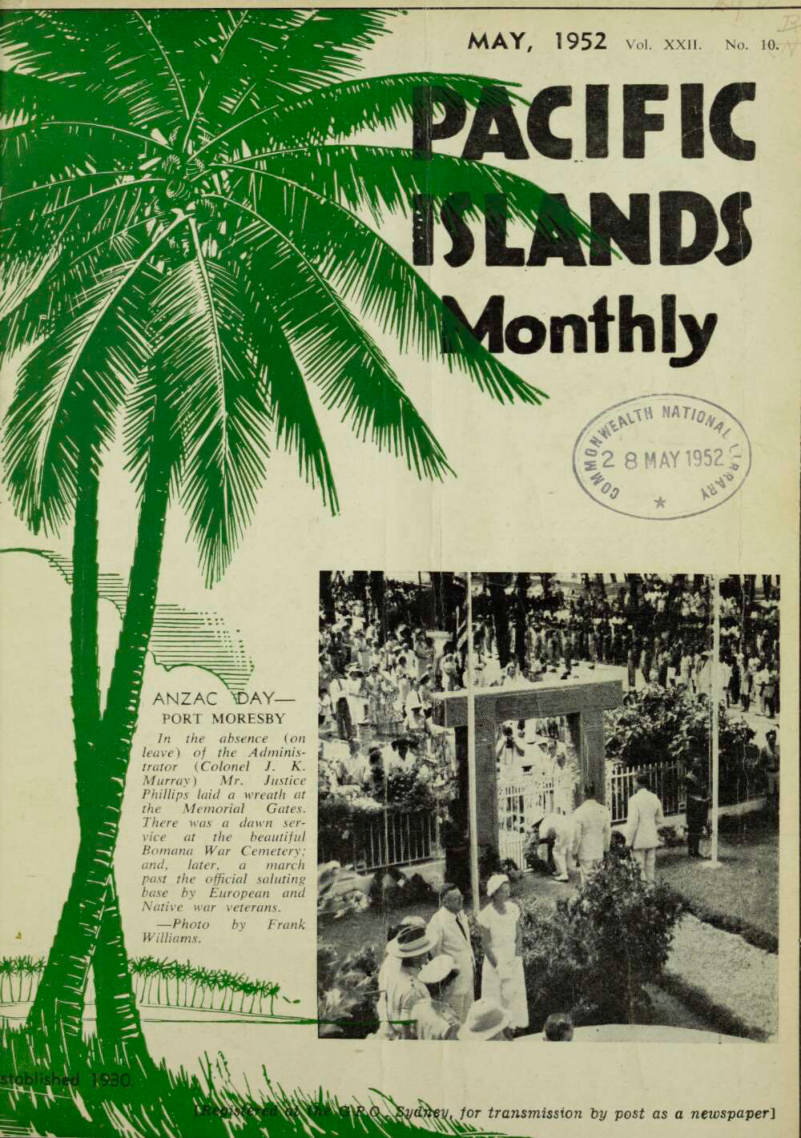 1
1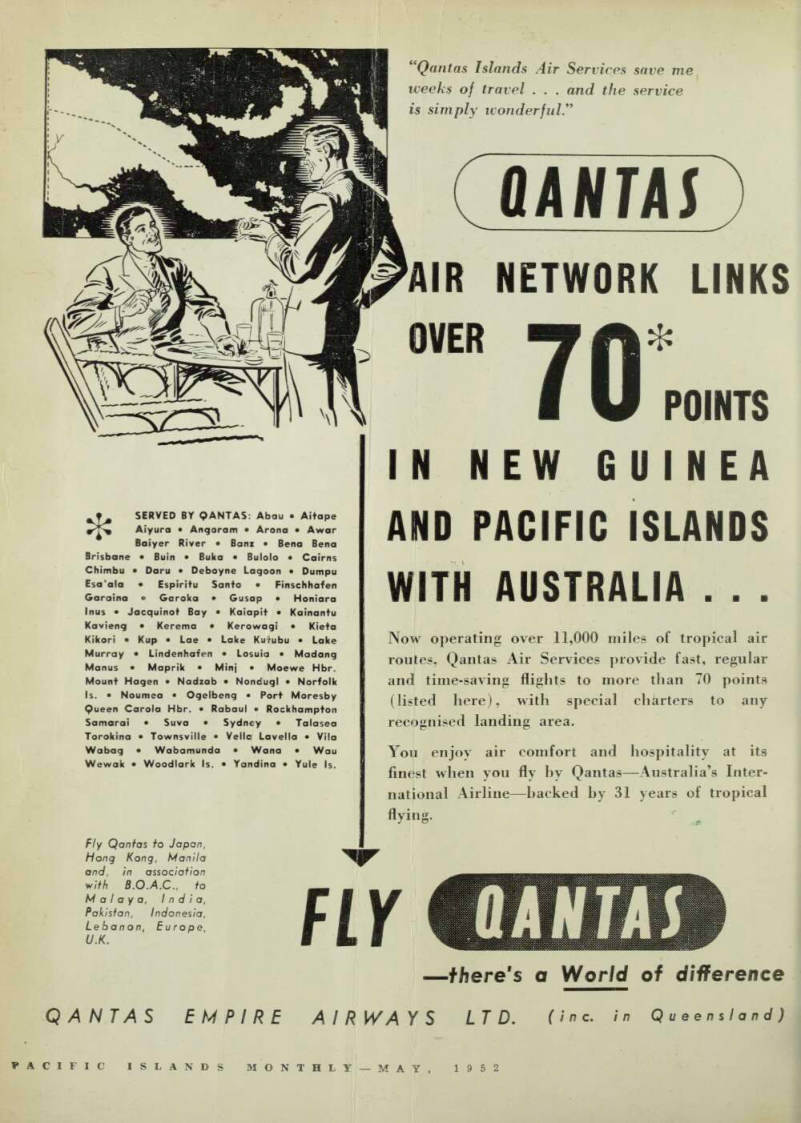 2
2 3
3 4
4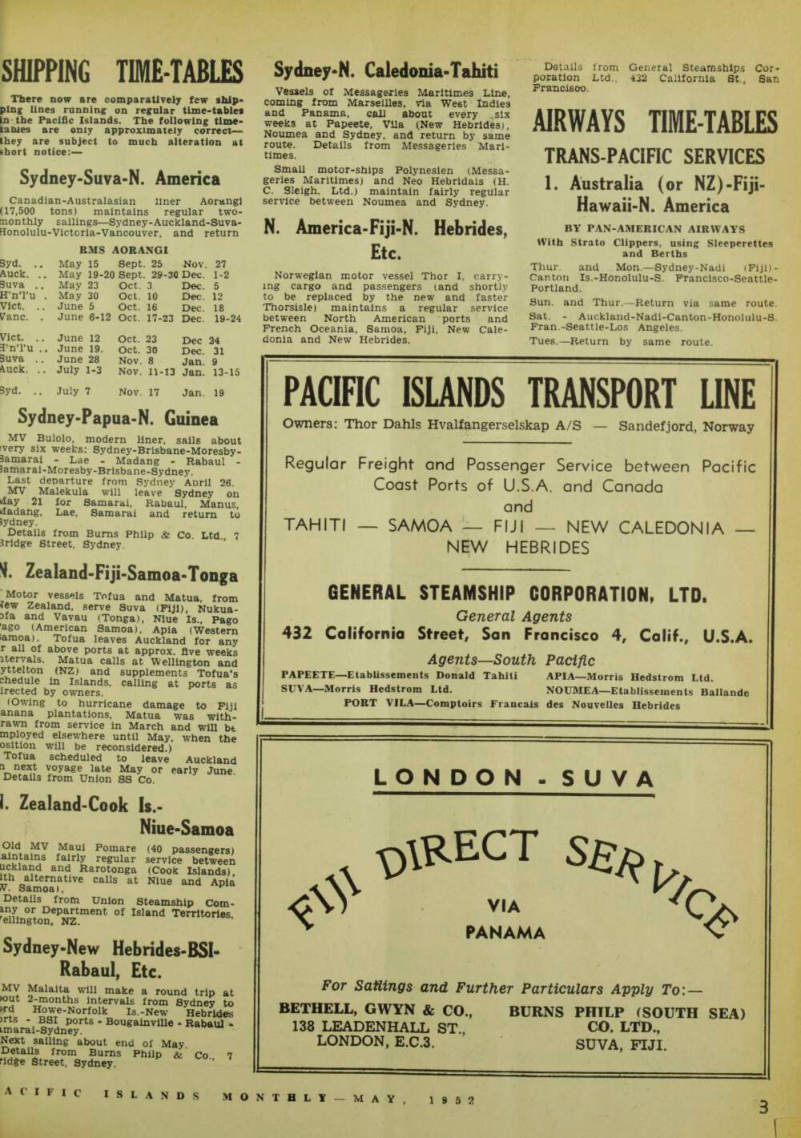 5
5 6
6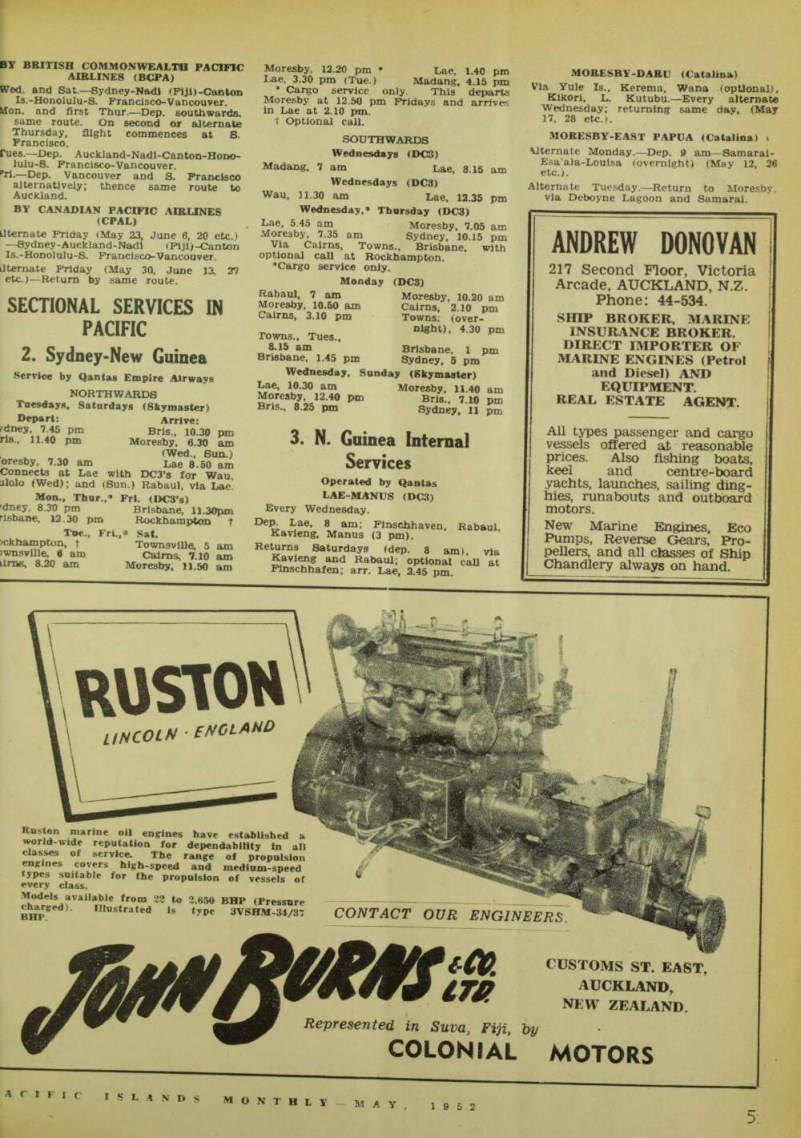 7
7 8
8 9
9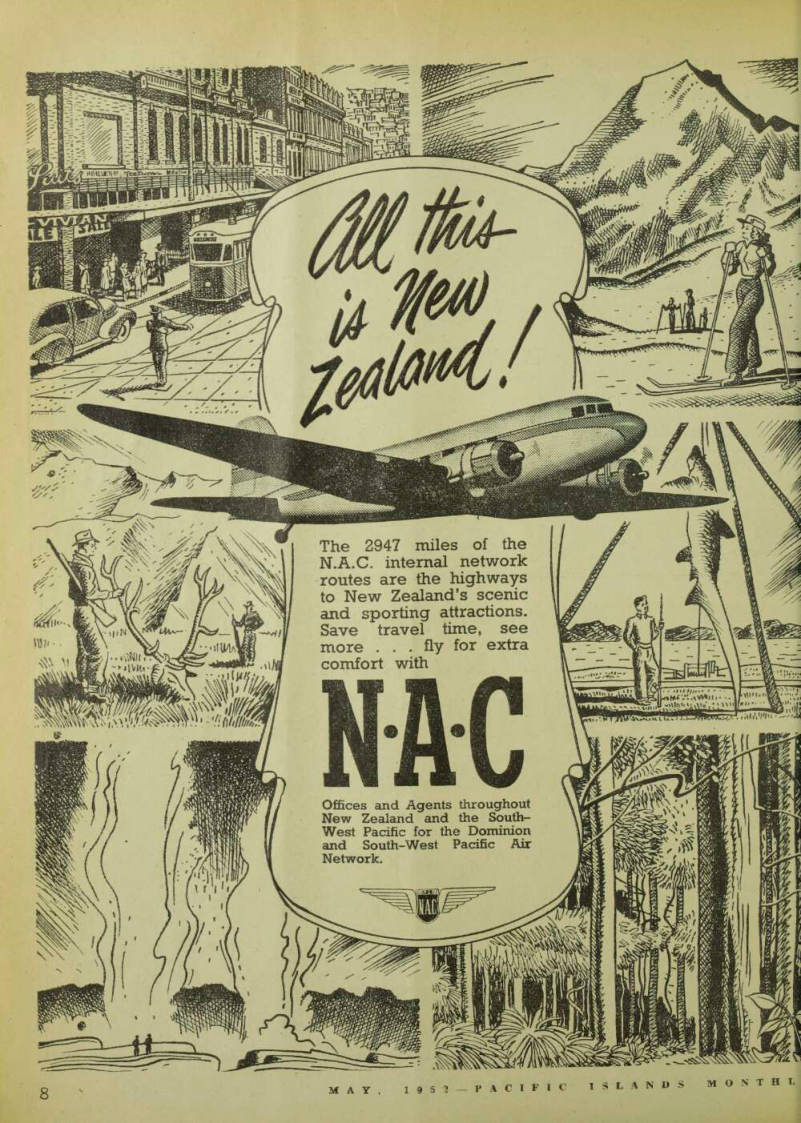 10
10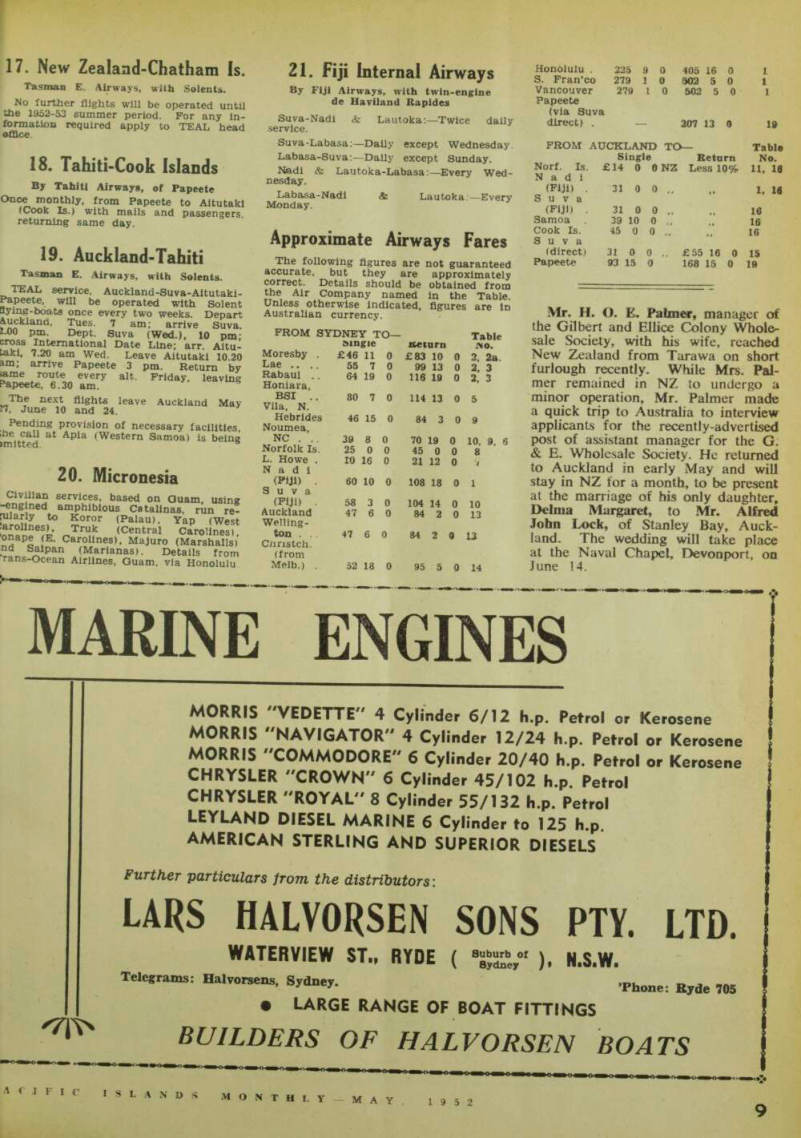 11
11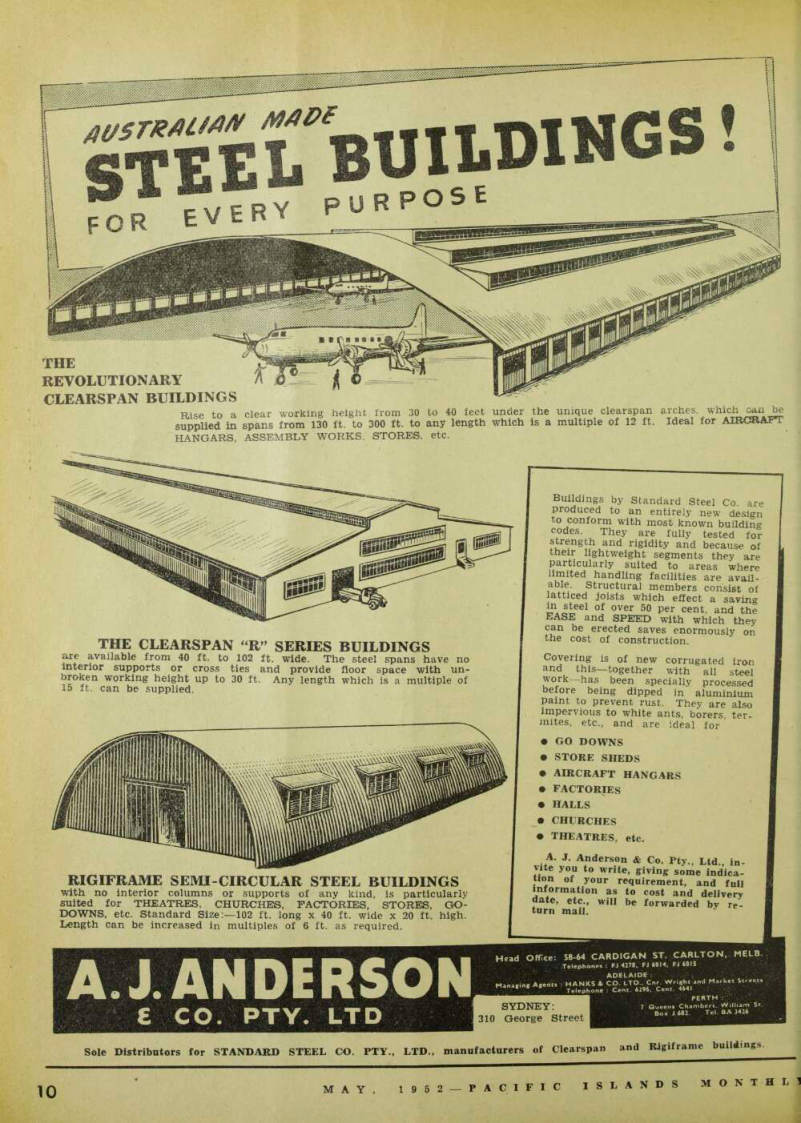 12
12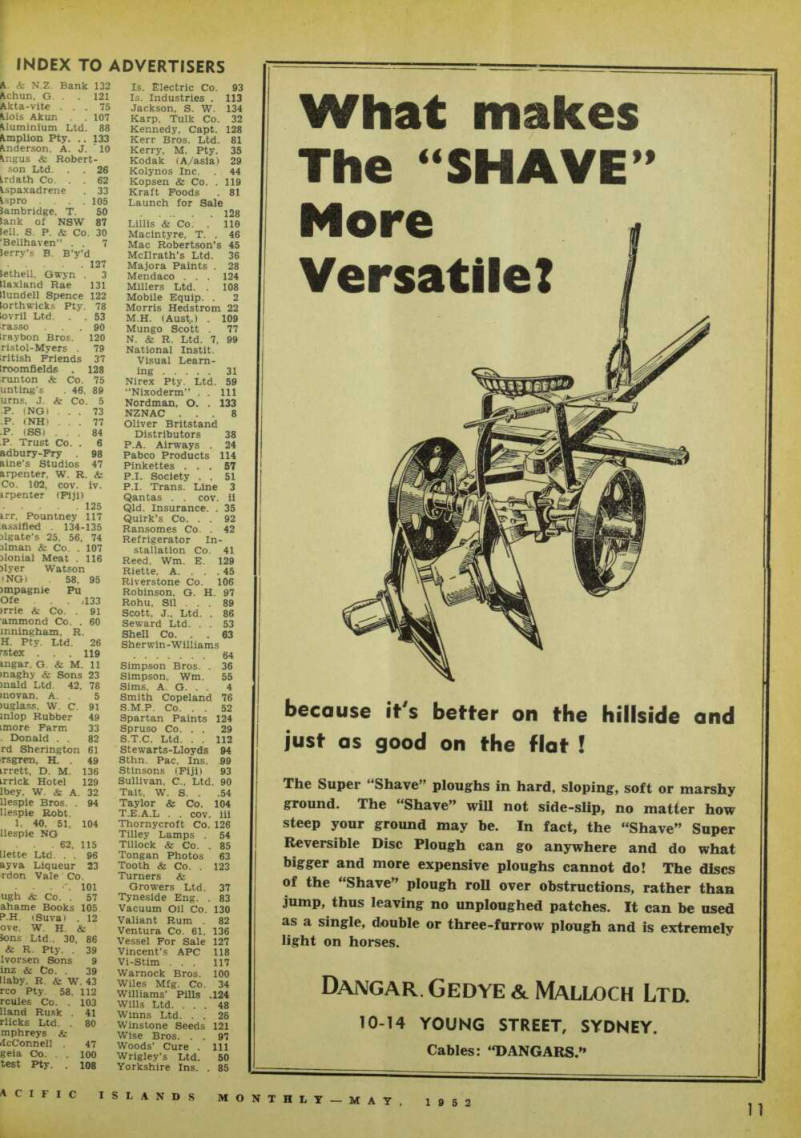 13
13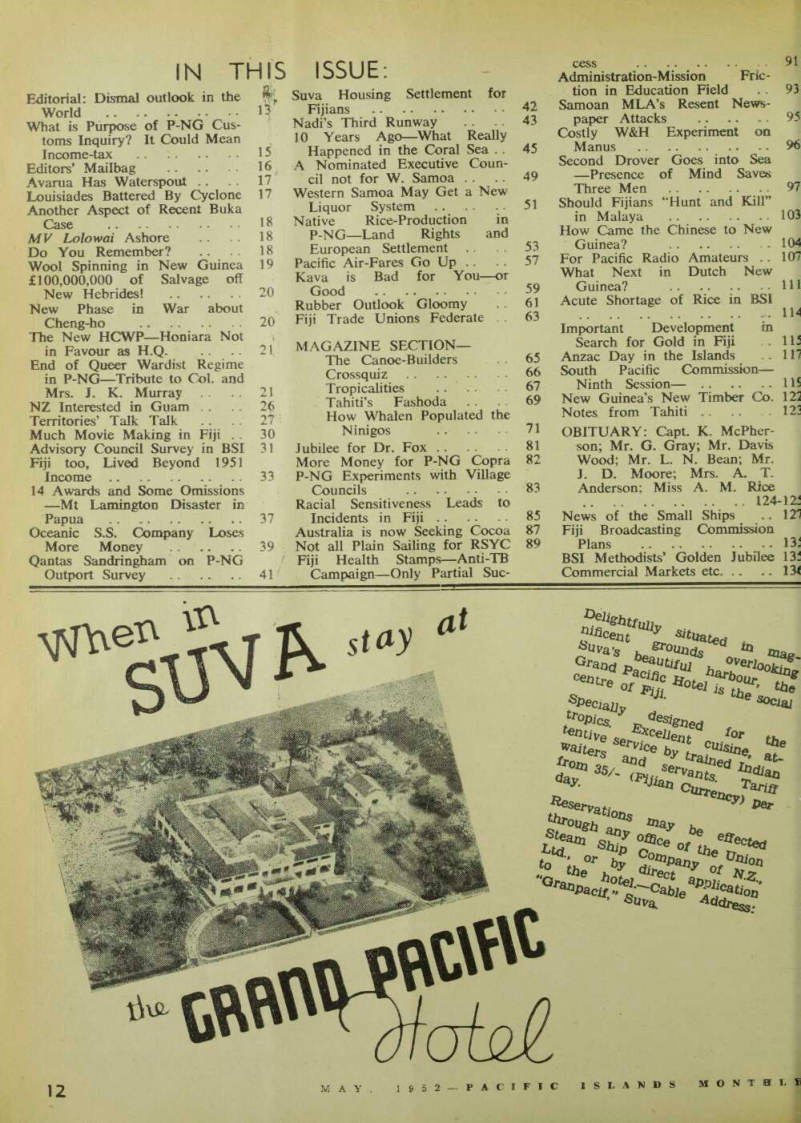 14
14 15
15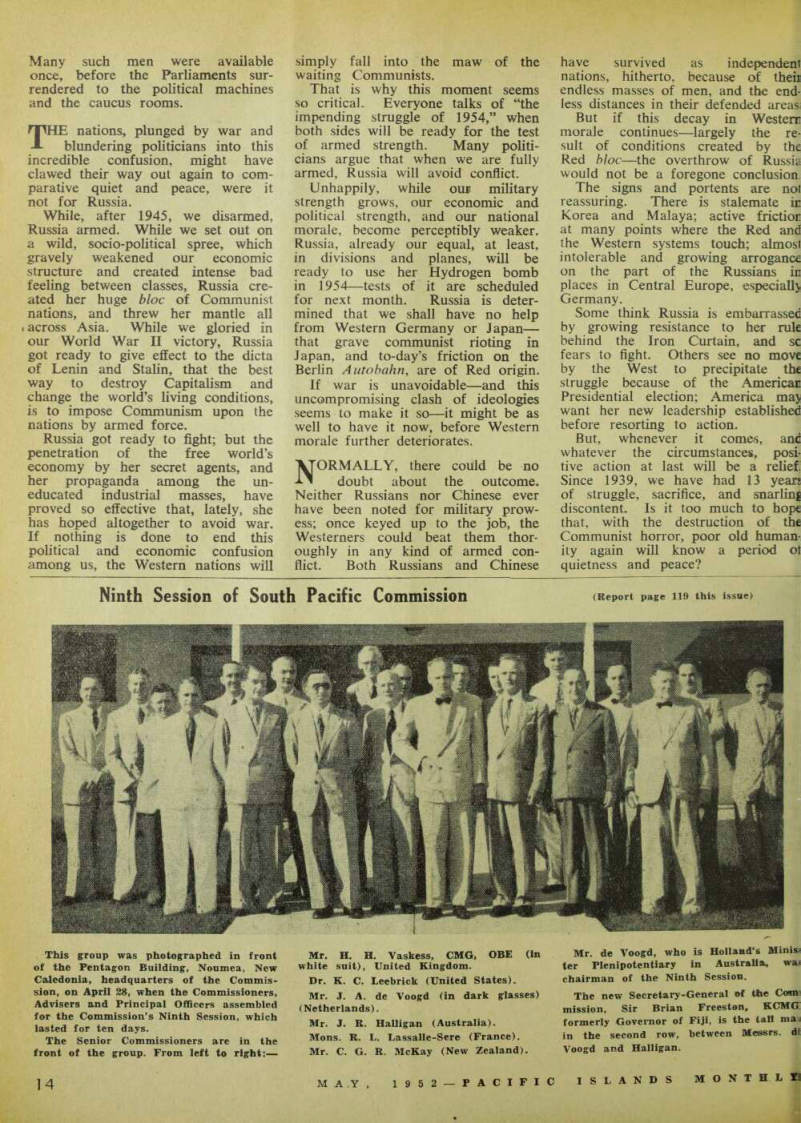 16
16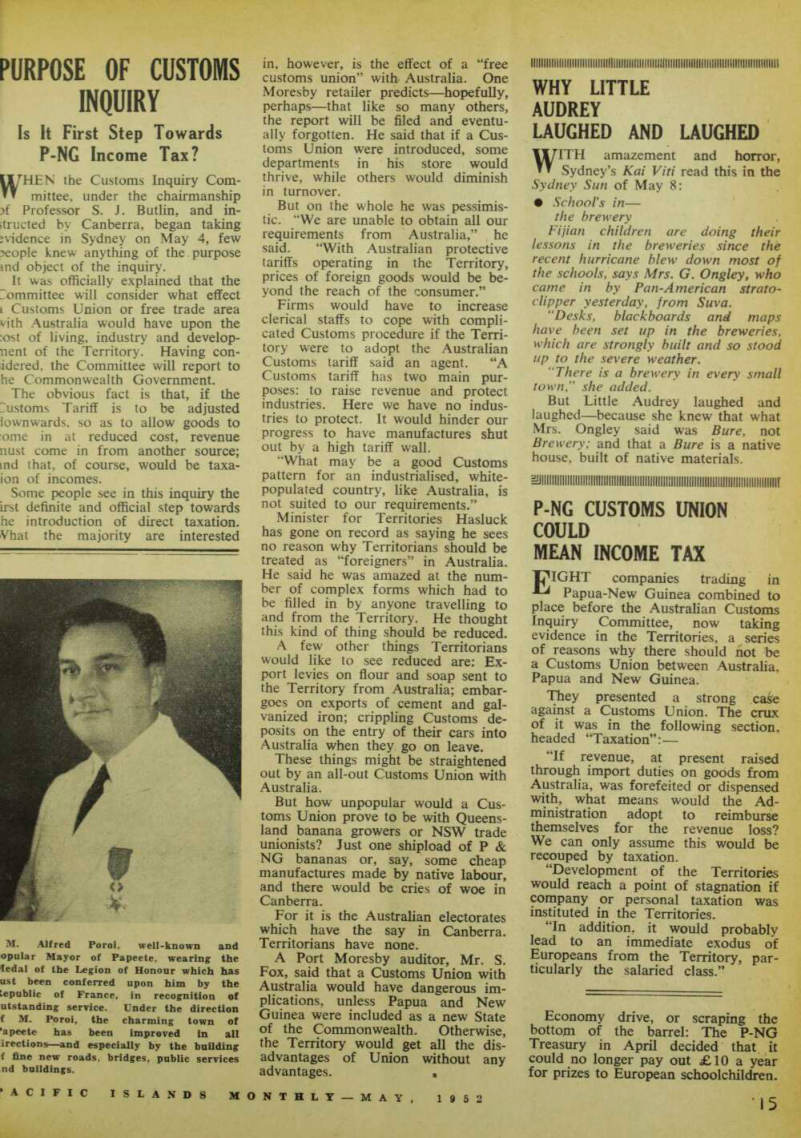 17
17 18
18 19
19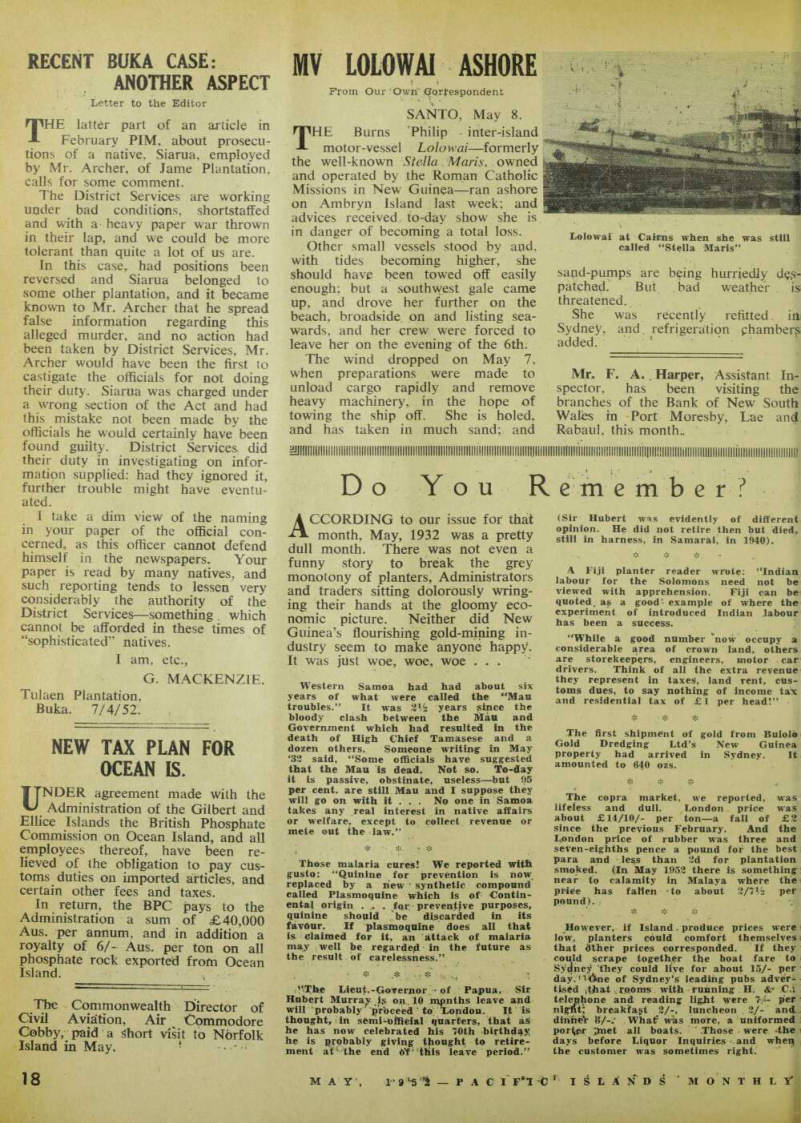 20
20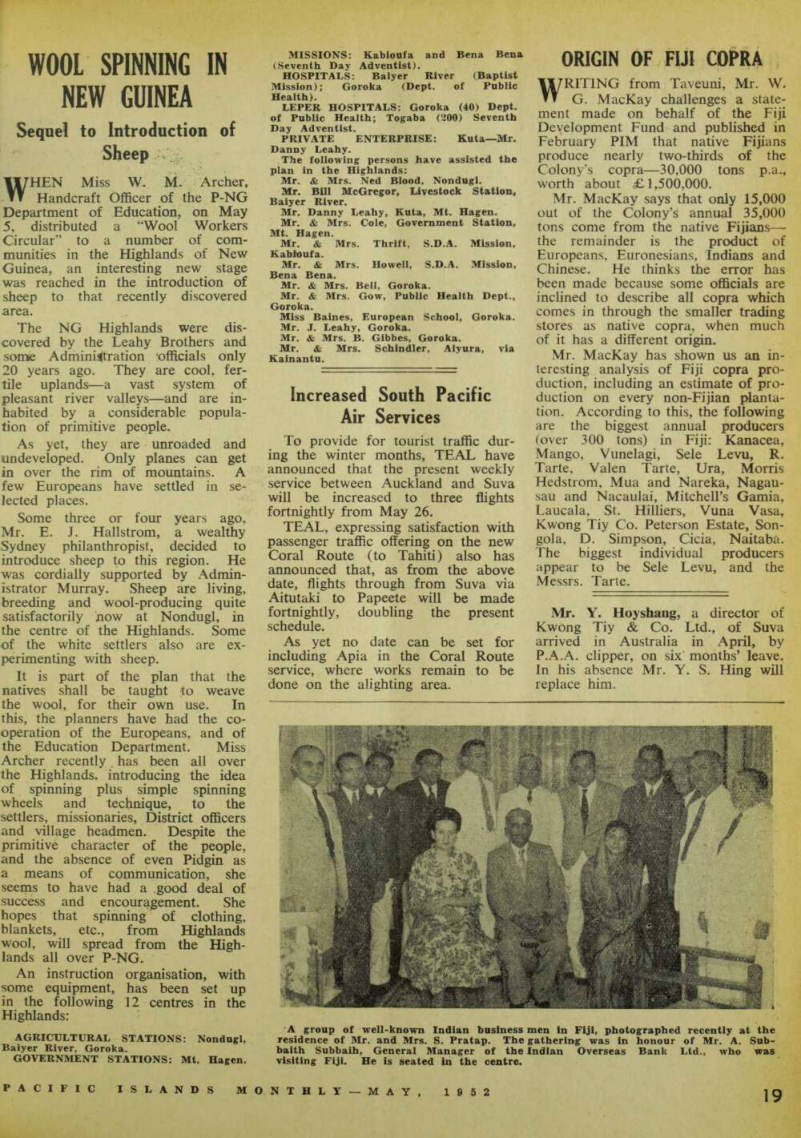 21
21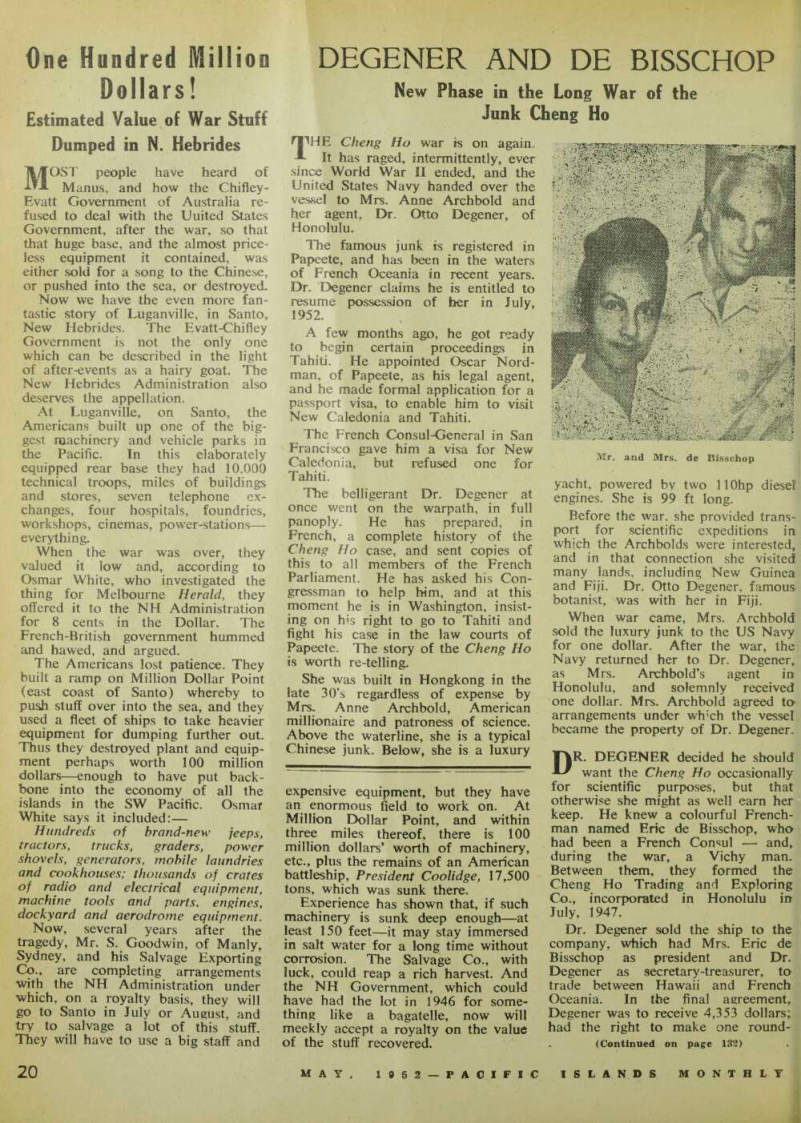 22
22 23
23 24
24 25
25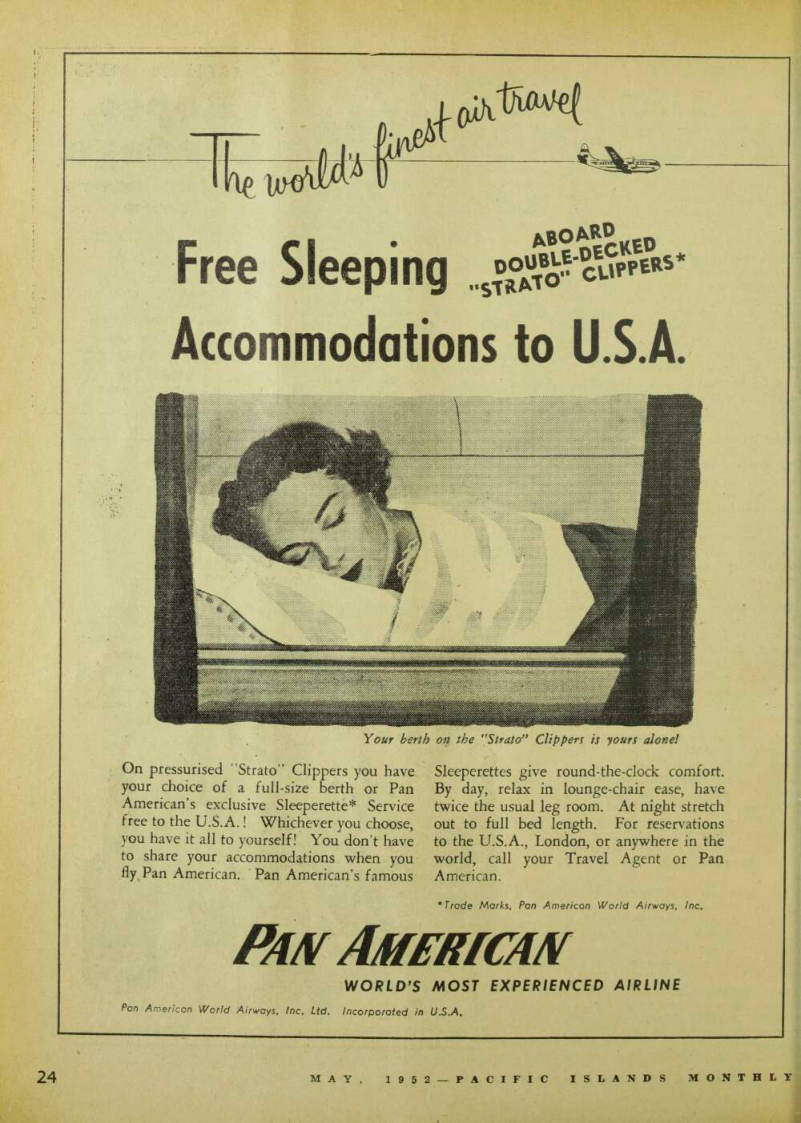 26
26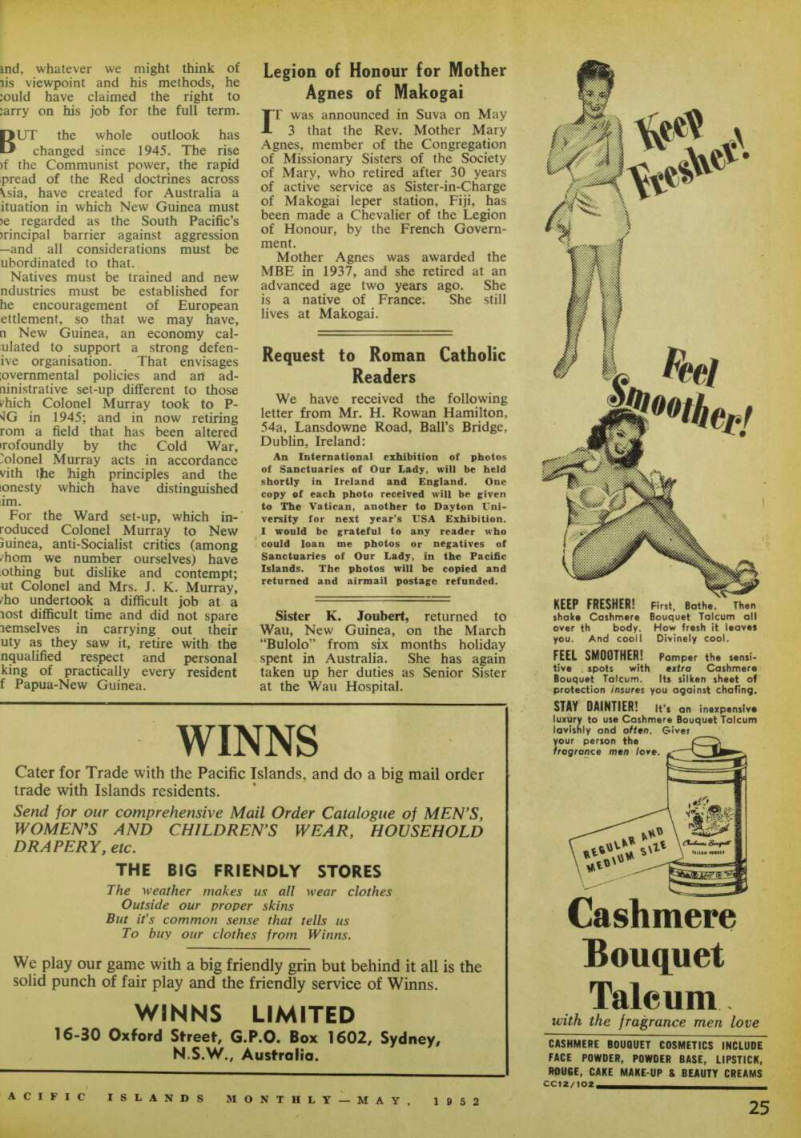 27
27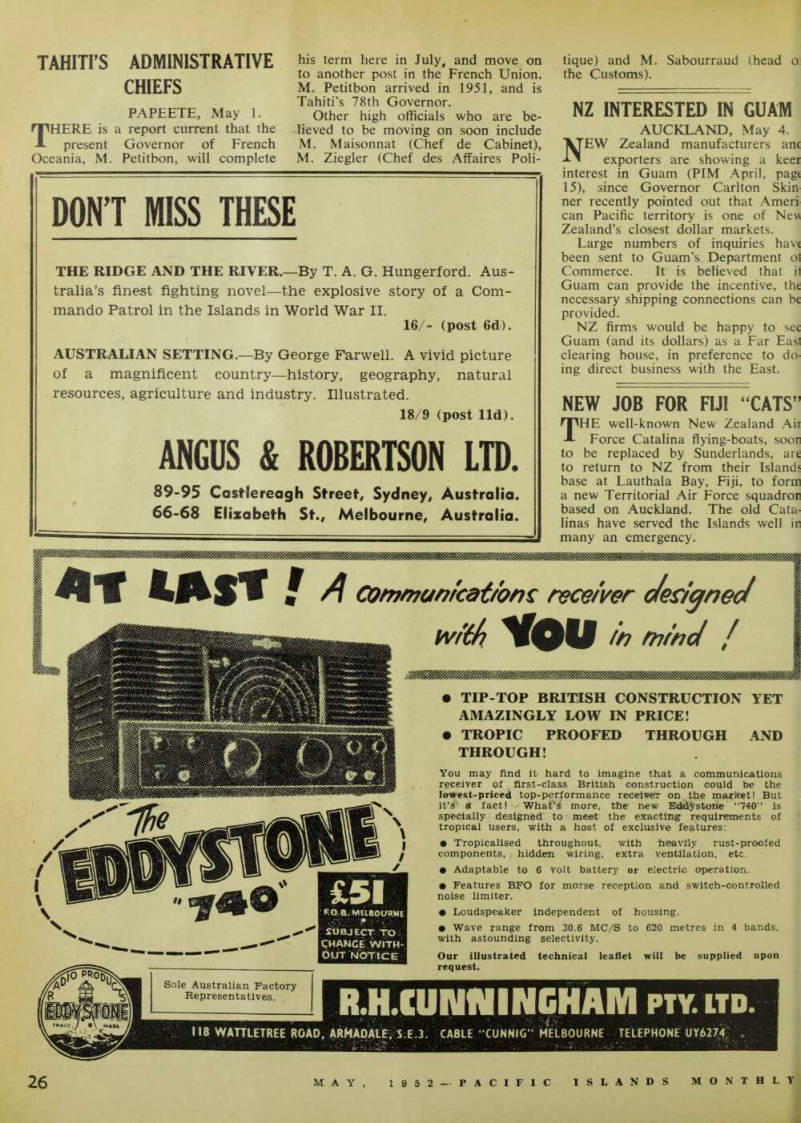 28
28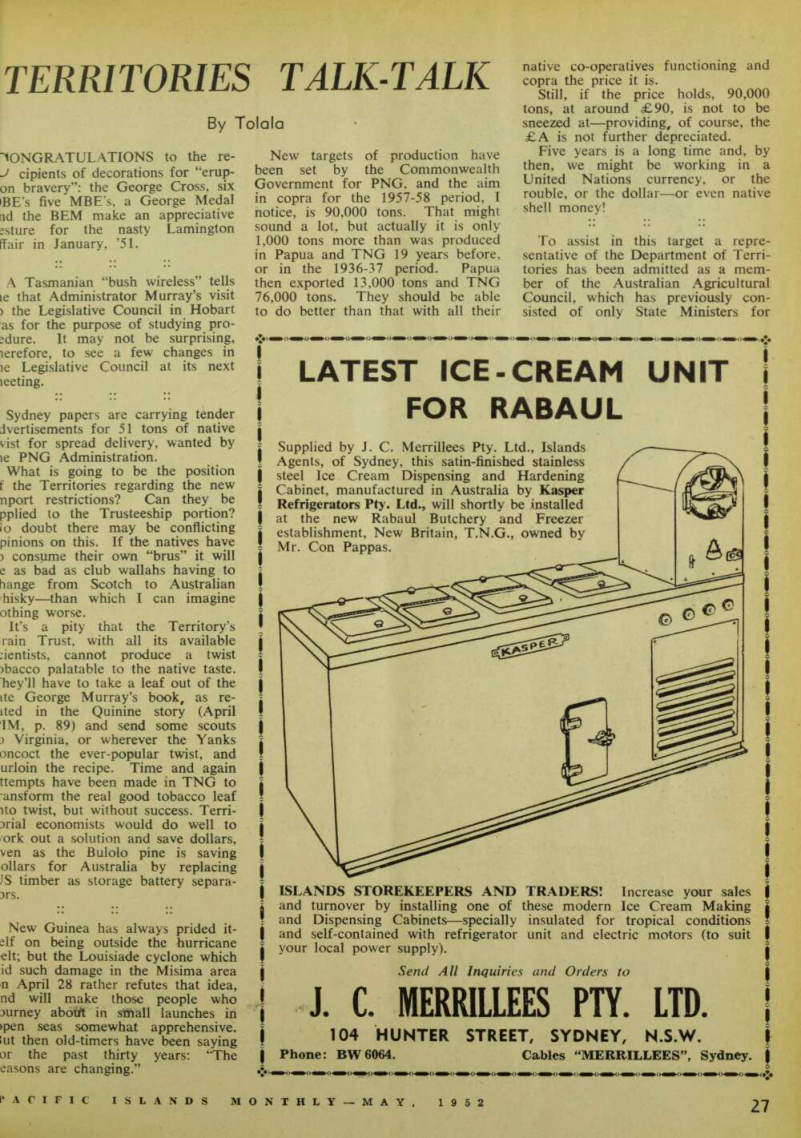 29
29 30
30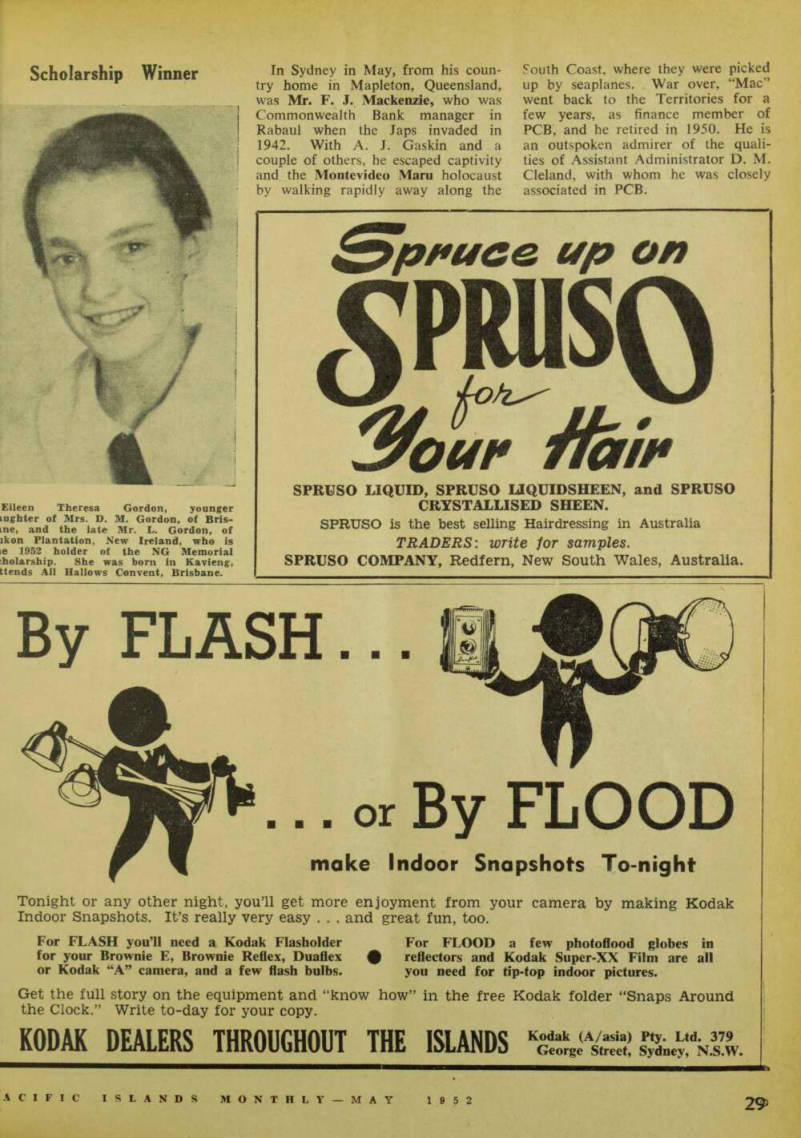 31
31 32
32 33
33 34
34 35
35 36
36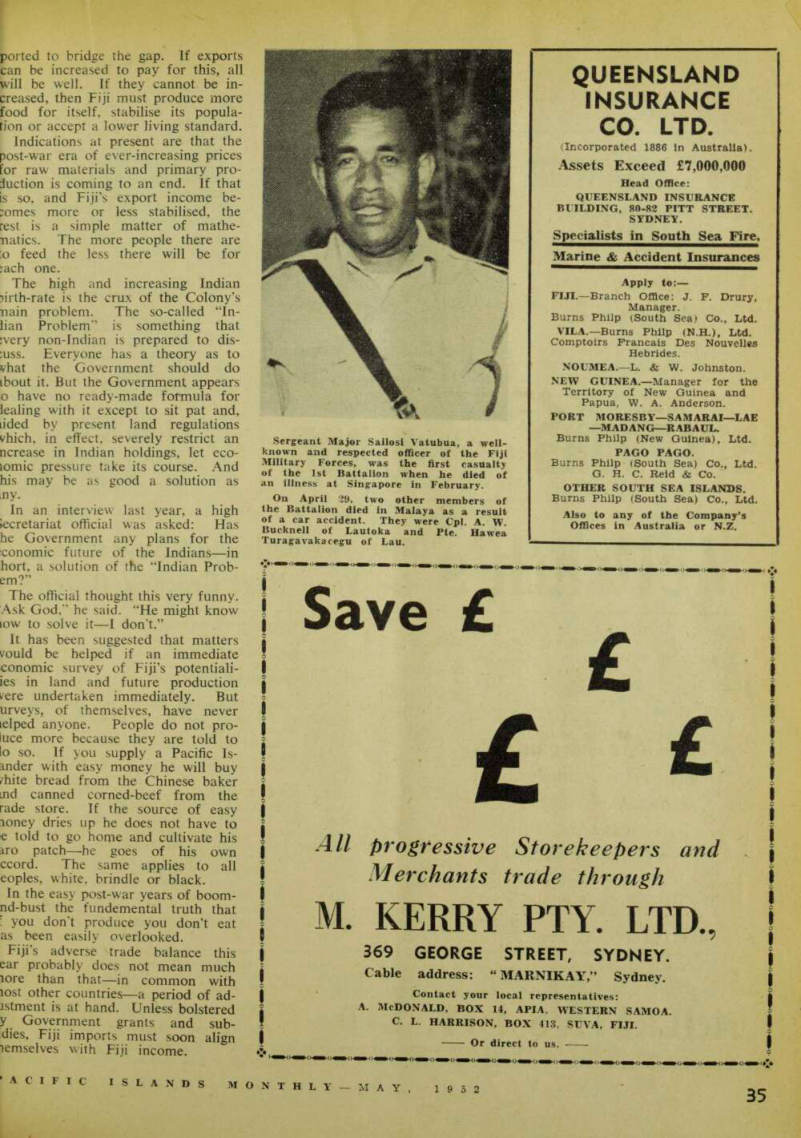 37
37 38
38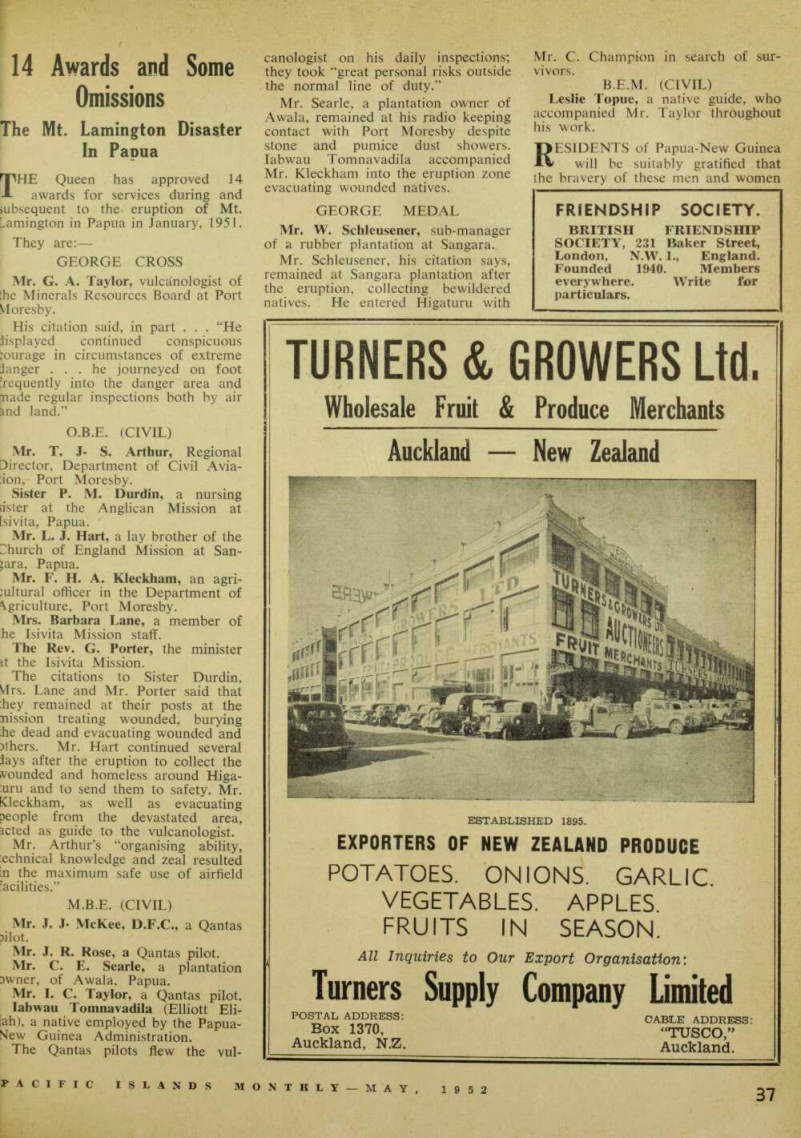 39
39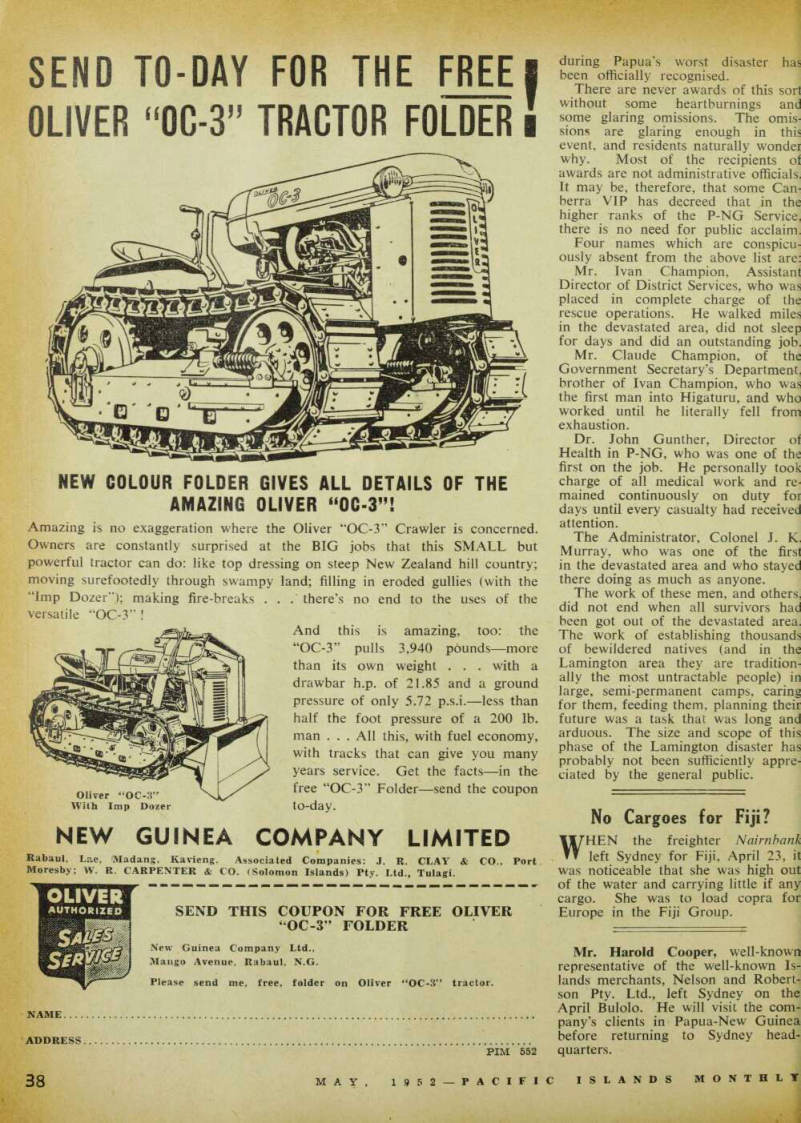 40
40 41
41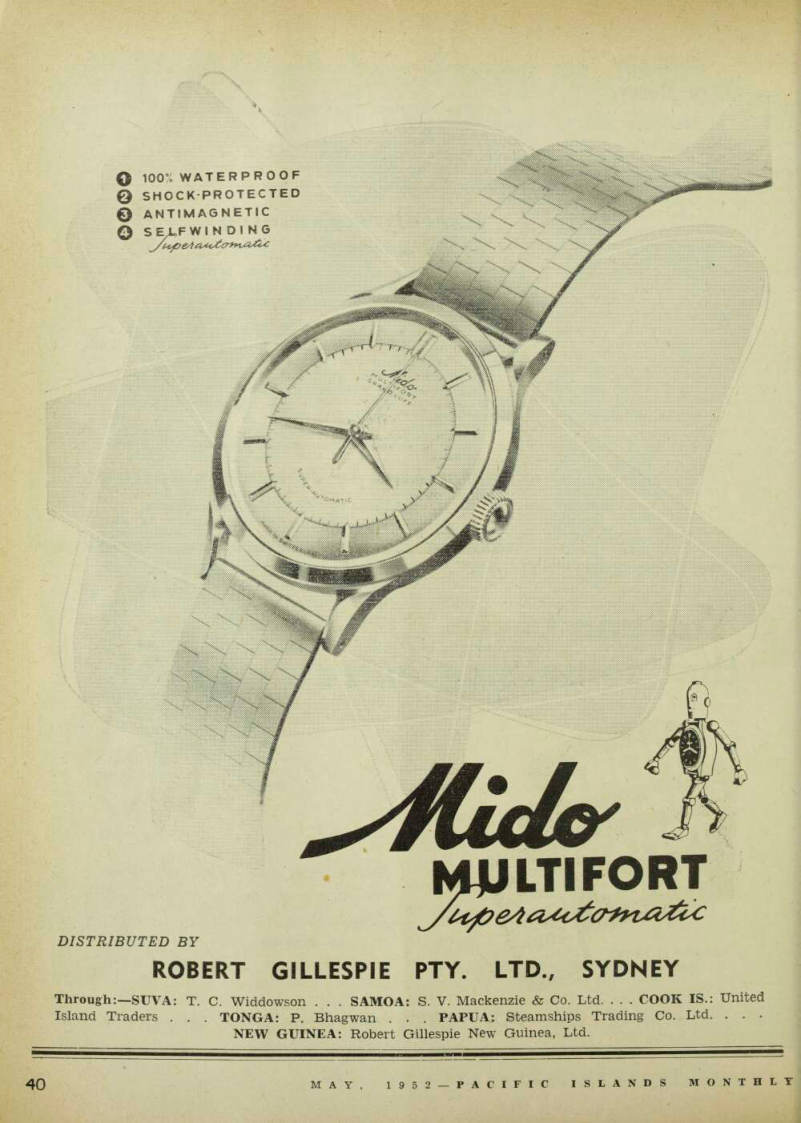 42
42 43
43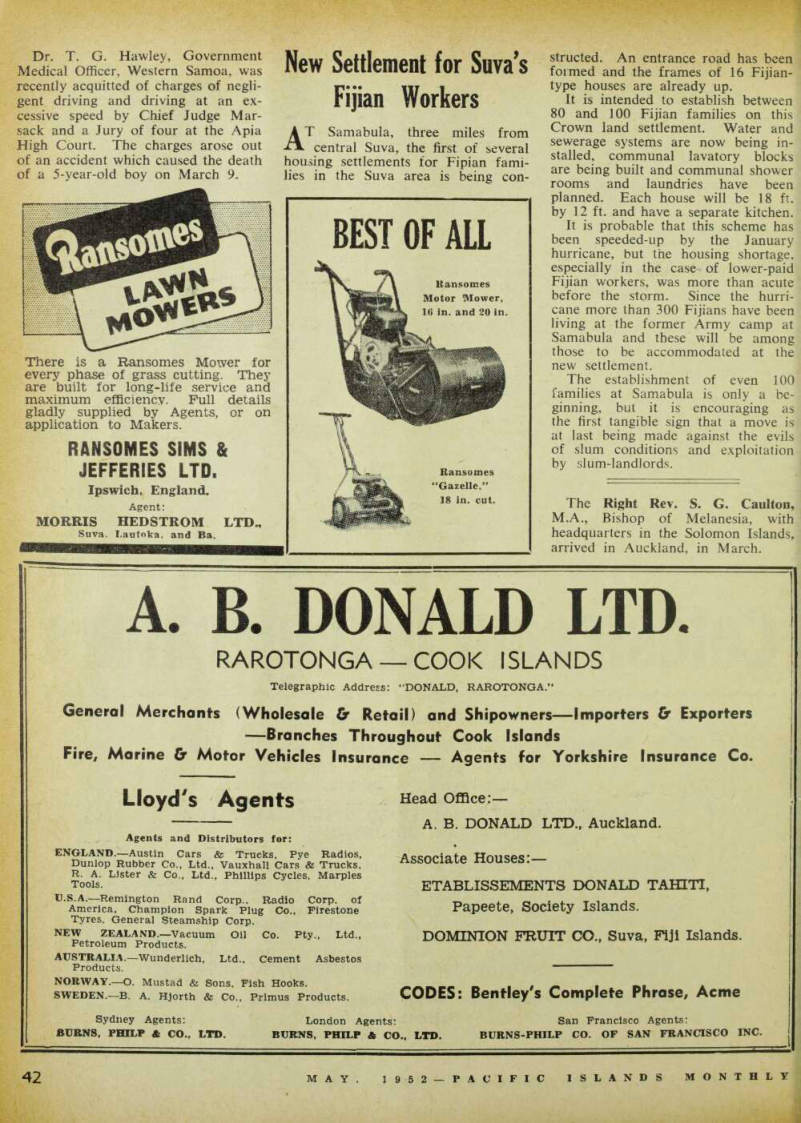 44
44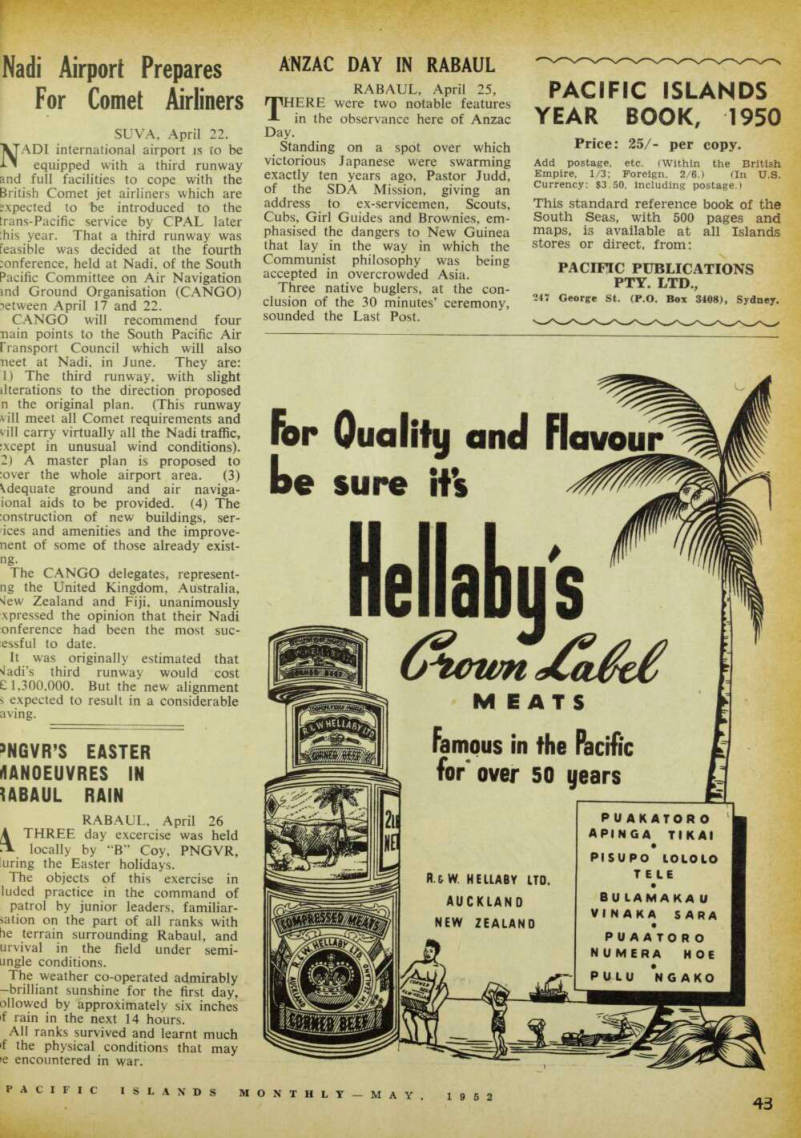 45
45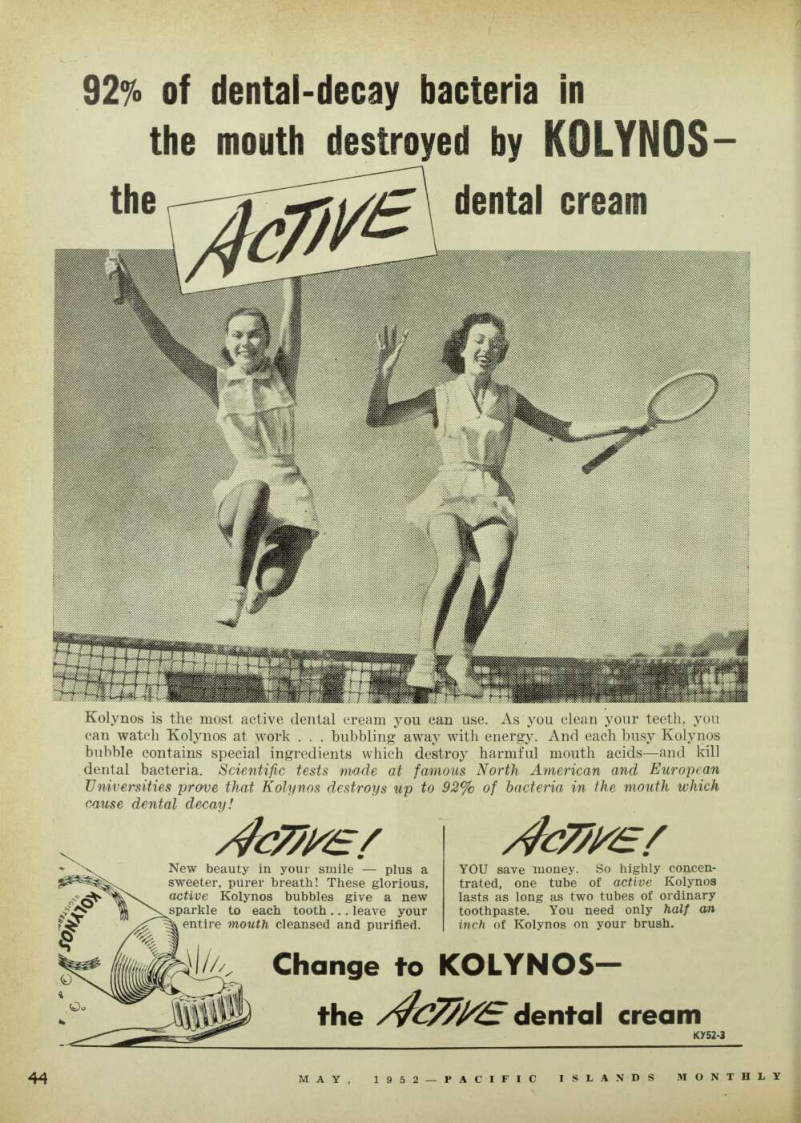 46
46 47
47 48
48 49
49 50
50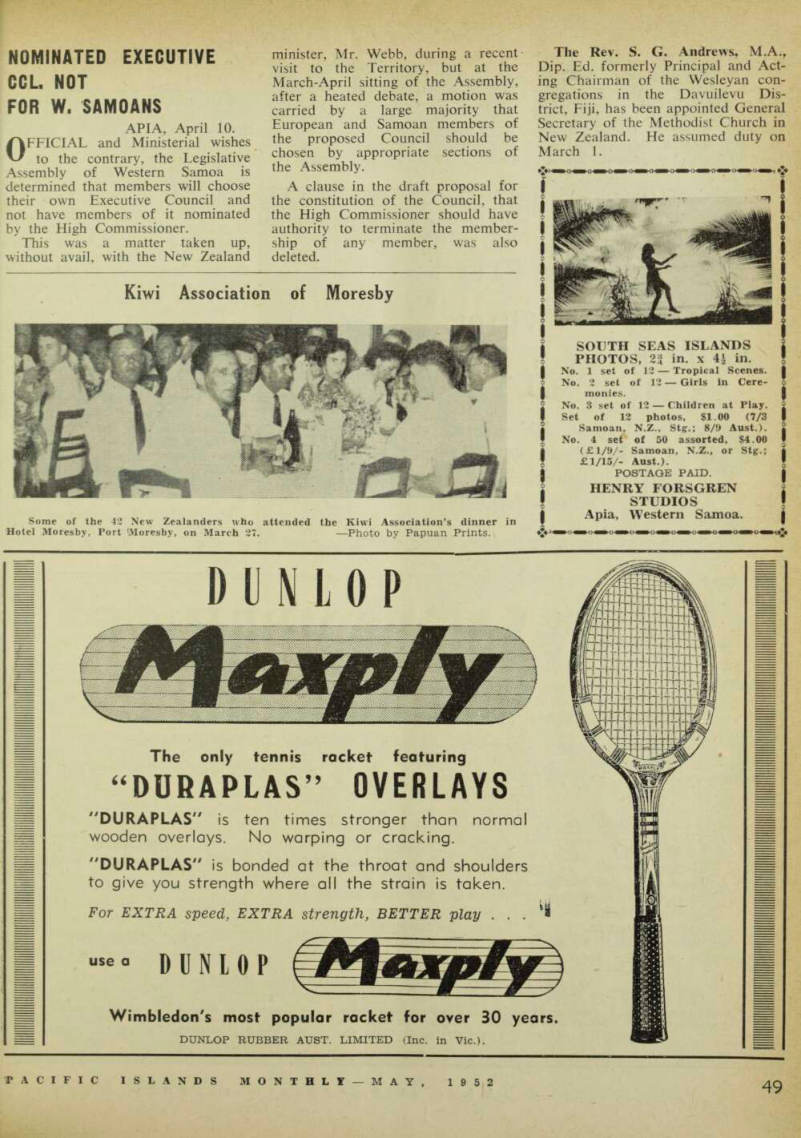 51
51 52
52 53
53 54
54 55
55 56
56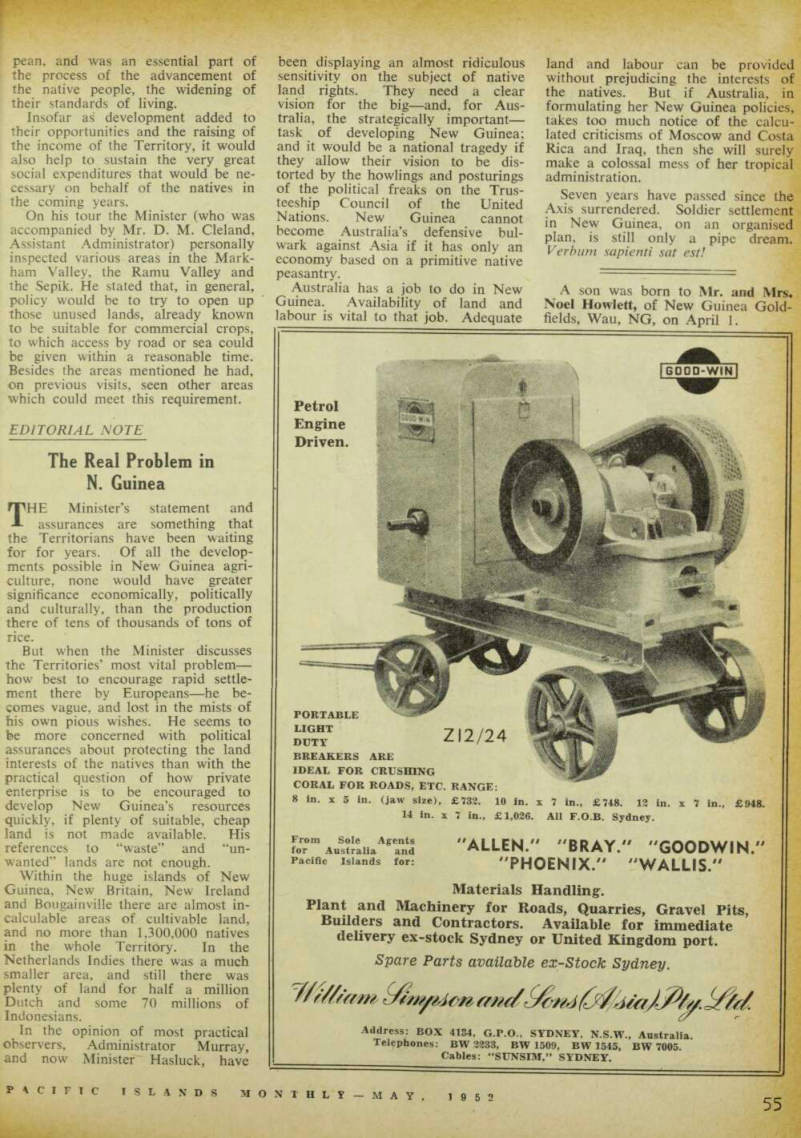 57
57 58
58 59
59 60
60 61
61 62
62 63
63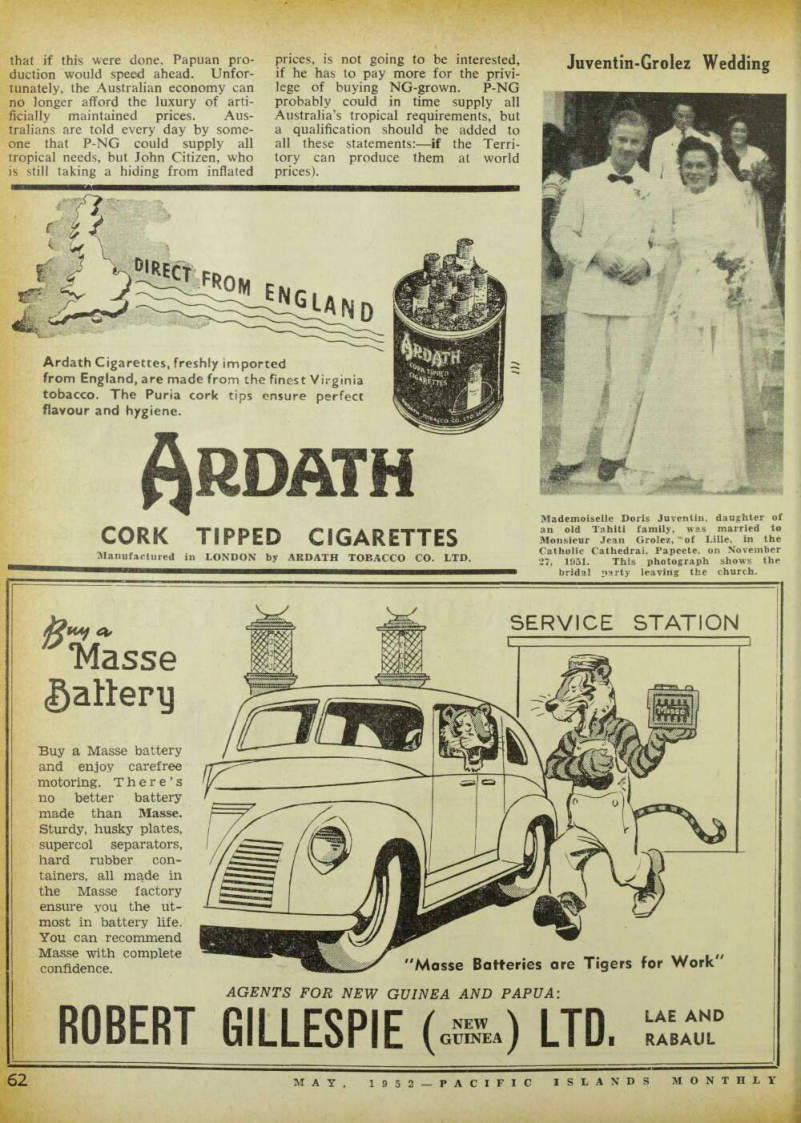 64
64 65
65 66
66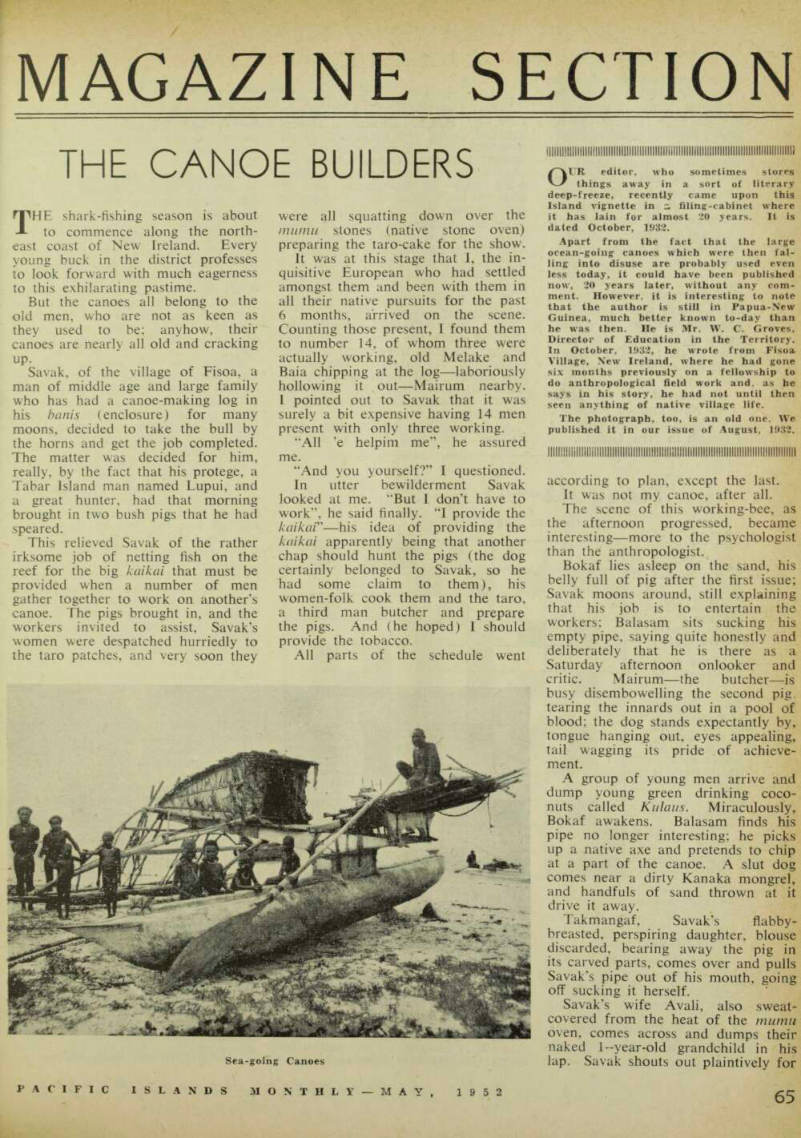 67
67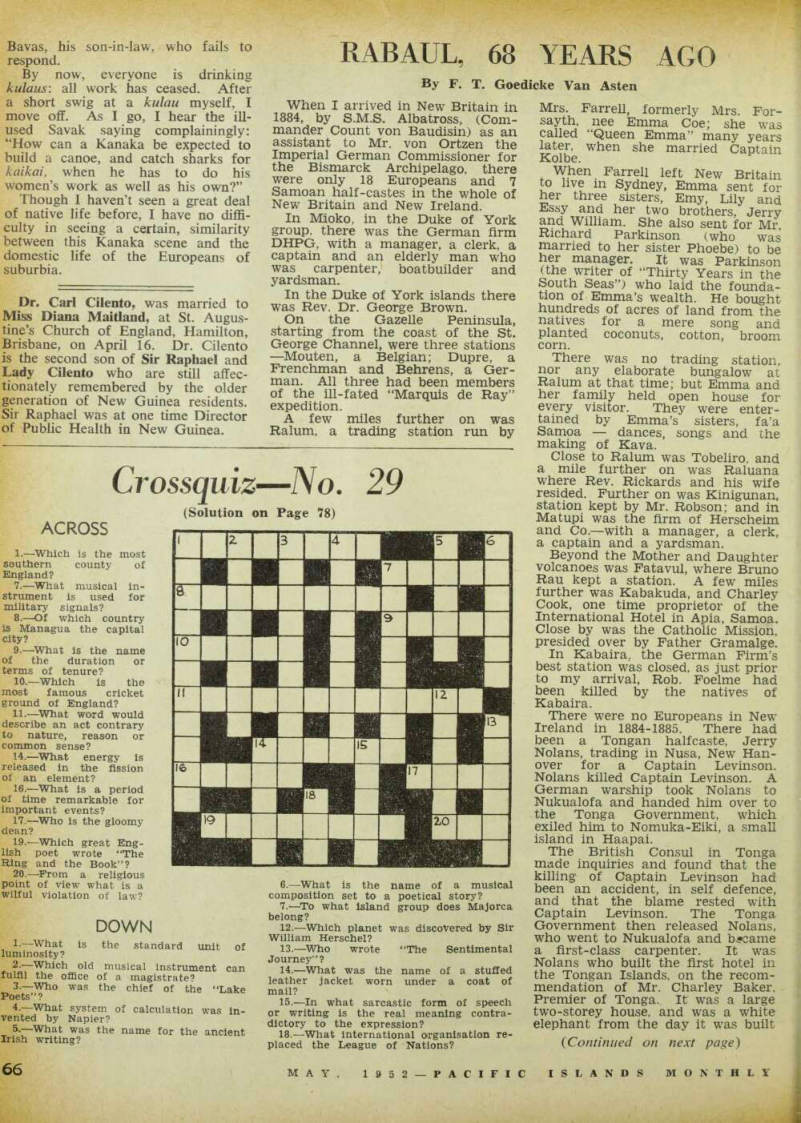 68
68 69
69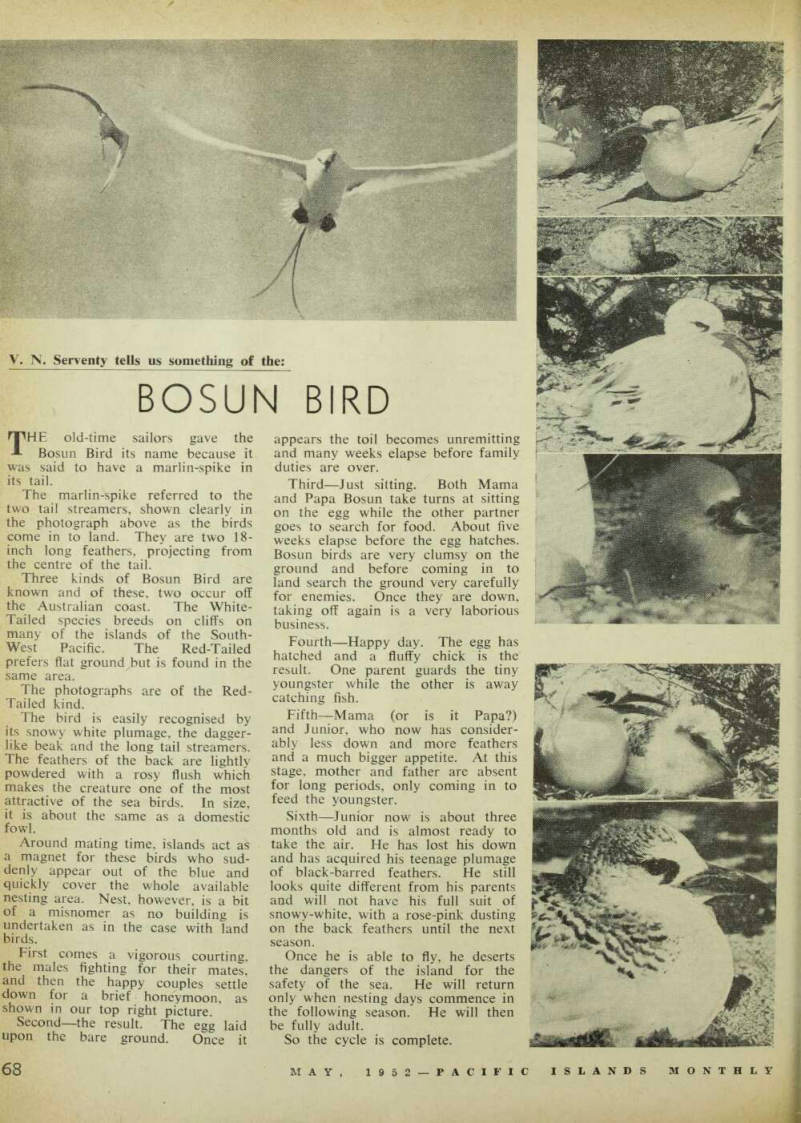 70
70 71
71 72
72 73
73 74
74 75
75 76
76 77
77 78
78 79
79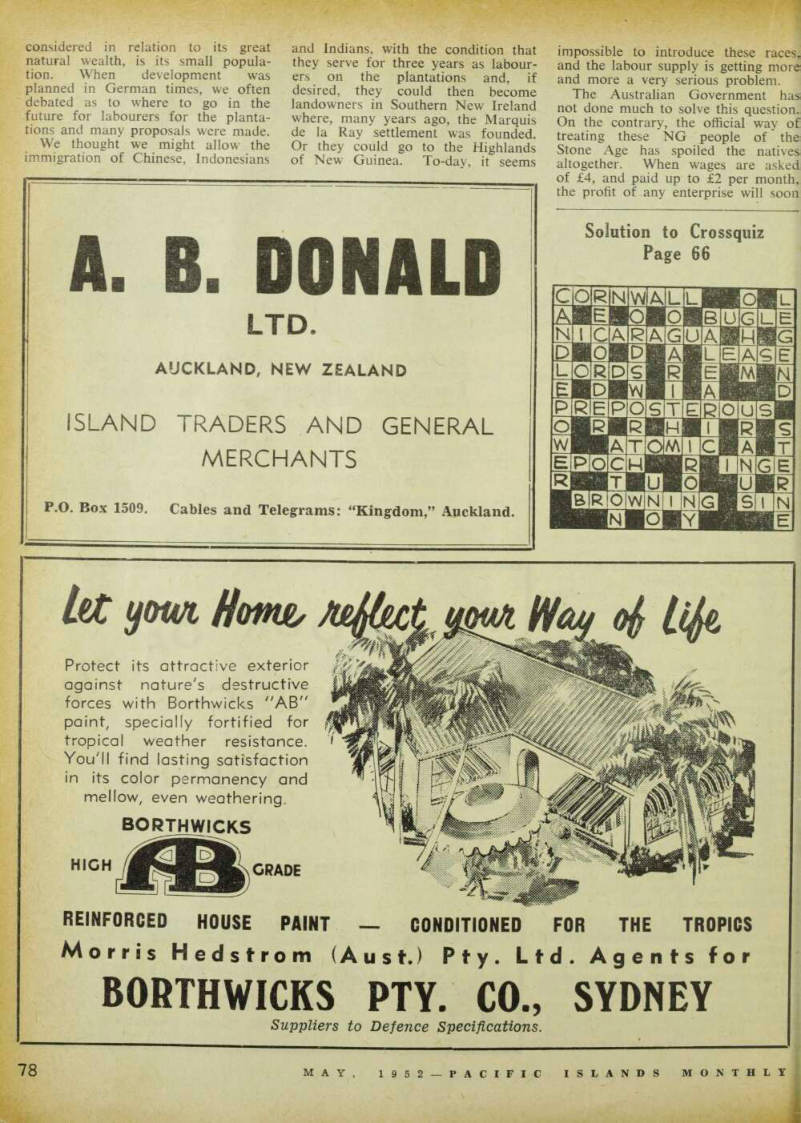 80
80 81
81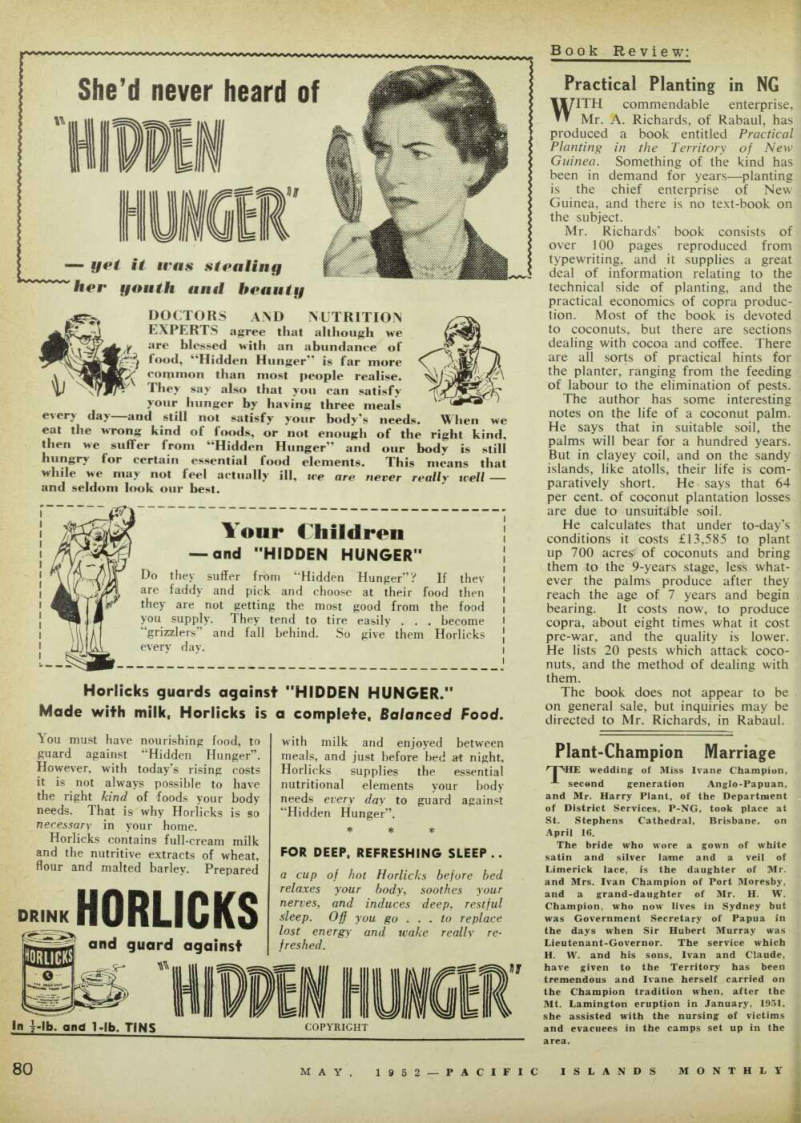 82
82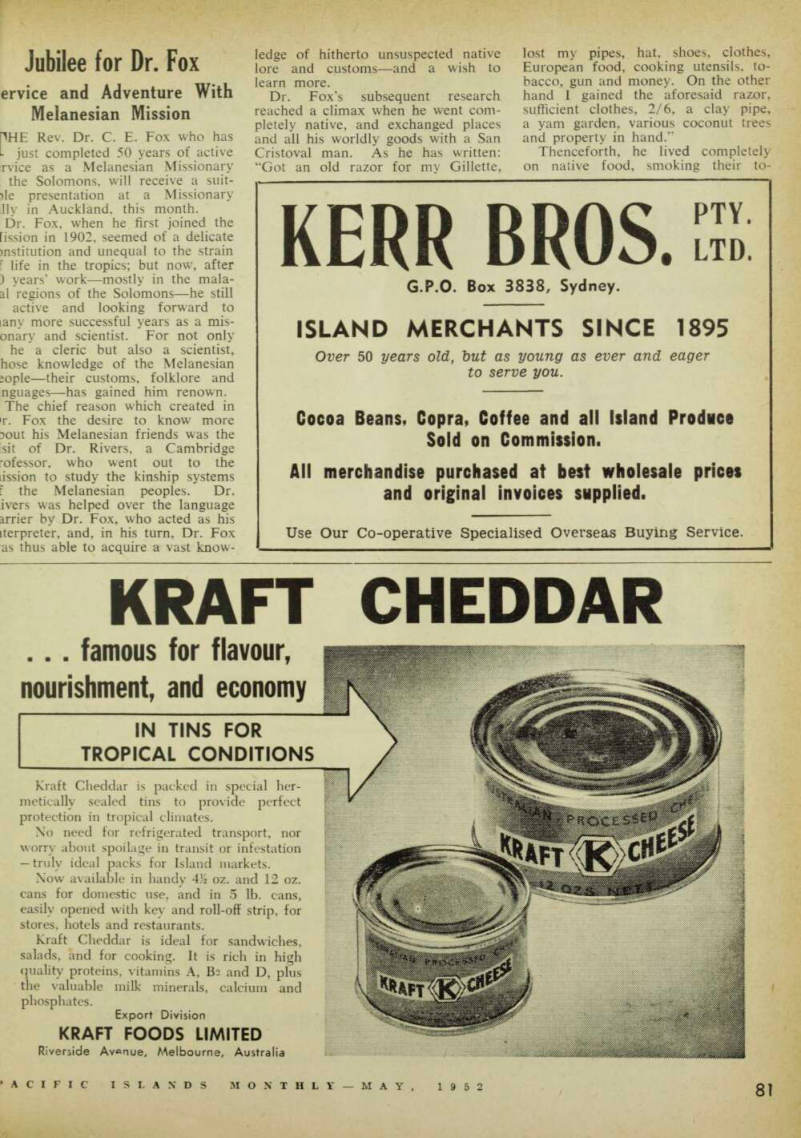 83
83 84
84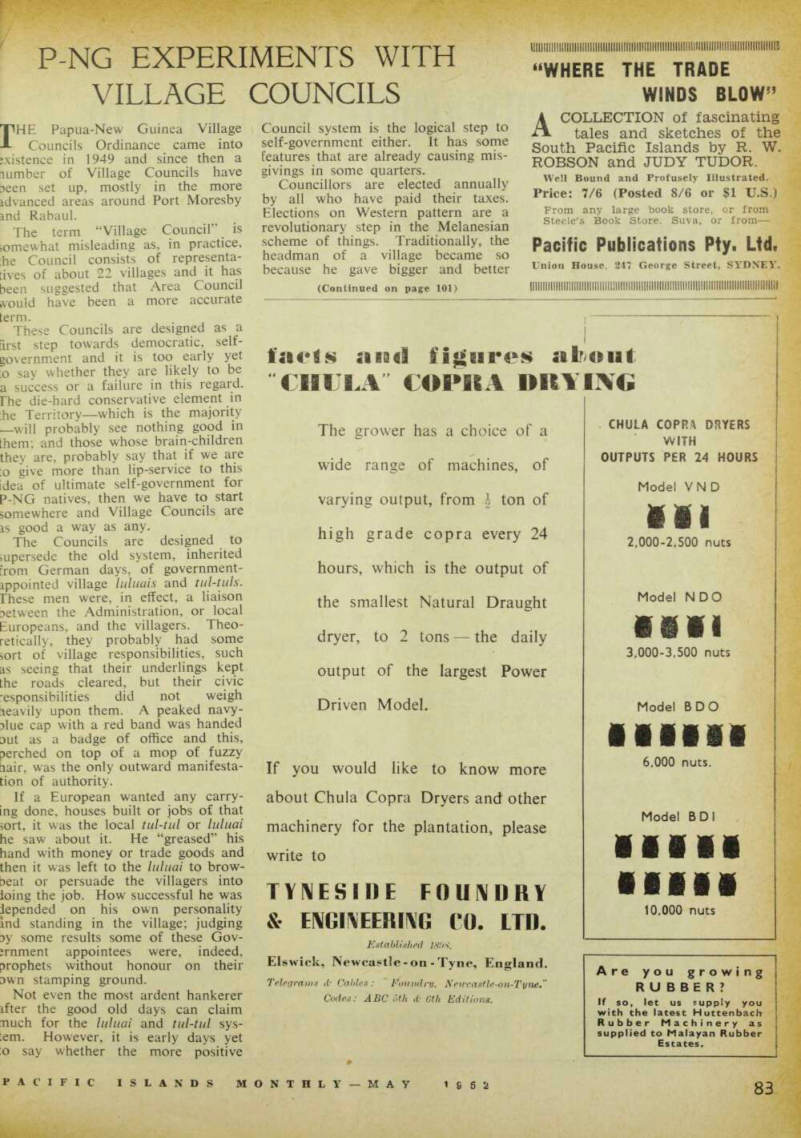 85
85 86
86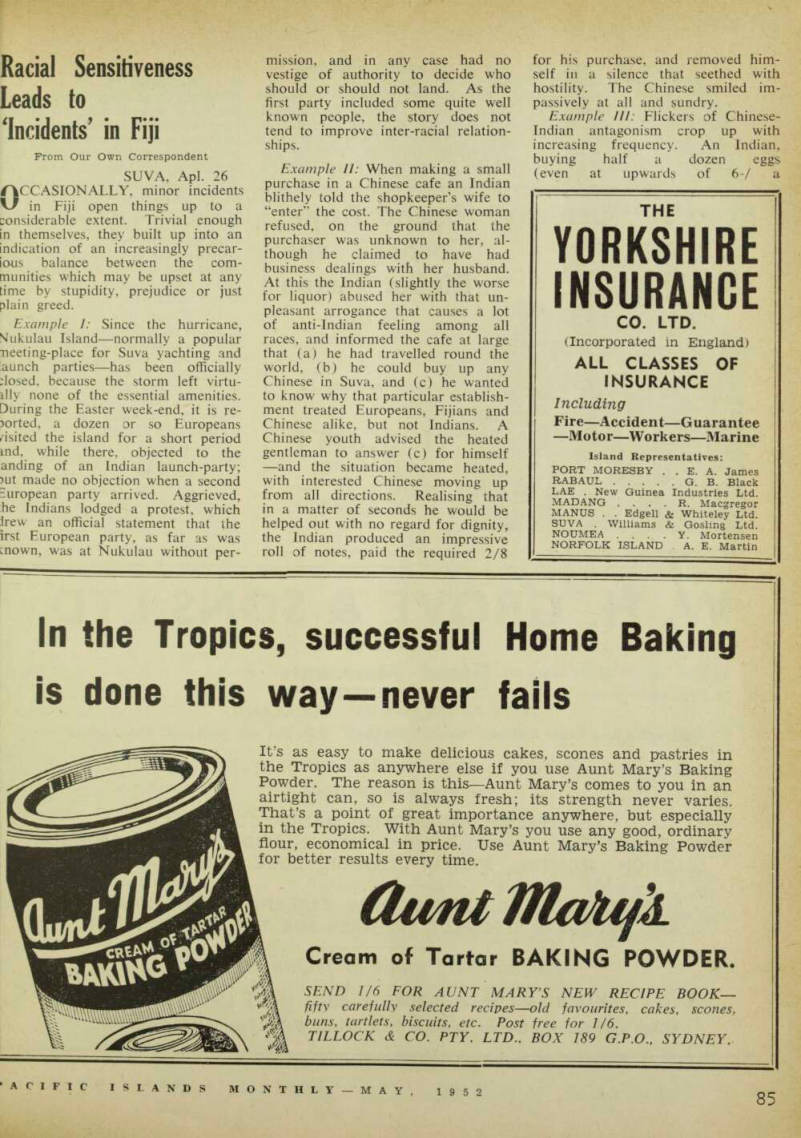 87
87 88
88 89
89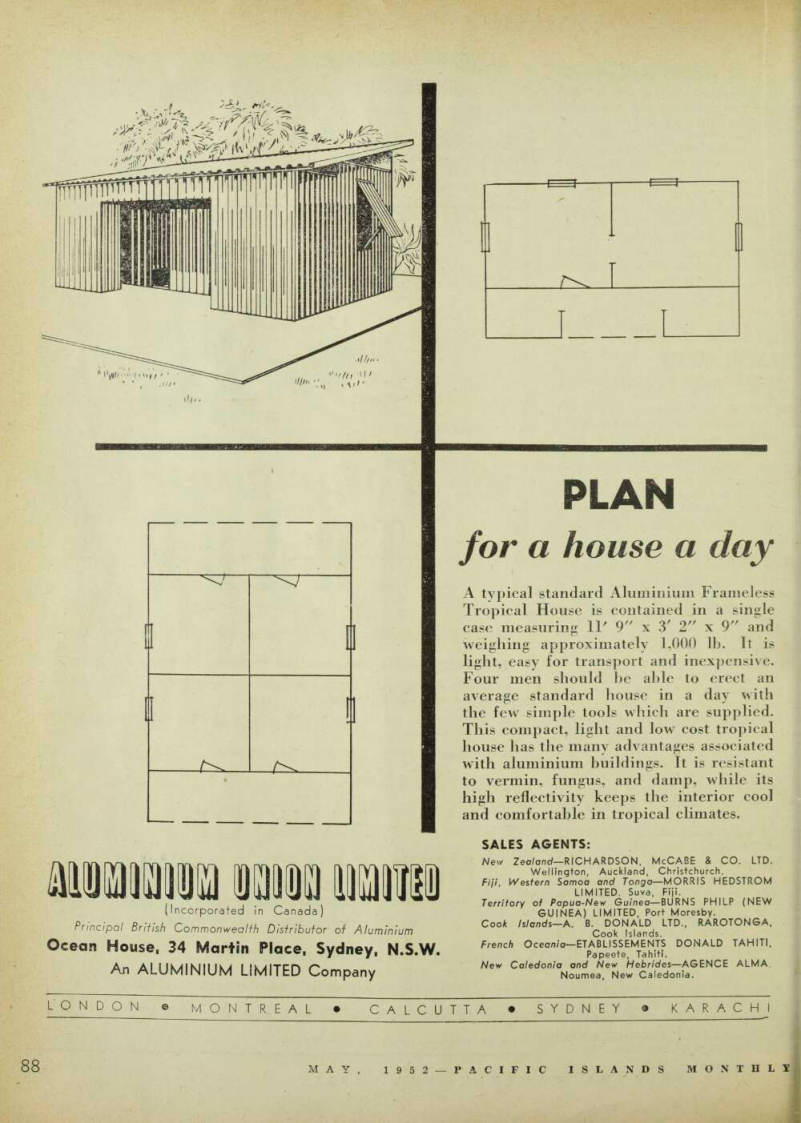 90
90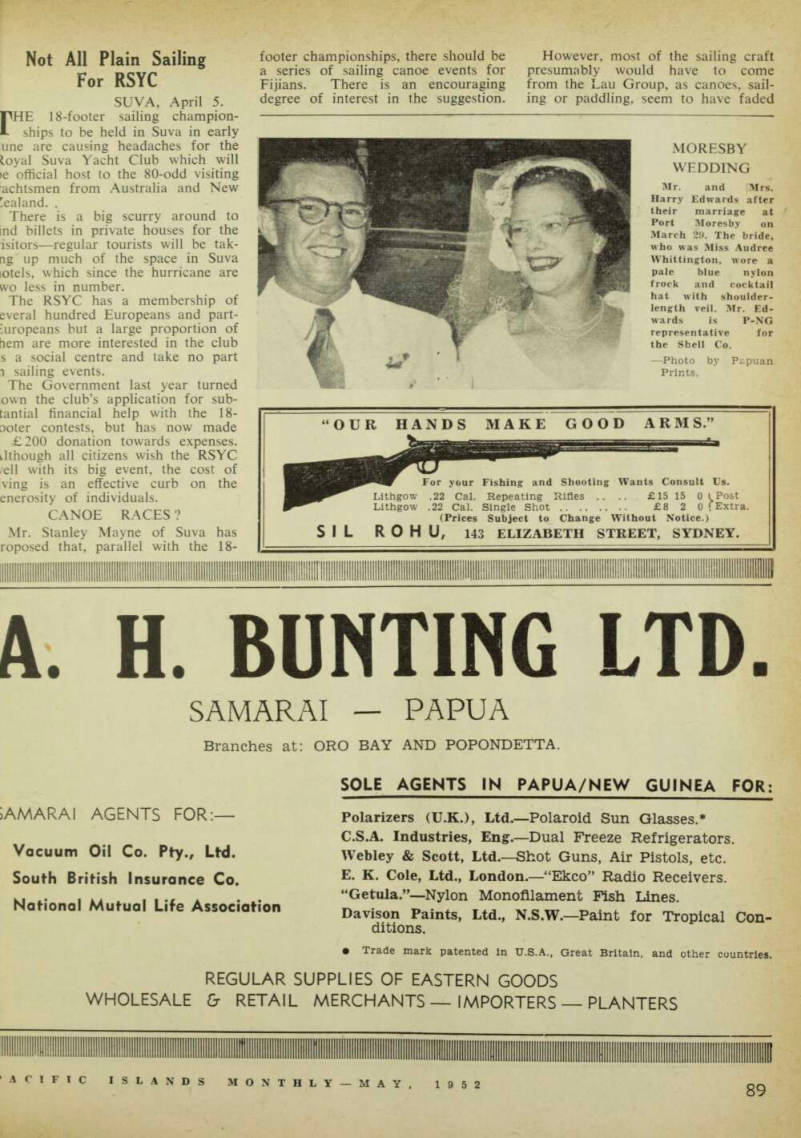 91
91 92
92 93
93 94
94 95
95 96
96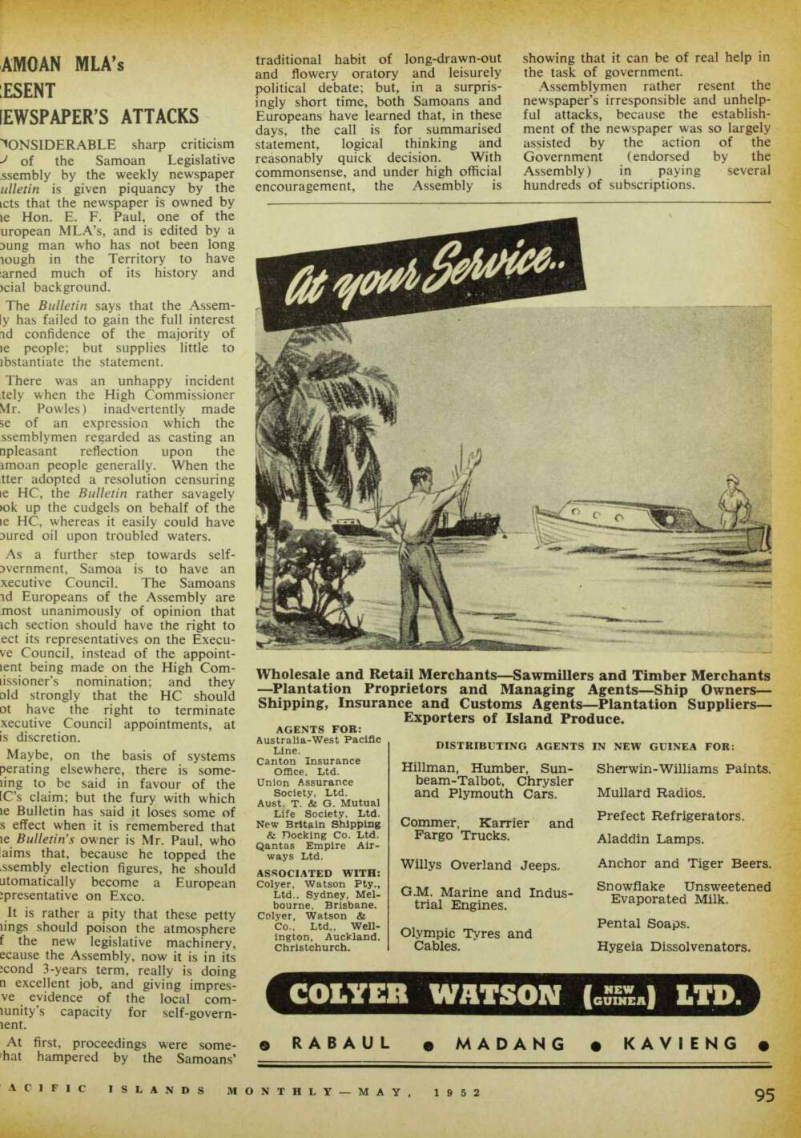 97
97 98
98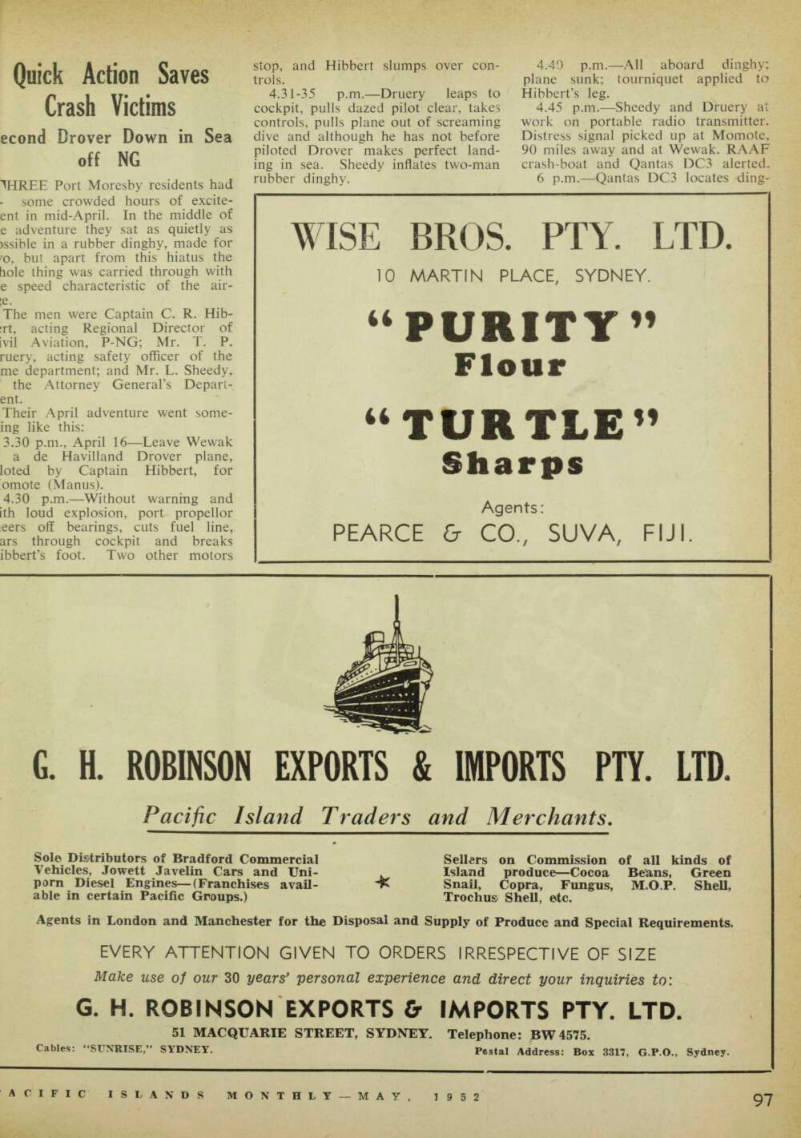 99
99 100
100 101
101 102
102 103
103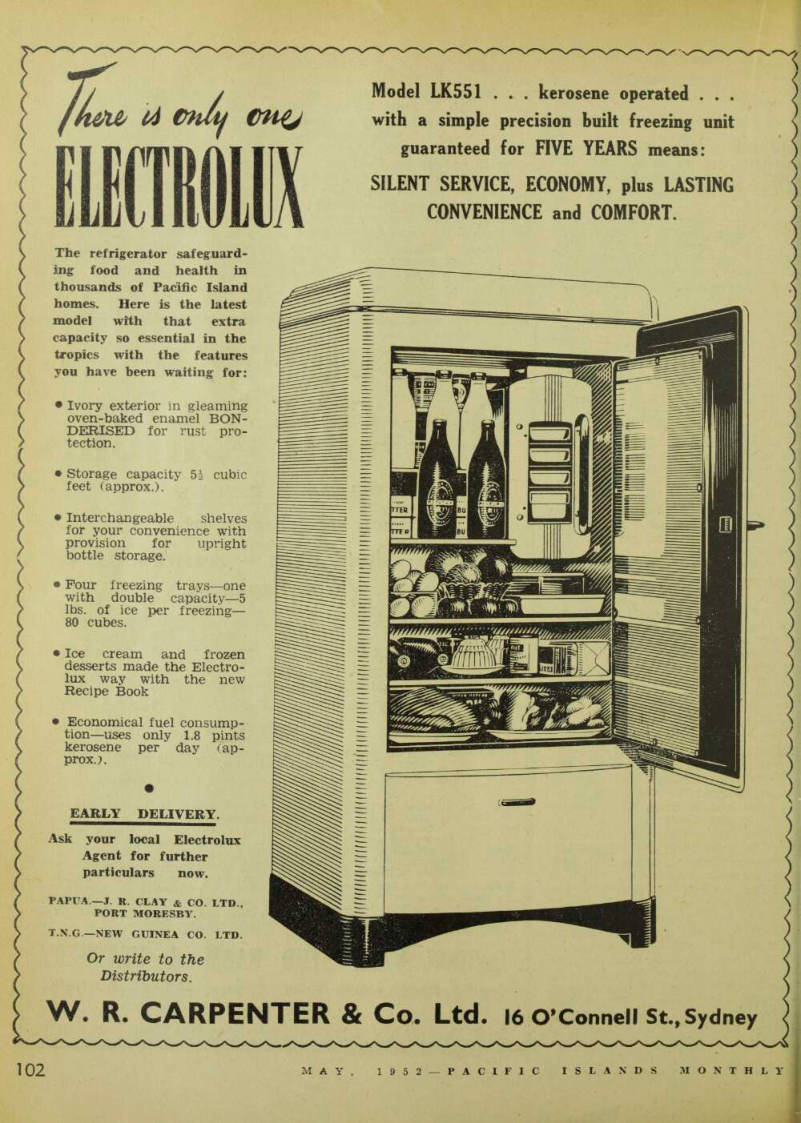 104
104 105
105 106
106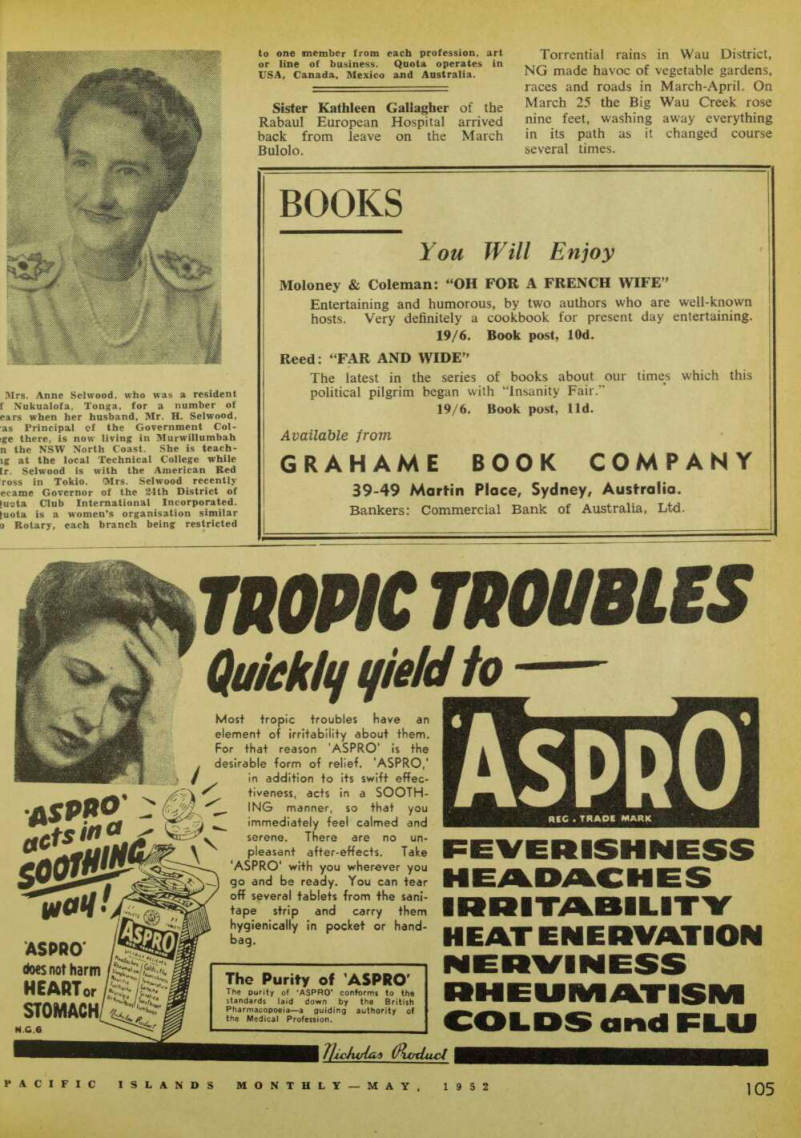 107
107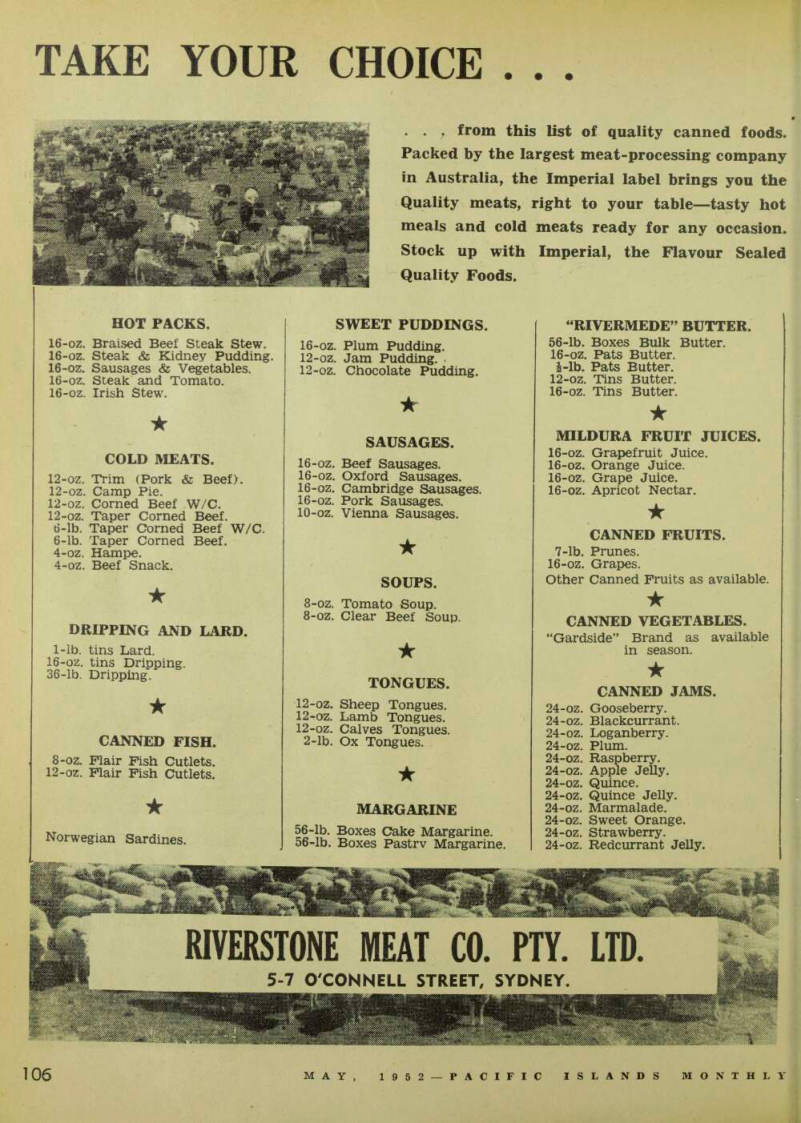 108
108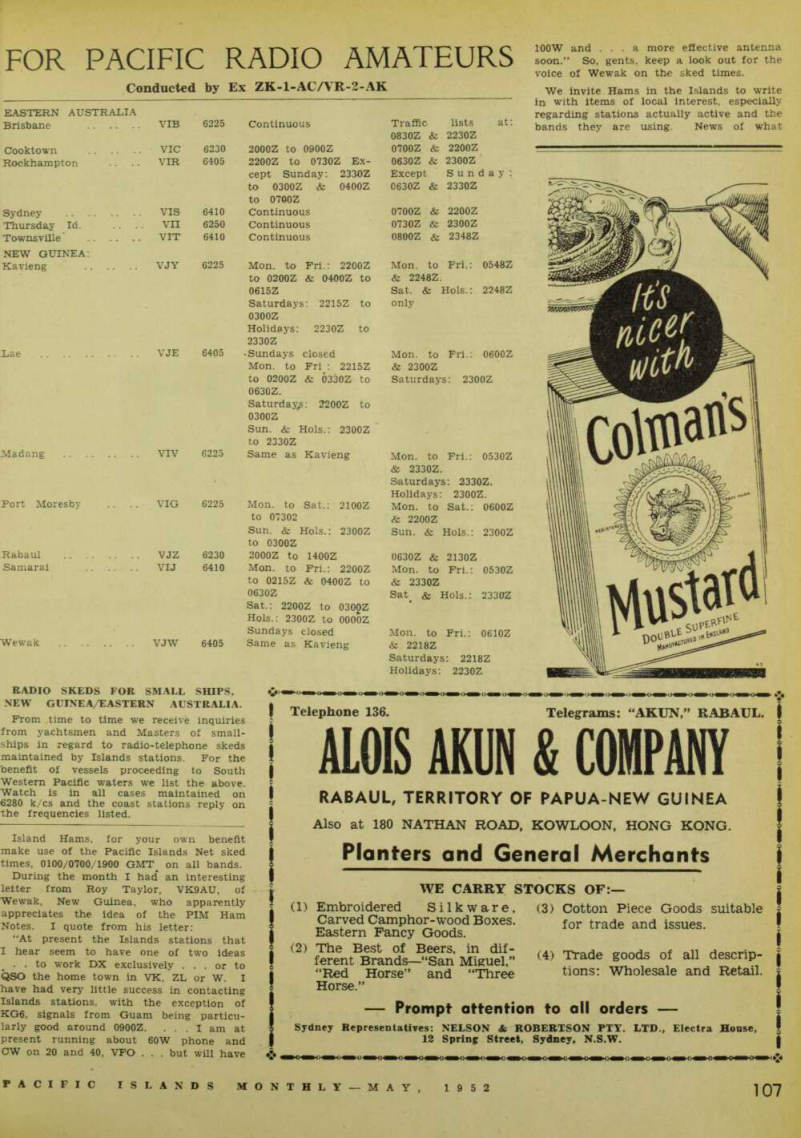 109
109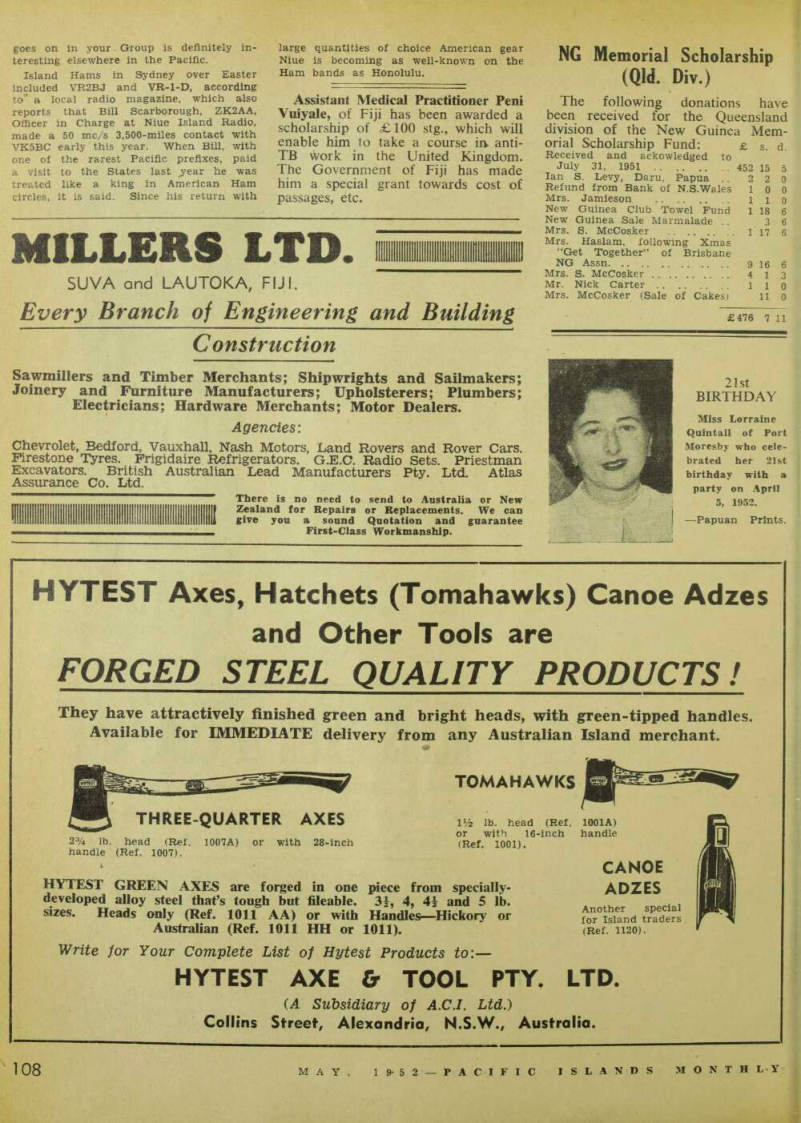 110
110 111
111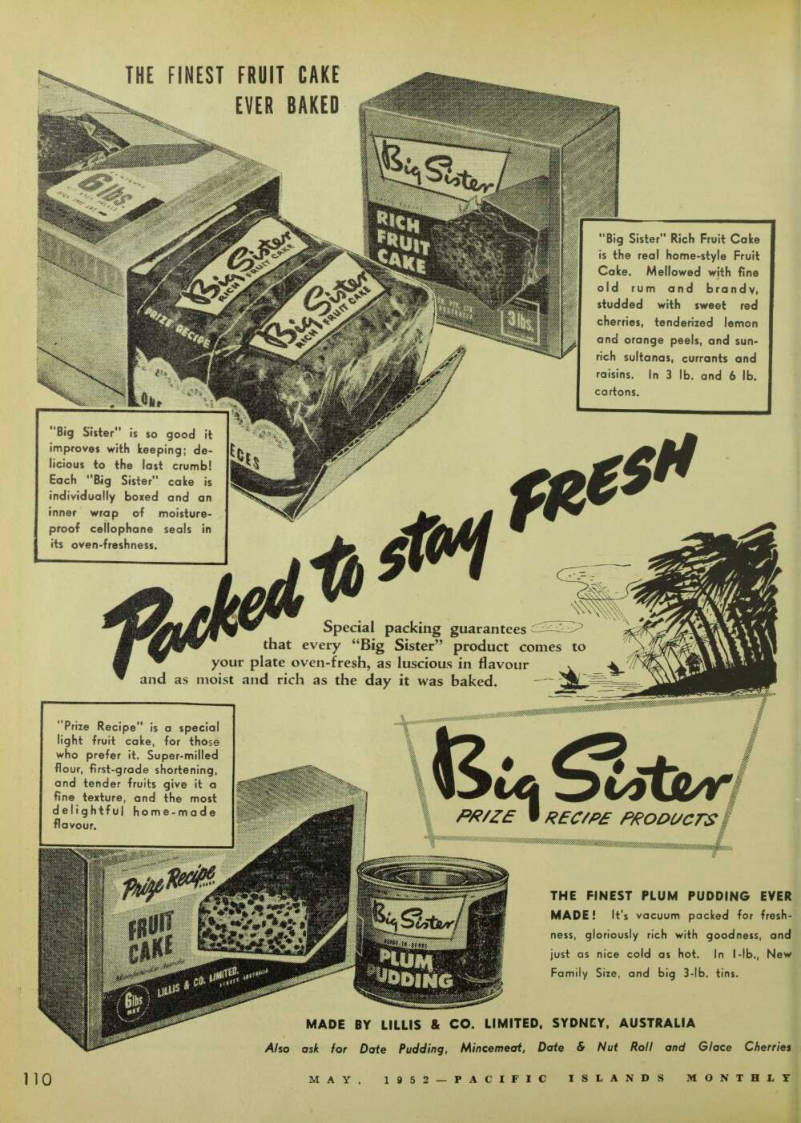 112
112 113
113 114
114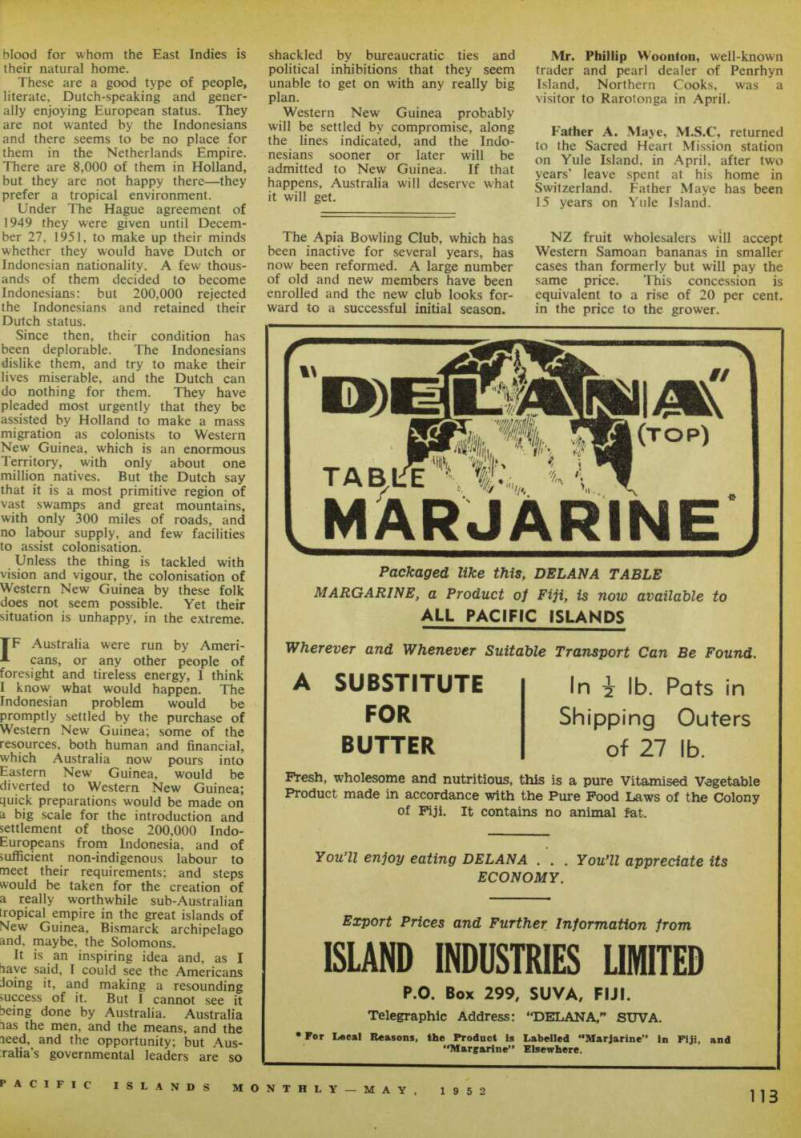 115
115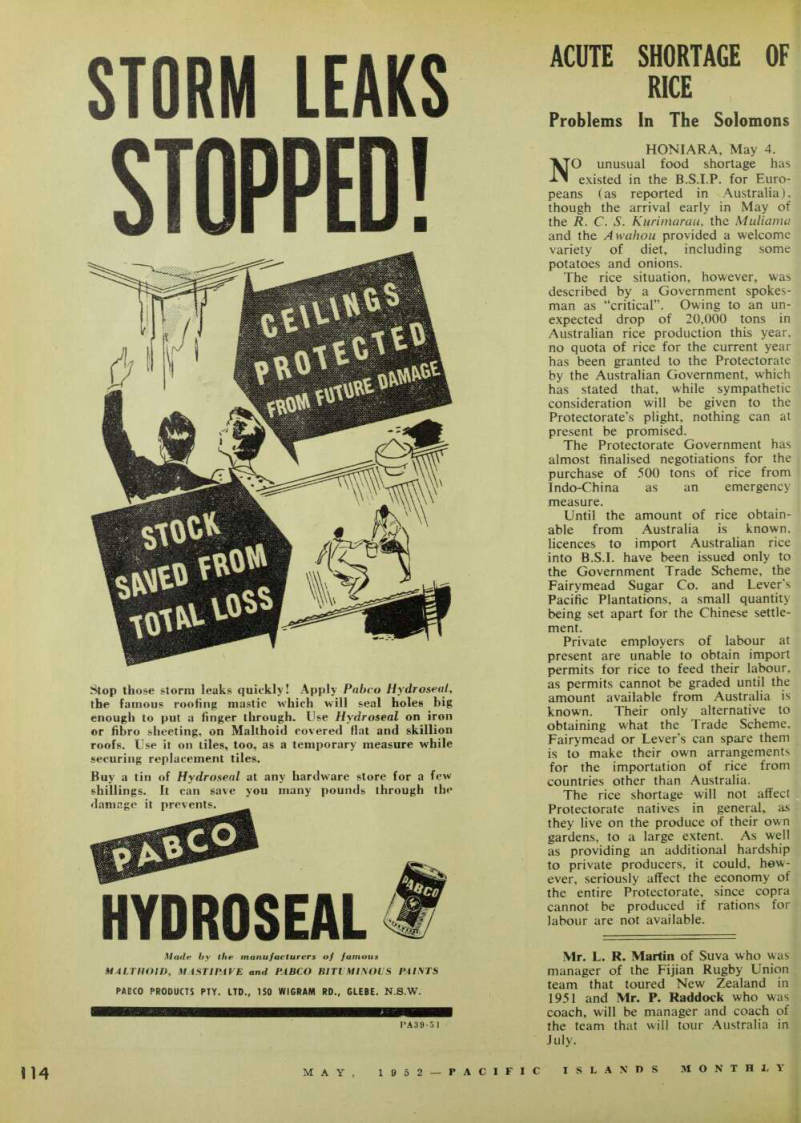 116
116 117
117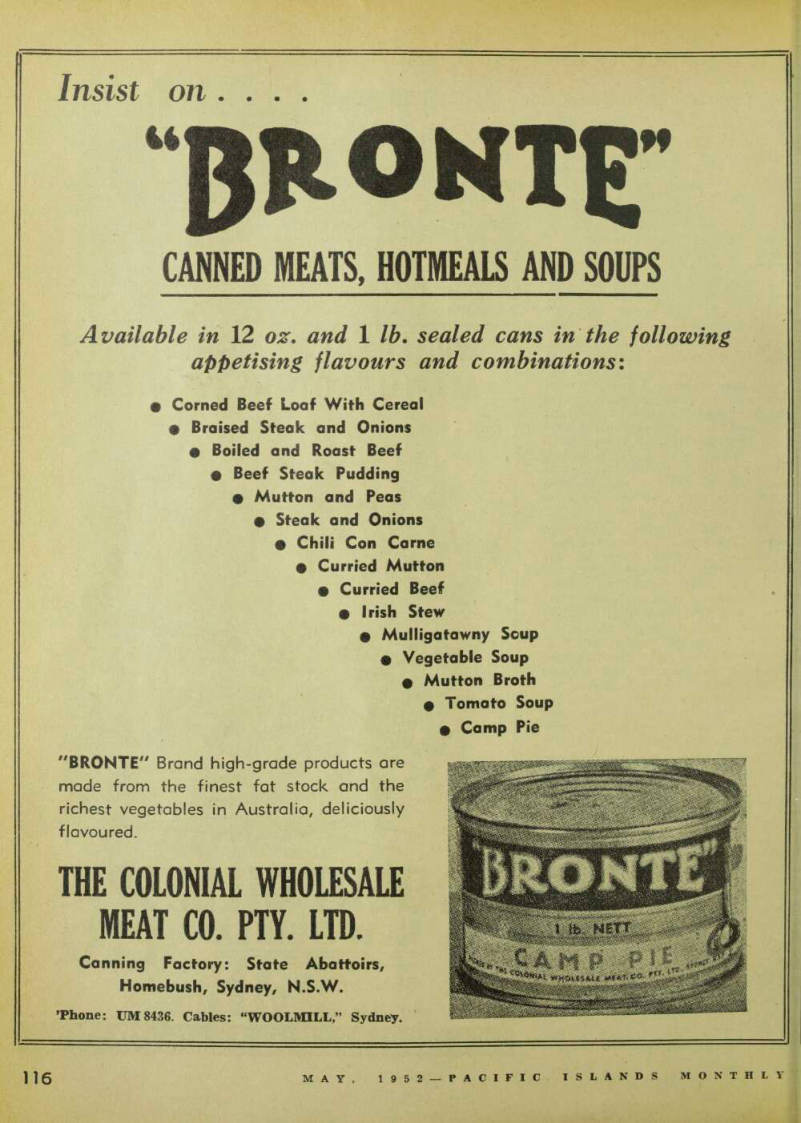 118
118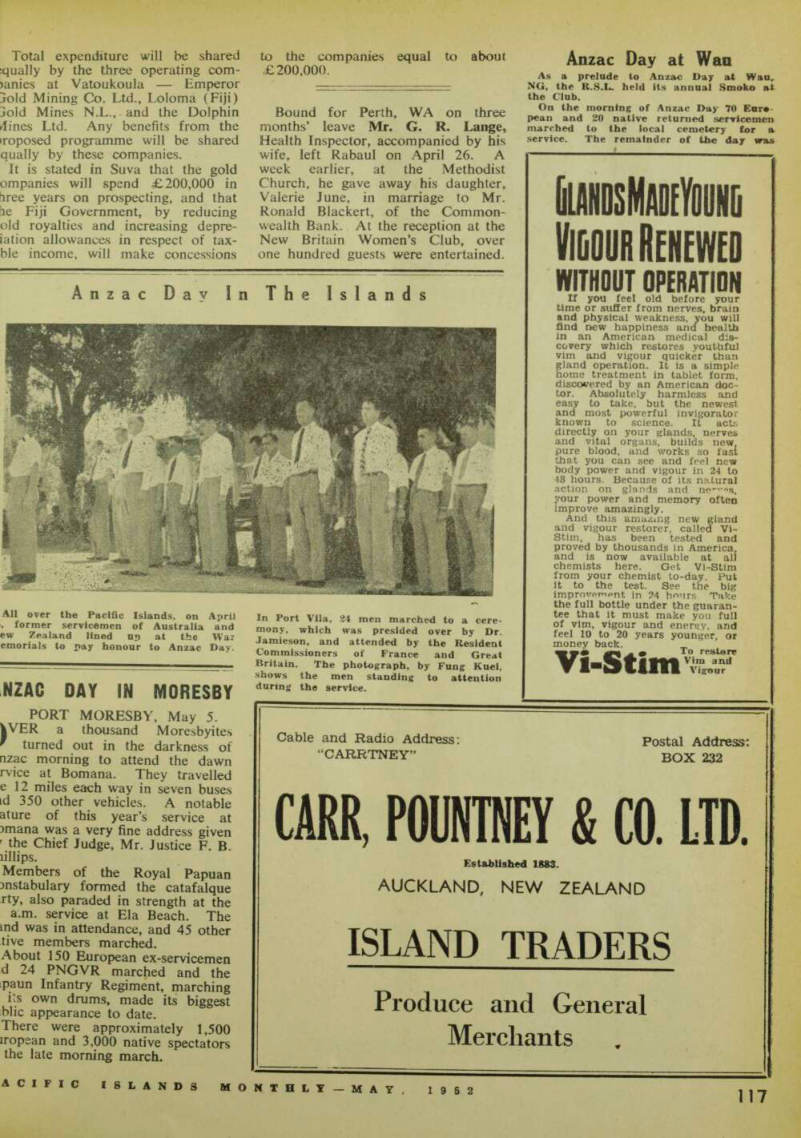 119
119 120
120 121
121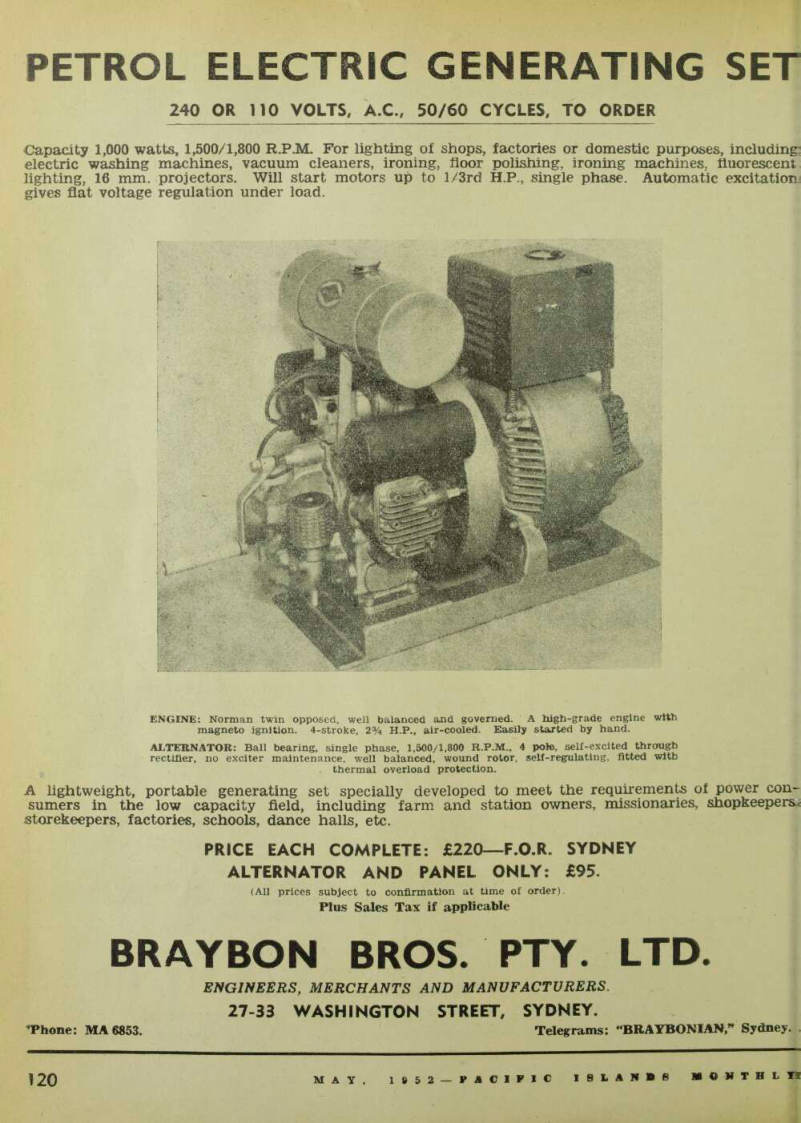 122
122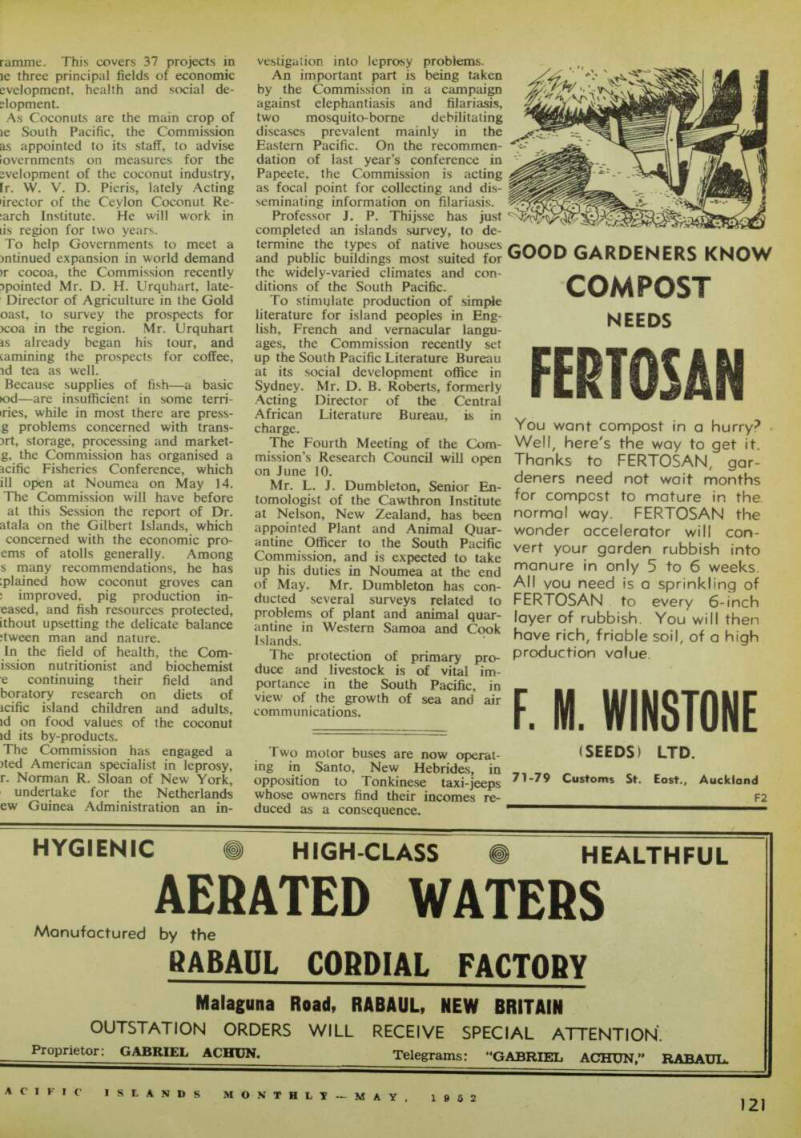 123
123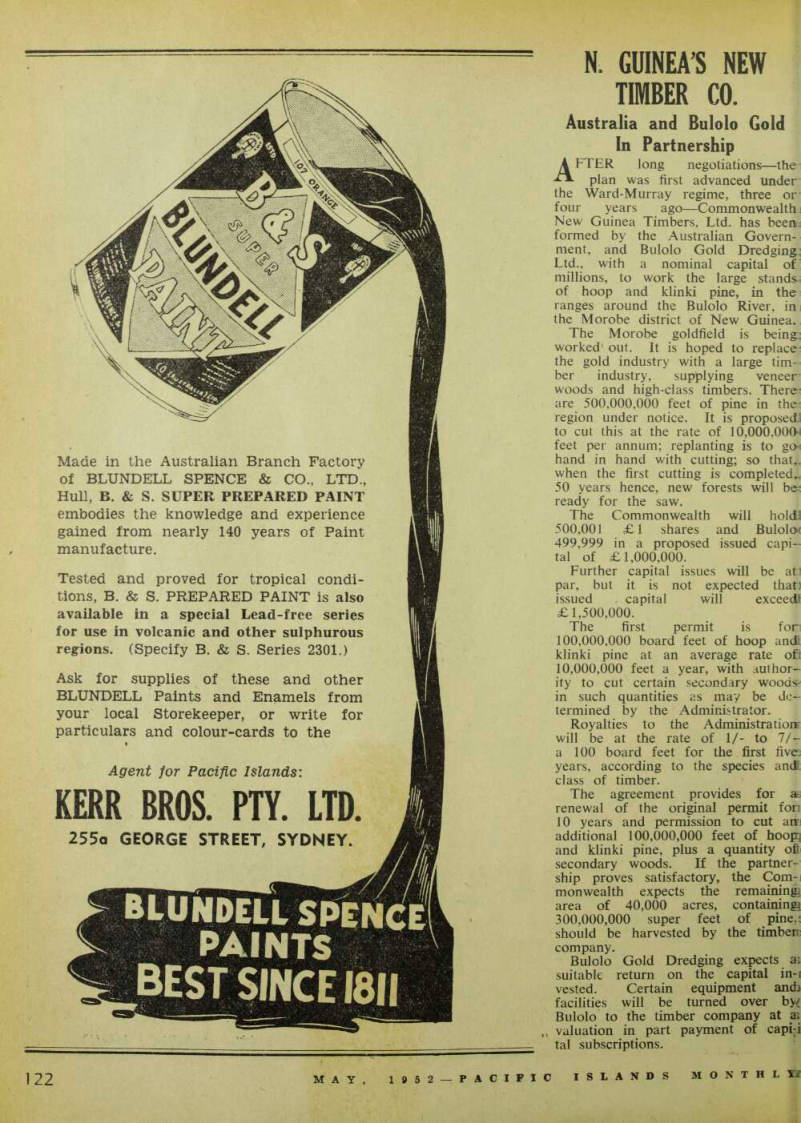 124
124 125
125 126
126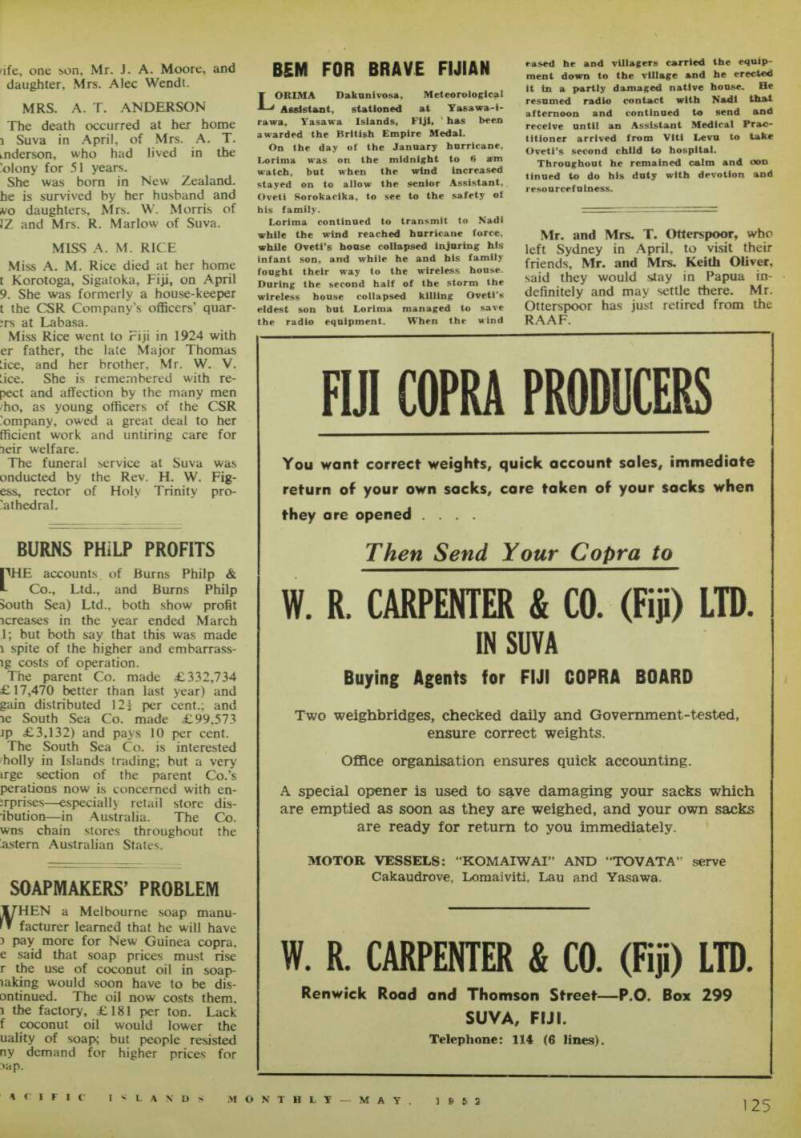 127
127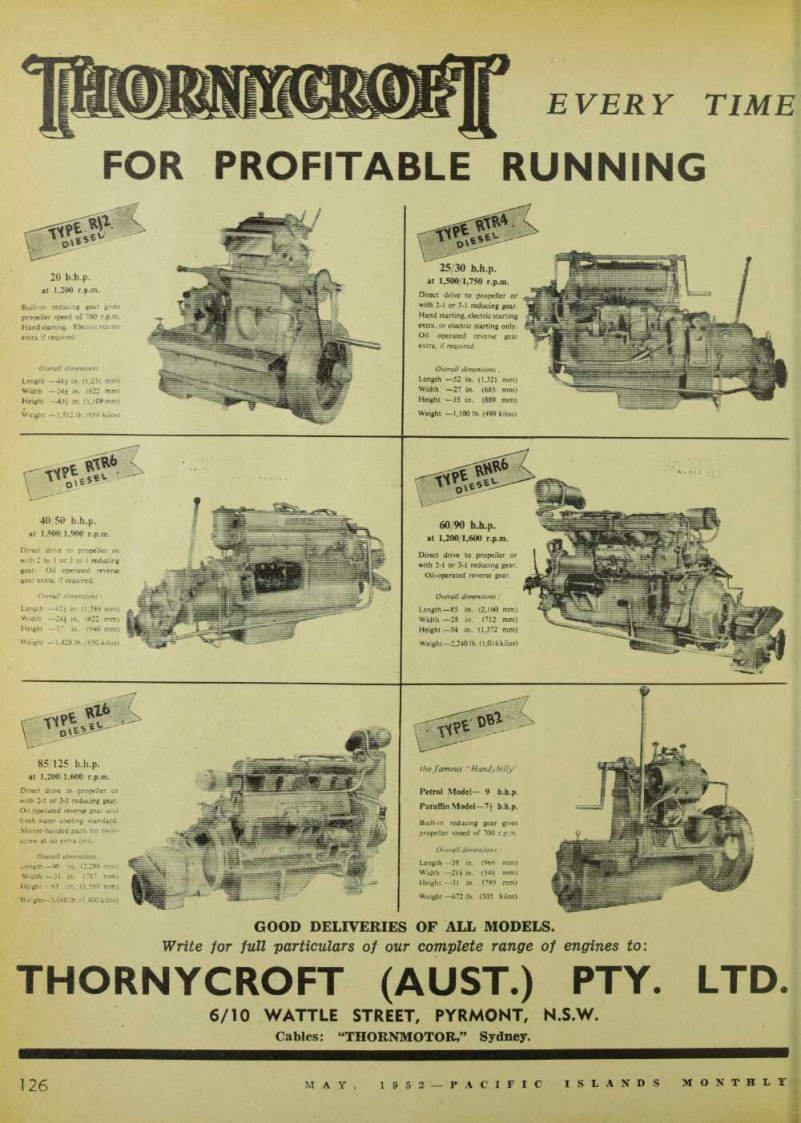 128
128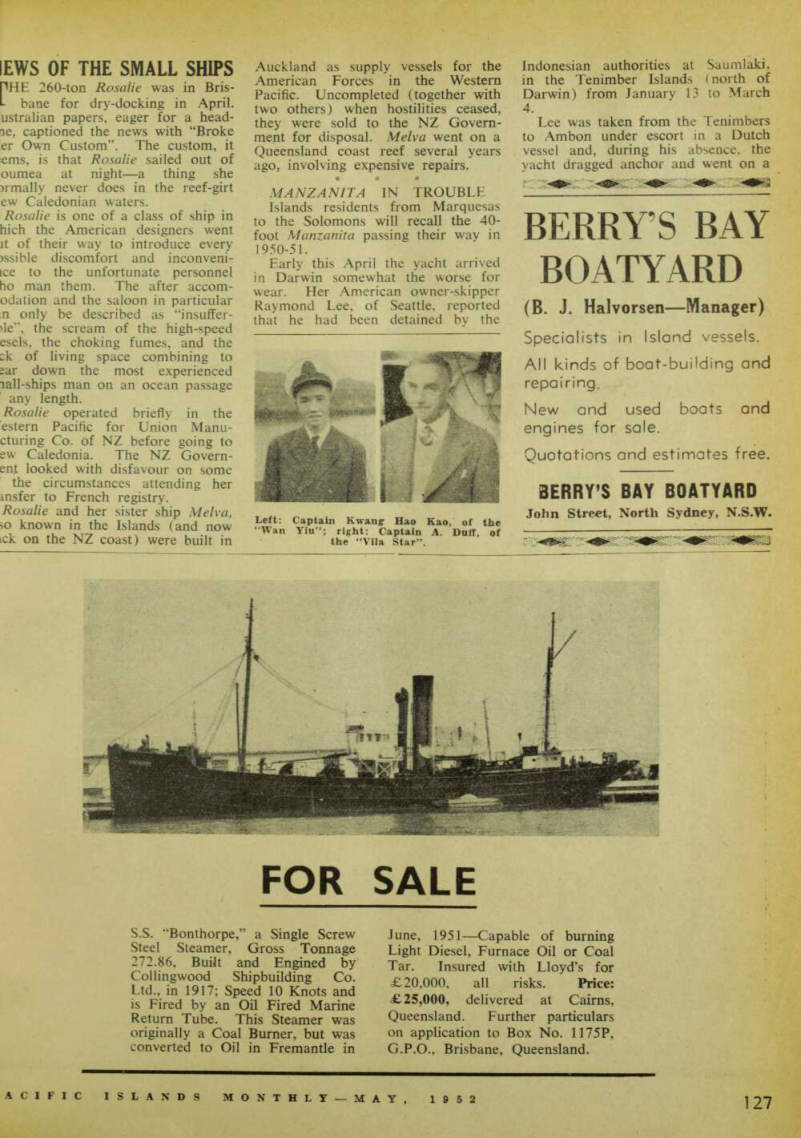 129
129 130
130 131
131 132
132 133
133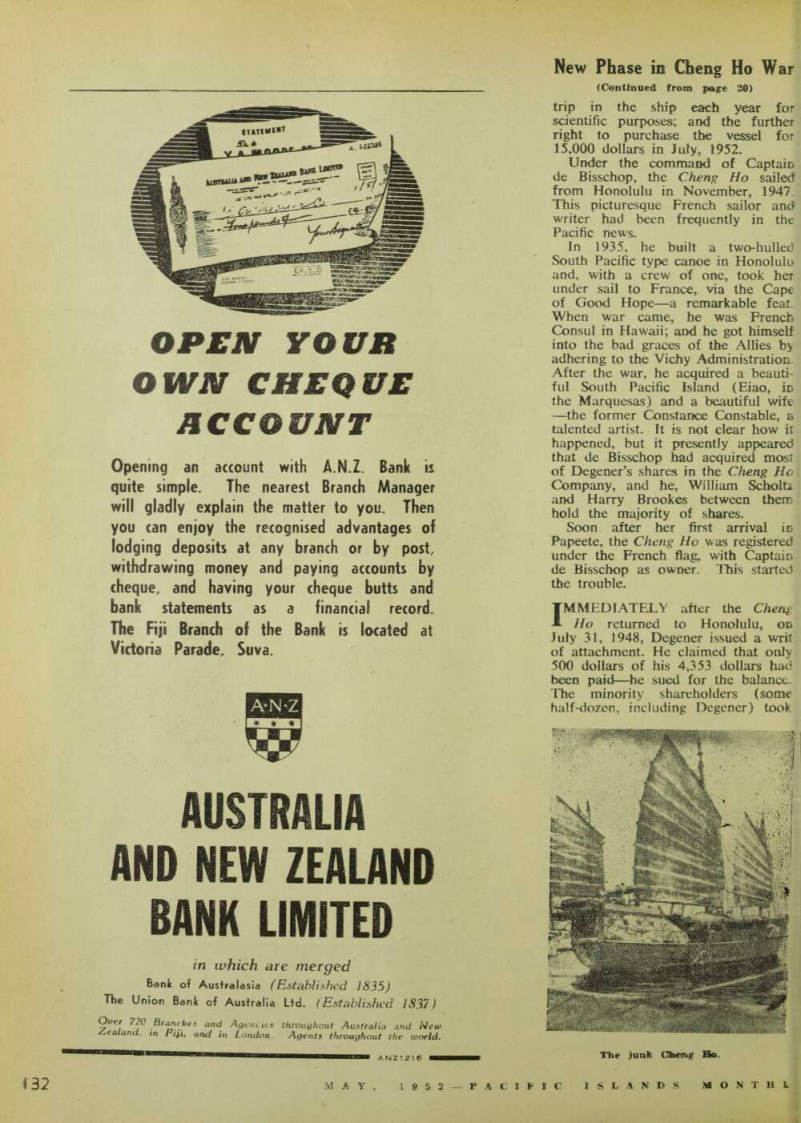 134
134 135
135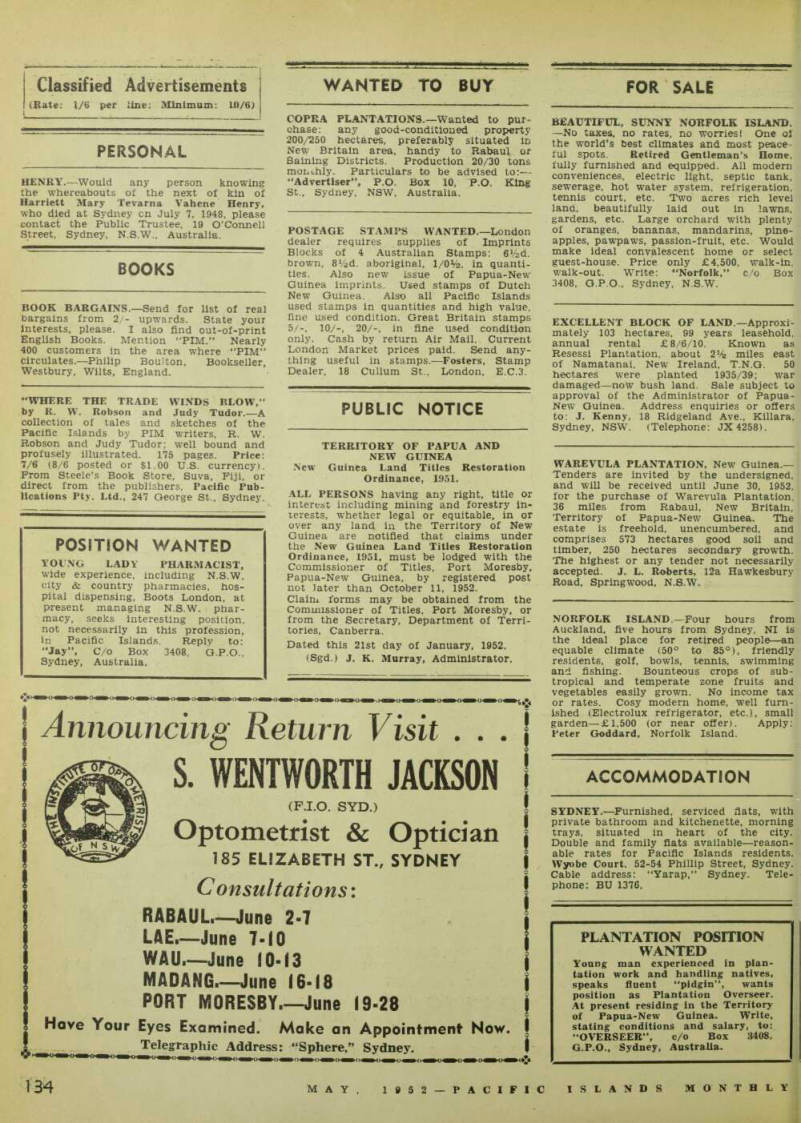 136
136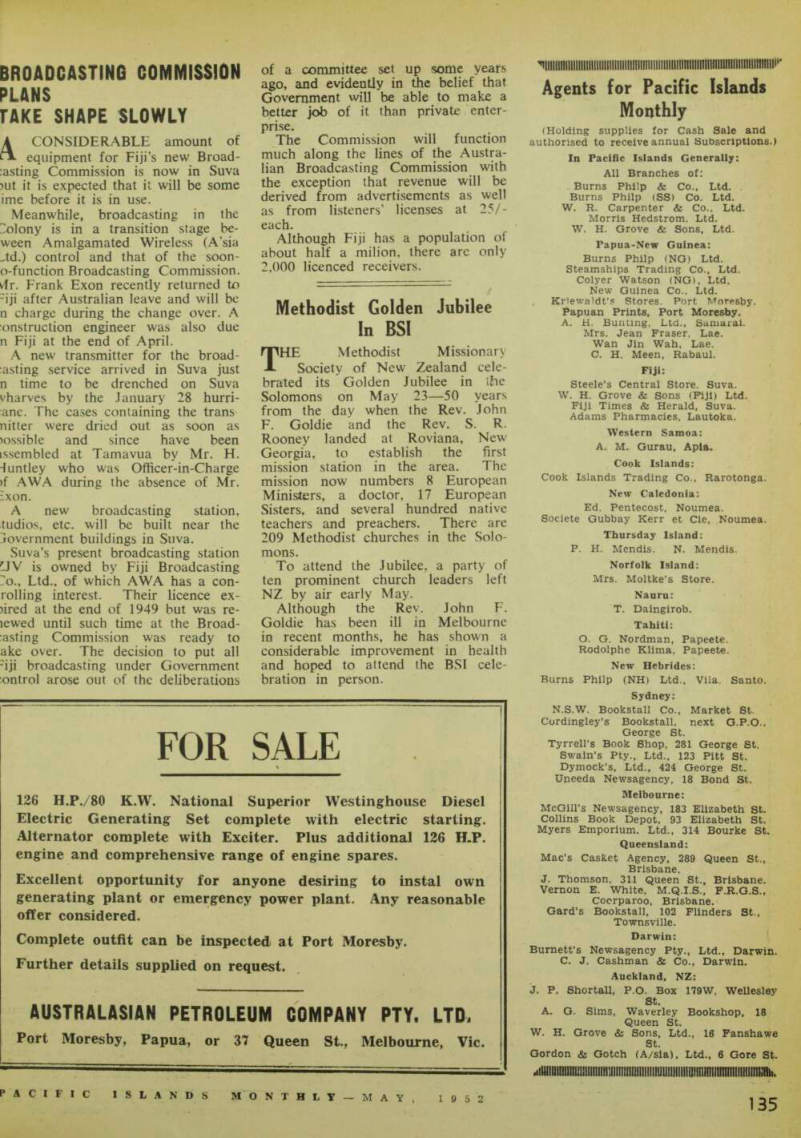 137
137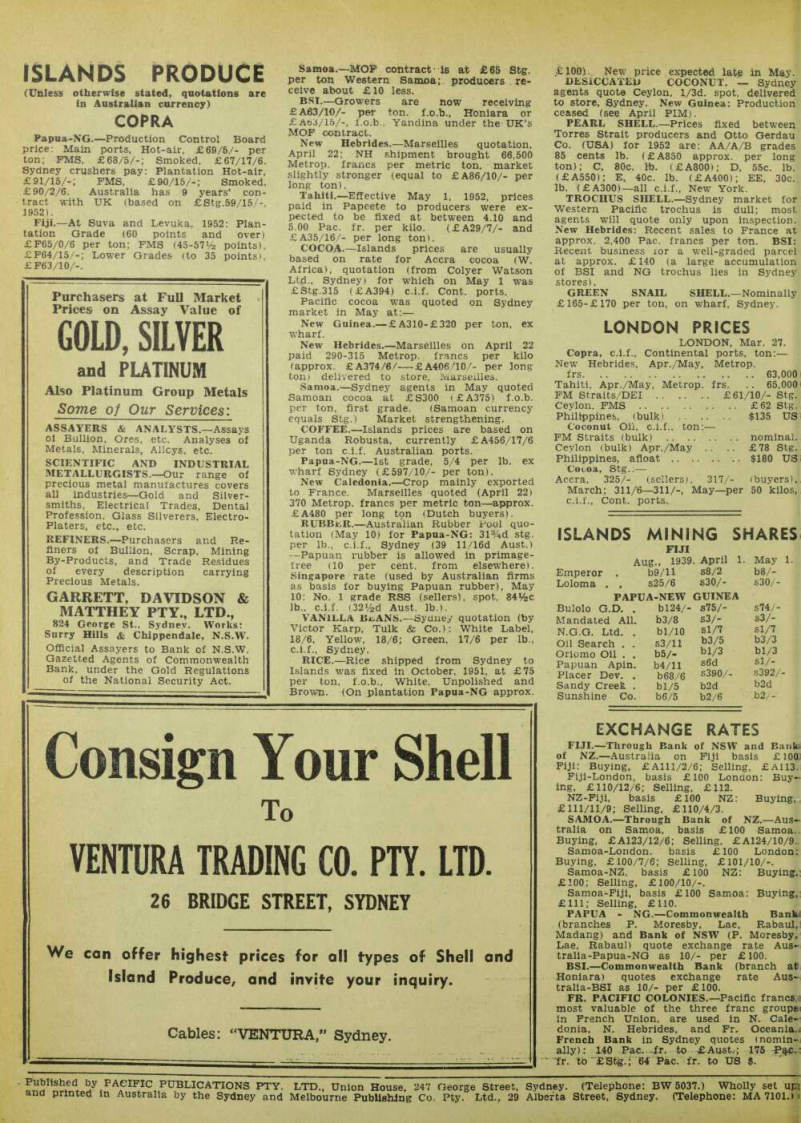 138
138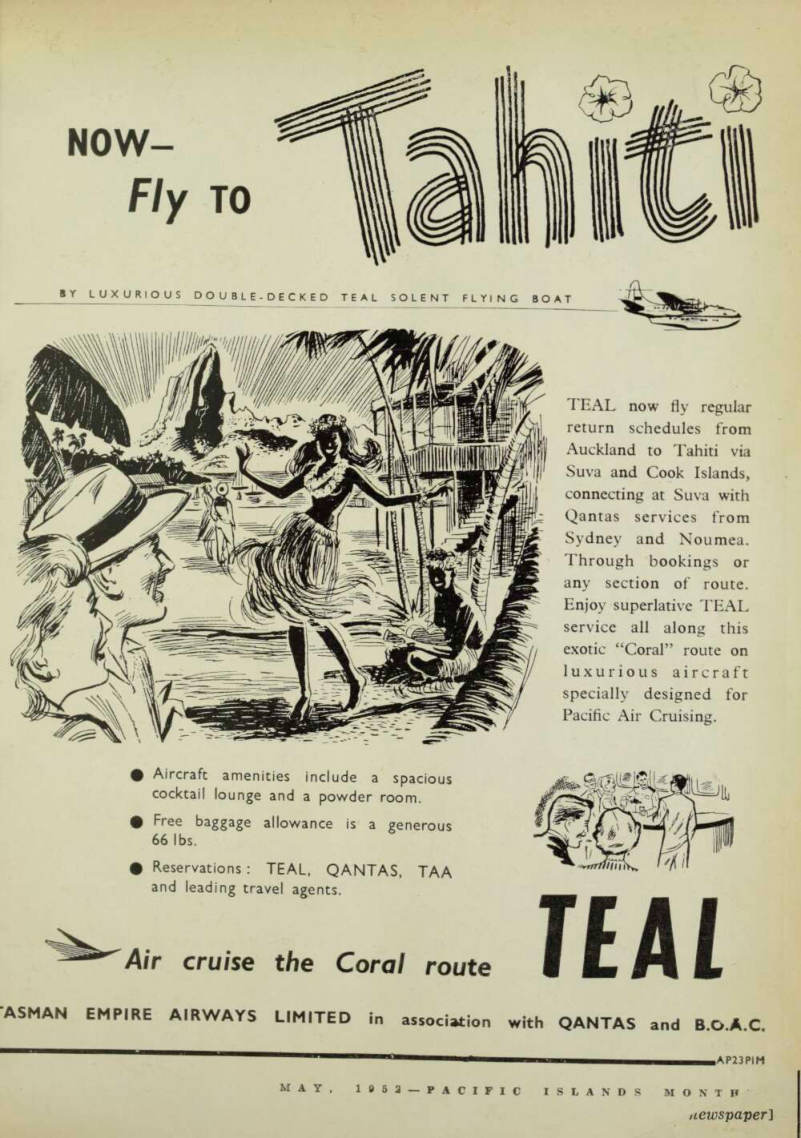 139
139 140
140