Bosun Bird
p. 70 · Read in the full issue
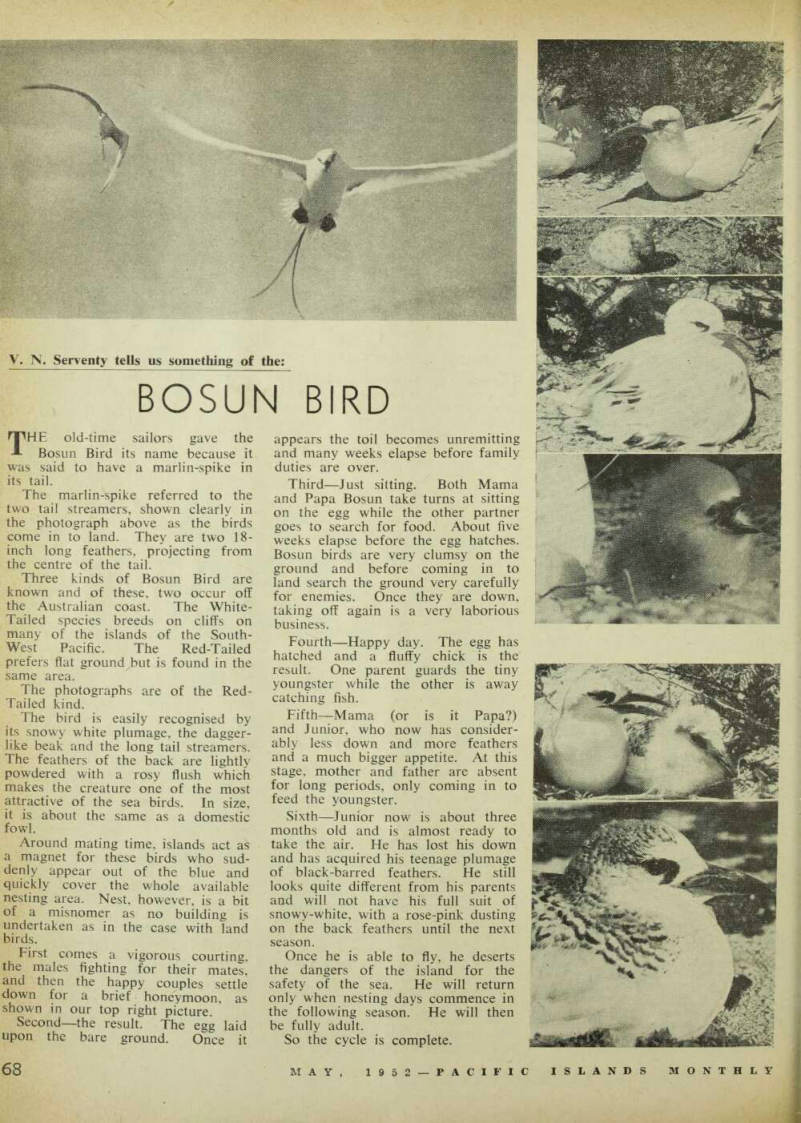
V. N. Serventy tells us something of the:
THE old-time sailors gave the Bosun Bird its name because it was said to have a marlin-spike in * ts tad - .
The marlin-spike referred to the two tail streamers, shown clearly in the photograph above as the birds come in to land. They are two 18inch long feathers, projecting from of the tail.
Three kinds of Bosun Bird are known and of these, two occur off me Australian coast. The White- 1 ailed species breeds on cliffs on many of the islands of the South- West Pacific. The Red-Tailed prefers flat ground but is found in the same area The photographs are of the Red- Tailed kind.
The bird is easily recognised by its snowy white plumage, the daggerlike beak and the long tail streamers.
The feathers of the back are lightly powdered with a rosy flush which makes the creature one of the most attractive of the sea birds. In size, it is about the same as a domestic fowl- Around mating time, islands act as a magnet for these birds who suddenly appear out of the blue and quickly cover the whole available nesting area. Nest, however, is a bit of a misnomer as no building is undertaken as in the case with land bi rds.
First comes a vigorous courting. the males fighting for their mates, and then the happy couples settle down for a brief honeymoon, as shown in our top right picture.
Second—the result. The egg laid upon the bare ground. Once it
appears the toil becomes unremitting and many weeks elapse before family duties are over.
Third—Just sitting. Both Mama an( j p a pa Bosun take turns at sitting on t h e egg while the other partner g oes to search for food. About five weeks elapse before the egg hatches, Bosun birds are very clumsy on the ground and before coming in to l an d search the ground very carefully f or enemies. Once they are down, taking off again is a very laborious business. r TT j T u u . f° u ? h — : Happy day. ?! e ? g ? s hatched and a fluffy chick is the result. One parent guards the tiny ?“?? ster fi ? ile the other !s away catching fish.
Fifth Mama (or is it Papa?) and Junior, who now has consider ably less down and more feathers and a much bigger appetite. At this stage, mother and father are absent for lon g periods, only coming in to feed the youngster, Sixth—Junior now is about three months old and is almost ready to take the air. He has lost his down and has acquired his teenage plumage of black-barred feathers. He still looks quite different from his parents and will not have his full suit of snowy-white, with a rose-pink dusting on the back feathers until the next season.
Once he is able to fly, he deserts the dangers of the island for the safety of the sea. He will return only when nesting days commence in the following season. He will then be fully adult, So the cycle is complete.