Magazine Section
pp. 67-68 · Read in the full issue
The Canoe Builders
THE shark-fishing season is about to commence along the north east coast of New Ireland. Every young buck in the district professes to look forward with much eagerness to this exhilarating pastime.
But the canoes all belong to the old men, who are not as keen as they used to be; anyhow, their canoes are nearly all old and cracking up.
Savak, of the village of Fisoa, a man of middle age and large family who has had a canoe-making log in his banis (enclosure) for many moons, decided to take the bull by the horns and get the job completed.
The matter was decided for him, really, by the fact that his protege, a Tabar Island man named Lupui, and a great hunter, had that morning brought in two bush pigs that he had
speared.
This relieved Savak of the rather irksome job of netting fish on the reef for the big kaikai that must be provided when a number of men gather together to work on another’s canoe. The pigs brought in, and the workers invited to assist, Savak’s women were despatched hurriedly to the taro patches, and very soon they
were all squatting down over the mumu stones (native stone oven) preparing the taro-cake for the show.
It was at this stage that I, the in quisitive European who had settled amongst them and been with them in all their native pursuits for the past 6 months, arrived on the scene.
Counting those present, I found them to number 14, of whom three were actually working, old Melake and Baia chipping at the log—laboriously hollowing it out —Mairum nearby. 1 pointed out to Savak that it was surely a bit expensive having 14 men present with only three working.
“All ’e helpim me”, he assured me.
“And you yourself?” 1 questioned.
In utter bewilderment Savak looked at me. “But I don’t have to work”, he said finally. “I provide the kaikai ” —his idea of providing the kaikai apparently being that another chap should hunt the pigs (the dog certainly belonged to Savak, so he had some claim to them), his women-folk cook them and the taro, a third man butcher and prepare the pigs. And (he hoped) I should provide the tobacco.
All parts of the schedule went
OUR editor, who sometimes stores things away in a sort of literary deep-freeze, recently came upon this Island vignette in i filing-cabinet where it has lain for almost 20 years. It is dated October, 1932.
Apart from the fact that the large ocean-going canoes which were then fal ling into disuse are probably used even less today, it could have been published now, 20 years later, without any com ment. However, it is interesting to note that the author is still in Papua-New Guinea, much better known to-day than he was then. He is Mr. W. C. Groves, Director of Education in the Territory.
In October, 1932, he wrote from Fisoa Village, New Ireland, where he had gone six months previously on a fellowship to do anthropological field work and. as he says in his story, he had not until then seen anything of native village life.
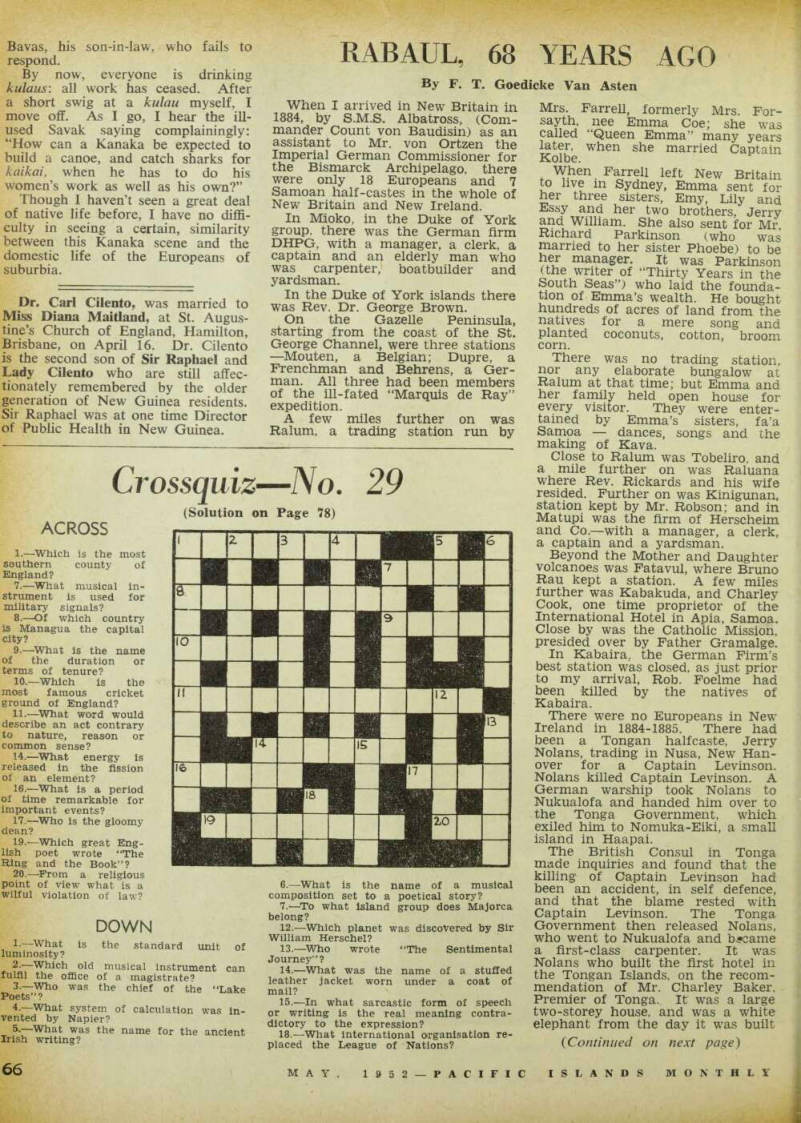
The photograph, too, is an old one. We published it in our issue of August, 1932.
according to plan, except the last.
It was not my canoe, after all.
The scene of this working-bee, as the afternoon progressed, became interesting—more to the psychologist than the anthropologist.
Bokaf lies asleep on the sand, his belly full of pig after the first issue; Savak moons around, still explaining that his job is to entertain the workers; Balasam sits sucking his empty pipe, saying quite honestly and deliberately that he is there as a Saturday afternoon onlooker and critic. Mairum—the butcher—is busy disembowelling the second pig. tearing the innards out in a pool of blood; the dog stands expectantly by, tongue hanging out, eyes appealing, tail wagging its pride of achieve ment.
A group of young men arrive and dump young green drinking coco nuts called Kulaus. Miraculously, Bokaf awakens. Balasam finds his pipe no longer interesting; he picks up a native axe and pretends to chip at a part of the canoe. A slut dog comes near a dirty Kanaka mongrel, and handfuls of sand thrown at it drive it away.
Takmangaf, Savak’s flabby breasted, perspiring daughter, blouse discarded, bearing away the pig in its carved parts, comes over and pulls Savak’s pipe out of his mouth, going off sucking it herself.
Savak’s wife Avali, also sweat covered from the heat of the mumu oven, comes across and dumps their naked 1-year-old grandchild in his lap. Savak shouts out plaintively for
Sea-going Canoes
Bavas, his son-in-law, who fails to respond.
By now, everyone is drinking kulaus : all work has ceased. After a short swig at a kulau myself, I move off. As I go, I hear the ill used Savak saying complainingly: “How can a Kanaka be expected to build a canoe, and catch sharks for kaikai, when he has to do his women’s work as well as his own?”
Though I haven’t seen a great deal of native life before, I have no diffi culty in seeing a certain, similarity between this Kanaka scene and the domestic life of the Europeans of suburbia.
Dr. Carl Cilento, was married to Miss Diana Maitland, at St. Augus tine’s Church of England, Hamilton, Brisbane, on April 16. Dr. Cilento is the second son of Sir Raphael and Lady Cilento who are still affec tionately remembered by the older generation of New Guinea residents.
Sir Raphael was at one time Director of Public Health in New Guinea.