Fiji, Too, Lived Beyond Its 1951 Income
pp. 35-38 · Read in the full issue

Trade Position Now Spotlights Indian Population Problem
SUVA, April 24, piJI received a jolt in the Govern ment statement, issued this month, at in 1951 imports exceeded ex >rts, in value, by more than .2,000,000.
This is the largest trade deficit in e Colony’s history, and it is only e sixth time in the present century at there has been a deficit. The evious largest gap was £577,000 1944.
In 1951 imports totalled 9,300,000 (£2,300,000 more than 1950), and exports £7,300,000 early £500,000 below 1950).
The Comptroller of Customs says at the decline in the total value of ports was attributable mainly to icreases in exports of sugar, gold id canned pineapples. These three mmodities accounted for a drop £1,200,000 compared with 1950. cports of coconut oil, copra, coco it meal, bananas, and biscuits in eased, and there was a larger re port trade with other Pacific is ids.
The drop in the value of sugar ports was due partly to a smaller ne crop and partly to the fact that e CSR Cos. had 41,500 tons of gar still awaiting export at the end 1951, compared with only 8,435 tis at the end of 1950. This differ ce of 33,000 tons was worth about 1,190,000, which accounts for more m half the adverse balance of ide.
The increased value of imports was e to higher landed costs, to the ing of orders outstanding in itain and Australia, to the reopen l of pre-war supply sources such Belgium and Japan, and to the :t that supplies generally were >re readily available.
The Comptroller of Customs, how -r “doubts whether all these fac s account entirely for the trade Scit of £2,055,147.” He says it unless there is an early and sub ntial increase in the exports of ; colony’s principal products, fur :r trade deficits are bound to occur, rticularly when the present high ces for Fiji produce start to fall.
Editorial; How Will Fiji
Close the Gap?
ECAUSE of long-term contracts with the British Government there mot be any abrupt falls in the :es received for the Colony’s main •ducts; but, because of a tendency
to recession in the free world prices of raw materials, at the present time, it may be difficult for Fiji to make up her trade deficit by increasing her exports.
Fiji’s current adverse trade balance has increased the misgivings of some of the Colony’s residents and gener
ally they do not like what they see of present-day trends in the Group.
The whole of the Colony’s income comes off the land, or out of it. There are no secodnary industries. The basic problem is therefore one of land, its use and its ownership.
The population of Fiji is now around 300,000, about half Indian.
Home production of food has not, however, kept pace with population increase, with the result that food stuffs at inflated prices must be im
ported to bridge the gap. If exports can be increased to pay for this, all will be well. If they cannot be in creased, then Fiji must produce more food for itself, stabilise its popula tion or accept a lower living standard.
Indications at present are that the post-war era of ever-increasing prices for raw materials and primary pro duction is coming to an end. If that is so, and Fiji’s export income be :omes more or less stabilised, the rest is a simple matter of mathe natics. The more people there are :o feed the less there will be for jach one.
The high and increasing Indian lirth-rate is the crux of the Colony’s nain problem. The so-called “In lian Problem” is something that ;very non-Indian is prepared to dis cuss. Everyone has a theory as to vhat the Government should do ibout it. But the Government appears o have no ready-made formula for lealing with it except to sit pat and, tided by present land regulations vhich, in effect, severely restrict an ncrease in Indian holdings, let eco lomic pressure take its course. And his may be as good a solution as my.
In an interview last year, a high lecretariat official was asked: Has he Government any plans for the conomic future of the Indians—in hort, a solution of the “Indian Prob em?”
The official thought this very funny.
Ask God,” he said. “He might know tow to solve it—l don’t.”
It has been suggested that matters vould be helped if an immediate conomic survey of Fiji’s potentiali ies in land and future production yere undertaken immediately. But urveys, of themselves, have never telped anyone. People do not pro luce more because they are told to lo so. If you supply a Pacific Is ander with easy money he will buy ffiite bread from the Chinese baker md canned corned-beef from the rade store. If the source of easy loney dries up he does not have to e told to go home and cultivate his aro patch—he goes of his own ccord. The same applies to all eoples, white, brindle or black.
In the easy post-war years of boom nd-bust the fundemental truth that : you don't produce you don’t eat as been easily overlooked.
Fiji’s adverse trade balance this ear probably does not mean much lore than that—in common with lost other countries—a period of ad istment is at hand. Unless bolstered y Government grants and sub dies, Fiji imports must soon align lemselves with Fiji income.
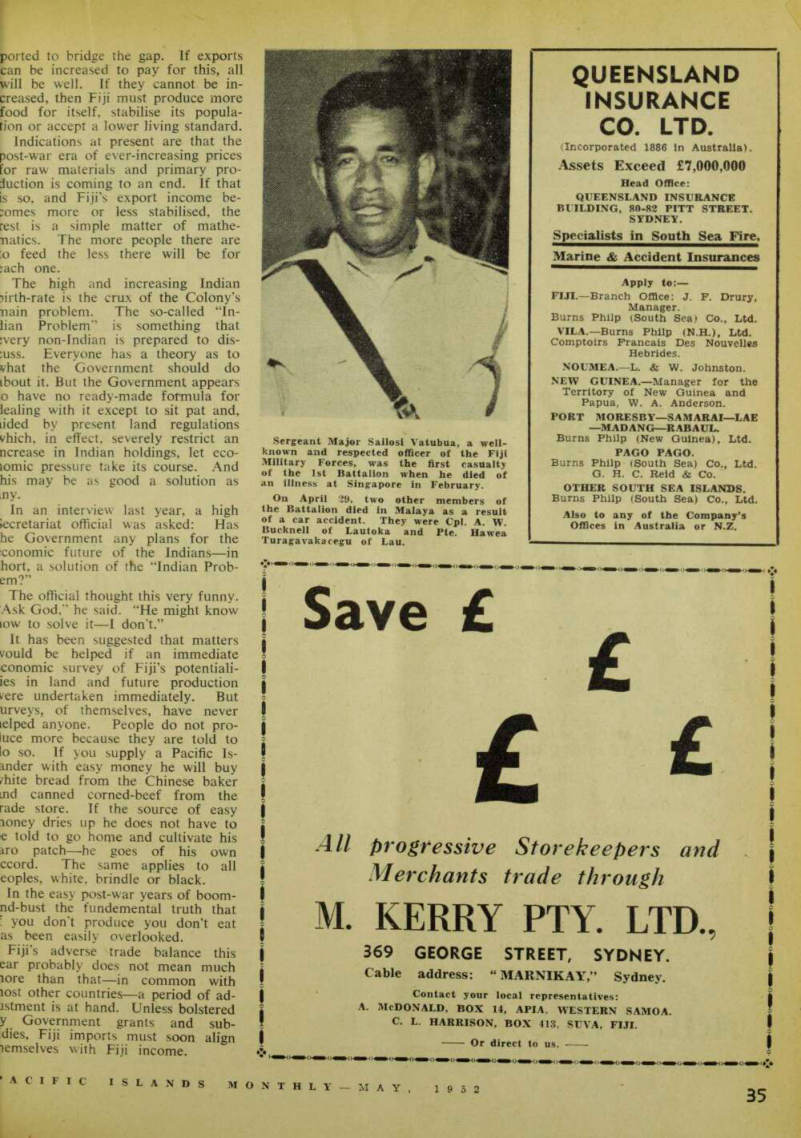
Sergeant Major Sailosi Vatubua, a well known and respected officer of the Fiji Military Forces, was the first casualty of the 1st Battalion when he died of an illness at Singapore in February.
On April 29, two other members of the Battalion died in Malaya as a result of a car accident. They were Cpl. A. W.
Bucknell of Lautoka and Pte. Hawea Turagavakacegu of Lau.
Captain Ken Nicholson, of Qantas Empire Airways, son of Mr, and Mrs. W. T. A. Nicholson of Suva, is the first Fiji born Captain of an overseas airliner. He was one of the
men who enlisted in Fiji during the war for service with the RAF and as a Squadron Leader saw service in Sandringhams in Coastal Command and later in Burma.