Degener And De Bisschop
pp. 22-135 · Read in the full issue
New Phase in the Long War of the Junk Cheng Ho
THE Cheng Ho war is on again.
It has raged, intermittently, ever since World War II ended, and the United States Navy handed over the vessel to Mrs. Anne Archbold and her agent, Dr. Otto Degener, of Honolulu.
The famous junk is registered in Papeete, and has been in the waters of French Oceania in recent years.
Dr. Degener claims he is entitled to resume possession of her in July, 1952.
A few months ago, he got ready to begin certain proceedings in Tahiti. He appointed Oscar Nord man, of Papeete, as his legal agent, and he made formal application for a passport visa, to enable him to visit New Caledonia and Tahiti.
The French Consul-General in San Francisco gave him a visa for New Caledonia, but refused one for Tahiti.
The belligerant Dr. Degener at once went on the warpath, in full panoply. He has prepared, in French, a complete history of the Cheng Ho case, and sent copies of this to all members of the French Parliament. He has asked his Con gressman to help him, and at this moment he is in Washington, insist ing on his right to go to Tahiti and fight his case in the law courts of Papeete. The story of the Cheng Ho is worth re-telling.
She was built in Hongkong in the late 30’s regardless of expense by Mrs. Anne Archbold, American millionaire and patroness of science.
Above the waterline, she is a typical Chinese junk. Below, she is a luxury
yacht, powered by two HOhp diesel engines. She is 99 ft long.
Before the war, she provided trans port for scientific expeditions in which the Archbolds were interested, and in that connection she visited many lands, including New Guinea and Fiji. Dr. Otto Degener, famous botanist, was with her in Fiji.
When war came, Mrs. Archbold sold the luxury junk to the US Navy for one dollar. After the war, the Navy returned her to Dr. Degener, as Mrs. Archbold’s agent in Honolulu, and solemnly received one dollar. Mrs. Archbold agreed to arrangements under wh ; ch the vessel became the property of Dr. Degener.
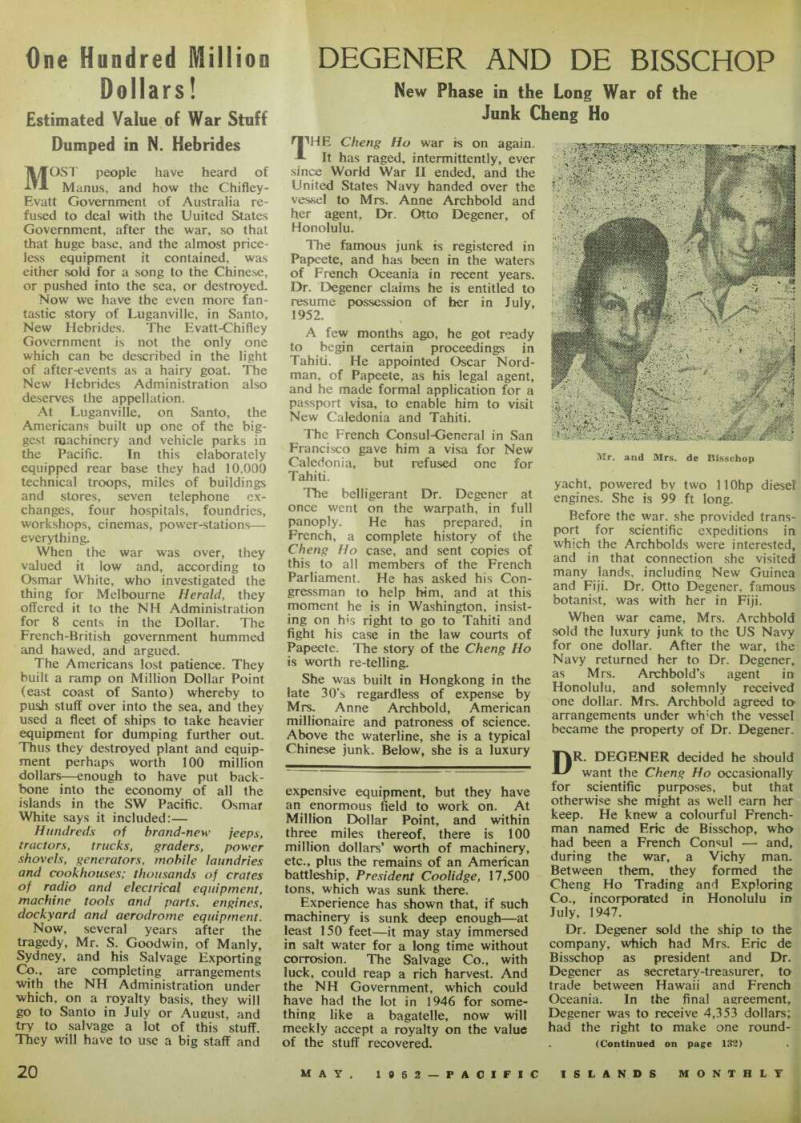
DR. DEGENER decided he should want the Cheng Ho occasionally for scientific purposes, but that otherwise she might as well earn her keep. He knew a colourful French man named Eric de Bisschop, who had been a French Consul and, during the war, a Vichy man.
Between them, they formed the Cheng Ho Trading and Exploring Co., incorporated in Honolulu in July, 1947.
Dr. Degener sold the ship to the company, which had Mrs. Eric de Bisschop as president and Dr.
Degener as secretary-treasurer, to trade between Hawaii and French Oceania. In the final agreement, Degener was to receive 4,353 dollars; had the right to make one round (Continued on page 132)
Mr, and Mrs. de Bisschop
trip in the ship each year for scientific purposes; and the further right to purchase the vessel for 15,000 dollars in July, 1952.
Under the command of Captain de Bisschop, the Cheng Ho sailed from Honolulu in November, 1947.
This picturesque French sailor and writer had been frequently in the Pacific news.
In 1935, he built a two-hulled South Pacific type canoe in Honolulu and, with a crew of one, took her under sail to France, via the Cape of Good Hope—a remarkable feat When war came, he was French Consul in Hawaii; and he got himself into the bad graces of the Allies by adhering to the Vichy Administration.
After the war, he acquired a beauti ful South Pacific Island (Eiao, in the Marquesas) and a beautiful wife —the former Constance Constable, a talented artist. It is not clear how it happened, but it presently appeared that de Bisschop had acquired most of Degener’s shares in the Cheng Ho Company, and he, William Scholti and Harry Brookes between them hold the majority of shares.
Soon after her first arrival in Papeete, the Cheng Ho was registered under the French flag, with Captain de Bisschop as owner. This started the trouble.
F MEDIATELY after the Cheng Ho returned to Honolulu, on July 31, 1948, Degener issued a writ! of attachment. He claimed that only 500 dollars of his 4,353 dollars had been paid—he sued for the balance.
The minority shareholders (some half-dozen, including Degener) took
The junk Cheng Ho.
egal action to compel the three najority shareholders to give an .ccounting; two Hawaiian crew-men edged a special claim; and eight 'ahitian members of the crew sued or wages due.
From then on, the Cheng Ho was under restraint” frequently before arious Hawaiian Courts—and was ot kindly regarded by the judges, /ho found the Co’s, legal and nancial affairs “extraordinarily omplicated”.
In November, 1948, one Court rdered that the Cheng Ho should emain in Honolulu, pending litiga on. A judge said: “I don’t want hat ship to sail until I see the new egistry act.” Captain de Bisschop xplained that the registration of the hip in Tahiti in his name, instead f that of the Co., was due to a lerical error in the office of the jovernor to Tahiti; and every effort /as being made to have the error orrected.
Eventually, when she got away rom Honolulu to Oceania, the 'heng Ho stayed in the Southeast 'acific. We do not know how the isputes of 1948-9 eventually were djusted. But Dr. Degener claims lat he has certain rights, upon /hich he insists.
“I do not now own the Cheng Ho ,” said Dr. Degener, in Honolulu last month, “but I do own the option to purchase her in July, 1952, for 15,000 dollars. Also, the Co owes me 3,000 dollars, and has not even once paid the interest due on that sum.”
It is expected that the ‘‘liaison officer” with the Fiji Rugby Team during its Australian tour will be
Mr. Ken Sands, who formerly prac tised as an accountant in Suva, and now resides in NSW. Mr. Sands was prominently connected with Rugby football during his residence in Suva, and he speaks Fijian.
Mr. W. Schleoscntr, assistant manager of a rubber plantation at Sangara, Papua, who was awarded the George Medal for bravery in the Mt. Lamington eruption, was on leave in Australia in April.