Origin Of Fiji Copra
p. 21 · Read in the full issue
WRITING from Taveuni, Mr. W.
G. Mac Kay challenges a state ment made on behalf of the Fiji Development Fund and published in February PIM that native Fijians produce nearly two-thirds of the Colony’s copra—3o,ooo tons p.a., worth about £1,500,000.
Mr. Mac Kay says that only 15,000 out of the Colony’s annual 35,000 tons come from the native Fijians— the remainder is the product of Europeans, Euronesians, Indians and Chinese. He thinks the error has been made because some officials are inclined to describe all copra which comes in through the smaller trading stores as native copra, when much of it has a different origin.
Mr. Mac Kay has shown us an in teresting analysis of Fiji copra pro duction, including an estimate of pro duction on every non-Fijian planta tion. According to this, the following are the biggest annual producers (over 300 tons) in Fiji: Kanacea, Mango, Vunelagi, Sele Levu, R.
Tarte, Valen Tarte, Ura, Morris Hedstrom, Mua and Nareka, Nagau sau and Nacaulai, Mitchell’s Gamia, Laucala, St. Hilliers, Vuna Vasa, Kwong Tiy Co. Peterson Estate, Son gola, D. Simpson, Cicia, Naitaba.
The biggest individual producers appear to be Sele Levu, and the Messrs. Tarte.
Mr. Y. Hoyshang, a director of Kwong Tiy & Co. Ltd., of Suva arrived in Australia in April, by P.A.A. clipper, on six months’ leave.
In his absence Mr. Y. S. Hing will replace him.
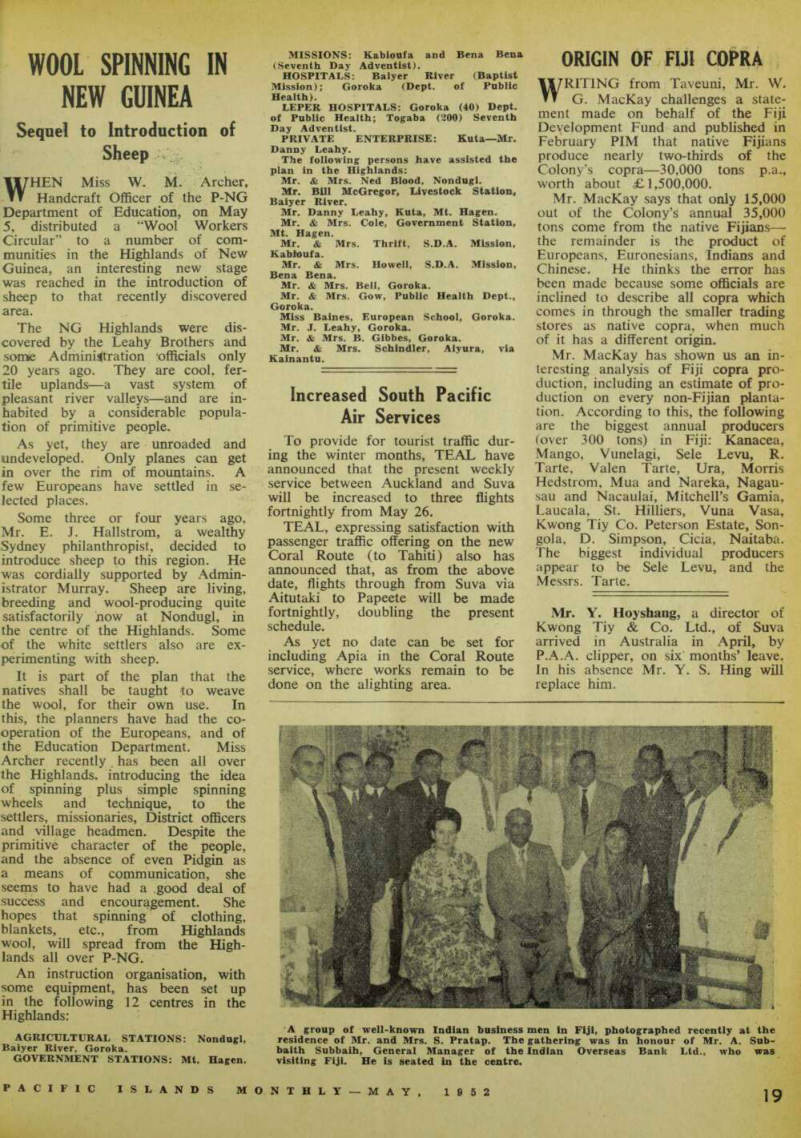
A group of well-known Indian businessmen in Fiji, photographed recently at the residence of Mr. and Mrs. S. Pratap. The gathering was in honour of Mr. A. Sub baith Subbaih, General Manager of the Indian Overseas Bank Ltd., who was visiting Fiji. He is seated in the centre.