Inquiry
p. 17 · Read in the full issue
Purpose Of Customs
Is It First Step Towards P-NG Income Tax?
lITHEN the Customs Inquiry Com ** mittee, under the chairmanship Professor S. J. Butlin, and in structed by Canberra, began taking evidence in Sydney on May 4, few ?eople knew anything of the purpose tnd object of the inquiry.
It was officially explained that the Committee will consider what effect i Customs Union or free trade area vith Australia would have upon the :ost of living, industry and develop nent of the Territory. Having con idered. the Committee will report to he Commonwealth Government.
The obvious fact is that, if the lustoms Tariff is to be adjusted lownwards. so as to allow goods to ome in at reduced cost, revenue nust come in from another source; ind that, of course, would be taxa ion of incomes.
Some people see in this inquiry the irst definite and official step towards he introduction of direct taxation.
Vhat the majority are interested
in, however, is the effect of a “free customs union” with Australia. One Moresby retailer predicts—hopefully, perhaps—that like so many others, the report will be filed and eventu ally forgotten. He said that if a Cus toms Union were introduced, some departments in his store would thrive, while others would diminish in turnover.
But on the whole he was pessimis tic. “We are unable to obtain all our requirements from Australia,” he said. “With Australian protective tariffs operating in the Territory, prices of foreign goods would be be yond the reach of the consumer.”
Firms would have to increase clerical staffs to cope with compli cated Customs procedure if the Terri tory were to adopt the Australian Customs tariff said an agent. “A Customs tariff has two main pur poses: to raise revenue and protect industries. Here we have no indus tries to protect. It would hinder our progress to have manufactures shut out by a high tariff wall.
“What may be a good Customs pattern for an industrialised, white populated country, like Australia, is not suited to our requirements.”
Minister for Territories Hasluck has gone on record as saying he sees no reason why Territorians should be treated as “foreigners” in Australia.
He said he was amazed at the num ber of complex forms which had to be filled in by anyone travelling to and from the Territory. He thought this kind of thing should be reduced.
A few other things Territorians would like to see reduced are; Ex port levies on flour and soap sent to the Territory from Australia; embar goes on exports of cement and gal vanized iron; crippling Customs de posits on the entry of their cars into Australia when they go on leave.
These things might be straightened out by an all-out Customs Union with Australia.
But how unpopular would a Cus toms Union prove to be with Queens land banana growers or NSW trade unionists? Just one shipload of P & NG bananas or, say, some cheap manufactures made by native labour, and there would be cries of woe in Canberra.
For it is the Australian electorates which have the say in Canberra.
Territorians have none.
A Port Moresby auditor, Mr. S.
Fox, said that a Customs Union with Australia would have dangerous im plications, unless Papua and New Guinea were included as a new State of the Commonwealth. Otherwise, the Territory would get all the dis advantages of Union without any advantages. ,
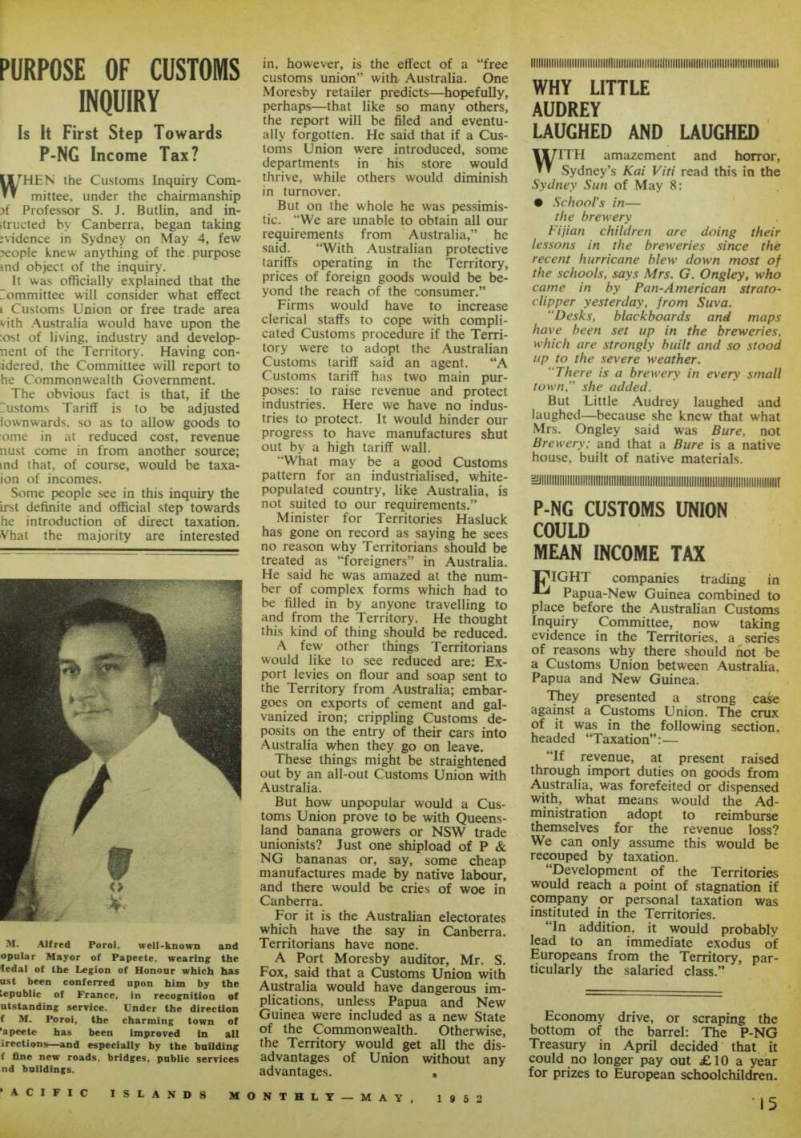
M. Alfred Poroi, well-known and popular Mayor of Papeete, wearing the Medal of the Legion of Honour which has [?}ust been conferred upon him by the Republic of France, in recognition of [?]utstanding service. Under the direction [?]f M. Poroi, the charming town of [?]apeete has been improved in all [?]irections —and especially by the building [?]f fine new roads, bridges, public services [?]nd buildings.