To Keta
p. 73 · Read in the full issue
A Little Story for Our Islands Planners—By R. W. Robson ONE does not judge all New Guinea natives by the “flash coons” and the “village big-heads” produced by war-time confusion and a well-meaning but often misguided Administration.
Among Melanesians, as among Europeans, there are more good than there are poor types; and a true story told me by Oil Co. Executive H. S.
Wynne shows just how good a good New Britain native can be.
Wynne played golf in Rabaul, about 1936. To Keta, attending a Mission school, earned a few pence, caddying. He had an eye like a hawk, and a remarkable knowledge of golf; and the thankful Wynne got him as a regular caddy.
Months later, To Keta entered Wynne’s service as a house-boy. He was regularly indentured. Wynne exchanged gifts with To Keta’s father, To Paivu, a good-looking Matupi man. The family were fond of To Keta.
Came the eruption. After a hec tic flight, the Wynne family found themselves in Kokopo—safe, but with only the clothes they wore.
Mr. Wynne went back to the half buried town in Induna Star, and be gan a search for his car, which he had been forced to abandon in the Nodup area. Eventually, in the bush beside the road, he found it, un damaged. Sleeping beside the car was To Keta, with Master’s bag of golf clubs clasped in his arms.
To Keta rounded up other boys.
With their help, Wynne was able to collect household and personal pos sessions, which were shipped with his family to Australia on the rescue vessel, Montoro.
“Rugged days followed,” says Wynne. “To Keta, faithful and re sourceful, helped me very much in the rehabilitation of my home,”
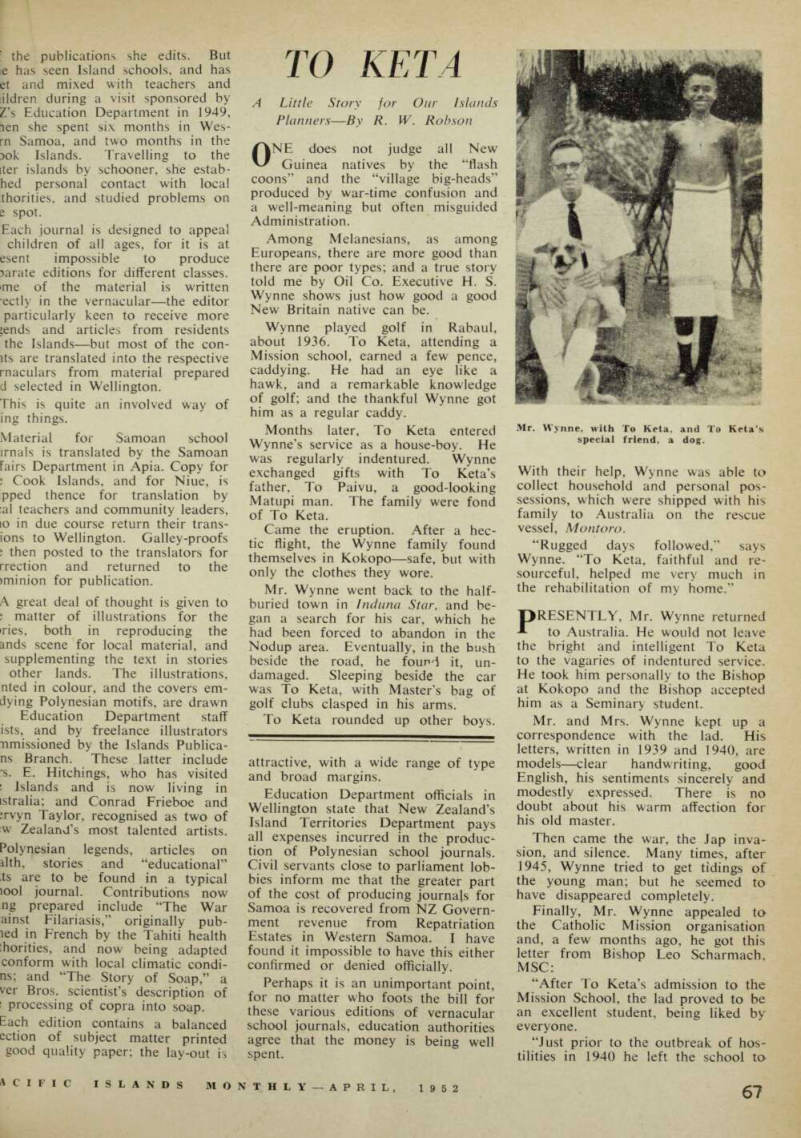
PRESENTLY, Mr. Wynne returned to Australia. He would not leave the bright and intelligent To Keta to the vagaries of indentured service.
He took him personally to the Bishop at Kokopo and the Bishop accepted him as a Seminary student.
Mr. and Mrs. Wynne kept up a correspondence with the lad. His letters, written in 1939 and 1940, are models—clear handwriting, good English, his sentiments sincerely and modestly expressed. There is no doubt about his warm affection for his old master.
Then came the war, the Jap inva sion, and silence. Many times, after 1945, Wynne tried to get tidings of the young man; but he seemed to have disappeared completely.
Finally, Mr. Wynne appealed to the Catholic Mission organisation and, a few months ago, he got this letter from Bishop Leo Scharmach,
Msc:
“After To Keta’s admission to the Mission School, the lad proved to be an excellent student, being liked by everyone.
“Just prior to the outbreak of hos tilities in 1940 he left the school U>
Mr. Wynne, with To Keta, and To Keta’s special friend, a dog.