Polynesia
pp. 72-73 · Read in the full issue
School Journals For
By Jack Thornton
IN Wellington, NZ, last year, the South Pacific Commission’s authority on social development, Mr.
H. E. Maude, paid tribute to the general excellence of the literature produced by the School Publications Branch of New Zealand’s Education Department for distribution in Wes tern Samoa, the Cook Islands, Niue Island and the Tokelau Group.
“They are well written and attrac tively produced,” he said, “and of great importance to the children con cerned. In the preparation of school journals adapted to meet the peculiar requirements of the Islanders, the Dominion has shown a progressive lead.” Examples that he had shown to British Colonial Office educational authorities had elicited the comment: “There is nothing better.”
Mr. Maude has had many years’ experience in the British Colonial Service, serving in the Gilbert and Ellice Group, in Tonga and with the Western Pacific High Commission.
His judgment is authoritative, so NZ’s School Publications staff has reason to be pleased about Mr. Maude’s evaluation of vernacular text-books for Polynesian schoolchildren.
Much of the credit for the high standard of these publications should be given to Miss M. P. Dennehy, an ex-s£hoolteacher who was appointed first editor of Islands Publications— a branch of NZ’s School Publications —in 1948. Prior to Miss Dennehy’s appointment, school journals for the Islands were published for Western Samoa only, at irregular intervals.
To-day, four different publications are issued regularly, and Miss Den nehy edits them all. Their titles are:
Tusitala Mo A'oga Samoa, Te Tuatua Apii O Te Kuki Airani, Tohi Tala Ma E Tan Aoga Niue, and Tala Mo A’oga I Tokelau.
Twelve thousand copies of the first-named are printed in Wellington six times annually; 10,000 of each edition are sent direct to Western Samoa where they are distributed free to schoolchildren, and subse quently read by many parents. The remaining 2,000 are retained in Wel lington for binding into yearly volumes, and are eventually dis patched to Samoan school libraries where they are stocked for reference and records purposes.
The Cook Islands are catered for in quarterly editions of 4,000 copies, of which the children receive 3,400 and 600 are issued to schools in
volumes. Niue Islanders are given 2,000 new journals every foun months.
In addition to the above, the Islands Publications Branch recently commenced issuing pamphlets ta schools in the Tokelau Group, which: previously received copies of the Samoan vernacular journal. The Tokelau vernacular is a spoken lan guage. not a written one, so the pamphlet is printed in Samoan, whiclr language is familiar to Tokelau.
Islanders as they use the Samoan; vernacular bible. The pamphlet is designed to cater for special local interests, and the first issue contained: an article describing the visit oft RNZNS Bellona to Tokelau.
Miss Dennehy does not speak on write any of the three vernaculars
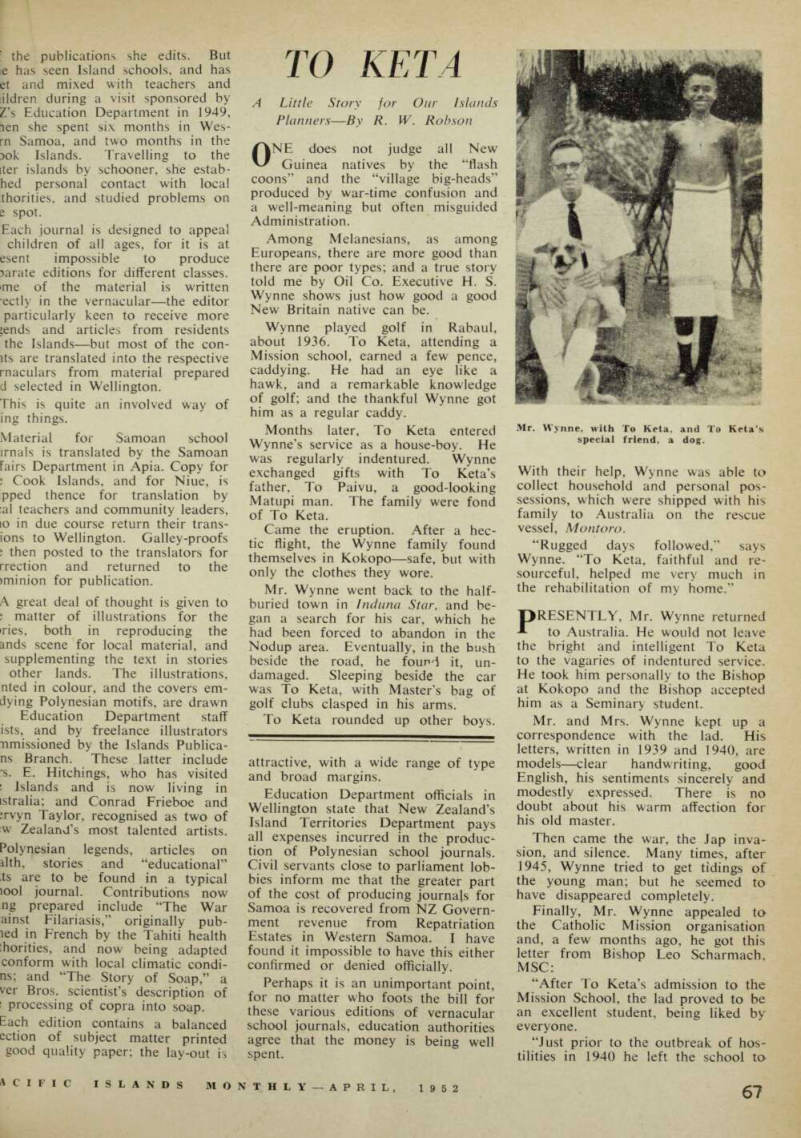
A village school in Western Samoa.
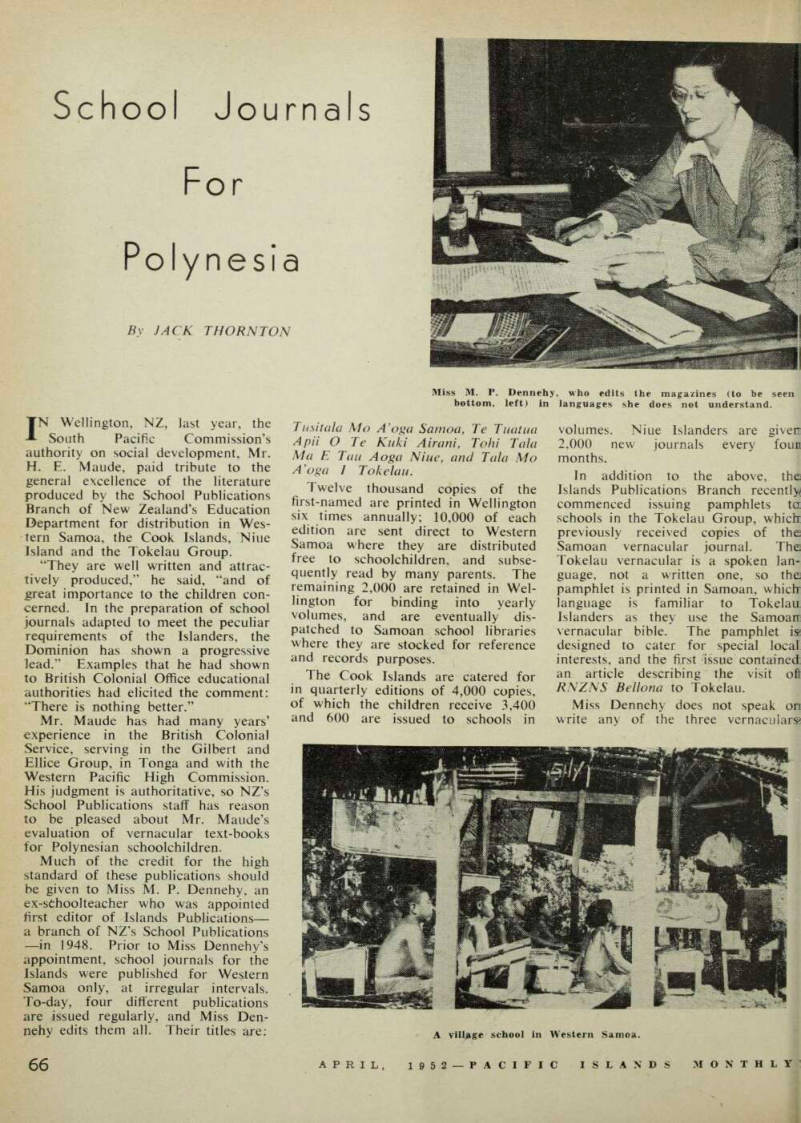
Miss M. P. Dennehy, who edits the magazines (to be seen bottom, left) in languages she does not understand.
: the publications she edits. But e has seen Island schools, and has et and mixed with teachers and lildren during a visit sponsored by Z’s Education Department in 1949, len she spent six months in Wes rn Samoa, and two months in the Dok Islands. Travelling to the iter islands by schooner, she estab hed personal contact with local thorities. and studied problems on B Spot.
Each journal is designed to appeal children of all ages, for it is at esent impossible to produce jarate editions for different classes, me of the material is written •ectly in the vernacular—the editor particularly keen to receive more ;ends and articles from residents the Islands—but most of the con its are translated into the respective rnaculars from material prepared d selected in Wellington.
This is quite an involved way of ing things.
Material for Samoan school irnals is translated by the Samoan Fairs Department in Apia. Copy for ; Cook Islands, and for Niue, is pped thence for translation by :al teachers and community leaders, 10 in due course return their trans ions to Wellington. Galley-proofs ; then posted to the translators for rrection and returned to the iminion for publication.
A great deal of thought is given to ; matter of illustrations for the Ties, both in reproducing the ands scene for local material, and supplementing the text in stories other lands. The illustrations, nted in colour, and the covers em dying Polynesian motifs, are drawn Education Department staff ists, and by freelance illustrators ■nmissioned by the Islands Publica ns Branch. These latter include ■s. E. Hitchings, who has visited : Islands and is now living in istralia; and Conrad Frieboe and irvyn Taylor, recognised as two of w Zealand’s most talented artists.
Polynesian legends, articles on alth, stories and “educational” ts are to be found in a typical 1001 journal. Contributions now ng prepared include “The War ainst Filariasis,” originally pub led in French by the Tahiti health :horities, and now being adapted conform with local climatic condi ns; and “The Story of Soap,” a ver Bros, scientist’s description of ; processing of copra into soap.
Each edition contains a balanced ection of subject matter printed good quality paper; the lay-out is
attractive, with a wide range of type and broad margins.
Education Department officials in Wellington state that New Zealand’s Island Territories Department pays all expenses incurred in the produc tion of Polynesian school journals.
Civil servants close to parliament lob bies inform me that the greater part of the cost of producing journals for Samoa is recovered from NZ Govern ment revenue from Repatriation Estates in Western Samoa. I have found it impossible to have this either confirmed or denied officially.
Perhaps it is an unimportant point, for no matter who foots the bill for these various editions of vernacular school journals, education authorities agree that the money is being well spent.