Kingdom
p. 68 · Read in the full issue
Rapa for His Kingdom
A few notes on Jimmy Paul by JPS.
JIM FILLYLOVE and his aspira tion to visit Rapa Is. (PIM, December) evoke memories of another Jim who was more success ful than Mr. Fillylove is likely to be in realising his dream.
Buried in the musty files of NZ papers there are fragments of the history of Jimmy Paul; and there must still be many in Tahiti who remember that amazing character, and can fill in the gaps. If ever a man had a tale to tell, it was Jimmy Paul, I remember his coming aboard the Norwegian ship Arcadia in the winter of 1945 to take passage to Auckland —one of the many trips he had made in his 20 or 30 years at Rapa, but, as it happened, this was to be the last. The dream was ended, and Jimmy knew it.
One may develop cancer, even in Rapa.
Jimmy was a hard man to know; but, slowly, on the seven days’ run towards his native land, his sourness relaxed in the realisation that we were genuinely interested in his
past.
In his youth, it seemed, he had been a top-ranking wrestler in NZ— and, at 70-odd, he was still ready to “step on deck and tackle anyone aboard, from the Old Man down.” 11l as he obviously was, he still rose at daybreak to go on deck and go through his “limbering up” exer cises. He refused to believe that there was anything amiss that could not be shaken off.
He told of how he had introduced a flock of pedigree sheep to Rapa when first he decided to settle there; but within two years the people had eaten every sheep.
So he returned to NZ and brought back cattle. They had a better fate, and still survive. A few cattle, deposited on the deck of a schooner, invariably paid his fare to Papeete on the first stage of his trips back to NZ, where he had money invested.
From the proceeds of this invest ment he bought stores to last him for a couple of years on Rapa.
When they were exhausted—back to NZ for more.
“So you’re coming down for some more stores, Jimmy?” we asked him.
“No—just cement,” was all that he volunteered on this occasion.
It was not until next day that w© raised the cement subject again.
“What would you be wanting the cement down there for, Jimmy?” we asked.
“What do you THINK I’d want it for,” he snapped. “I’ve got three legal wives, all with families, back there on Rapa, and I give them everything I’ve got—but I’ve been down there long enough to know that those b ds will be too damn lazy to dig a decent hole for me when I go. I know their ways!
They’ll heave me into the taro swamps or plant me a couple of feet deep and the pigs will have me up.
So I’ve figured that if I dig myself a decent hole on the hill up back of the village, and cement it properly, they MIGHT find the energy to dump me in it. Guess I can’t live forever.”
Calling at Papeete a few months later we heard that Jimmy was back —but in hospital. He had under gone a serious operation, but he was already up and about on the verandah overlooking the hospital square.
He seemed happier. He was al ready planning to charter Captain Gilling’s little yacht to take him back home to Rapa. We said fare well to the old man.
The next news we had was that he was dead. We could only hope that he had completed his little building job down at lonely Rapa.
He was, we believe, the last European civilian allowed to remain, by right of long residence and by right of marriage, on the island, when the French Administration declared it a closed area in the 1930’5.
For Mr. Fillylove’s information we might add that Jimmy Paul ad mitted that leprosy, TB —and VD — are all well-known in this Last Paradise.
“And Here is the News . . .
No matter how hard plantation 1 No matter how hot the‘day.
No matter how dumb the Chim line, What trials are in the way; No matter if things are pre bad, And worries fill your cup: There’s always joy at seven o’clocl The news to cheer you up!
There’s trouble in Korea, There’s trouble in Sudan.
There’s trouble in the Middle Es And in the Yucatan.
The price of beans is going up And bh, the price of peas!
And what are your little w( compared With perilous things like these?
No matter what cares beset yc life, If stores and mail don’t come; If you’ve run out of 4-inch nail* Or worse, run out of rum.
What matter if you’ve busted t truck, Or lost the Melbourne Cup: There’s always the news at sev o’clock— And that will cheer you up.
There’s trouble in the Suez, There’s trouble in Iran, And no one knows the Feelings Peru or Pakistan.
They tell us Melbourne’s havi strikes, And Sydney’s on the freeze; What are your little woes compar With perilous things like these?
They’ve got some lovely atom bom To cheer you with to-night: They say the Upsi Woopsi tribes Are getting up to fight, And Barbara Hutton’s divorc again— Which shows she’s hard to please And what are your little wc compared With perilous things like these?
Noelle Mason.
Bougainville,
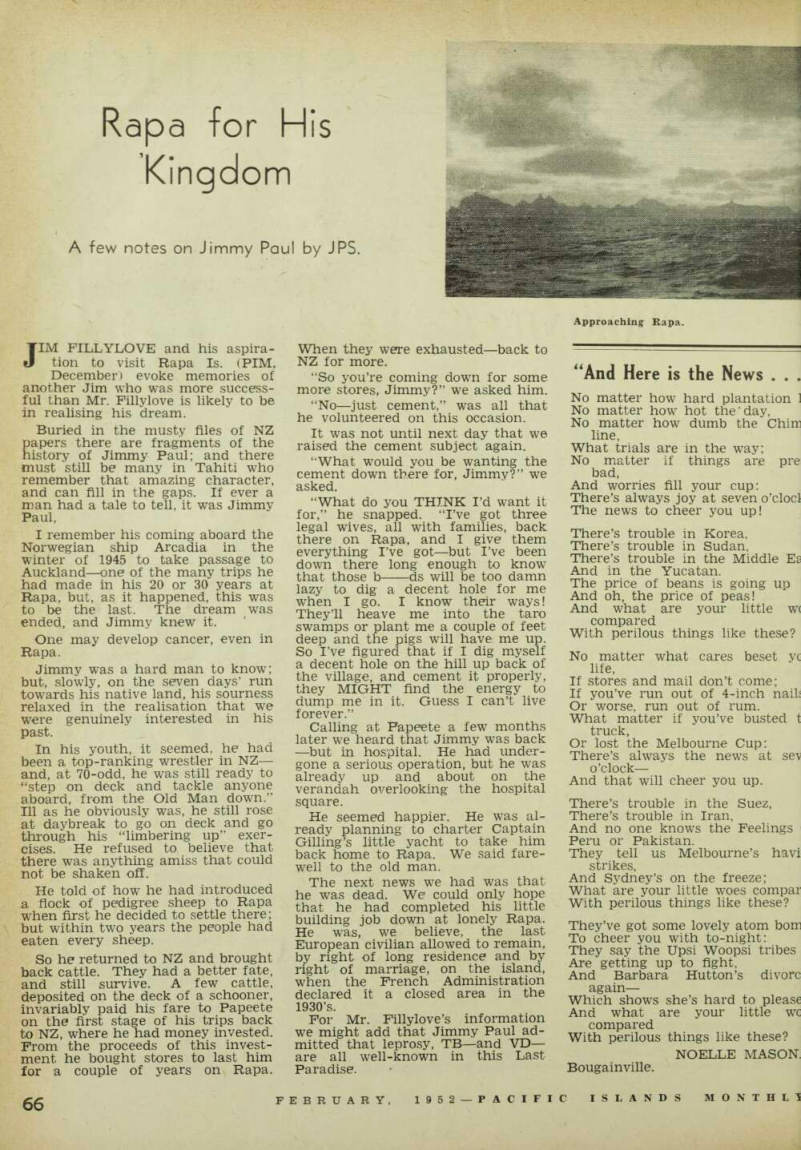
Approaching Rapa.