Magazine Section
p. 67 · Read in the full issue
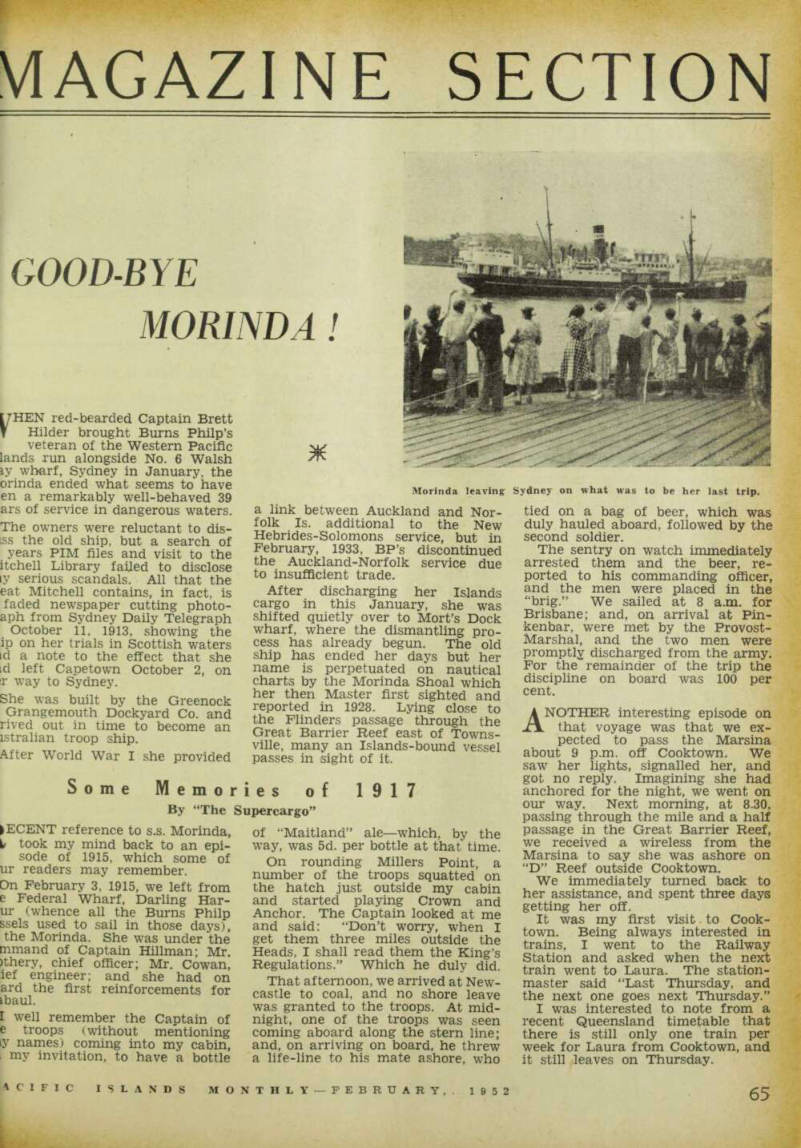
Good-Bye
Morinda!
I7HEN red-bearded Captain Brett ▼ Hilder brought Burns Philp’s veteran of the Western Pacific lands run alongside No. 6 Walsh iy wharf, Sydney in January, the orinda ended what seems to have en a remarkably well-behaved 39 ars of service in dangerous waters.
The owners were reluctant to dis iss the old ship, but a search of years PIM files and visit to the itchell Library failed to disclose iy serious scandals. All that the eat Mitchell contains, in fact, is faded newspaper cutting photo aph from Sydney Daily Telegraph October 11, 1913, showing the ip on her trials in Scottish waters id a note to the effect that she id left Capetown October 2, on ir way to Sydney.
She was built by the Greenock Grangemouth Dockyard Co. and rived out in time to become an istralian troop ship.
After World War I she provided
a link between Auckland and Nor folk Is. additional to the New Hebrides-Solomons service, but in February, 1933, BP’s discontinued the Auckland-Norfolk service due to insufficient trade.
After discharging her Islands cargo in this January, she was shifted quietly over to Mort’s Dock wharf, where the dismantling pro cess has already begun. The old ship has ended her days but her name is perpetuated on nautical charts by the Morinda Shoal which her then Master first sighted and reported in 1928. Lying close to the Flinders passage through the Great Barrier Reef east of Towns ville, many an Islands-bound vessel passes in sight of it.
Some Memories of 1917
By “The Supercargo”
RECENT reference to s.s. Morinda, I took my mind back to an epi sode of 1915, which some of ur readers may remember.
On February 3, 1915, we left from e Federal Wharf, Darling Har ur (whence all the Burns Philp ssels used to sail in those days), the Morinda. She was under the tnmand of Captain Hillman; Mr. )thery, chief officer; Mr. Cowan, ief engineer: and she had on ard the first reinforcements for ibaul. t well remember the Captain of e troops (without mentioning iy names) coming into my cabin, . my invitation, to have a bottle
of “Maitland” ale —which, by the way, was sd. per bottle at that time.
On rounding Millers Point, a number of the troops squatted on the hatch just outside my cabin and started playing Crown and Anchor. The Captain looked at me and said: “Don’t worry, when I get them three miles outside the Heads, I shall read them the King’s Regulations.” Which he duly did.
That afternoon, we arrived at New castle to coal, and no shore leave was granted to the troops. At mid night, one of the troops was seen coming aboard along the stern line; and, on arriving on board, he threw a life-line to his mate ashore, who
tied on a bag of beer, which was duly hauled aboard, followed by the second soldier.
The sentry on watch immediately arrested them and the beer, re ported to his commanding officer, and the men were placed in the “brig.” We sailed at 8 a.m. for Brisbane; and, on arrival at Pin kenbar, were met by the Provost- Marshal, and the two men were promptly discharged from the army.
For the remainder of the trip the discipline on board was 100 per cent.
ANOTHER interesting episode on that voyage was that we ex pected to pass the Marsina about 9 p.m. off Cooktown. We saw her lights, signalled her, and got no reply. Imagining she had anchored for the night, we went on our way. Next morning, at 8.30, passing through the mile and a half passage in the Great Barrier Reef, we received a wireless from the Marsina to say she was ashore on “D” Reef outside Cooktown.
We immediately turned back to her assistance, and spent three days getting her off.
It was my first visit to Cook town. Being always interested in trains, I went to the Railway Station and asked when the next train went to Laura. The station master said “Last Thursday, and the next one goes next Thursday.”
I was interested to note from a recent Queensland timetable that there is still only one train per week for Laura from Cooktown, and it still leaves on Thursday.
Morinda leaving Sydney on what was to be her last trip.