Miles Further...
pp. 70-71 · Read in the full issue
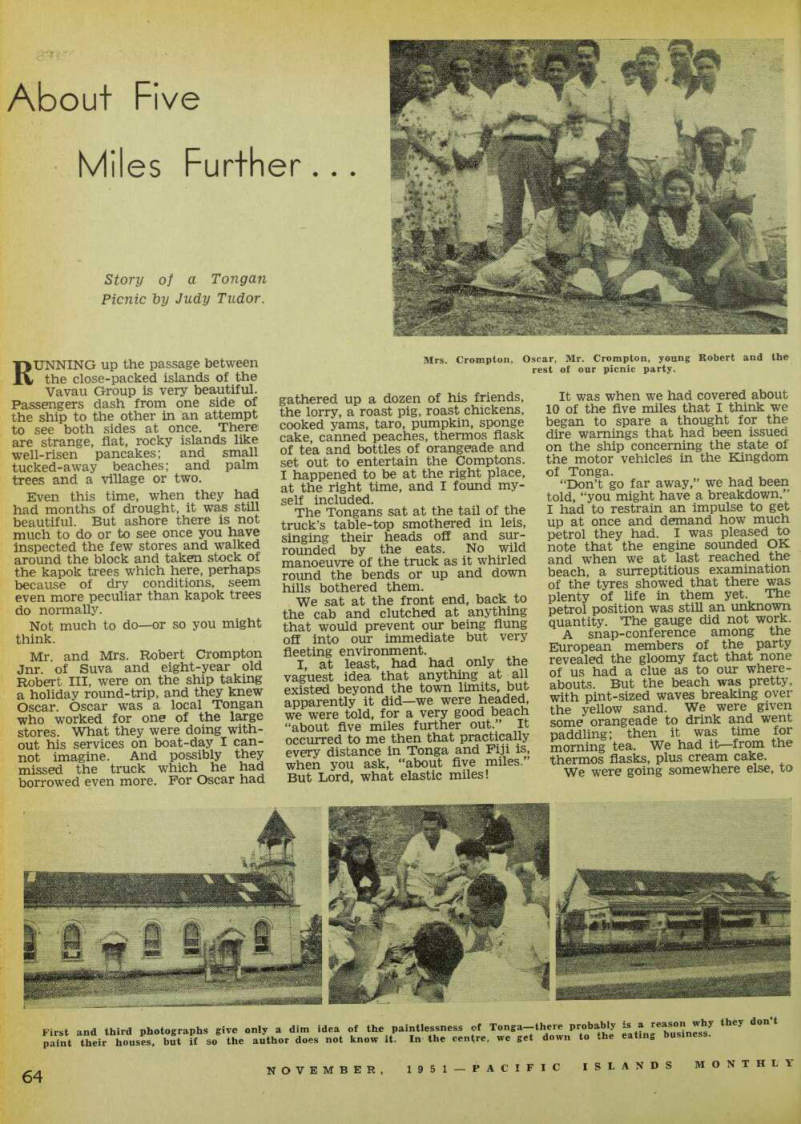
About Five Miles Further...
Story of a Tongan Picnic hy Judy Tudor.
RUNNING up the passage between the close-packed islands of the Vavau Group is very beautiful.
Passengers dash from one side of the ship to the other in an attempt to see both sides at once. There are strange, flat, rocky islands like well-risen pancakes; and small tucked-away beaches; and palm trees and a village or two.
Even this time, when they had had months of drought, it was still beautiful. But ashore there is not much to do or to see once you have inspected the few stores and walked around the block and taken stock of the kapok trees which here, perhaps because of dry conditions, seem even more peculiar than kapok trees do normally.
Not much to do—or so you might think.
Mr. and Mrs. Robert Crompton Jnr. of Suva and eight-year old Robert 111, were on the ship taking a holiday round-trip, and they knew Oscar. Oscar was a local Tongan who worked for one of the large stores. What they were doing with out his services on boat-day I can not imagine. And possibly they missed the truck which he had borrowed even more. For Oscar had
gathered up a dozen of his friends, the lorry, a roast pig, roast chickens, cooked yams, taro, pumpkin, sponge cake, canned peaches, thermos flask of tea and bottles of orangeade and set out to entertain the Comptons.
I happened to be at the right place, at the right time, and I found my self included.
The Tongans sat at the tail of the truck’s table-top smothered in leis, singing their heads off and sur rounded by the eats. No wild manoeuvre of the truck as it whirled round the bends or up and down hills bothered them.
We sat at the front end, back to the cab and clutched at anything that would prevent our being flung off into our immediate but very fleeting environment.
I, at least, had had only the vaguest idea that anything at all existed beyond the town limits, but apparently it did —we were headed, we were told, for a very good beach “about five miles further out.” It occurred to me then that practically every distance in Tonga and Fiji is, when you ask, “about five miles.
But Lord, what elastic miles!
It was when we had covered about 10 of the five miles that I think we began to spare a thought for the dire warnings that had been issued on the ship concerning the state of the motor vehicles in the Kingdom of Tonga.
“Don’t go far away,” we had been told, “you might have a breakdown.”
I had to restrain an impulse to get up at once and demand how much petrol they had. I was pleased to note that the engine sounded OK and when we at last reached the beach, a surreptitious examination of the tyres showed that there was plenty of life in them yet. The petrol position was still an unknown quantity. The gauge did not work.
A snap-conference among the European members of the party revealed the gloomy fact that none of us had a clue as to our where abouts. But the beach was pretty, with pint-sized waves breaking over the yellow sand. We were given some orangeade to drink and went paddling; then it was time for morning tea. We had it—from the thermos flasks, plus cream cake.
We were going somewhere else, to
Mrs. Crompton, Oscar, Mr. Crompton, young Robert and the rest of our picnic party.
First and third photographs give only a dim idea of the paintlessness of Tonga—there probably is a reason why they don't paint their houses, but if so the author does not know it. In the centre, we get down to the eating business.
ake, to have the real picnic lunch.
How far?” we asked.
About five miles further,” we re told.
HIS time I sat in the cabin with the driver but the Cromp tons, being of sterner stuff, ►t their back-to-front position on tray. This manoeuvre dampened spirits of the driver; he stopped ?ing, got very polite, and closed like a clam. But at least my aery now approached me decently m in front instead of dashing dly up from the rear and whirl over my head.
Ve passed wayside pineapple ts, many churches and houses, with rusty iron roofs and no nt on the wooden walls, and age schools and finally we got to top of a hill where you could the lake (Tuanaku by name and >h water, not salt).
How far?” we asked.
About five miles further,” we were 1.
Tie land sloped away from us on ee sides but there was no sign habitation anywhere. “In which ;ction do you think the ship ?” we asked one another. But in no one had a clue. omehow our hosts were per ded that the lake was not for us that trip and it was decided to ch right there. The roast king-pig was unwrapped from its tana leaf dust-jacket. The ckens were dismembered. The as and vegetables handed round platters. We ate with our fingers I the food was delicious.
Vlien we got back to the wharf it > something of an anticlimax to the ship still there loading lanas. She was still there several its later. is we waved a last goodbye to our its, Mrs. Crompton remarked ectively; “That was real Tongan ipitality. All I did was to inquire Oscar if there were anything to in Vavau ...”
Ir. E. K. Laws, Senior Super endent of Police, Kenya, has been jcted for the post of Commis aer of Police, Fiji. He will spend ; months on leave in the UK ore going to Fiji to take up his >ointment. lister K. Joubert, Sister-in arge of the Wau Hospital, went ith in late August for six nths’ leave in Australia, Sister >ck, who is well known in other 'ts of New Guinea, has arrived take her place. Another new ter at Wau Hospital is Sister ill, who has taken the place of ter Rodgie, who recently left to married.