Tropicalities
pp. 68-69 · Read in the full issue
Is It Dancing?
rRALALA, a Fijian diversion which formerly had the tacit sanction of more or less anti dancing mission circles, has run into trouble.
Originally a hand-in-hand rhyth mical walk round a room, it has be come Europeanised on the lines of more sophisticated ballroom danc ing. Further, taralala at several well-known halls in Suva has gone off the rails, according to Fijian and other authorities. The most serious allegation comes from a Fijian com plainant who has disclosed that at times liquor is drunk by young Fijian girls at inadequately super vised dance-halls. “As a result,” says this Fijian source, “many silly
things can be found to happen.”
S.
So It’S “Taralala”
LOOKING over the above Tropi cality I find that I apparently spelled this form of Fijian diversion wrongly in October PIM, when describing what went on at the Adams establishment in Lautoka when the CPAL travellers were there. , Taralala, I fear now, probably means something in Fijian. But me —I thought it was “tralala,” some thing all bubble and froth, the sort of fore part of “tiddily-om-pom,” and other light inanities.
I hasten to make this apology be fore 59 enraged Fijians, white and otherwise, write to metaphorically tell me to pull my head in.
What I would like to know now, is what the word really does mean; and who invented this form of dancing? I presume that as it looks to be about a 42nd cousin of modern European dancing it is not traditional Fijian, and as far as I know, it is not indulged in outside the Colony.
To the time of syncopated music it consists of male and female partners mooching, loose-kneed, around the room. Sometimes they just hold hands; others clasp each other around the waist (but side by side, skating attitude).
There is a little kicking up of heels in some cases, and a measure of hilarity. But others take the business so seriously they look close to death from acute melancholia.
It seems harmless enough and is a pretty sensible form of dance when you consider that most of these people have bare feet. Too bad if it falls into disrepute. However I imagine that if the Fijians feel the urge upon them to get together and make wassail, the banning of the
taralala is not going to make any difference one way or the other.
JT.
Walking—At £Lo A Mile
fTVHE years roll on, and cars and A jeeps in the most unlikely places tend to make us all a bit soft, but getting from one point to another in the shortest possible time is still a matter of honour in New Guinea.
Recently, in Rabaul, Mr. Jack Chipper won £2OO from two other well-known citizens of the town, Mr. Jack Sedgers and Scout Richards, by walking the 20 miles from Rabaul to Kokopo in 41 hours.
They said that he could not walk it in five hours. He said that he could. He set out one midnight and strode vigorously into the Kokopo Club 4i hours later. They followed in a car.
I guess Mr. Chipper has been doing most of his travel by jeep or car or truck recently. It is ob vious that Messrs. Sedgers and Richards would not have been so free with their bets if they had known him in the late thirties when
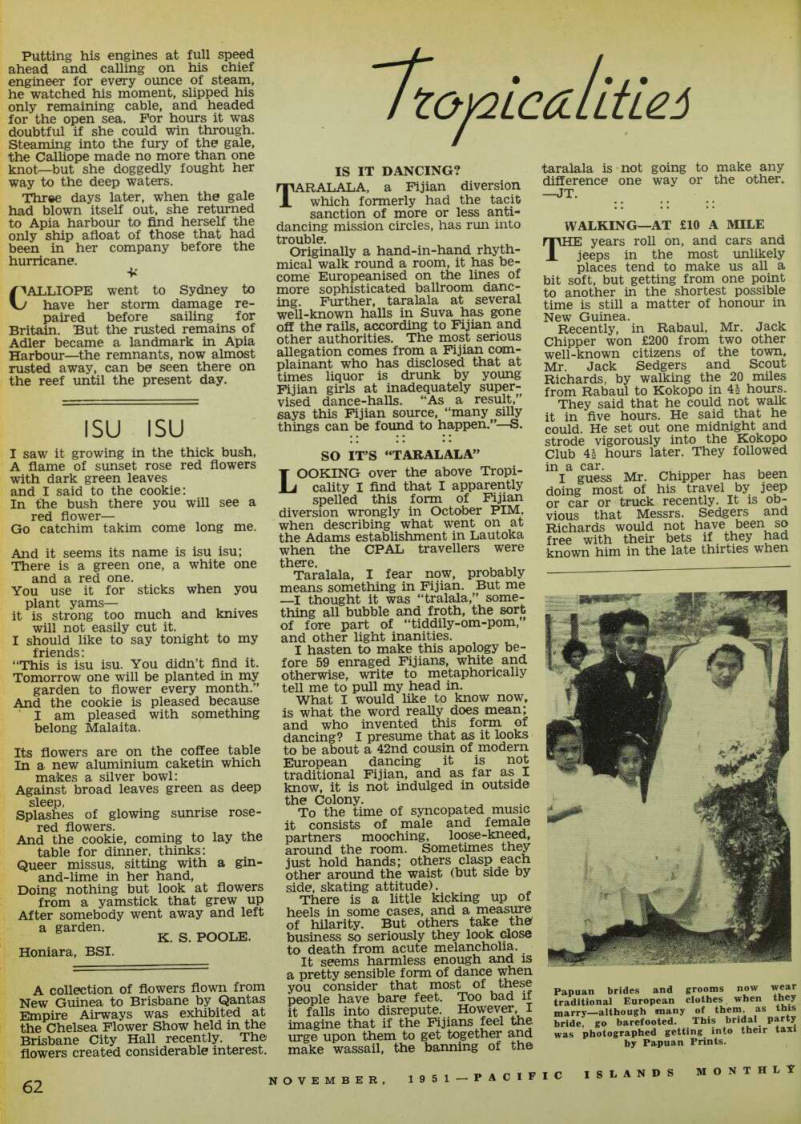
Papuan brides and grooms now wear traditional European clothes when they marry—although many of them, as this bride, go barefooted. This bridal party was photographed getting into their taxi by Papuan Prints.
the distance from Maprik (behind Wewak) over the range to his claim on the Ulahau —terrain that would break the heart of a mountain goat—was “a couple of hours’ walk,
if you run.”-
J.
Teeth And Souls
DR. G. E. HOULT, of the Meth odist Mission in the BSI (head-quarters at Roviana), is a qualified dentist as well as medi cal practitioner.
Dentists are rare in the Islands, and thus it happened that when Dr. Hoult visited Honiara recently to represent the Methodist Mission at a medical conference at which Government grants were under dis cussion, he had a busy programme.
For a week prior to the confer ence Dr. Hoult rendered dental help to the staff of a sister mission—did more than 50 fillings and 30 extrac tions. repaired six dental plates and made four new ones.
Dr. Hoult is a New Zealander who accepted a call to be the Mission’s medical officer in BSI when this post was vacant. He took his degree in dentistry as well as in medicine and surgery with the definite view
of serving in mission fields.-
Ajs.
Fishermen Please Note!
SOME months ago the capture of a metal-tagged swordfish on the New Zealand coast, and the mystery of who had performed the tagging, was headline news.
Australia denied all knowledge; America was still investigating when last reported.
Now, their interest stimulated by this event the Bay of Islands Swordfish and Mako Shark Club of New Zealand will this season embark on a project of tagging and releasing “about 60” swordfish to aid science in discovering just where they go when they leave New Zealand waters each Autumn.
Swordfish are caught from Alaska to the Philippines and Tasmania to Peru, but it has never yet been proved just how far any particular specimen migrates.
Anyone catching a swordfish with a metal tag marked: “Please return to Box 55, Russell, New Zealand,” will know what it’s all about. (Send back the tag—not the fish!) Special Note for American sou venir hunters: If tempted to keep the tag, you will be serving science by at least reporting the discovery and describing the tag in detail to
the above address.-
JS.
Nz Taxpayers’ South Seas
Farm
RECENT advertisements by the NZ Air Department, calling for staff, including farm hands, for Raoul or Sunday Is., in Kermadecs, some 600 miles NNE of Auckland, reminds us that
nothing is ever seen of the produce of the Government farm, though the staff includes at least three Europeans and a number of Niue Islanders.
This farm is entirely apart from the scientific staff of the radio and weather stations, although its sole purpose seems to be to keep them in fresh milk, meat and vegetables.
A number of years ago it was re ported that a citrus industry was to be established by the Govern ment on Sunday Island, but the tax-paying public of NZ are still awaiting the first shipment of oranges. All produced are eaten on the island, or aboard the Naval supply ships which regularly change the staff.
One may safely bet that this is the most costly and uneconomic farm under the New Zealand flag.
DON WILKINSON has just retired from Tanna in the New Hebrides, after 19 years as a trader on the island. For most of that time he has been running Tanna Plantations, Ltd., which he has sold to Bums Philp (N.H.), Ltd.
The property consists of about 250 acres in all, a plantation and trade store at Lenakel, and other sections of undeveloped land, some of which contains sandalwood trees.
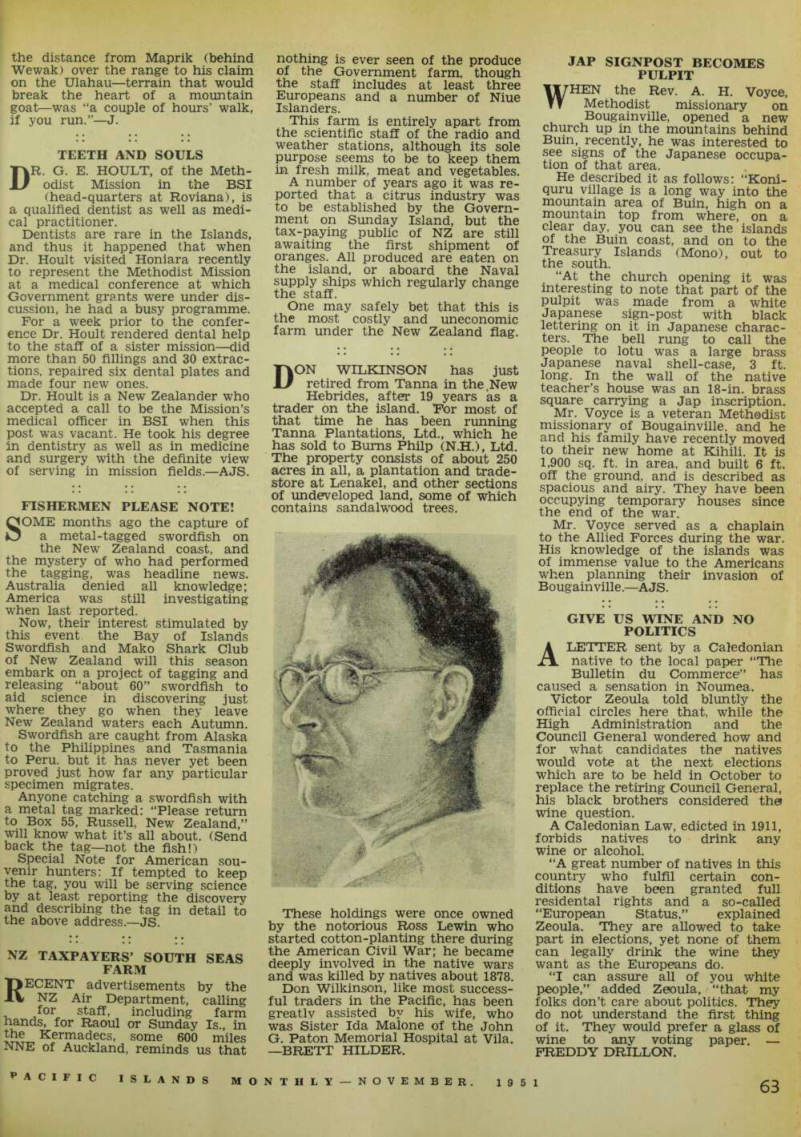
These holdings were once owned by the notorious Ross Lewin who started cotton-planting there during the American Civil War; he became deeply involved in the native wars and was killed by natives about 1878.
Don Wilkinson, like most success ful traders in the Pacific, has been greatly assisted by his wife, who was Sister Ida Malone of the John G. Paton Memorial Hospital at Vila.
Brett Hilder.
Jap Signpost Becomes
Pulpit
WHEN the Rev. A. H. Voyce, Methodist missionary on Bougainville, opened a new church up in the mountains behind Buin, recently, he was interested to see signs of the Japanese occupa tion of that area.
He described it as follows: “Koni quru village is a long way into the mountain area of Buin, high on a mountain top from where, on a clear day, you can see the islands of the Buin coast, and on to the Treasury Islands (Mono), out to the south.
“At the church opening it was interesting to note that part of the pulpit was made from a white Japanese sign-post with black lettering on it in Japanese charac ters. The bell rung to call the people to lotu was a large brass Japanese naval shell-case, 3 ft. long. In the wall of the native teacher’s house was an 18-in. brass square carrying a Jap inscription.
Mr. Voyce is a veteran Methodist missionary of Bougainville, and he and his family have recently moved to their new home at Kihili. It is 1,900 sq. ft. in area, and built 6 ft. off the ground, and is described as spacious and airy. They have been occupying temporary houses since the end of the war.
Mr. Voyce served as a chaplain to the Allied Forces during the war.
His knowledge of the islands was of immense value to the Americans when planning their invasion of
Bougainville.-
Ajs.
Give Us Wine And No
Politics
A LETTER sent by a Caledonian native to the local paper “The Bulletin du Commerce” has caused a sensation in Noumea.
Victor Zeoula told bluntly the official circles here that, while the High Administration and the Council General wondered how and for what candidates the natives would vote at the next elections which are to be held in October to replace the retiring Council General, his black brothers considered thet wine question.
A Caledonian Law, edicted in 1911, forbids natives to drink any wine or alcohol.
“A great number of natives in this country who fulfil certain con ditions have been granted full residental rights and a so-called “European Status,” explained Zeoula. They are allowed to take part in elections, yet none of them can legally drink the wine they want as the Europeans do.
“I can assure all of you white people,” added Zeoula, “that my folks don’t care about politics. They do not understand the first thing of it. They would prefer a glass of wine to any voting paper.