Rehabilitation of A Citizen
pp. 67-68 · Read in the full issue
Citizen
p|NE day—on August 21, 1951 —a L/ messenger came to the door of Oscar Nordman’s residence, jverlooking the harbour, in Papeete, rhe presence of Monsieur Nord nan was requested, immediately, at he head office of the Adminis ration.
Oscar looked speculatively at his rife. “I wonder what this can be, Margot,” he said. “More trouble, h?”
Oscar, on occasion, had found ligh officialdom difficult. There iras a recent occasion when, called o the office of the Government Secretary, he had been sternly colded, and accused of being false o his French citizenship, because f an article he had written for the T Monthly about the French colonies. They would Lot accept his assurance that he ;as not the author. Yet Oscar poke the whole truth. (I know, ecause I wrote the article.) Slowly—for he is getting on in ears—Oscar made his way to head uarters. On every hand, he was reeted cordially by Tahitians, Jhinese, Europeans. He is known or his simple kindness, his love f children, and the endless ospitality of himself and his harming wife.
A commissionaire ushered him traight into officialdom’s largest ssembly-room. Gathered there /"ere most of the departmental Leads, leading citizens, the judges— veryone of importance, except the rovemor himself. Oscar’s natural larm faded, when he saw in their aces only friendship and goodwill.
Oscar was led before the judges, n a simple, but impressive public eremony, he was given civil re .abilitation. [>ACK 25. years, to the late 20’s, [j A little gang of unscrupulous gentlemen concocted a plan to lake some quick, easy money. They fere to get possession of a large, Id schooner which lay in Papeete, quip and load and clear her for larotonga, insure her heavily, and hen make of her a total loss under uch circumstances that it would ppear to be an accident.
To round out the plot, they ceded a representative in Papeete, nd an approach was made to lordman. Nordman had just re ired after a couple of decades at ea most of it as a purser on
Trans-Pacific liners. He had a young business, an attractive wife, three young children.
Nordman accepted the commis sion.
He was not in the plot. He did suspect that there was some thing wrong somewhere, but he foolishly carried out instructions —transmitted to the crew cer tain orders which were sent to him from Rarotonga.
The plan to cast away the ship misfired completely. She went ashore in Raiatea, in cir cumstances which clearly showed it was a case of barratry.
Oscar was arrested, put on trial, convicted of barratry—and sentenced to 20 years’ hard labour. It was clear there were others in the crime—but Oscar
closed up and would give no in formation. As the waterfront ex pressed it: “Nordman took the rap for the Rarotonga gang.”
Very strong representations were made to Paris. The 20 years’ sen-
tence was reduced to 5 years; and then a new Governor, who made his own inquiries into what he regarded as a peculiar case, was instrumental in getting the sentence cancelled at the end of three years, and Oscar was released.
OSCAR resumed his business and family life in Papeete, where it had been in terrupted on his arrest.
Generally, people were as kind and as friendly as ever. He prospered.
He did his duty and more than his duty, as he saw it, by the com munity. The circle of his friends grew ever wider.
But the stigma re mained. Officially, he was a man who had been convicted of a crime. Important per sonages did not receive him socially. He was denied certain privi leges of citizenship— the vote, for instance.
When a prominent man in Paris offered mar riage to one of his good looking and charming daughters, the girl re plied: “Maybe you had better first inquire about my family—my daddy has been in gaol.”
Oscar himself said nothing, and carried on. But, among pro minent men in Tahiti,
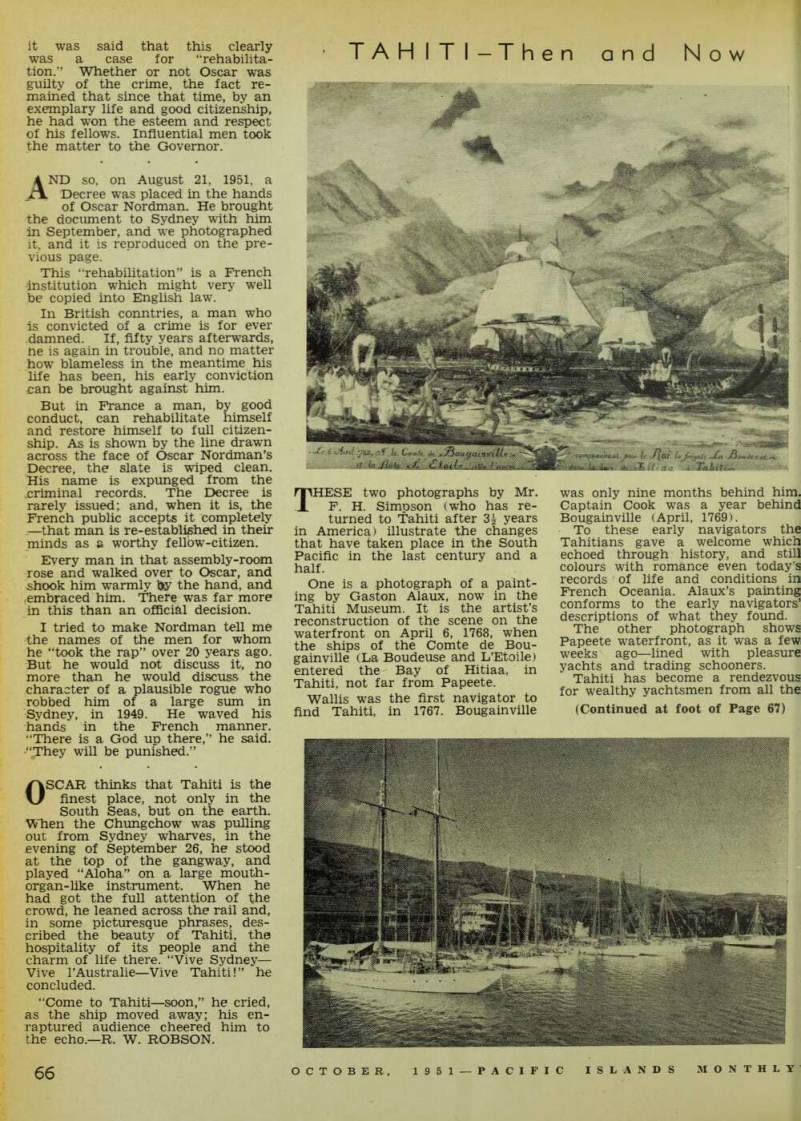
The document that makes it legal.
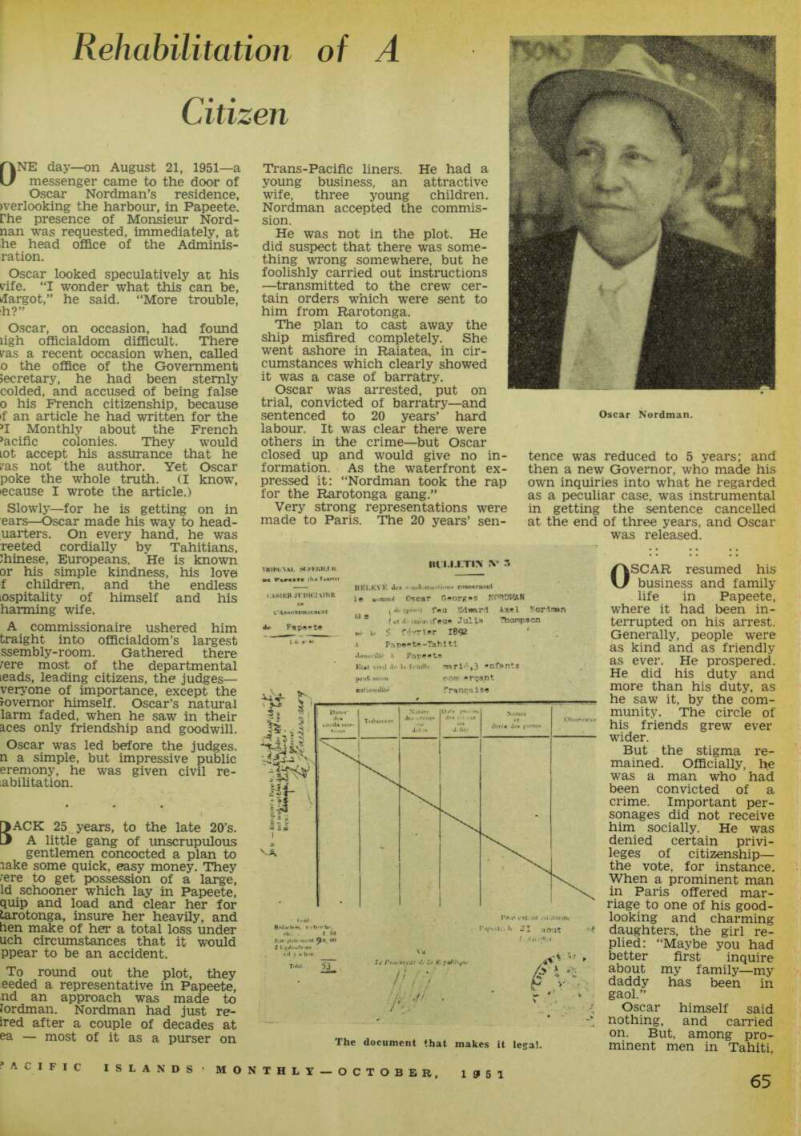
Oscar Nordman.
it was said that this clearly was a case for “rehabilita tion.” Whether or not Oscar was guilty of the crime, the fact re mained that since that time, by an exemplary life and good citizenship, he had won the esteem and respect of his fellows. Influential men took the matter to the Governor, A ND so, on August 21, 1951, a Decree was placed in the hands of Oscar Nordman. He brought the document to Sydney with him in September, and we photographed it, and it is reproduced on the pre vious page.
This “rehabilitation” is a French institution which might very well be copied into English law.
In British countries, a man who is convicted of a crime is for ever damned. If, fifty years afterwards, he is again in trouble, and no matter how blameless in the meantime his life has been, his early conviction can be brought against him.
But in France a man, by good conduct, can rehabilitate himself and restore himself to full citizen ship. As is shown by the line drawn across the face of Oscar Nordman’s Decree, the slate is wiped clean.
His name is expunged from the criminal records. The Decree is rarely issued; and, when it is, the French public accepts it completely —that man is re-established in their minds as a worthy fellow-citizen.
Every man in that assembly-room rose and walked over to Oscar, and shook him warmly by the hand, and .embraced him. There was far more in this than an official decision.
I tried to make Nordman tell me ■the names of the men for whom he “took the rap” over 20 years ago.
But he would not discuss it, no more than he would discuss the character of a plausible rogue who robbed him of a large sum in Sydney, in 1949. He waved his hands in the French manner.
“There is a God up there,” he said.
-“.They will be punished.”
OSCAR thinks that Tahiti is the finest place, not only in the South Seas, but on the earth.
When the Chungchow was pulling out from Sydney wharves, in the evening of September 26, he stood at the top of the gangway, and played “Aloha” on a large mouth organ-like instrument. When he had got the full attention of the crowd, he leaned across the rail and, in some picturesque phrases, des cribed the beauty of Tahiti, the hospitality of its people and the charm of life there. “Vive Sydney— Vive I’Australie—Vive Tahiti!” he concluded.
“Come to Tahiti—soon,” he cried, as the ship moved away; his en raptured audience cheered him to
the echo.-