The Myth of New Guinea's Sulphur Deposits
pp. 115-117 · Read in the full issue
Letter to the Editor
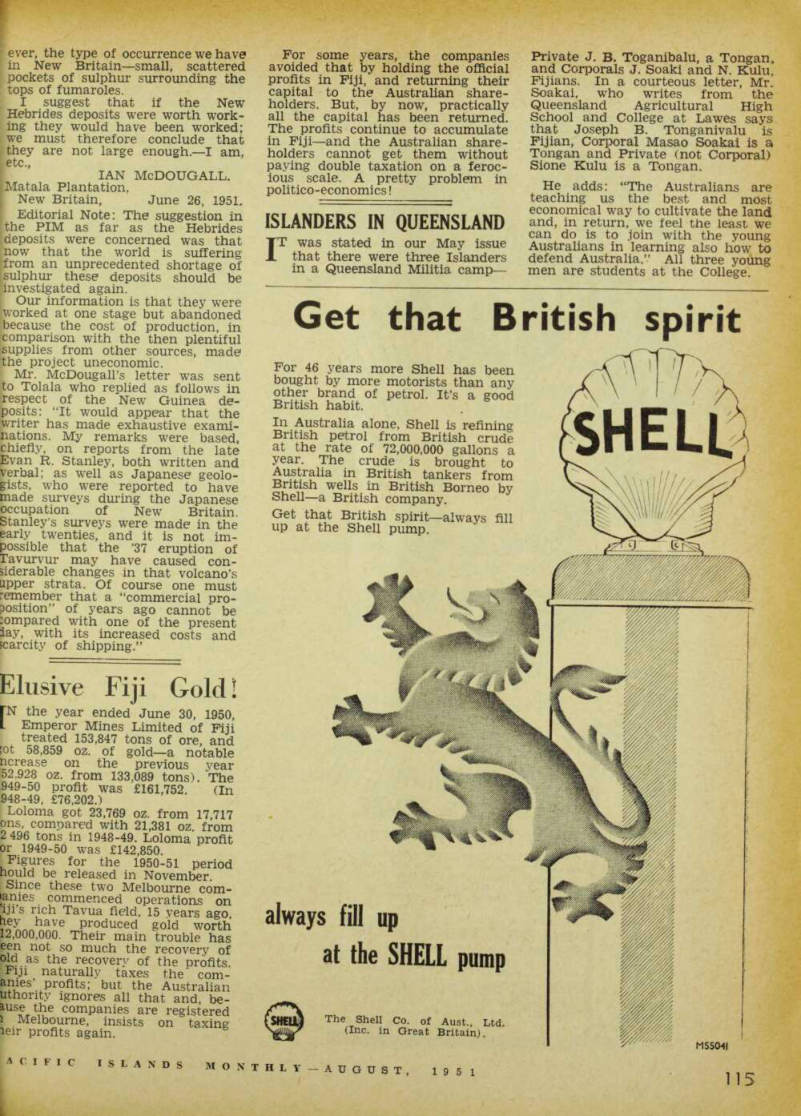
THERE is only one reason why New Guinea sulphur deposits have not been developed and . that is that there is not one deposit that approached commer- ICltl1 C1 t1 S i! ZG ’ it has nothing to do with conpets with vested interests or in order that Australia may sell flour toltal y- It is not true that before the war Australian users of sulphur did not want to develop deposits here. I have been told by one of New Britain’s few consistent and scientfic prospectors that before the war one of Australia’s largest users of sulphur offered to finance him in developing any deposit he could He was also offered a market in New Zealand at a price that would be attractive even today. The ■nmri m nn/ e nrJ! lroU f£‘ S 6031 1? he not P ro^ uc ® the deposit.
The syndicate that I represented prepared to mine up to 100,000 tons per year for Australia and the jame quantity for overseas.
FBetween December, 1949, and nvrvloTr n ? ac J e Preliminary surveys at Matupi, Lolobau, South son, Pangalu, Bango, Krummel, Welcher, Kasololi and four unlamed hot springs in New Britain.
as well as Kairiru Island off Wewak and the lamelele area of Fergus son Island, Papua. I inspected every likely area that anyone had ever heard of.
As a result of my preliminary survey all areas that were even remotely capable of producing suf ficient sulphur were investigated by a party of geologists from the Commonwealth Bureau of Mineral Resources led bv Dr. N. H Fisher, Chief Geologist of the Bureau and a former vulcanologist and geolo gist in pre-war New Guinea; the late Government Geologist of P-NG, Mr. G. A. Taylor, present P-NG vulcanologist, and myself repre renting: the syndicate, were also in Full testing equipment was carried. After all the areas were in vestigated all were rejected because the f, rosa Y alue of ail of the sulphur in all Of the areas was insufficient to cover the cost of equipment for developing any one of the areas The capital cost of working any of the areas would be enormous None of the deposits are near good harbours and most of them are miles from the sea on volcanoes un to 5,000 ft. above sea level I have been informed' hv Mr Gilbert Renton of Sul. who ws
a shareholder in one of the syndi cates interested in selling the sul phur to Japan, that Japan was not interested.
The Hebrides deposits are known to the Australian mining world and probably overseas.
I. personally, have not seen them but the photograph in May PIM conveys nothing—it suggests, how
ever, the type of occurrence we have in New Britain —small, scattered pockets of sulphur surrounding the tops of fumaroles.
I suggest that if the New Hebrides deposits were worth work ing they would have been worked; we must therefore conclude that , they are not large enough.—l am, ! etc.,
Ian Mcdougall.
Matala Plantation, I New Britain, June 26, 1951, [ Editorial Note: The suggestion in the PIM as far as the Hebrides deposits were concerned was that [now that the world is suffering from an unprecedented shortage of [sulphur these deposits should be
[investigated again.
Our information is that they were [worked at one stage but abandoned because the cost of production, in icomparison with the then plentiful (Supplies from other sources, made the project uneconomic.
Mr. McDougall’s letter was sent to Tolala who replied as follows in Tespect of the New Guinea de posits: “It would appear that the writer has made exhaustive exami nations. My remarks were based, chiefly, on reports from the late Evan R. Stanley, both written and verbal; as well as Japanese geolo gists, who were reported to have made surveys during the Japanese occupation of New Britain.
Stanley’s surveys were made in the early twenties, and it is not im possible that the ’37 eruption of Tavurvur may have caused con siderable changes in that volcano’s upper strata. Of course one must remember that a “commercial pro position” of years ago cannot be compared with one of the present iay, with its increased costs and scarcity of shipping.”