Wandering
p. 79 · Read in the full issue
Bill Murnan 53 Days Alone in the Indian Ocean
IN a circular letter to his friends, Mr, Bill Murnan, of the Ameri can yacht Seven Seas 11, wrote from Port Elizabeth, South Africa, on May 15, 1951.
Bill Murnan, wandering lone yachtsman, arrived in Honolulu in December, 1941, the day the Japanese attacked Pearl Harbour.
Two years ago, Mr. Murnan was in Samoa. After that, he visited and stayed awhile in Fiji, New Hebrides, Solomons, and Papua. He left his yacht in Port Moresby at the end of 1949, and spent a few weeks in Australia. He left Moresby in May, 1950, and spent June and July in
and around Torres Strait, and got to Timor at the end of July.
After a spell in Indonesia, he sailed off alone and reached the phosphate island of Christmas in October. Then he had one of his toughest ad ventures. Here it is, in his own laconic style:— “T h e weather got bad at Christ ma s Island; all shipping had to leave and go to sea. So I headed
for Cocos Is., 600 miles away.
Weather still bad; had a tough time trying to get any sights; so I gave Cocos Is. a wide berth and went south of it, heading for Rod riguez.
“Had a wide variety of weather
coming down —some good but mostly bad —and the sails got pretty badly tom up. When I got into the area of Rodriguez there was a hurricane close aboard. So I stayed away from it, too, and headed right straight out for Durban, South Africa. Fifty-three days later I arrived. On December 7, 1950 —just nine years after our and the Jap anese arrival in Hawaii—l pulled into Durban.”
After that, he waited 2 h months in Durban for his wife; and, when she joined him, he set out for Port Elizabeth and Capetown early in March. He planned to cross the At lantic from Capetown to Brazil, and then go home through the West Indies to Florida.
Herr Hjalmar Schacht, formerly financial adviser to the late Herr Hitler, has accepted an invitation from the Indonesian Government and will go there to help straighten out USI economy.
The Australian Farmers and Settlers Association has asked the Commonwealth Government to speed up scientific investigation of kenaf fibre as a substitute for jute.
Kenaf is now being grown experi mentally in Papua, and it is hoped that the fibre will be suitable for wool packs and grain bags.
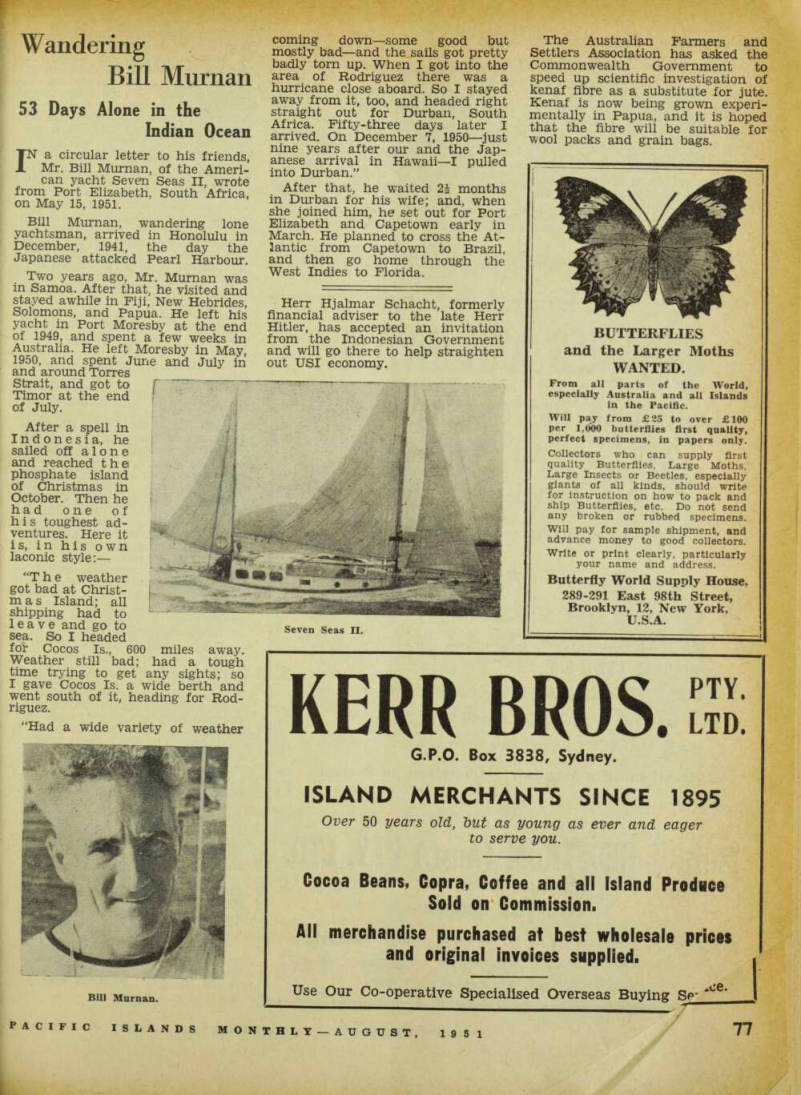
Seven Seas 11.
Bill Murnan.