Record Phosphate
pp. 47-48 · Read in the full issue
Export
From Ocean, Nauru
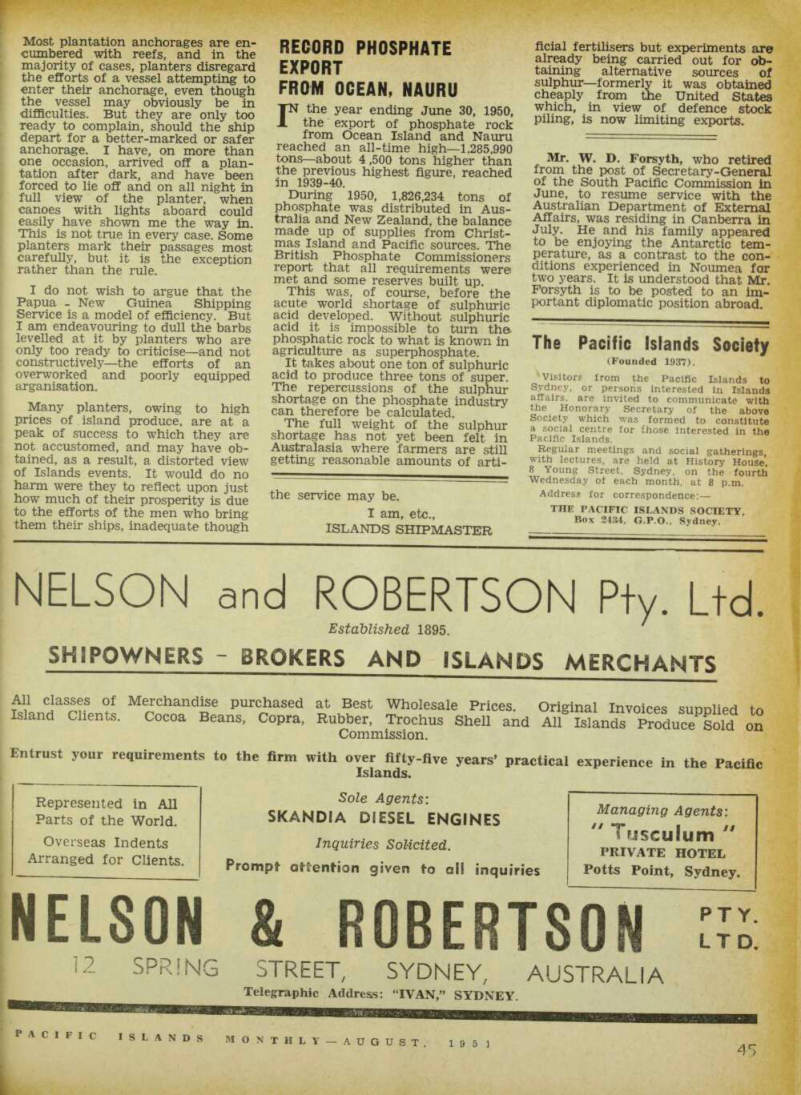
Fthe year ending June 30, 1950, the export of phosphate rock from Ocean Island and Nauru reached an all-time high—1,285,990 tons—about 4 ,500 tons higher than the previous highest figure, reached in 1939-40 During 1950, 1,826,234 tons of phosphate was distributed in Aus tralia and New Zealand, the balance made up of supplies from Christ mas Island and Pacific sources. The British Phosphate Commissioners report that all requirements were met and some reserves built up.
This was, of course, before the acute world shortage of sulphuric acid developed. Without sulphuric acid it is impossible to turn tlm phosphatic rock to what is known in agriculture as superphosphate.
It takes about one ton of sulphuric acid to produce three tons of super.
The repercussions of the sulphur shortage on the phosphate industry can therefore be calculated.
The full weight of the sulphur shortage has not yet been felt in Australasia where farmers are still getting reasonable amounts of arti
ficial fertilisers but experiments are already being carried out for ob taining alternative sources of sulphur—formerly it was obtained cheaply from the United States which, in view of defence stock piling, is now limiting exports.
Mr. W. D. Forsyth, who retired from the post of Secretary-General of the South Pacific Commission in June, to resume service with the Australian Department of External Affairs, was residing in Canberra in July. He and his family appeared to be enjoying the Antarctic tem perature, as a contrast to the con ditions experienced in Noumea for two years. It is understood that Mr.
Forsyth is to be posted to an im portant diplomatic position abroad.
Freight charges between Aus tralia and the New Hebrides have been increased by 175 per cent., and Messageries Maritimes has also in creased freights between Noumea and Sydney by 25 per cent. Freight for general merchandise is now 1,150 francs a ton; and for rice, flour, sugar, potatoes, salt and other essential foodstuffs 950 francs.
A large number of Samoan resi dents who have been unable to return to the Territory by the Island vessel Matua owing to the New Zealand wharf strike, should get passage soon, as seamen stewards and cooks have now returned to work. The Union Steamship C°m pany is giving preference to Islands residents on passenger waitmg lists.