Tributes To James Norman Hall
pp. 19-22 · Read in the full issue

Tahiti Mourns The Passim? or a Lovable Man
ALL sections of the people of French Oceania Europeans, Tahitians and Asiatics —were united in their sincere grief at the death, on July 5, of James Norman Hall, famous American author. As a young American airman, he fought for France in World War I in the renowned Lafayette Squad ron; as a young journalist, he settled in Tahiti, and married a charming daughter of the French- Tahitian community; as a world famous writer, he (with his friend Charles B. Nordhoff) brought end less valuable publicity to Tahiti; and as a kindly man and a loyal, unassuming friend he was esteemed, respected and loved by everyone in Tahiti.
The demonstration made at his
funeral by every class, from the Governor to the poorest fisherman, showed the regard in which Hall was held.
An article in the Tahiti news paper, Bulletin de Presse, on July 24, paid a deep and moving tribute to the famous author. It referred especially to his great services to France.
There have been many interesting incidents. For example, the Ameri can flag which draped the coffin was supplied by Oscar Nordman, who was one of Hall’s first Tahitian friends. When Hall first went out to the Tuamotus, in 1921, Nordman was supercargo in the Bluenose schooner Percival S. Parks, in which Hall made the voyage; and when Hall wrote his book “Faery
Tales,” based on that voyage, he amusingly presented Nordman as the drunken supercargo who played marbles with the native boys and Q'ot into much mischief got into muen m sc .
When Halls well-loved daughter Nancy, now Mrs. Rutgers, of Honolulu, arrived in the yacht Vega in July, just too late to see her father alive it was Nordman’s daughter Anatila who presented the flag to Mrs. Rutgers, as a token of their love and friendship.
James Norman Hall is gone, but he never will be forgotten in Tahiti.
In the fame he won, and in the love he inspired in the people, and in the fact that he was buried in a snot of his own choosing, there is’ a similarity between the life and death of Hall in Tahiti, and of Robert Louis Stevenson in Samoa. It was not unfitting that the French newsoaper. ending its tribute to Hall, should have quoted Stevenson’s famous epitaph;— “Here I lie where I long to be— Home is the sailor, home from the sea, And the hunter home from the hill.”
(Continued on Page 19)
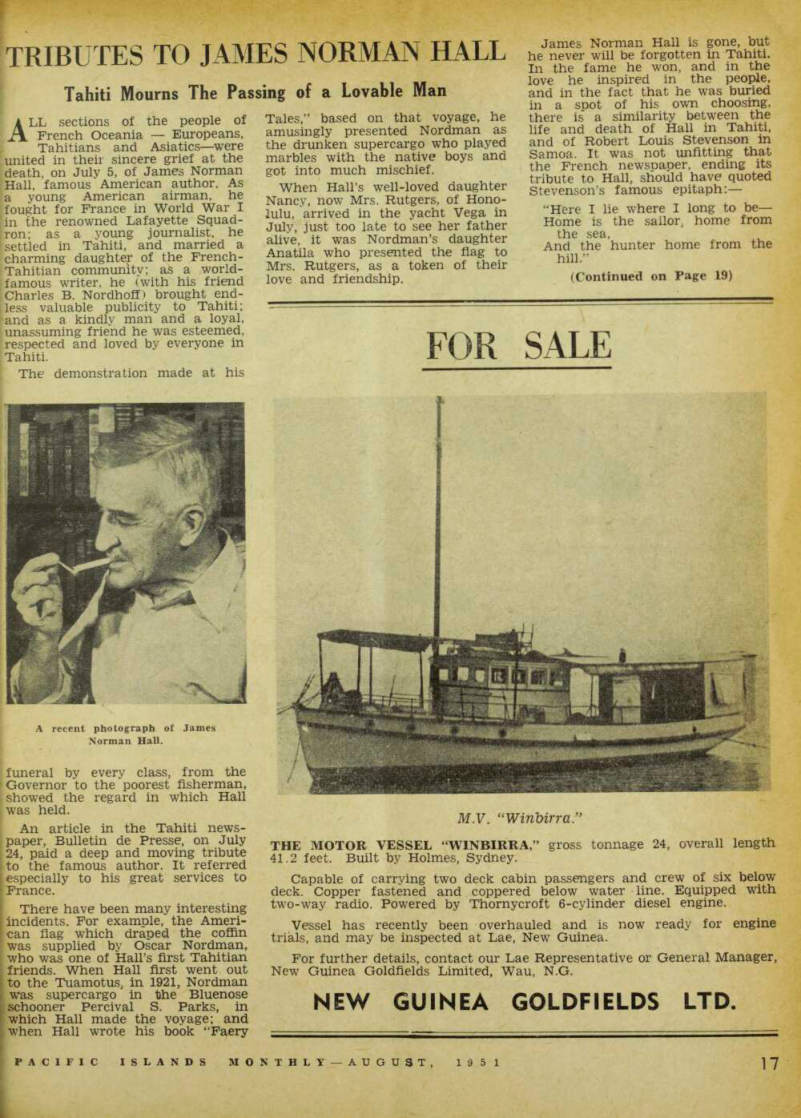
A recent photograph of James Norman Hall.
By Eric Ramsden, in Wellington “Post"
IT is curious that death should have claimed James Norman Hall and Marshal Henri Petain within a few days of each other.
One, a successful novelist, died in Tahiti, which had been his home for the past 25 years, while the other, disgraced, senile, and almost forgotten outside his island prison, off the French coast, had long out lived his glory.
It was of Hall, then serving in the Escadrille Lafayette, that Petain wrote during the First World War: “Brilliant pursuit-pilot, a model of courage and spirit, who recently brought down an enemy plane, met a glorious death in com bat with four monoplanes, one of which crashed in flames.”
But the Marshal was wrong.
Though Hall’s death was reported on more than one occasion, he lived to join forces with another Ameri can, Charles Nordhoff (also of the Escadrille) and formed the most famous literary partnership the Pacific has known.
Success came with the trilogy of the Bounty,” “Men Against the Sea,” and “Pitcairn’s Island.” But both served a stern apprenticeship over many years. It was not until their books were filmed that wealth came. Apart from his collaboration with Nord hoff, the more industrious Hall wrote at least a dozen books. “The Far Lands,” a Polynesian epic, appeared only a few months ago.
These writers, who had so much in common, provided a marked con trast. Nordhoff once told me that xmless they collaborated money al ways eluded them. Hall was by far the better craftsman. Nordhoff sup plied the romantic flair and drive, and Hall the thorough research that formed the background to their work.
In Kitchener’S Army
Born in Colfax, lowa, and a graduate of Grinnell College in 1910, Hall was in England during the First World War, and served for a period in Kitchener’s Army, later transferring to the French.
Nordhoff was born in Engand of American parents, returned to the States as a child, and graduated from Harvard. Both were born in the same year—lBB7.
In Tahiti they lived at opposite •ends of the island. When they worked on a book they took an ■office in Papeete and observed regu lar hours. But there were long periods when Nordhoff fished, and Hall indulged in his favourite hobby of mountaineering.
Nothing provided a greater con trast than the manner in which they looked after their books. As
wealth came to Nordhoff he added room after room to his home until in time it resembled a series of railway carriages. At the far end of his house was what was called the library. There the tropic pests that riddle books had a completely free hand.
Hall, on the other hand, sprayed his books from time to time, and kept them in perfect order. It was well that he did so, as the im portant Bounty bibliography which the authors accumulated was in his keeping.
From the thatched bungalow in which he worked, Hall once pointed out to me, in Matavai Bay below, the bank on which the Dolphin, the first British ship to visit Tahiti, grounded. The neighbourhood of Arue was redolent of history.
I knew Nordhoff at the pinnacle of his success. He was a most like able man, exceedingly popular in Tahiti, but his own enemy. Failing eyesight—a result of too many fish ing expeditions on the reef—and the shock of a domestic tragedy drove him from the island to die in California in 1947.
Now death has called Hall, his partner and friend. With the recent death of Robert Dean Frisbie, also an American and a protege of Hall and Nordhoff, the Pacific lost an other figure of literary importance.
As Nordhoff’s menage terminated
tragically, neither did sorrow pass by Hall. One of his children caught some strange tropical complaint
that necessitated long residences abroad. . . .
His Last Act
One of Hall’s last acts was to write a series of articles, in which he quoted from Frisbie’s letters, and the proceeds went to a fund for the maintenance of Frisbie’s children.
Hall never indulged in excesses; he lived quietly at Arue, with occasional trips abroad, living, as he said, far more intently in books than he did in real life. Tahiti he
regarded as “a grandstand seat to observe the workings of a mad machine age.”
Hon F. W. Doidge, New Zealand Minister for External Affairs, who has had Ministerial charge of New Zealand’s Islands Territories, has been appointed New Zealand High Commissioner in London. He knows London well; he was a high executive of the Beaverbrook press for 15 years after World War I.