In Samoa
p. 65 · Read in the full issue
Stevenson Did Not Die From TB In Samoa
By His Step-Daughter, Isabel Field
THE Oceanic Steamship line, about 1893, put three large, fine passenger-ships into service between San Francisco and Sydney. They had been stopping at Apia, Western Samoa, our sea-port, for several months before it happened that my step-father and I were in town when the Alameda was in port.
I suggested that we go on board; for I knew now much my friend, Captain Morse, wanted to meet Robert Louis Stevenson. He had told me that on every trip, as his ship neared Samoa, the passengers had asKed him about the great author—what he looked like, did he have a Scotch brogue, was he friendly, would he come aboard ship? Captain Morse said he was ashamed to tell them that, though he had been in command of the Alameda for more than six months, he had never seen Mr. Stevenson.
“But,” he complained to me with some bitterness, “it was my ship that brought the cargo of California red-wood that built their fine house, and it was my ship that carried all that furniture that came from two houses. I was beginning to think that the Alameda, the handsomest liner on the Pacific Ocean, was no better than a cargo ship for the Stevensons!”
Louis (as we all called him, pronouncing it “Lewis”), agreed to go on board; and I was pleased, because I knew that we’d be enthusiastically welcomed. We were, in deed.
Captain Morse, a fine-looking, jovial man, showed us into his cabin, which was soon filled with curious and interested passengers; for the news had quickly circulated that Robert Louis Stevenson was in the Captain’s cabin.
I remember that occasion vividly, for it was the first time that I saw my beloved step-father, so simple and unaffected at home, take his position as a celebrity.
I looked at him critically, and thought he looked very nice. He wore Bedford cords, a riding habit he had been fitted for in Sydney. He wore silver spurs on his high-laced riding-boots, and carried a whip with a silver handle. His hair was not long, as he had been forced to wear it in Europe, where he had been too ill to sit up and have it neatly shingled, as it was now. It was light brown in colour, thick, and was just long enough to show a slight curl that was very becoming.
I was proud of him and took a careful note of his appearance and that of the surrounding crowd of passengers—some of whom were sitting on the floor—for I knew that this was a scene I’d be called on to describe to the family when we re turned home.
Louis himself was perched on the side
wits among the passengers. It was a gay scene, interrupted by a messenger from the purser, asking to see Mr. Stevenson for a few minutes about some letters Then he left; and I’ll never forget Captain Morse’s comments; “So that was Robert Louis Stevenson! He isn’t at all what I expected. I thought he’d come in solemn and pompous, the great man look ing down his nose at the likes of us. He’s so young! And so good-looking! Why he’s just a jolly boy! I like him!”
A shout came from the crowd of pas sengers like a chorus; “So do we!”
of the Captain’s bunk. The numerous, excited questions hurled at him he answered so humorously that we were soon all laughing, for there were a few
Although she now is 94 years of age, Robert Louis Stevenson’s famous step daughter, Isobel Field, takes still a keen interest in world affairs. To her home at El Mirasol, Santa Barbara, California, there goes a flood of correspondence, from imany countries; and, despite her failing sight, Mrs. Field keeps in touch by letter with a host of friends.
Recently, a Scottish journal asked Mrs.
Field for something about her life with the Stevensons in Western Samoa; and the attached article is what she wrote.
To her indignation, the cautious Celtic editor sent it back to her—he would not believe the story.
“I suppose, if I had described RLS, while in Samoa, as a pallid, miserably dressed consumptive, it would have been accepted.” writes Mrs. Field, when send ing this article to the editor of the PIM. ‘‘l assure you that every word I have written is true.
“Mr. Stevenson recovered his health in Samoa, and wrote many articles bragging about his fine appetite, and his rides on Jack, his lively pony. He joined in a paper-chase, rode to town several times a week, and attended the parties given in Apia; and, when he died, it was from thrombosis—which could not happen to a consumptive. ‘‘The fantastic tales—that his horse was a cheap old bony nag that could hardly walk, that he smoked 80 cigars a day, that he taught King Kalekaua to play poker so that he could win his money— these and many more were from un scrupulous writers who never saw him and drew on their imagination. ‘‘The people to believe are those who knew him—like Barrie, and Henry James, and the artist, Will Low. who wrote ‘Old Friendships.’ Another great friend was Edmund Gosse, the poet, who sent us a book dedicated to RLS—and I shall never forget how beautifully Louis read the poem beginning:— “ ‘By strange pathways God has led thee, Tusitala.’ ”
Mrs. Field is mentioned many times in ‘ The Vailima Letters.” Stevenson called her. variously: Mrs. Strong (her first married name). My Daughter, The Amenuensis, Teuila, and Belle.
This description ef Stevenson’s health in Samoa, and the manner of his death, is of considerable interest. The story that he actually died from tuberculosis in Samoa has been almost generally accepted.
Hence, presumably, the rejection of the MS by the Scottish editor.
Stevenson took up residence in Western Samoa in 1890, and died suddenly there on December 3, 1894.
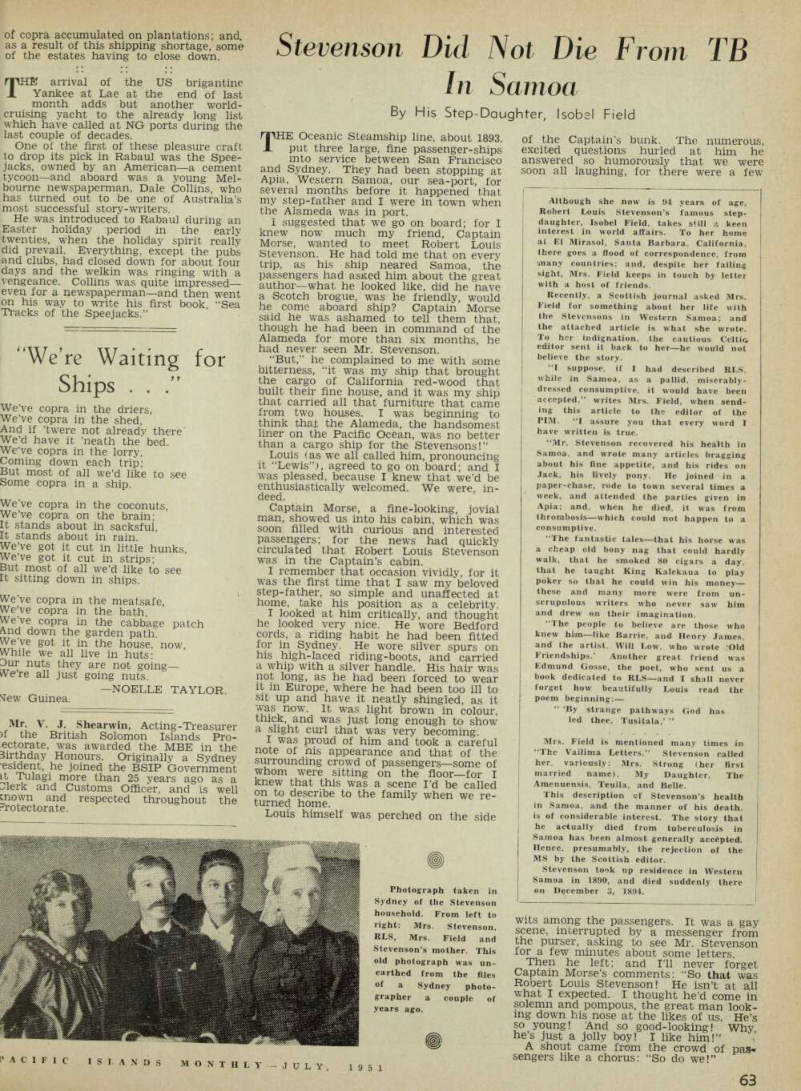
Photograph taken in Sydney of the Stevenson household. From left to right: Mrs. Stevenson, RLS, Mrs. Field and Stevenson’s mother. This old photograph was un earthed from the files of a Sydney photo grapher a couple of years ago.