Magazine Section
p. 59 · Read in the full issue
Five Times Round The World
IN the third week in June, the Irving Johnsons and their amateur crew of young Americans on the brigantine Yankee, had reached Rabaul, nine months out from the Eastern United States.
This is the Yankee’s fifth world cruise; only recently we reviewed their fourth cruise, undertaken about 1948. which was described in story and picture in March, 1951, issue of the National Geographic Magazine.
The ship’s current voyage commenced on October 29, 1950, and will end on April 27, 11952. Few regular shipping companies would like to give such a hard and-fast date of arrival for an 18 months cruise but Skipper Johnson prides him self on getting back on schedule, and if he says April 27, 1952, then, no doubt, that is when it will be.
Already Yankee has visited Pitcairn Island where the ship’s doctor assisted the isolated islanders by removing one re calcitrant appendix and setting one broken leg. In the Tuamotus they found a measles epidemic which had interfered with the season’s pearl diving schedule.
The ship’s company fortunately escaped the disease.
They lost a topmast in a squall between Honolulu and Samoa but replaced it in Apia; and at Palmyra they met an American salvage outfit which was gather ing up left-over war materials from that lonely outpost as well as from Fanning Island.
From Western Samoa they sailed to Niuafo’ou in the Tongan Group—better known, perhaps, as Tin Can Island.
Niuafo’ou was completely abandoned in 1947 after disastrous eruptions had ruined most of the cultivated land. When the Johnsons called on their 1948 cruise they had found it quite deserted but on this occasion (April, 1951) they say that there were people ashore signalling to them.
The sea was too rough to attempt a landing, but a couple of the men swam out with poles in the old Tin Can Post man manner. They told those on board that there were 90 on the island cutting copra. They had arrived in November last but were expecting a ship to call for them and the copra they had cut, within a week.
The Yankee made its usual visit to the New Hebrides and the Solomons and after leaving Rabaul expected to call at Lae where a party would fly to the Central Highlands.
PIM correspondents, like everyone else at the Yankee’s ports of call, were in
terested in the Johnsons, their ship and their crew. From our Rabaul correspondent we have received this:—
Farm Bov's Dream Come True
* THE story of the brigantine Yankee, at present in Rabaul Harbour, is the story of a Yankee farm boy’s dream come true.
“Even to-day,” says Skipper Irving M.
Johnson, on his fifth voyage around the world, “I can’t get over the good fortune of this particular farm-boy, who can dream his favourite dream over and over again. Well, every 18 months anyway.
Tne dream begins to come true on the day we board the good ship Yankee, to sail clear around the world, and continues for the 18 months it takes us to do it. To me the eighteen months, ashore, between voyages, is just the longest time.”
Skipper Johnson may have begun life as a farm-boy, but to-day, with his twinkling blue eyes, and the keen angular face of the typical yachtsman, he has come a long way from the plough.
The 23 lucky young people who sail with him have only to be just that—young, enthusiastic and amateurs.
These are far and away the best crew, says the Skipper. They are all naturally keen and anxious to learn. Always a few women are included amongst the crew members, but no more than four or five.
This is mainly to provide a home atmosphere, as well as being feminine company for Mrs. Johnson, who unfailingly accompanies her husband on his round-theworld journeys.
He said this was part of his good luck— to have found a wife who is as keen on the sea-going part of their lives as he is.
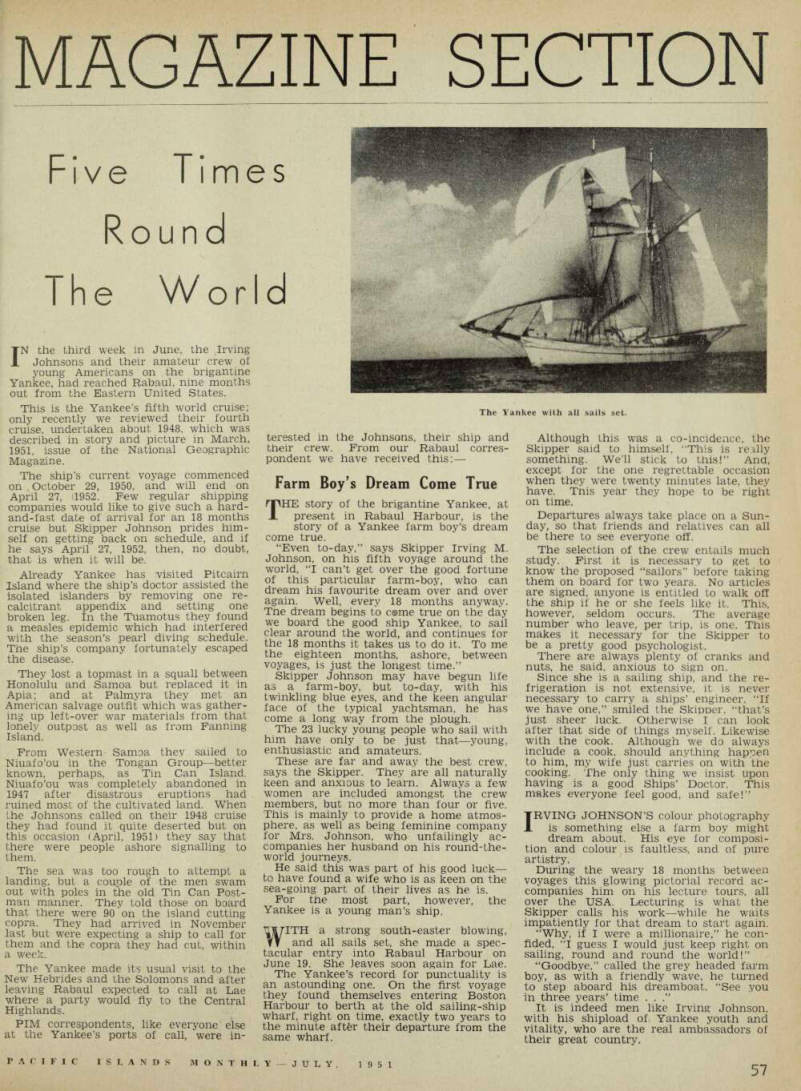
For the most part, however, the Yankee is a young man’s ship. , ... :TnTH a strong south-easter blowing, f? and all sails set, she made a spectacular entry into Rabaul Harbour on June 19. She leaves soon again for Lae.
The Yankee’s record for punctuality is an astounding one. On the first voyage they found themselves entering Boston Harbour to berth at the old sailing-ship wharf, right on time, exactly two years to the minute after their departure from the same wharf.
Although this was a co-incidence, the Skipper said to himself, “This is really something. We’ll stick to this!” And, except for the one regrettable occasion ™ hen they were twenty minutes late, they have. This year they hope to be right on time.
Departures always take place on a Sun day, so that friends and relatives can all be there to see everyone off.
The selection of the crew entails much study. First it is necessary to get to know the proposed “sailors” before taking them on board for two years. No articles are signed, anyone is entitled to walk off the ship if he or she feels like it. This, however, seldom occurs. The average number who leave, per trip, is one. This makes it necessary for the Skipper to be a pretty good psychologist, There are always plenty of cranks and nuts, he said, anxious to sign on.
Since she is a sailing ship, and the re frigeration is not extensive, it is never necessary to carry a ships’ engineer. “If we have one,” smiled the Skipper, “that’s just sheer luck. Otherwise I can look after that side of things myself. Likewise with the cook. Although we do always include a cook, should anything hapnen to him, my wife just carries on with the cooking. The only thing we insist upon having is a good Ships’ Doctor. This makes everyone feel good, and safe!”
TRYING JOHNSON’S colour photography 1 i s something else a farm boy might dream about. His eye for composi tion and colour is faultless, and of pure artistry.
During the weary 18 months between voyages this glowing pictorial record ac companies him on his lecture tours, all over the USA. Lecturing is what the Skipper calls his work—while he waits impatiently for that dream to start again.
“Why, if I were a millionaire,” he con fided, “I guess I would just keep right on sailing, round and round the world!”
“Goodbye,” called the grey headed farm boy, as with a friendly wave, he turned to step aboard his dreamboat, “See you i n three years’ time . . .” it is indeed men like Irving Johnson, with his shipload of Yankee youth and vitality, who are the real ambassadors of their great country.
The Yankee with all sails set.