Sudden Death
pp. 102-103 · Read in the full issue
Of Notanle
Dunwooie Of Samoa
One of the most notable and highly -rmvuin cprvnnts of two op^p™f^ns P hi the South Pacific Mr E.
P^tmast^ r and B’superinten<^n 8 ’superinten<^nt W (ff S Radio
in Western Samoa from the time of the New Zealand occupation in 1914 until his retirement in 1936. He married a part- Samoan woman; and he and his wife were leading and beloved figures in Polynesia “Dun,” as lie was generally known, joined the New Zealand Posfc and Tele . graph service in 1905; and about 1910, when he was recognised as one of the best and speediest telegraph operators m duce^to^afiio Hemisphere ’ was When 1914 came, he was one of the
first New Zealanders to enlist for over seas service, and he sailed on the first troopship a few days after the outbreak of war, as radio specialist. They thought they were going to France; but they found themselves at Noumea and, a few days later, off the German Colony of Western Samoa. They had been given the task of capturing the large German radio station there, and occupying the German colony. They were ready to fight, but there was no shooting.
Mr. Dunwoodie, with two others, pro ceeded unofficially ahead of the troops to the station at Tafaigata. On the way, they located the popular “half-way house” near Tuaefu and were royally treated.
Carrying on to Tafaigata, they were hospitably received by the German wire-
less staff—a bottle of Scotch figuring in the proceedings. By the time the troops arrived, later in the day, the station had been “seized.”
With the rank of Regimental Sergeant- Major, Mr. Dunwoodie was appointed second-in-command of the station, and his outstanding ability was soon recog nised. For most valuable service rendered during the first year of the Military Occupation, he was decorated with the French Medaille Militaire. His several requests for service in Europe were refused and in October, 1916, he became Com manding Officer. Under Civil Adminis tration in 1920 he was made Officer-in charge of the station.
With the amalgamation of the Postal and Radio Departments in 1930 he was made Chief Postmaster as well as Super intendent of Radio positions he held until his retirement on superannuation in December, 1936.
Mr. Dunwoodie was a model civil servant, one who earned the respect of all citizens. He held fine ideals, and pos sessed tact of a high order, and his motto was service before self; he was a public servant first and an official second.
Mr. Dunwoodie was the only Postmaster who attended to mails irrespective of the time of their arrival or departure, and he thus earned the gratitude of all citizens, and the business community in particular.
Mr and Mrs. Dunwoodie took an active interest in all things pertaining to Samoa and its welfare. It is recalled that on his ; initiative and action, he trained numerous; part-Samoans in the art of wireless; telegraphy, and' erected stations in the Tokelau Group, in addition to several out- ■ stations in Upolu. He obviated the need! to recruit civil servants in New Zealand tor maintain the postal and radio services,, and placed those outlying places m con stant contact with Apia. With the= exception of one other European, all hiss services in and outside Apia were staffedt with native lads.
Mr. Dunwoodie had a remarkable senses of humour, and a keen memory. It is as pity he did not write a book from tries
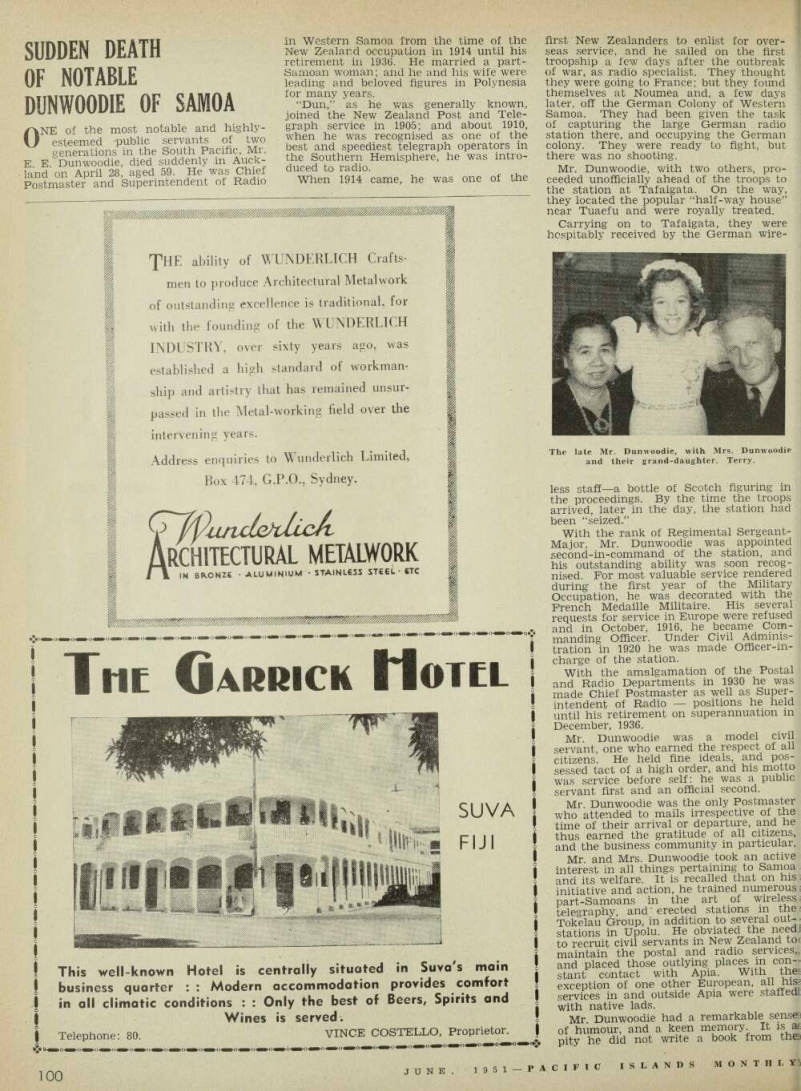
The late Mr. Dunwoodie, with Mrs. Dunwoodie and their grand-daughter, Terry.
storehouse of knowledge that he possessed.
Many hundreds, including overseas personages, will remember the generous hospitality so freely given at Tafaigata.
The farev/ell function tendered in their honour in December, 1936, was the most successful and representative gathering held in Apia for many years, and was an indication of the high esteem in which the Dunwoodies were held.
The Assembly Hall, Melbourne, was crowded on the night of May 29, when a technicolour film showing the work of the Presbyterian Mission in the New Hebrides was screened.