Giant Snails Still A Pest
p. 20 · Read in the full issue
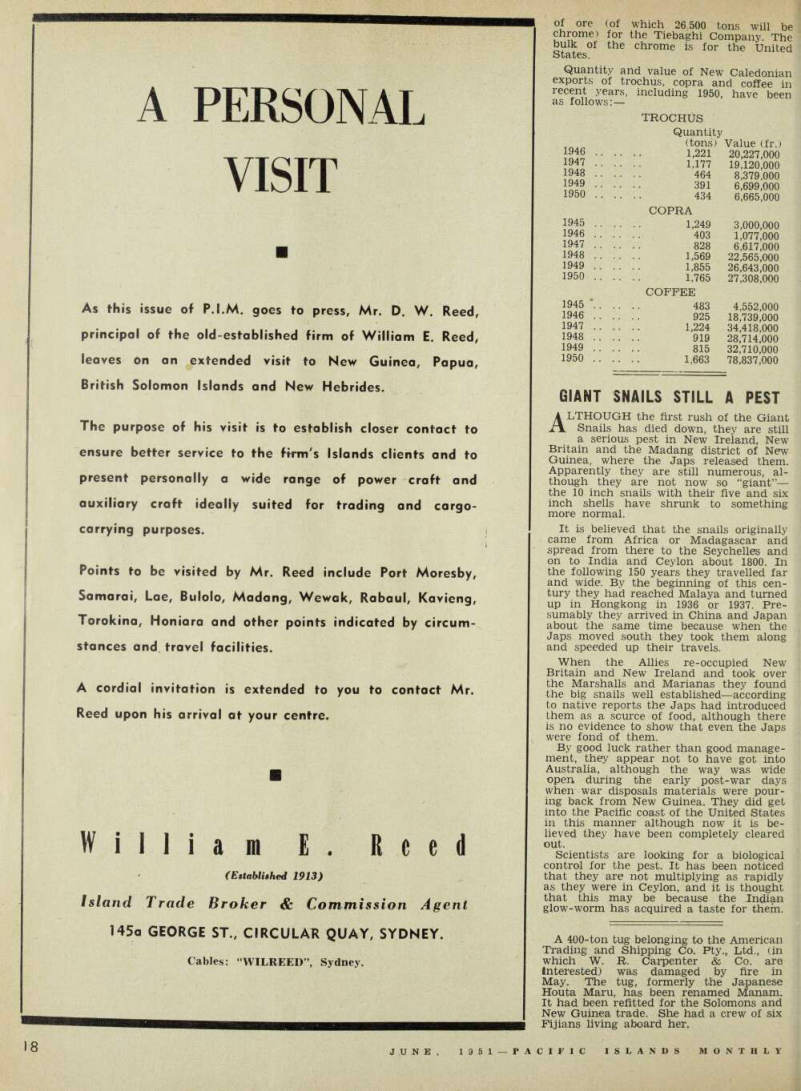
ALTHOUGH the first rush of the Giant Snails has died down, they are still a serious pest in New Ireland. New Britain and the Madang district of New Guinea, where the Japs released them.
Apparently they are still numerous, al though they are not now so “giant”— the 10 inch snails with their five and six inch shells have shrunk to something more normal.
It is believed that the snails originally came from Africa or Madagascar and spread from there to the Seychelles and on to India and Ceylon about 1800. In the following 150 years they travelled far and wide. By the beginning of this cen tury they had reached Malaya and turned up in Hongkong in 1936 or 1937. Pre sumably they arrived in China and Japan about the same time because when the Japs moved south they took them along and speeded up their travels.
When the Allies re-occupied New Britain and New Ireland and took over the Marshalls and Marianas they found the big snails well established —according to native reports the Japs had introduced them as a source of food, although there is no evidence to show that even the Japs were fond of them.
By good luck rather than good manage ment, they appear not to have got into Australia, although the way was wide open, during the early post-war days when war disposals materials were pour ing back from New Guinea. They did get into the Pacific coast of the United States in this manner although now it is be lieved they have been completely cleared out.
Scientists are looking for a biological control for the pest. It has been noticed that they are not multiplying as rapidly as they were in Ceylon, and it is thought that this may be because the Indian glow-worm has acquired a taste for them.
A 400-ton tug belonging to the American Trading and Shipping Co. Fty., Ltd., (in which W. R. Carpenter & Co. are Interested) was damaged by fire in May. The tug, formerly the Japanese Houta Maru, has been renamed Manam.
It had been refitted for the Solomons and New Guinea trade. She had a crew of six Fijians living aboard her.