School, Mrs. Worthington!
pp. 91-93 · Read in the full issue
Don't Put Your Daughter Into School, Mrs. Worthington!
FEES at girls’ schools in New South Wales have gone up again—in some cases for the second time since December. Church of England Grammar Schools have raised their fees (day scholars) to £2l per term. Other schools are now around the 18 guinea mark—and upwards.
Boarding-school fees have also soared.
They range from £7O to £BO per term and “extras” can make them a great deal more.
Boys’ schools and schools in New Zealand charge comparable fees.
School fees in Australia and New Zealand are of vital importance to Euro pean parents in Papua-New Guinea, Fiji, Samoa and other South Pacific territories.
And, at their present scale, including clothes, fares to and from the Islands, and other miscellaneous items it is unlikely that it will cost parents much less than £3OO per annum to send a child South to boarding-school.
If your are so unfortunate as to have two children, it will cost you £6OO- and if you have three—you will probably have the choice between bankruptcy or sending mother out to work.
For this year only—because they could not build a high school at Wau —the Administration of Papua-New Guinea is paying £125 plus one return fare for each European child of secondary school age who must go to Australia to school. The arrangement will be reviewed at the end of the year. The allowance is a help to harassed parents—but by no means the complete solution of the problem.
The position is rapidly getting to the point where, when the children are pro vided for, mother and father will have to live on bread and dripping.
They say that there is a fatal fascina
tion about living in the Pacific Islands.
There must be —else no one would be pre pared to put up with the crushing financial burden of doing It.
Mr. James M. Johnson, a well-known timber man of Northern New South Wales and one of the first men to make a timber survey of New Guinea, died in Kyogle, NSW, at the end of April. He made a survey of New Guinea timber for a British firm during World War I.
Friends of the late Dr. G. H. Vernon of Papua—particularly the Regimental As sociation of the Australian 11th Light Horse —have been instrumental in estab lishing a hospital for natives on the Bamu River, Western Papua, in his memory.
The Regimental Association recently pro vided an operating theatre for the hospital and this has now been shipped to Papua from Brisbane. Dr. Vernon was Regimental Medical Officer of the unit in World War I.
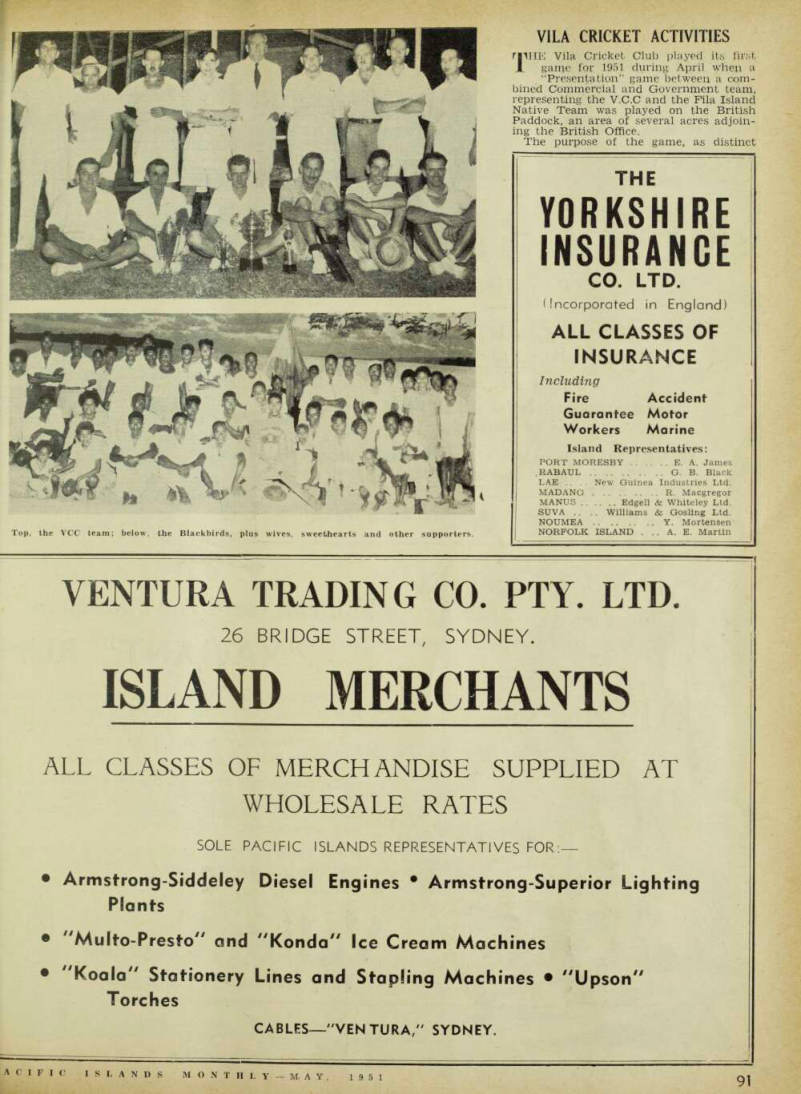
Top, the VCC team; below, the Blackbirds, plus wives, sweethearts and other supporters.