Those Henderson Island Mysteries
pp. 64-65 · Read in the full issue
by H. E. Maude, O.B. E.
THE eight skeletons which Mr. N. W.
Thomas and Captain J. Webster found on Henderson Island (see PIM, November, 1950) are not a new discovery; in fact, it would seem high time that they were given a decent interment.
They were first seen in 1819 by members of the crew of the ill-fated South Sea whaler Essex, which was charged and wrecked in mid-ocean by a 40-feet sperm whale, thus providing material for Her man Melville’s immortal story, Moby Dick.
The survivors reached Henderson in three boats and, after a week there, set off again in an endeavour to get to South America, leaving the Mate, Thomas Chap pel, and two others on the island.
Chappel, with his companions, was res scued by the Surrey, sent specially from Valparaiso for the purpose, on April 5, 1820, after 107 days on the island, and in an account of his experiences published by the Religious Tract Society in 1830, he relates that “among the rocks were several caves formed by nature, which afforded shelter from the wind and rain. In one of these caves we found eight human skeletons, in all probability the remains of some poor mariners who had been ship wrecked on the isle, and perished for want of food and water. They were side by side, as if they had lain down and died together!”
Since that date the skeletons have been seen by the Pitcairn Islanders, who have long been accustomed to visiting the island once or twice a year to gather the hard miro wood used for making curios.
Their second visit, on August 16, 1851. was made, however, not in their own boats but on board the Joseph Meigs, and the Pit cairn Island Register Book relates how, on their arrival, “they discovered a human skeleton, and, as nothing could be found that may lead to discover who the un
fortunate individual was, it must ever remain a mystery.”
On November 11 of the same year, 38 of the islanders again visited Henderson, this time on the Sharon, of Fairhaven, and the Register records that “eight human skeletons were found upon the island, lying in caves. They were doubt less the remains of some unfortunate ship wrecked seamen, as 'several pieces of wreck were found upon the shore.”
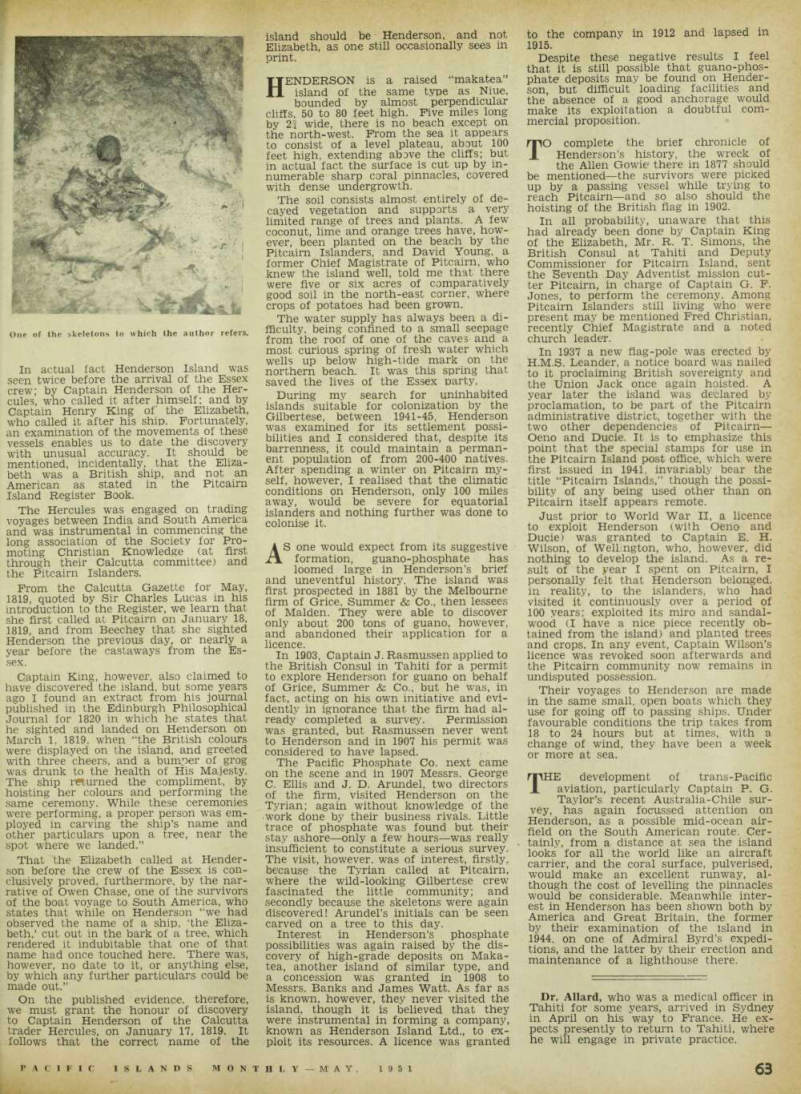
Prom the above account there would seem to be little doubt that the eight skulls found by Captain Webster and the skeletons seen by Mr. Thomas in a near by cave are identical with those recorded by Chappel and the Pitcairn Islanders.
A FURTHER “mystery” of Henderson which has exercised students of Pacific history is who actually dis covered the island; apart, that is, from those unforunate persons who left their remains there, but no other record for posterity.
Captain Beechey, writing in 1831, claims that it was first seen by the crew of the Essex and this statement is repeated in the latest edition of the official Admiralty Pacific Islands Pilot, as well as in the Pacific Islands Year Book, Robert Gibbings, on the other hand, in his introduction to the Golden Cockerel Press edition of the Narratives of the Wreck of the Essex, holds that it was discovered in 1791 by Captain Edwards of the Pandora, who named it Lord Hoods Island.
The second claim can be easily dis proved, for Captain Edwards described his discovery as lying in latitude 21 deg. 31 seconds S. and longitude 135 deg. 30 seconds W. and being a “low lagoon island covered with wood”; it was almost cer tainly one of the Tuamotu Islands.
Continued on page 63.
In actual fact Henderson Island was seen twice before the arrival of the Essex crew; by Captain Henderson of the Her cules, who called it after himself: and by Captain Henry King of the Elizabeth, who called it after his ship. Fortunately, an examination of the movements of these vessels enables us to date the discovery with unusual accuracy. It should be mentioned, incidentally, that the Eliza beth was a British ship, and not an American as stated in the Pitcairn Island Register Book.
The Hercules was engaged on trading voyages between India and South America and was instrumental in commencing the long association of the Society for Pro moting Christian Knowledge (at first through their Calcutta committee) and the Pitcairn Islanders.
From the Calcutta Gazette for May, 1819, quoted by Sir Charles Lucas in his introduction to the Register, we learn that she first called at Pitcairn on January 18, 1819, and from Beechey that she sighted Henderson the previous day, or nearly a year before the castaways from the Es sex, Captain King, however, also claimed to have discovered the island, but some years ago I found an extract from his journal published in the Edinburgh Philosophical Journal for 1820 in which he states that he sighted and landed on Henderson on March 1, 1819. when “the British colours were displayed on the island, and greeted with three cheers, and a bumper of grog was drunk to the health of His Majesty.
The ship returned the compliment, by hoisting her colours and performing the same ceremony. While these ceremonies were performing, a proper person was em ployed in carving the ship’s name and other particulars upon a tree, near the spot where we landed.”
That the Elizabeth called at Hender son before the crew of the Essex is con clusively proved, furthermore, by the nar rative of Owen Chase, one of the survivors of the boat voyage to South America, who states that while on Henderson “we had observed the name of a ship, ‘the Eliza beth,’ cut out in the bark of a tree, which rendered it indubitable that one of that name had once touched here. There was, however, no date to it, or anything else, by which any further particulars could be made out.”
On the published evidence, therefore, we must grant the honour of discovery to Captain Henderson of the Calcutta trader Hercules, on January 17, 1819. It follows that the correct name of the
island should be Henderson, and not Elizabeth, as one still occasionally sees in print.
HENDERSON is a raised “makatea” island of the same type as Niue, bounded by almost perpendicular cliffs, 50 to 80 feet high. Five miles long by 22 wide, there is no beach except on the north-west. Prom the sea it appears to consist of a level plateau, about 100 feet high, extending above the cliffs; but in actual fact the surface is cut up by in numerable sharp coral pinnacles, covered with dense undergrowth.
The soil consists almost entirely of de cayed vegetation and supports a very limited range of trees and plants. A few coconut, lime and orange trees have, how ever, been planted on the beach by the Pitcairn Islanders, and David Young, a former Chief Magistrate of Pitcairn, who knew the island well, told me that there were five or six acres of comparatively good soil in the north-east corner, where crops of potatoes had been grown.
The water supply has always been a di fficulty, being confined to a small seepage from the roof of one of the caves and a most curious spring of fresh water which wells up below high-tide mark on the northern beach. It was this spring that saved the lives of the Essex party.
During my search for uninhabited islands suitable for colonization by the Gilbertese, between 1941-45, Henderson was examined for its settlement possi bilities and I considered that, despite its barrenness, it could maintain a perman ent population of from 200-400 natives.
After spending a winter on Pitcairn my self, however, I realised that the climatic conditions on Henderson, only 100 miles away, would be severe for equatorial islanders and nothing further was done to colonise it.
AS one would expect from its suggestive formation, guano-phosphate has loomed large in Henderson’s brief and uneventful history. The island was first prospected in 1881 by the Melbourne firm of Grice, Summer & Co., then lessees of Malden. They were able to discover only about 200 tons of guano, however, and abandoned their application for a licence.
In 1903, Captain J. Rasmussen applied to the British Consul in Tahiti for a permit to explore Henderson for guano on behalf of Grice, Summer & Co., but he was, in fact, acting on his own initiative and evi dently in ignorance that the firm had al ready completed a survey. Permission was granted, but Rasmussen never went to Henderson and in 1907 his permit was considered to have lapsed.
The Pacific Phosphate Co. next came on the scene and in 1907 Messrs. George C. Ellis and J. D. Arundel, two directors of the firm, visited Henderson on the Tyrian; again without knowledge of the work done by their business rivals. Little trace of phosphate was found but their stay ashore —only a few hours —was really insufficient to constitute a serious survey.
The visit, however, was of interest, firstly, because the Tyrian called at Pitcairn, where the wild-looking Gilbertese crew fascinated the little community; and secondly because the skeletons were again discovered! Arundel’s initials can be seen carved on a tree to this day.
Interest in Henderson’s phosphate possibilities was again raised by the dis covery of high-grade deposits on Maka tea, another island of similar type, and a concession was granted in 1908 to Messrs. Banks and James Watt. As far as is known, however, they never visited the island, though it is believed that they were instrumental in forming a company, known as Henderson Island Ltd., to ex ploit its resources. A licence was granted
to the company in 1912 and lapsed in 1915.
Despite these negative results I feel that it is still possible that guano-phos phate deposits may be found on Hender son, but difficult loading facilities and the absence of a good anchorage would make its exploitation a doubtful com mercial proposition.
TO complete the brief chronicle of Henderson’s history, the wreck of the Allen Gowie there in 1877 should be mentioned —the survivors were picked up by a passing vessel while trying to reach Pitcairn —and so also should the hoisting of the British flag in 1902.
In all probability, unaware that this had already been done by Captain King of the Elizabeth, Mr. R. T. Simons, the British Consul at Tahiti and Deputy Commissioner for Pitcairn Island, sent the Seventh Day Adventist mission cut ter Pitcairn, in charge of Captain G. F.
Jones, to perform the ceremony. Among Pitcairn Islanders still living who were present may be mentioned Fred Christian, recently Chief Magistrate and a noted church leader.
In 1937 a new flag-pole was erected by H.M.S. Leander, a notice board was nailed to it proclaiming British sovereignty and the Union Jack once again hoisted. A year later the island was declared by proclamation, to be part of the Pitcairn administrative district, together with the two other dependencies of Pitcairn — Oeno and Ducie. It is to emphasize this point that the special stamps for use in the Pitcairn Island post office, which were first issued in 1941. invariably bear the title “Pitcairn Islands,” though the possi bility of any being used other than on Pitcairn itself appears remote.
Just prior to World War 11, a licence to exploit Henderson (with Oeno and Ducie) was granted to Captain E. H.
Wilson, of Wellington, who, however, did nothing to develop the island. As a re sult of the year I spent on Pitcairn, I personally felt that Henderson belonged, in reality, to the islanders, who had visited it continuously over a period of 100 years; exploited its miro and sandal wood (I have a nice piece recently ob tained from the island) and planted trees and crops. In any event, Captain Wilson’s licence was revoked soon afterwards and the Pitcairn community now remains in undisputed possession.
Their voyages to Henderson are made in the same small, open boats which they use for going off to passing ships. Under favourable conditions the trip takes from 18 to 24 hours but at times, with a change of wind, they have been a week or more at sea.
THE development of trans-Pacific aviation, particularly Captain P. G.
Taylor’s recent Australia-Chile sur vey, has again focussed attention on Henderson, as a possible mid-ocean air field on the South American route. Cer tainly, from a distance at sea the island looks for all the world like an aircraft carrier, and the coral surface, pulverised, would make an excellent runway, al though the cost of levelling the pinnacles would be considerable. Meanwhile inter est in Henderson has been shown both by America and Great Britain, the former by their examination of the island in 1944, on one of Admiral Byrd’s expedi tions, and the latter by their erection and maintenance of a lighthouse there.
Dr. Allard, who was a medical officer in Tahiti for some years, arrived in Sydney in April on his way to France. He ex pects presently to return to Tahiti, where he will engage in private practice.
One of the skeletons to which the author refers.